
In recent years, perovskite solar cells have emerged as a promising photovoltaic technology due to their high power conversion efficiencies and low-cost fabrication processes. Among them, inorganic perovskite solar cells, particularly those based on cesium lead halide compositions like CsPbI3 and its derivatives, have gained significant attention for their superior thermal and photostability compared to organic-inorganic hybrid counterparts. These properties make inorganic perovskite solar cells ideal candidates for tandem solar cell applications, such as perovskite/silicon tandem devices, where a wide-bandgap top cell is required. However, the performance of inorganic perovskite solar cells is often limited by high surface defect state densities, which lead to significant non-radiative recombination losses and reduced open-circuit voltage (VOC). In this study, we explore a surface defect management strategy using L-proline benzyl ester hydrochloride (L-PBEH) to enhance the photovoltaic performance and stability of inorganic perovskite solar cells. By systematically investigating the effects of L-PBEH treatment on film morphology, crystallinity, and defect states, we demonstrate a remarkable improvement in device efficiency and durability. This approach not only addresses the critical issue of defect-induced voltage losses but also provides a pathway toward the practical application of inorganic perovskite solar cells in advanced photovoltaic systems.
The inherent advantages of inorganic perovskite solar cells stem from their composition, which excludes organic cations that are prone to degradation under heat and light. For instance, CsPbI3 has a bandgap of approximately 1.73 eV, making it suitable for tandem configurations. Despite this, the fabrication of high-quality inorganic perovskite films remains challenging due to rapid crystallization and the formation of surface defects, such as vacancies and interstitials. These defects act as non-radiative recombination centers, impeding charge carrier extraction and leading to substantial VOC deficits. In our work, we focus on CsPbI2.85Br0.15 as the active layer, as it offers a balance between bandgap and stability. The introduction of L-PBEH as a surface modifier aims to passivate these defects and improve the overall film quality. We employ a combination of spectroscopic, microscopic, and electrical characterization techniques to elucidate the mechanisms behind the performance enhancement. Our findings reveal that L-PBEH treatment effectively reduces the defect state density, suppresses non-radiative recombination, and enhances charge carrier lifetime, resulting in devices with power conversion efficiencies exceeding 20% and improved operational stability.
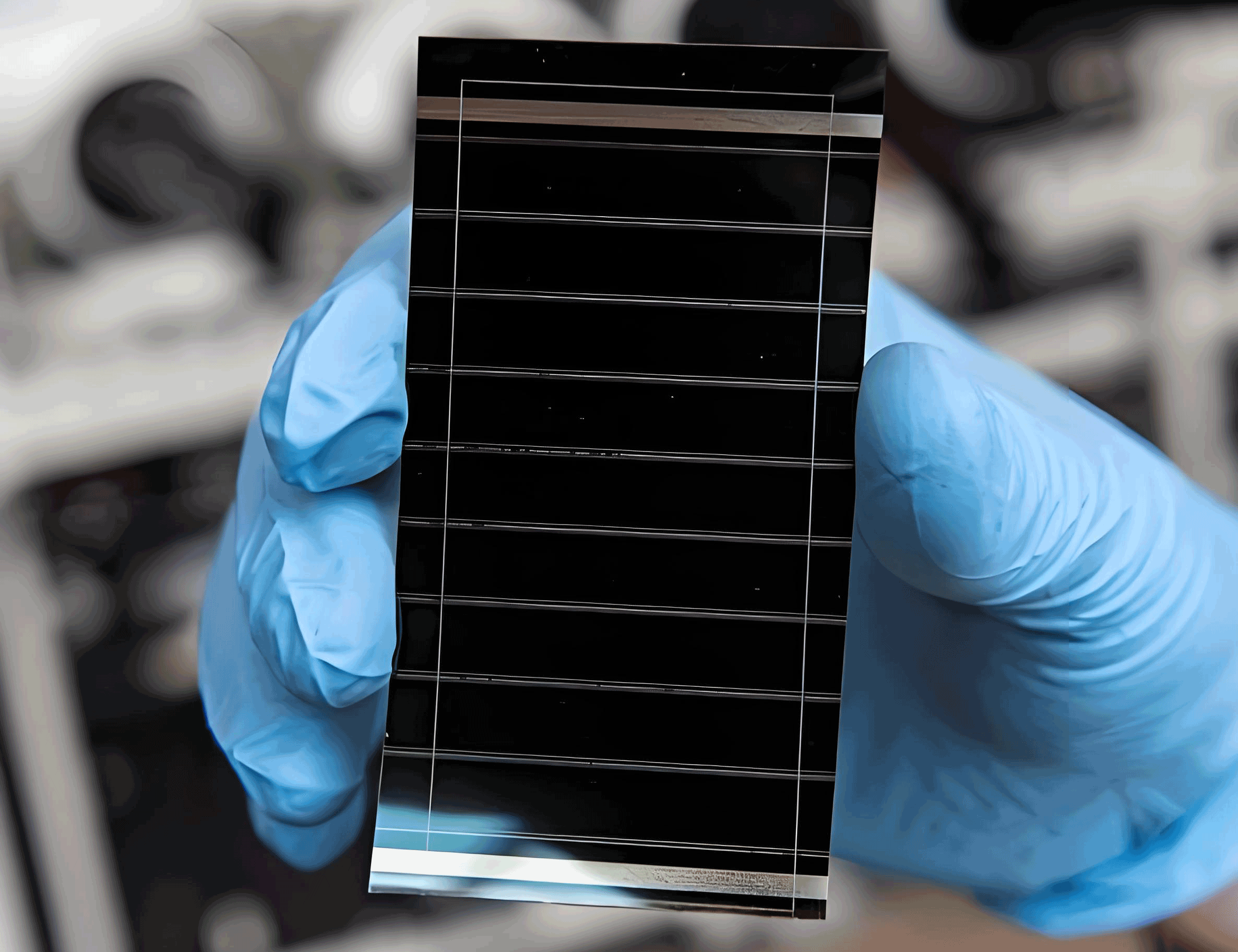
To understand the impact of L-PBEH on the inorganic perovskite solar cells, we first examined the structural and morphological changes in the CsPbI2.85Br0.15 films. X-ray diffraction (XRD) analysis showed that the L-PBEH-treated films exhibited enhanced peak intensities at the (110) and (220) planes, indicating improved crystallinity without the introduction of new phases. This suggests that L-PBEH facilitates a recrystallization process during the secondary annealing step, leading to a more ordered perovskite lattice. Scanning electron microscopy (SEM) images revealed a significant reduction in surface pinholes and voids in the treated films, which are known to be hotspots for non-radiative recombination. Atomic force microscopy (AFM) further confirmed a decrease in surface roughness from 31.3 nm to 23.1 nm, promoting better interface contact with subsequent charge transport layers. These morphological improvements are critical for minimizing defect-assisted recombination and enhancing the overall performance of the perovskite solar cells.
The optical properties of the perovskite films were evaluated using ultraviolet-visible (UV-vis) absorption spectroscopy and photoluminescence (PL) measurements. The absorption spectra indicated no significant change in the bandgap after L-PBEH treatment, confirming that the modifier does not alter the fundamental light-harvesting characteristics. However, steady-state PL spectra showed a notable increase in emission intensity for the treated films, signifying a reduction in non-radiative recombination pathways. Time-resolved photoluminescence (TRPL) decay curves were fitted using a bi-exponential model, yielding carrier lifetimes that increased from 56.65 ns for the control films to 195.71 ns for the L-PBEH-treated films. This prolonged carrier lifetime is attributed to the effective passivation of surface defects, which inhibits charge carrier trapping and recombination. The enhancement in optical properties underscores the role of L-PBEH in improving the quality of the perovskite solar cells.
To quantify the defect state density, we performed space-charge-limited current (SCLC) measurements on electron-only devices with a structure of ITO/SnO2/perovskite/PCBM/Ag. The defect density (Nt) was calculated using the formula:
$$N_t = \frac{2 \epsilon_0 \epsilon V_{TFL}}{e L^2}$$
where $\epsilon_0$ is the vacuum permittivity, $\epsilon$ is the relative permittivity of the perovskite, $V_{TFL}$ is the trap-filling limit voltage, $e$ is the electron charge, and $L$ is the film thickness. The results, summarized in Table 1, show that the defect density decreased from $1.84 \times 10^{16}$ cm−3 for the control films to $1.45 \times 10^{16}$ cm−3 for the L-PBEH-treated films. This reduction aligns with the observed improvements in PL and TRPL, confirming that L-PBEH treatment effectively manages the surface defect state density in the perovskite solar cells.
| Sample | Defect Density (cm−3) | Carrier Lifetime (ns) | PL Intensity (a.u.) |
|---|---|---|---|
| Control | 1.84 × 10¹⁶ | 56.65 | 1.00 |
| L-PBEH Treated | 1.45 × 10¹⁶ | 195.71 | 2.45 |
The photovoltaic performance of the inorganic perovskite solar cells was evaluated under AM 1.5G illumination. Current density-voltage (J-V) curves for both control and L-PBEH-treated devices are shown in Figure 1, and the key parameters are summarized in Table 2. The control devices exhibited a champion power conversion efficiency (PCE) of 18.16%, with a VOC of 1.076 V, a short-circuit current density (JSC) of 20.21 mA/cm2, and a fill factor (FF) of 82.13%. In contrast, the L-PBEH-treated devices achieved a remarkable PCE of 20.36%, with a VOC of 1.209 V, a JSC of 20.29 mA/cm2, and an FF of 83.02%. The significant increase in VOC by approximately 100 mV is a direct consequence of reduced non-radiative recombination, as evidenced by the defect density measurements. Moreover, the hysteresis index, defined as the difference between forward and reverse scan efficiencies, decreased from 1.71% for the control devices to 0.23% for the treated devices, indicating improved interfacial charge extraction and reduced ion migration. External quantum efficiency (EQE) spectra confirmed the JSC values, with integrated current densities of 19.58 mA/cm2 and 19.73 mA/cm2 for the control and treated devices, respectively. The steady-state power output measured at the maximum power point (MPP) showed negligible degradation over 1100 seconds, highlighting the operational stability of the L-PBEH-treated perovskite solar cells.
| Parameter | Control Device | L-PBEH Treated Device |
|---|---|---|
| PCE (%) | 18.16 | 20.36 |
| VOC (V) | 1.076 | 1.209 |
| JSC (mA/cm2) | 20.21 | 20.29 |
| FF (%) | 82.13 | 83.02 |
| Hysteresis Index (%) | 1.71 | 0.23 |
The enhanced performance of the L-PBEH-treated perovskite solar cells can be attributed to the effective passivation of surface defects, which reduces the trap-assisted recombination. The non-radiative recombination loss (ΔVOC,nr) can be expressed using the following formula:
$$\Delta V_{OC,nr} = \frac{n k T}{q} \ln \left( \frac{1}{EQE_{EL}} \right)$$
where $n$ is the ideality factor, $k$ is the Boltzmann constant, $T$ is the temperature, $q$ is the elementary charge, and $EQE_{EL}$ is the electroluminescence external quantum efficiency. With reduced defect density, the $EQE_{EL}$ increases, leading to a lower ΔVOC,nr and thus a higher VOC. This correlation underscores the importance of defect management in achieving high-performance perovskite solar cells.
We further investigated the stability of the devices under various environmental conditions. As shown in Figure 2, the L-PBEH-treated perovskite solar cells exhibited superior stability compared to the control devices. Under continuous MPP tracking in a nitrogen atmosphere, the treated devices retained 87.35% of their initial PCE after 500 hours, while the control devices degraded to 57.76%. Thermal stability tests at 65°C in nitrogen revealed that the treated devices maintained 85.11% of their initial PCE, whereas the control devices dropped to 54.30%. Under ambient conditions with 20–30% relative humidity (RH), the treated devices retained 84.22% of their initial PCE, and even at 50% RH, they still retained 67.34%, significantly higher than the 30.13% retention for control devices. These results demonstrate that L-PBEH treatment not only improves efficiency but also enhances the long-term durability of inorganic perovskite solar cells, making them more viable for commercial applications.
In conclusion, we have demonstrated a simple yet effective surface defect management strategy for inorganic perovskite solar cells using L-PBEH. This treatment improves film crystallinity, reduces surface roughness and pinholes, and significantly lowers the defect state density. As a result, non-radiative recombination is suppressed, leading to higher VOC and overall device efficiency. The champion L-PBEH-treated perovskite solar cell achieved a PCE of 20.36% with excellent stability under light, heat, and humidity stress. This work highlights the critical role of surface engineering in advancing the performance of perovskite solar cells and provides a foundation for future developments in inorganic perovskite-based tandem and single-junction photovoltaics. Further optimization of the passivation layer and exploration of other functional molecules could lead to even higher efficiencies and stabilities, pushing the boundaries of perovskite solar cell technology.