
In remote alpine regions, off-grid solar systems play a critical role in providing reliable electricity where grid connectivity is impractical. As a researcher focused on renewable energy applications in harsh environments, I have conducted extensive field investigations to understand the challenges faced by energy storage components, particularly lead-acid batteries, in these systems. The longevity of batteries is a paramount concern, as it directly impacts the sustainability and cost-effectiveness of off-grid solar systems. This article delves into the factors influencing battery life, drawing from empirical data and theoretical analyses to propose mitigation strategies. Through this work, I aim to contribute to the optimization of off-grid solar systems in cold climates, ensuring they meet the energy needs of communities while minimizing environmental impacts.
The performance of off-grid solar systems is intrinsically linked to the efficiency of their energy storage units. In alpine areas, low temperatures exacerbate the degradation of lead-acid batteries, which are commonly used due to their cost-effectiveness and reliability compared to alternatives. My research involves analyzing the interplay between environmental conditions, system design, and user behavior. For instance, I have observed that improper usage, such as overloading or deep discharging, significantly shortens battery lifespan. Additionally, the charging strategies employed by controllers in off-grid solar systems can either prolong or accelerate battery decay. By integrating findings from field studies with mathematical models, I seek to provide a comprehensive framework for enhancing battery durability in these challenging settings.
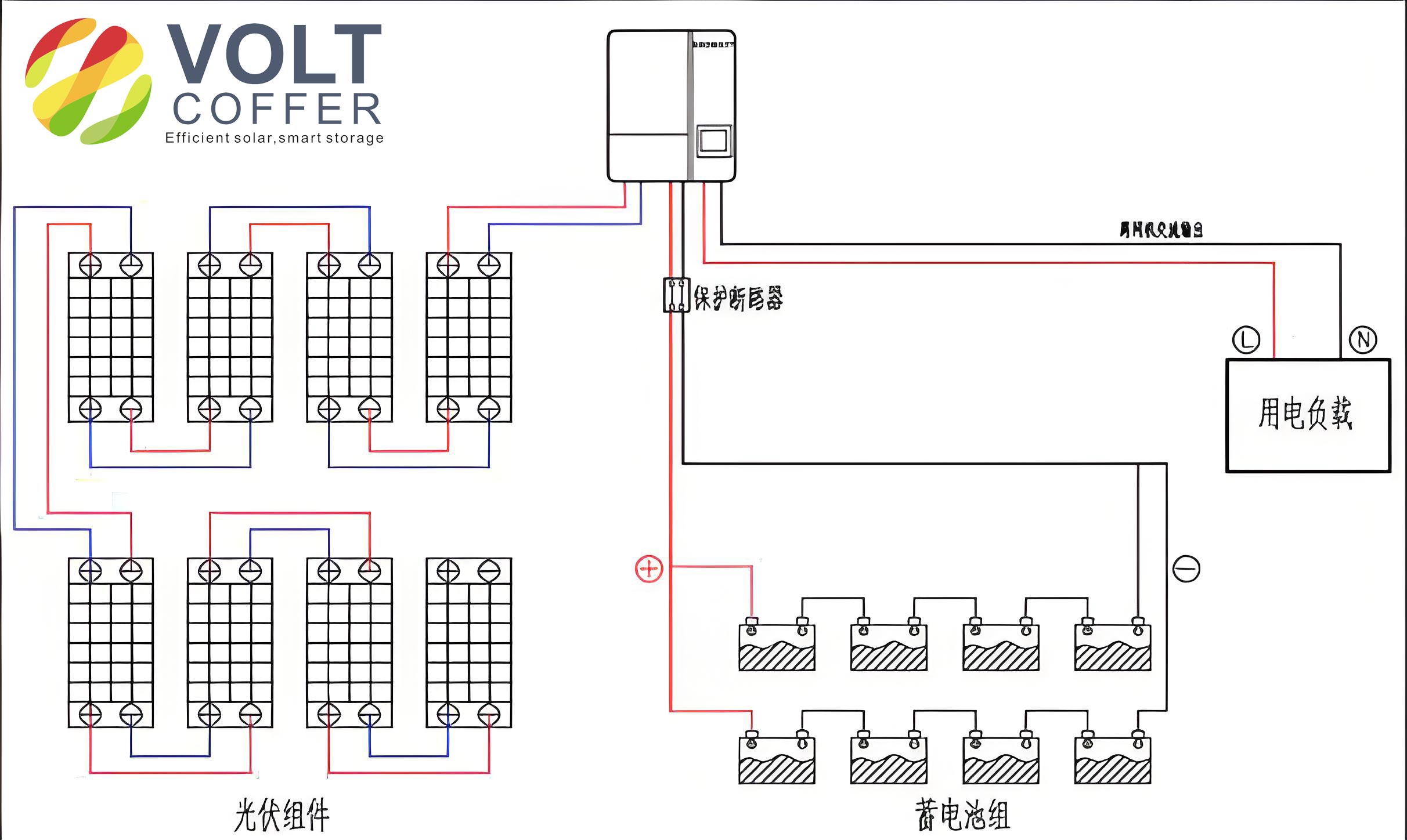
To quantify the effects of various parameters on battery life, I have developed several formulas and tables. For example, the output power of photovoltaic (PV) modules in an off-grid solar system is highly sensitive to temperature and solar irradiance. The relationship can be expressed as:
$$ P(T) = P(T_0) \times \left[1 – \alpha \times (T – T_0)\right] $$
where \( P(T) \) is the power output at temperature \( T \), \( P(T_0) \) is the power at reference temperature \( T_0 \), and \( \alpha \) is the temperature coefficient, typically around -0.0035 per °C for silicon-based PV modules. This means that for every 1°C increase in temperature, the power output decreases by 0.35%. Conversely, in cold environments, the power output can be higher, but this does not always translate to improved battery charging due to other constraints.
The charging current in an off-grid solar system is another critical factor. For a system with a peak power output of 5 kW and a battery bank voltage of 48 V, the maximum charging current \( I_{charge} \) can be calculated as:
$$ I_{charge} = \frac{P_{max}}{V_{battery}} = \frac{5000}{48} \approx 104 \, \text{A} $$
This high current can lead to accelerated battery degradation if not managed properly. The impact of charging current on battery life is summarized in Table 1, which I compiled based on field data from multiple off-grid solar systems.
| Charging Current (A) | Battery Capacity (Ah) | Estimated Life Reduction (%) | Observations |
|---|---|---|---|
| 50 | 100 | 10 | Moderate degradation; suitable for slow discharge |
| 104 | 100 | 40 | High degradation; risk of overheating and plate damage |
| 50 | 150 | 5 | Minimal impact; ideal for long-term use |
| 104 | 150 | 30 | Significant wear; requires thermal management |
In addition to charging current, the depth of discharge (DoD) and discharge rate profoundly affect battery longevity. My investigations reveal that a discharge depth of 70% or more, combined with a fast discharge rate (e.g., 2-hour rate), can reduce battery life by over 50% compared to shallow discharges (30% DoD) at a 10-hour rate. This is particularly relevant for off-grid solar systems in alpine regions, where users may inadvertently strain the batteries due to high energy demands. The relationship between DoD and cycle life can be modeled using the following equation:
$$ N = N_0 \times \left( \frac{DoD_0}{DoD} \right)^k $$
where \( N \) is the number of cycles at a given DoD, \( N_0 \) is the cycle life at reference DoD \( DoD_0 \), and \( k \) is a constant typically ranging from 1.2 to 1.5 for lead-acid batteries. This emphasizes the importance of designing off-grid solar systems with appropriate load management to avoid deep discharges.
Temperature is another pivotal factor in battery performance. In cold environments, the capacity of lead-acid batteries diminishes significantly. For example, at temperatures below -10°C, the available capacity can drop to 50% of the rated value. This is described by the Arrhenius equation, which relates the reaction rate to temperature:
$$ k = A \exp\left(-\frac{E_a}{RT}\right) $$
where \( k \) is the rate constant, \( A \) is the pre-exponential factor, \( E_a \) is the activation energy, \( R \) is the gas constant, and \( T \) is the temperature in Kelvin. Lower temperatures slow down the electrochemical reactions, reducing efficiency. To mitigate this, insulation and thermal management are essential in off-grid solar systems. Table 2 illustrates how temperature affects battery parameters based on my field measurements.
| Temperature Range (°C) | Capacity Retention (%) | Charging Efficiency (%) | Recommended Actions |
|---|---|---|---|
| < -10 | 50-60 | 70-80 | Implement heating or insulation |
| 10 to 30 | 95-100 | 90-95 | Optimal range; no intervention needed |
| > 30 | 85-90 | 80-85 | Requires cooling to prevent thermal runaway |
The design of the off-grid solar system itself, including the PV array and charge controller, plays a crucial role in battery health. Maximum Power Point Tracking (MPPT) controllers are commonly used to optimize energy harvest, but they can sometimes lead to high charging currents that stress the batteries. The controller’s charging strategy typically involves a fast-charge phase followed by a float-charge phase. The transition between these phases is governed by the battery’s state of charge and temperature. For instance, the charging voltage \( V_{charge} \) can be adjusted for temperature compensation using:
$$ V_{charge} = V_{ref} + \beta (T – T_{ref}) $$
where \( V_{ref} \) is the reference voltage, \( \beta \) is the temperature coefficient (usually -5 mV/°C per cell for lead-acid batteries), and \( T_{ref} \) is the reference temperature. This ensures that the battery is charged appropriately across varying temperatures, a critical aspect for off-grid solar systems in alpine regions.
My field studies also highlight the impact of solar irradiance on the off-grid solar system’s output. The current generated by PV modules is directly proportional to irradiance, as shown by:
$$ I = I_{sc} \times \frac{G}{G_0} $$
where \( I \) is the output current, \( I_{sc} \) is the short-circuit current at standard test conditions, \( G \) is the actual irradiance, and \( G_0 \) is the reference irradiance (1000 W/m²). In high-altitude alpine areas, irradiance levels can exceed 1000 W/m², leading to high charging currents that may not be compatible with battery specifications. This underscores the need for customized system designs that balance energy harvest with battery preservation.
Furthermore, the discharge characteristics of batteries in off-grid solar systems are influenced by the load profile. A typical discharge curve can be modeled using Peukert’s equation, which accounts for the rate capacity effect:
$$ C_p = I^k t $$
where \( C_p \) is the Peukert capacity, \( I \) is the discharge current, \( t \) is the time, and \( k \) is the Peukert exponent (approximately 1.1 to 1.3 for lead-acid batteries). This equation demonstrates that higher discharge currents reduce the effective capacity, emphasizing the importance of load management in off-grid solar systems to extend battery life.
In terms of environmental impact, the widespread use of lead-acid batteries in off-grid solar systems poses risks of pollution if not disposed of properly. My research advocates for battery repair and recycling programs to mitigate this issue. For example, old batteries can often be reconditioned to restore up to 80% of their original capacity, reducing waste and conserving resources. This approach aligns with sustainable practices for off-grid solar systems in remote areas.
To synthesize these findings, I have developed a comprehensive model that predicts battery life based on multiple variables. The model incorporates factors such as temperature, charging current, DoD, and discharge rate, using regression analysis to estimate lifespan. For instance, the overall life \( L \) in years can be approximated as:
$$ L = L_0 \times f_T \times f_I \times f_{DoD} $$
where \( L_0 \) is the baseline life under ideal conditions, and \( f_T \), \( f_I \), and \( f_{DoD} \) are correction factors for temperature, current, and depth of discharge, respectively. These factors are derived from empirical data and can be tabulated for practical applications, as shown in Table 3.
| Factor | Condition | Value Range | Description |
|---|---|---|---|
| \( f_T \) | Temperature < 0°C | 0.5 – 0.7 | Reduced life due to low temperature |
| \( f_T \) | Temperature 10-30°C | 1.0 | Optimal range |
| \( f_T \) | Temperature > 30°C | 0.8 – 0.9 | Moderate reduction |
| \( f_I \) | Charging current > 100A | 0.6 – 0.8 | High current degradation |
| \( f_I \) | Charging current < 50A | 1.0 – 1.2 | Favorable conditions |
| \( f_{DoD} \) | DoD > 70% | 0.5 – 0.7 | Significant life reduction |
| \( f_{DoD} \) | DoD < 30% | 1.2 – 1.5 | Extended life |
In conclusion, the longevity of batteries in off-grid solar systems in alpine regions is affected by a complex interplay of environmental and operational factors. My research demonstrates that low temperatures, high charging currents, deep discharges, and fast discharge rates are primary contributors to battery degradation. By implementing strategies such as thermal insulation, optimized charging algorithms, and user education on load management, the lifespan of lead-acid batteries can be significantly extended. Moreover, promoting battery repair and recycling is essential for minimizing environmental impacts. As off-grid solar systems continue to be a vital energy source in remote areas, these insights will help enhance their reliability and sustainability, ensuring they meet the needs of communities while preserving the ecosystem.
Through this work, I have emphasized the importance of a holistic approach to designing and maintaining off-grid solar systems. Future research should focus on developing advanced battery technologies and smart controllers that can adapt to the unique challenges of alpine environments. By continuing to refine these systems, we can unlock the full potential of solar energy in even the most demanding locations, providing clean and reliable power for generations to come.