
The widespread integration of renewable energy sources and the electrification of transportation have placed unprecedented demands on advanced battery energy storage systems. Lithium-ion batteries, due to their high energy density and long cycle life, are the predominant technology in modern battery energy storage system applications. Accurate and reliable estimation of the State-of-Charge (SOC) is a critical Battery Management System (BMS) function, directly impacting the safety, efficiency, and lifespan of the entire battery energy storage system. Traditional SOC estimation methods, such as open-circuit voltage (OCV) measurement or simple Coulomb counting, suffer from limitations like long relaxation times, cumulative errors, and sensitivity to operating conditions like temperature and aging. These shortcomings can compromise the operational reliability of a large-scale battery energy storage system. This article presents a comprehensive study on an advanced SOC estimation method tailored for lithium-ion batteries within battery energy storage system applications, combining model-based and data-driven algorithmic approaches.
The core of the proposed method is a model-based framework. We begin by constructing an equivalent circuit model (ECM) for the lithium-ion battery, which provides a mathematical representation of its electrical behavior. A second-order Thevenin model is commonly adopted for its favorable balance between accuracy and computational complexity, making it suitable for real-time implementation in a battery energy storage system BMS. This model comprises an ideal voltage source representing the open-circuit voltage (UOC), a series resistance (R0) representing the ohmic polarization, and two parallel RC networks (R1,C1 and R2,C2) representing the electrochemical and concentration polarizations, respectively. The terminal voltage UL can be expressed as:
$$ U_L = U_{OC}(SOC) – I \cdot R_0 – U_1 – U_2 $$
where I is the load current (positive for discharge, negative for charge), and U1, U2 are the voltages across the two RC pairs, governed by:
$$ \frac{dU_1}{dt} = -\frac{1}{R_1 C_1}U_1 + \frac{1}{C_1}I $$
$$ \frac{dU_2}{dt} = -\frac{1}{R_2 C_2}U_2 + \frac{1}{C_2}I $$
The relationship between the OCV and SOC is a fundamental, non-linear characteristic of the battery. Through experimental testing at a constant temperature (e.g., 25°C), this mapping can be obtained. The OCV-SOC curves during charge and discharge exhibit hysteresis. They can be fitted using high-order polynomial functions. For instance, a 5th-order polynomial is often sufficient:
$$ U_{OC}(SOC) = a_5 \cdot SOC^5 + a_4 \cdot SOC^4 + a_3 \cdot SOC^3 + a_2 \cdot SOC^2 + a_1 \cdot SOC + a_0 $$
where the coefficients a0…a5 are different for the charge and discharge paths. This non-linear mapping is crucial for translating the estimated electrical state to the chemical state of charge within the battery energy storage system.
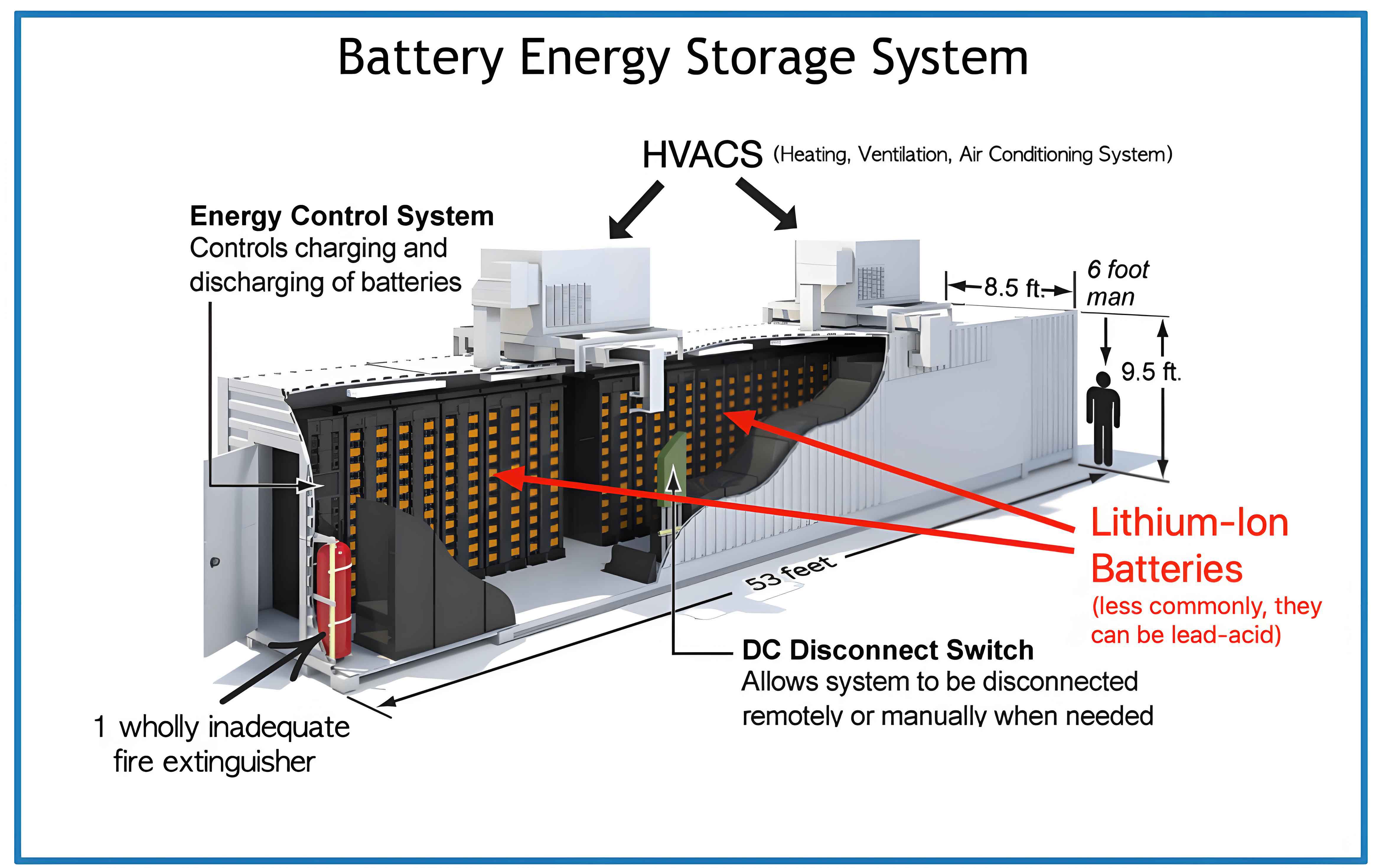
A significant challenge in model-based estimation is that the ECM parameters (R0, R1, R2, C1, C2) are not constant; they vary with SOC, temperature, current rate, and battery state of health (SOH). To maintain estimation accuracy over the lifetime of the battery energy storage system, online parameter identification is essential. We employ the Forgetting Factor Recursive Least Squares (FFRLS) algorithm for this purpose. This algorithm excels in tracking time-varying parameters by adaptively updating the model with new data while gradually discounting older data.
The continuous-time ECM transfer function can be discretized using methods like the bilinear transform. The resulting discrete-time input-output relationship can be expressed in a standard linear regression form suitable for RLS:
$$ y(k) = \boldsymbol{\phi}^T(k) \boldsymbol{\theta}(k) $$
where:
- y(k) is the system output at time step k, defined as the over-potential E(k) = UOC(k) – UL(k).
- \(\boldsymbol{\phi}(k)\) is the regressor vector, containing past outputs and inputs: \(\boldsymbol{\phi}(k) = [E(k-1), E(k-2), I(k), I(k-1), I(k-2)]^T\).
- \(\boldsymbol{\theta}(k)\) is the parameter vector to be identified: \(\boldsymbol{\theta}(k) = [\theta_1, \theta_2, \theta_3, \theta_4, \theta_5]^T\).
The core FFRLS update equations are as follows:
1. Calculate the gain vector K(k):
$$ \mathbf{K}(k) = \frac{\mathbf{P}(k-1) \boldsymbol{\phi}(k)}{\lambda + \boldsymbol{\phi}^T(k) \mathbf{P}(k-1) \boldsymbol{\phi}(k)} $$
2. Update the parameter estimate:
$$ \hat{\boldsymbol{\theta}}(k) = \hat{\boldsymbol{\theta}}(k-1) + \mathbf{K}(k) \left[ y(k) – \boldsymbol{\phi}^T(k) \hat{\boldsymbol{\theta}}(k-1) \right] $$
3. Update the covariance matrix:
$$ \mathbf{P}(k) = \lambda^{-1} \left[ \mathbf{I} – \mathbf{K}(k) \boldsymbol{\phi}^T(k) \right] \mathbf{P}(k-1) $$
Here, \(\lambda\) is the forgetting factor (typically between 0.95 and 0.999). A value closer to 1 provides smoother estimates but slower adaptation, which is a crucial tuning parameter for the dynamic conditions of a battery energy storage system.
Once the parameter vector \(\hat{\boldsymbol{\theta}}(k)\) is identified online, the original physical ECM parameters (R0, R1, R2, C1, C2) can be recovered through algebraic relationships derived from the discretization process. These updated parameters feed into the state observer for SOC estimation.
With an accurate and continuously updated battery model, we formulate the SOC estimation as a nonlinear state estimation problem. The Extended Kalman Filter (EKF) is a widely adopted solution. The system state vector is defined as \(\mathbf{x} = [SOC, U_1, U_2]^T\). The state-space model is derived from the ECM and the definition of SOC (from Coulomb counting):
State Equation (Process Model):
$$ \mathbf{x}_{k} = f(\mathbf{x}_{k-1}, I_{k-1}) + \mathbf{w}_{k-1} $$
$$ \begin{bmatrix} SOC_k \\ U_{1,k} \\ U_{2,k} \end{bmatrix} = \begin{bmatrix} 1 & 0 & 0 \\ 0 & e^{-\Delta t / (R_1 C_1)} & 0 \\ 0 & 0 & e^{-\Delta t / (R_2 C_2)} \end{bmatrix} \begin{bmatrix} SOC_{k-1} \\ U_{1,k-1} \\ U_{2,k-1} \end{bmatrix} + \begin{bmatrix} -\frac{\eta \Delta t}{Q_n} \\ R_1 (1 – e^{-\Delta t / (R_1 C_1)}) \\ R_2 (1 – e^{-\Delta t / (R_2 C_2)}) \end{bmatrix} I_{k-1} + \mathbf{w}_{k-1} $$
Measurement Equation:
$$ y_k = h(\mathbf{x}_k, I_k) + v_k $$
$$ U_{L,k} = U_{OC}(SOC_k) – I_k R_0 – U_{1,k} – U_{2,k} + v_k $$
Here, Qn is the battery’s nominal capacity, \(\eta\) is the coulombic efficiency, \(\Delta t\) is the sampling time, and \(\mathbf{w}_k\), \(v_k\) are process and measurement noise, assumed to be zero-mean Gaussian with covariance matrices \(\mathbf{Q}\) and \(R\), respectively. The EKF linearizes the non-linear function h(SOC) around the current state estimate using its Jacobian matrix \(\mathbf{H}_k = \frac{\partial h}{\partial \mathbf{x}} \big|_{\hat{\mathbf{x}}_{k|k-1}}\). The standard Kalman Filter prediction and update steps are then applied iteratively. The synergy between the online parameter identification (FFRLS) and the state estimation (EKF) forms a robust, adaptive, and accurate SOC estimation framework for the battery energy storage system.
The performance of the proposed FFRLS-EKF method was validated through experimental tests designed to mimic realistic battery energy storage system operating conditions. A commercial Lithium Iron Phosphate (LiFePO4) battery cell was used. The key specifications are summarized in Table 1.
| Parameter | Value |
|---|---|
| Chemistry | LiFePO4 |
| Rated Capacity | 24 Ah |
| Nominal Voltage | 3.4 V |
| Upper Cut-off Voltage | 3.6 V |
| Lower Cut-off Voltage | 2.8 V |
| Operating Temperature Range | -20°C to 60°C |
A dedicated battery test bench was established, comprising a programmable cycler, a thermal chamber, and a host PC with data acquisition and control software. Two complex dynamic profiles were applied to evaluate the method under different battery energy storage system scenarios:
Profile 1: Grid-Storage Simulated Charging. This profile involved a pulsed charging sequence: 2 minutes at 0.48C, followed by 40 seconds of rest, then 2 minutes at 0.52C, followed by 40 seconds of rest, repeated cyclically. This simulates intermittent renewable energy input to a battery energy storage system.
Profile 2: Variable Current Discharging. A dynamic discharge profile with a base rate of 0.5C but containing current variations was used, simulating the fluctuating demand from a grid-connected battery energy storage system or an electric vehicle.
The proposed FFRLS-EKF method was implemented in real-time. The initial SOC was set with an error to test convergence. For comparison, two other advanced methods from recent literature were also implemented under identical conditions: a Gated Recurrent Unit (GRU) neural network-based method (Ref. A) and a Least Squares Support Vector Machine (LS-SVM) based method (Ref. B). The reference “true” SOC was obtained using a high-precision Coulomb counting method with periodic OCV resets under controlled laboratory conditions.
The estimation results for the dynamic discharge profile are summarized in Table 2 and discussed below. Figure 2 conceptually illustrates the superior tracking performance of the proposed method against the reference and other methods.
| Method | Max Absolute Error | Mean Absolute Error | Root Mean Square Error | Remarks |
|---|---|---|---|---|
| Proposed FFRLS-EKF | < 3.0% | ~1.2% | ~1.5% | Stable across full SOC range. |
| Ref. A (GRU Network) | ~5.5% | ~2.0% | ~2.5% | Good performance but requires large training dataset and may struggle with unseen dynamics. |
| Ref. B (LS-SVM) | ~7.0% | ~2.8% | ~3.5% | Computationally intensive for online updates; error accumulation observed in low SOC region. |
The experimental analysis yielded several key findings. The proposed FFRLS-EKF method demonstrated excellent estimation accuracy, with the maximum error consistently below 3% across both test profiles. This level of accuracy is highly desirable for ensuring the safe and efficient operation of a battery energy storage system, preventing over-charge or over-discharge. The method showed rapid convergence from an erroneous initial SOC and maintained robust tracking even during the current transients of the variable discharge profile. The online parameter identification via FFRLS was crucial; it effectively tracked the changes in internal resistance and polarization parameters, which is a major advantage over methods with fixed parameters, especially as the battery in a long-duration battery energy storage system ages.
In the medium-to-high SOC range (approximately 60%-100%), the estimation error was minimal and very stable. A minor deviation was observed near the fully charged state (95% SOC), likely due to the flattening of the OCV-SOC curve in that region, which reduces the sensitivity of the terminal voltage to SOC changes. In the lower SOC range (20%-60%), the error magnitude showed a slight increase and more variability compared to the high-SOC region. This is a common challenge due to the steeper OCV gradient and potentially more pronounced non-linear dynamics at lower states of charge. Nevertheless, the proposed method handled this region significantly better than the comparison methods, which exhibited larger errors and less stability. The integration of a precise, hysteresis-aware OCV-SOC model and the adaptive nature of the algorithm contributed to this superior performance.
In conclusion, accurate State-of-Charge estimation is a non-negotiable requirement for the safe, reliable, and efficient management of lithium-ion batteries within a modern battery energy storage system. This article has detailed a sophisticated SOC estimation method that synergistically combines an adaptive battery model with a nonlinear state observer. The use of the Forgetting Factor Recursive Least Squares algorithm enables real-time identification of the battery’s internal parameters, allowing the model to adapt to varying operational conditions and aging effects inherent in a long-life battery energy storage system. The Extended Kalman Filter then leverages this updated model to provide a robust and accurate estimate of the SOC. Experimental validation under dynamic charging and discharging profiles, representative of real battery energy storage system duties, confirmed the method’s effectiveness, showing superior accuracy and robustness compared to other contemporary data-driven approaches. The maximum estimation error remained within a practical 3% boundary. This method provides a powerful and implementable solution for enhancing the intelligence and reliability of battery management systems, thereby supporting the broader deployment and optimization of grid-scale and distributed battery energy storage system technologies.