
In recent years, perovskite solar cells have garnered significant attention in the photovoltaic community due to their high power conversion efficiency, solution processability, and cost-effectiveness. Among various architectures, carbon-based perovskite solar cells without a hole-transporting layer offer simplified fabrication and enhanced stability, making them promising for practical applications. However, the performance of these perovskite solar cells is often limited by defects at the perovskite surface, which lead to non-radiative recombination and reduced carrier lifetime. Additionally, the inherent instability of perovskite materials under environmental stressors such as moisture and heat remains a critical challenge. To address these issues, we explore the use of tetraethyl orthosilicate (TEOS) as a surface modifier for perovskite films. TEOS undergoes hydrolysis in ambient conditions to form silicon-oxygen oligomers, which passivate surface defects and create a protective barrier. This study investigates the impact of TEOS modification on the photovoltaic performance and stability of carbon-based perovskite solar cells, providing insights into carrier behavior and interfacial engineering.
The fabrication of perovskite solar cells began with cleaning fluorine-doped tin oxide (FTO) substrates using acetone, ethanol, and deionized water, followed by UV-ozone treatment. A compact TiO₂ layer was deposited by spin-coating a precursor solution of titanium isopropoxide in ethanol with hydrochloric acid, then annealing at 500 °C. A mesoporous TiO₂ layer was applied using a commercial TiO₂ nanoparticle suspension, followed by another annealing step. The perovskite precursor solution was prepared by dissolving methylammonium iodide, lead iodide, and lead chloride in a mixed solvent of dimethylformamide and dimethyl sulfoxide. This solution was spin-coated onto the TiO₂ layer, and a gas-assisted vacuum extraction technique was employed to form uniform films, which were annealed at 100 °C. TEOS solutions in isopropanol at concentrations of 0.05 M, 0.10 M, and 0.20 M were spin-coated onto the perovskite surface and heated at 60 °C to form the passivation layer. Finally, a carbon electrode was applied using a doctor-blade method with carbon paste and annealed at 100 °C. Characterization included X-ray diffraction for crystallinity, scanning electron microscopy for morphology, Fourier-transform infrared spectroscopy for chemical interactions, X-ray photoelectron spectroscopy for elemental analysis, photoluminescence and transient photoluminescence for carrier dynamics, and current-voltage measurements for photovoltaic performance. Stability tests were conducted under ambient conditions (30% relative humidity, 25 °C) and thermal stress (65 °C).
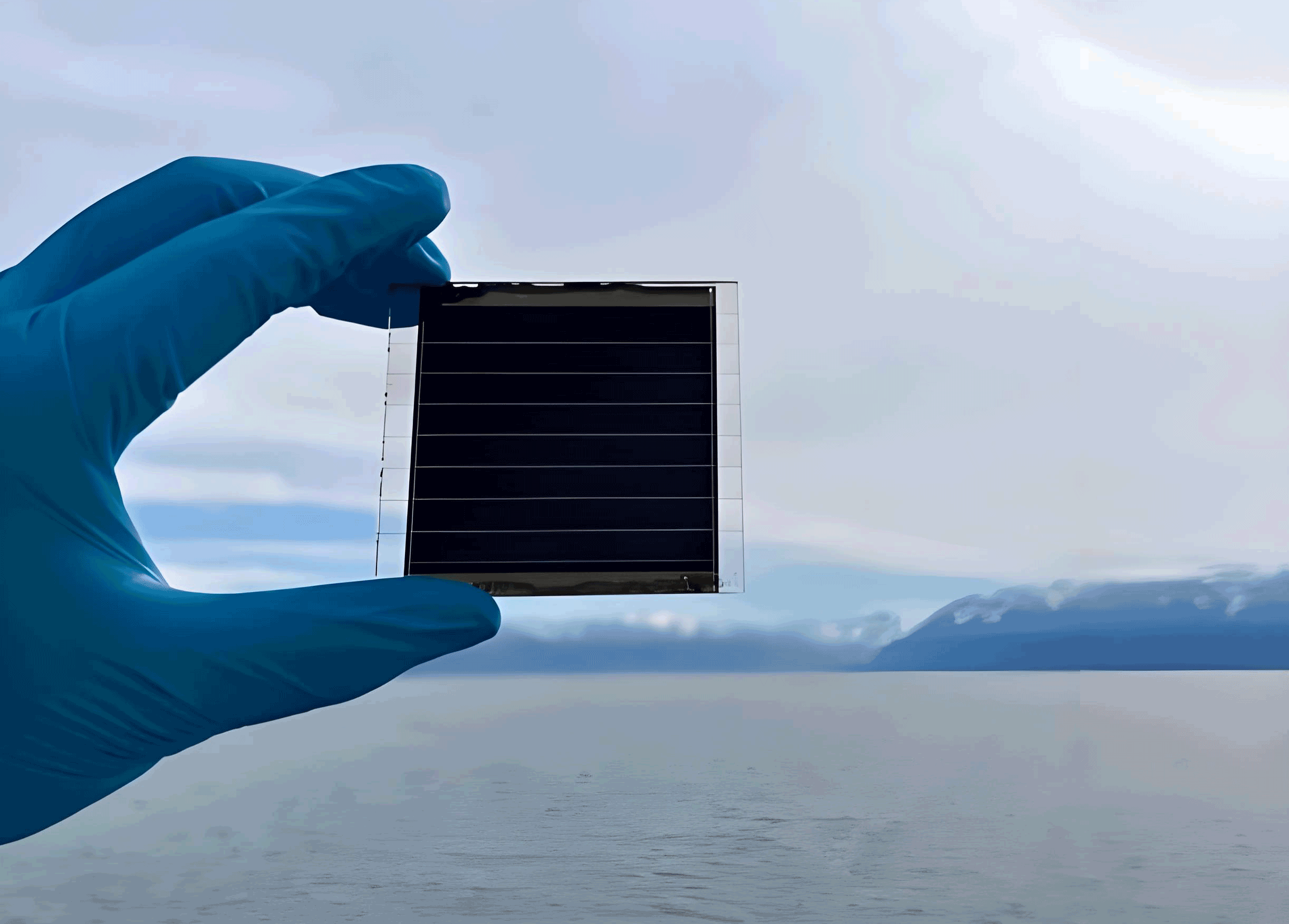
The surface morphology of pristine and TEOS-modified perovskite films was examined using scanning electron microscopy. The pristine film exhibited a uniform and dense structure, indicative of high-quality crystallization. After TEOS treatment, no significant changes in morphology were observed, suggesting that the modification did not alter the film’s microstructure. Photoluminescence spectra showed enhanced intensity for the 0.10 M TEOS-modified sample, indicating reduced non-radiative recombination. Transient photoluminescence decay curves were fitted to a bi-exponential model, revealing an increase in carrier lifetime from 93.51 ns for the pristine film to 123.38 ns for the TEOS-modified film. This improvement is attributed to defect passivation by silicon-oxygen oligomers, which mitigate trap-assisted recombination. The enhanced carrier behavior underscores the effectiveness of TEOS in optimizing the performance of perovskite solar cells.
To quantify the photovoltaic parameters, we fabricated devices with and without TEOS modification and measured their current-density-voltage characteristics under AM 1.5 G illumination. The average values of power conversion efficiency, short-circuit current density, fill factor, and open-circuit voltage are summarized in Table 1. The TEOS-modified perovskite solar cells demonstrated superior performance across all parameters, with the champion device achieving a power conversion efficiency of 16.33%, compared to 14.52% for the pristine device. This improvement is linked to reduced recombination and better charge extraction. External quantum efficiency measurements supported these findings, with integrated current densities aligning closely with the short-circuit current density values. Steady-state power output at the maximum power point confirmed the stability of the TEOS-modified perovskite solar cells, maintaining a power conversion efficiency of 15.87% over 300 seconds.
| Sample | PCE (%) | JSC (mA/cm²) | FF (%) | VOC (V) |
|---|---|---|---|---|
| Pristine | 14.52 | 20.45 | 63.55 | 1.04 |
| 0.10 M TEOS | 16.33 | 21.11 | 66.99 | 1.07 |
The interaction mechanism between TEOS and the perovskite surface was investigated using Fourier-transform infrared spectroscopy and X-ray photoelectron spectroscopy. Fourier-transform infrared spectra revealed a broad peak between 966 cm⁻¹ and 1078 cm⁻¹, corresponding to Si-O-Si stretching vibrations, confirming the formation of silicon-oxygen oligomers. X-ray photoelectron spectroscopy analysis showed shifts in the Pb 4f and I 3d peaks to higher binding energies after TEOS modification, indicating strong chemical bonding. This bonding passivates surface defects, such as lead and iodine vacancies, reducing trap density. The defect density was further evaluated using space-charge-limited current measurements in hole-only devices. The trap-filled limit voltage decreased from 0.69 V for pristine devices to 0.60 V for TEOS-modified devices, corresponding to a reduction in hole defect density from 2.09 × 10¹⁶ cm⁻³ to 1.82 × 10¹⁶ cm⁻³. This passivation effect enhances charge transport and minimizes recombination in perovskite solar cells.
Capacitance-voltage measurements provided insights into the built-in potential and carrier behavior. The Mott-Schottky analysis yielded a built-in potential of 1.34 V for TEOS-modified perovskite solar cells, higher than the 1.19 V for pristine devices. This increase facilitates better charge separation and collection. The open-circuit voltage dependence on light intensity was analyzed to understand recombination mechanisms. The slope for TEOS-modified devices was 1.34 kT/q, lower than the 1.97 kT/q for pristine devices, indicating suppressed Shockley-Read-Hall recombination. Electrochemical impedance spectroscopy revealed a larger recombination resistance and smaller series resistance for TEOS-modified perovskite solar cells, consistent with reduced non-radiative losses. Dark current measurements showed lower leakage currents for modified devices, further confirming diminished recombination. These results highlight the role of TEOS in optimizing the interfacial properties of perovskite solar cells.
The stability of perovskite solar cells is crucial for practical deployment. We monitored the structural integrity of pristine and TEOS-modified films under ambient conditions (30% RH, 25 °C) using X-ray diffraction. After 35 days, the pristine film exhibited peaks corresponding to PbI₂, indicating decomposition, while the TEOS-modified film remained phase-pure. This enhanced moisture resistance is attributed to the hydrophobic silicon-oxygen oligomer layer, which acts as a barrier against water ingress. Thermal stability was tested at 65 °C, where the pristine film showed PbI₂ formation within 4 hours, but the TEOS-modified film remained stable. The long-term operational stability of unencapsulated devices was evaluated over 100 days. The power conversion efficiency of TEOS-modified perovskite solar cells retained over 80% of its initial value, whereas pristine devices degraded to 80% within 55 days. The protective role of TEOS-derived oligomers in preventing perovskite decomposition underscores their potential for durable perovskite solar cells.
To summarize the carrier dynamics, we model the recombination rate using the following equation: $$R = A \cdot n \cdot p + B \cdot (n \cdot p – n_i^2) + C \cdot (n \cdot p – n_i^2)$$ where \(R\) is the recombination rate, \(A\) is the defect-assisted recombination coefficient, \(B\) is the radiative recombination coefficient, \(C\) is the Auger recombination coefficient, \(n\) and \(p\) are electron and hole concentrations, and \(n_i\) is the intrinsic carrier density. For TEOS-modified perovskite solar cells, the reduction in defect density lowers \(A\), leading to improved performance. Additionally, the fill factor can be expressed as: $$\text{FF} = \frac{V_{\text{mp}} \cdot J_{\text{mp}}}{V_{\text{OC}} \cdot J_{\text{SC}}}$$ where \(V_{\text{mp}}\) and \(J_{\text{mp}}\) are the voltage and current density at the maximum power point. The enhancement in fill factor after TEOS modification is consistent with reduced series resistance and improved charge collection.
| Parameter | Pristine | 0.10 M TEOS |
|---|---|---|
| Hole defect density (cm⁻³) | 2.09 × 10¹⁶ | 1.82 × 10¹⁶ |
| Carrier lifetime (ns) | 93.51 | 123.38 |
| Recombination resistance (Ω) | 1.2 × 10³ | 2.5 × 10³ |
In conclusion, our study demonstrates that tetraethyl orthosilicate modification significantly enhances the performance and stability of carbon-based perovskite solar cells without a hole-transporting layer. The in situ formation of silicon-oxygen oligomers passivates surface defects, reduces non-radiative recombination, and improves charge transport. This results in a notable increase in power conversion efficiency, from 14.52% to 16.33%, along with superior environmental and thermal stability. The hydrophobic nature of the oligomer layer effectively shields the perovskite from moisture and heat, extending the device lifetime. These findings highlight the potential of TEOS-based interface engineering for advancing the commercialization of perovskite solar cells. Future work will focus on optimizing the concentration and application methods to further push the boundaries of efficiency and durability in perovskite solar cells.