
In the context of rapid development in clean energy technologies, perovskite solar cells have emerged as a promising candidate due to their high power conversion efficiency and low-cost fabrication potential. As a researcher in this field, I have observed that the stability of perovskite solar cells remains a critical challenge for their widespread commercialization. The performance degradation of perovskite solar cells is primarily influenced by environmental factors such as moisture, oxygen, temperature, and ultraviolet radiation. These elements accelerate the decomposition of perovskite materials, leading to reduced efficiency and lifespan. In this article, I will analyze the key stability factors affecting perovskite solar cells and discuss effective strategies to enhance their performance, incorporating tables and equations to summarize critical data and concepts. The goal is to provide a comprehensive overview that advances the practical application of perovskite solar cell technology.
Perovskite solar cells are based on materials with an ABX3 crystal structure, where A represents a monovalent cation, B is a divalent metal cation, and X is a halide anion. This structure contributes to excellent optoelectronic properties, but it is highly susceptible to environmental degradation. For instance, in the presence of moisture, perovskite materials undergo phase transitions that diminish their optical activity. Studies using techniques like ambient pressure X-ray photoelectron spectroscopy (AP-XPS) have shown that water vapor adsorption leads to oxygen incorporation and vacancy formation, triggering irreversible changes. To address this, all-inorganic perovskite materials, such as CsPbIxBr3−x, have been developed. These variants exhibit superior stability under harsh conditions, as demonstrated by experiments where CsPbI2Br devices maintained operational stability for over 30 days in environments with approximately 25% relative humidity. However, challenges persist in highly humid conditions, necessitating further optimization of perovskite solar cell designs.
The stability of perovskite solar cells is governed by multiple environmental factors. Moisture, for example, diffuses rapidly into perovskite layers even at low humidity levels, causing structural defects and reduced crystallinity. Oxygen interacts with perovskite components, leading to the formation of by-products like water and iodine, which accelerate degradation. Temperature fluctuations induce lattice instabilities, as seen in FAPbI3-based cells, where high temperatures cause ion displacement and efficiency loss. Ultraviolet radiation, particularly in the UVB range, breaks chemical bonds such as Pb-O, resulting in ion migration and defect formation. This not only lowers the power conversion efficiency but also shortens the device lifetime. To quantify these effects, consider the degradation coefficient (C) and radiation fluence (φx) under different radiation types, as summarized in Table 1. For example, under electron irradiation, the short-circuit current density degrades with C = 0.0470 and φx = 6.34 × 10¹¹, highlighting the sensitivity of perovskite solar cells to external stresses.
| Cell Parameter | Short-Circuit Current Density | Open-Circuit Voltage | Maximum Power Point Power |
|---|---|---|---|
| Electron Irradiation | C = 0.0470, φx = 6.34 × 10¹¹ | C = 0.0140, φx = 2.82 × 10¹³ | C = 0.0093, φx = 1.69 × 10¹² |
| Proton Irradiation | C = 0.054, φx = 5.68 × 10¹³ | C = 0.043, φx = 5.56 × 10¹⁴ | C = 0.087, φx = 9.67 × 10¹³ |
| Gamma Irradiation | C = 0.015, φx = 3.93 × 10¹⁰ | C = 0.003, φx = 2.96 × 10⁹ | C = 0.007, φx = 4.69 × 10⁷ |
To mitigate these issues, encapsulation techniques are essential for protecting perovskite solar cells from environmental exposure. In my experience, performing fabrication in inert atmospheres, such as nitrogen-filled gloveboxes with water and oxygen levels below 1 × 10⁻⁶, significantly reduces degradation. Pre-heating substrates and precursor solutions can enhance solvent evaporation, forming a protective layer that shields against moisture and oxygen during coating processes. This approach has been shown to improve the stability of perovskite solar cells by preventing premature decomposition. Additionally, advanced encapsulation materials can further isolate the active layers, extending the operational life of these devices in real-world conditions.
Material modification is another key strategy for enhancing the stability of perovskite solar cells. By replacing unstable organic cations with inorganic ions like cesium (Cs+), the chemical robustness of perovskite materials is improved. For example, Cs-doped perovskites exhibit slower degradation rates under high-temperature and humid environments compared to their organic counterparts. The general formula for such modified perovskites can be expressed as $$(A_{1-x}Cs_x)BX_3$$, where x represents the doping ratio. This substitution not only stabilizes the crystal lattice but also optimizes optoelectronic properties. In all-inorganic perovskite solar cells, interface engineering plays a crucial role; introducing p-type cesium-doped nickel oxide (Cs:NiOx) as an active interlayer enhances charge extraction and thermal stability. Devices with this modification retained over 95% of their initial efficiency after 1,000 hours at 60°C, demonstrating the effectiveness of material-level improvements for perovskite solar cells.
Surface passivation techniques address defect-related losses in perovskite solar cells. During film growth, uncoordinated Pb2+ ions and halide vacancies act as trap states, promoting non-radiative recombination and reducing efficiency. Passivation agents, such as tetraethylammonium chloride (TEACl) or similar compounds, fill these vacancies and form stable bonds. The passivation process can be modeled using the equation for defect density reduction: $$N_d = N_0 \exp(-k t)$$, where Nd is the defect density after time t, N0 is the initial defect density, and k is the passivation rate constant. Experimental results show that adding 3% TMACl to SnO2 electron transport layers in CsPbI2Br-based perovskite solar cells increased power conversion efficiency to 13.84% and improved stability under LED illumination. This highlights how surface treatments can significantly boost the performance of perovskite solar cells by minimizing energy losses.
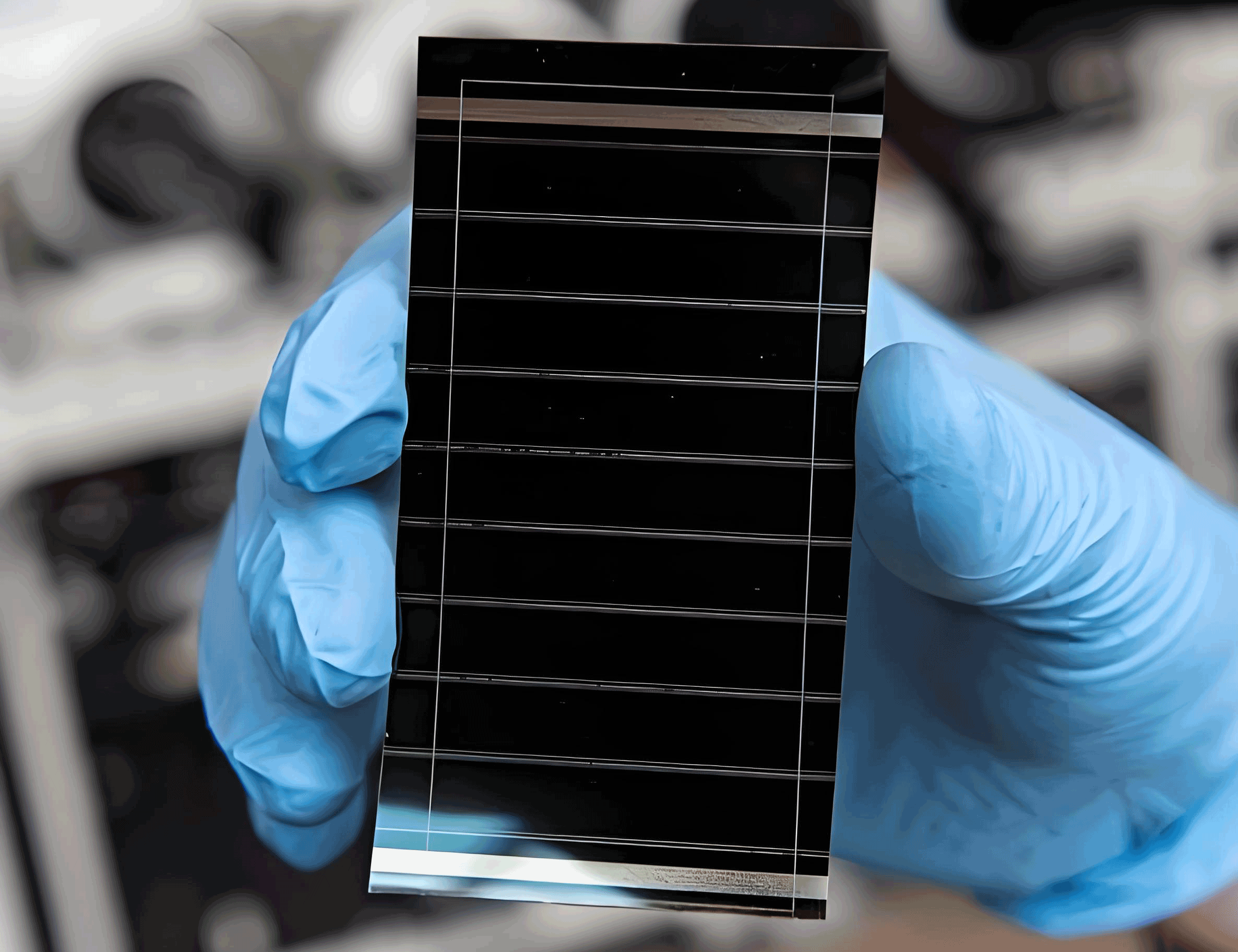
Two-dimensional (2D) perovskite layers offer a protective barrier for three-dimensional (3D) perovskite solar cells. By depositing organic-inorganic hybrid 2D materials on top of 3D active layers, moisture and oxygen penetration are effectively blocked. In accelerated aging tests, 2D-protected perovskite solar cells maintained approximately 81% of their initial efficiency after 1,000 hours in 85°C and 85% relative humidity conditions, whereas unprotected devices dropped below 50%. This approach leverages the inherent stability of 2D structures to safeguard the more efficient but vulnerable 3D perovskites. The synergy between layers can be described by the interface energy equation: $$\Delta G = \gamma_{2D/3D} – \gamma_{substrate}$$, where ΔG represents the Gibbs free energy change, and γ denotes interfacial tensions. Optimizing this interface is crucial for long-term durability in perovskite solar cells.
The “dopant-additive” synergistic mechanism further enhances the performance of perovskite solar cells. For instance, introducing oleic acid into precursor solutions improves film quality by passivating deep and shallow level defects. The carboxyl and nitrogen groups in oleic acid bind to uncoordinated Pb2+ and I− ions, reducing trap states and promoting larger grain growth. This can be quantified by the grain size increase equation: $$D = D_0 + \alpha C_{additive}$$, where D is the final grain size, D0 is the initial size, α is a constant, and Cadditive is the additive concentration. Perovskite solar cells treated with oleic acid achieved a power conversion efficiency of 22.09%, compared to 19.89% for control devices, and retained 93.85% of efficiency after 1,000 hours in air. Such strategies demonstrate how chemical additives can synergize with doping to optimize the stability and efficiency of perovskite solar cells.
In practical applications, perovskite solar cells face challenges like low efficiency, poor consistency, and scalability issues. To address these, combining encapsulation with material modifications has proven effective. For example, incorporating methylammonium chloride (MACl) as a dopant eliminates yellow phases and enhances crystallization, leading to certified efficiencies of 23.3% for modules with an aperture area of 27.22 cm2. These devices maintained 94.66% and 84.53% of their initial efficiency after 1,000 hours of continuous illumination at room temperature and 65°C, respectively. This underscores the importance of integrated approaches in advancing perovskite solar cell technology toward commercial viability.
In conclusion, the stability of perovskite solar cells is intricately linked to environmental factors and material properties. Through encapsulation, material modification, surface passivation, 2D layer protection, and synergistic dopant-additive mechanisms, significant improvements can be achieved. As research progresses, focusing on these strategies will help overcome existing barriers, paving the way for durable and high-performance perovskite solar cells in the renewable energy landscape. The continuous innovation in this field holds promise for making perovskite solar cells a cornerstone of sustainable power generation.