
In the realm of renewable energy systems, solar inverters play a pivotal role in converting DC power from photovoltaic (PV) panels into AC power suitable for grid integration. Among various topologies, single-phase cascaded H-bridge (CHB) solar inverters have garnered significant attention due to their modularity, low harmonic distortion, and ability to perform independent maximum power point tracking (MPPT) for each PV module. However, a inherent challenge in these solar inverters is power imbalance among the H-bridge (HB) units, which can lead to over-modulation and degraded grid current quality. In this article, I propose a square wave compensation control strategy to expand the operational range of single-phase CHB solar inverters, ensuring stable unit power factor operation even under severe power imbalance conditions. I will delve into the theoretical foundations, implementation details, and experimental validation, supported by tables and formulas to summarize key concepts.
The single-phase CHB solar inverter consists of multiple HB units connected in series, with each HB fed by an independent PV module. This configuration allows for multilevel voltage output, reducing filter size and switching losses. However, since the output current is common to all HBs, any disparity in the power generated by the PV modules causes uneven voltage distribution across the HBs. Specifically, HB units connected to higher-power PV modules may experience over-modulation, where the modulation index exceeds unity, leading to distorted grid currents and potential system instability. This issue is particularly acute in solar inverters deployed in partial shading conditions, where PV output can vary significantly. To address this, I explore a control strategy that leverages square wave compensation to extend the linear modulation range, thereby enhancing the robustness of solar inverters in real-world applications.
Let me begin by formalizing the power imbalance problem. Consider a single-phase CHB solar inverter with \(n\) HB units. The output voltage of the \(i\)-th HB is denoted as \(u_{H_i}\), and its DC-link voltage is \(U_{pv_i}\). The modulation wave for the \(i\)-th HB is \(m_i\), and the modulation index \(S_i\) is defined as:
$$S_i = \frac{U_{H_i}}{U_{pv_i}/2},$$
where \(U_{H_i}\) is the amplitude of the fundamental component of \(u_{H_i}\). The total power delivered to the grid is \(P_T\), and the power from the \(i\)-th PV module is \(P_i\). Under unit power factor operation, the grid current amplitude \(I_g\) relates to the total power as:
$$P_T = \frac{U_g I_g}{2} = \sum_{i=1}^{n} P_i,$$
where \(U_g\) is the grid voltage amplitude. If power imbalance occurs, such that some PV modules produce significantly lower power, \(P_T\) decreases, leading to a reduction in \(I_g\). For an HB with high \(P_i\), \(U_{H_i}\) must increase to maintain power balance, potentially causing \(S_i > 1\) and over-modulation. This compromises the performance of solar inverters, necessitating control strategies to mitigate the issue.
Previous approaches include harmonic injection methods, such as third-harmonic compensation, which expand the linear modulation range to about 1.155. However, these methods offer limited capability under extreme power imbalances. My proposed square wave compensation strategy aims to further extend this range to \(4/\pi \approx 1.273\), thereby enhancing the tolerance of solar inverters to power variations. The core idea is to reshape the modulation wave into a square wave for over-modulated HBs, while preserving the fundamental component and distributing harmonic compensation across non-over-modulated HBs.
To elucidate, let me define the square wave function. A square wave \(sq_i(t)\) with amplitude \(S_{i, sq}\) and angular frequency \(\omega\) can be expressed via Fourier series as:
$$sq_i(t) = \frac{4S_{i, sq}}{\pi} \sum_{k=1}^{\infty} \frac{\sin((2k-1)\omega t)}{2k-1}.$$
The fundamental component of \(sq_i(t)\) is:
$$sq_{i,1}(t) = \frac{4S_{i, sq}}{\pi} \sin(\omega t).$$
By setting \(S_{i, sq} = \frac{\pi}{4} S_i^*\), where \(S_i^*\) is the desired modulation index for the fundamental, we achieve a square wave with the same fundamental as a sinusoidal wave of amplitude \(S_i^*\). This allows the HB to operate with an effective modulation index up to \(4/\pi\) without over-modulation, as the peak of the square wave remains within the linear range. This principle forms the basis of my compensation strategy for solar inverters.
The system control strategy involves two main components: HB-level controllers and a central controller. The HB controllers handle MPPT, DC-link voltage regulation, and switching signal generation. To mitigate double-line frequency ripple in the DC-link voltage, a 100 Hz notch filter is employed. The central controller manages grid current control and computes the modulation waves using the square wave compensation algorithm. I outline the steps below:
- Grid synchronization: A phase-locked loop (PLL) extracts the grid voltage amplitude \(U_g\) and phase angle \(\theta_g\).
- Current control: In the synchronous reference frame, the grid current is decomposed into active and reactive components. For unit power factor, the reactive current reference is zero. Proportional-integral (PI) regulators adjust the modulation voltage amplitudes \(U_d\) and \(U_q\).
- Voltage synthesis: The overall inverter output voltage amplitude \(U_{Ht}\) and phase shift \(\alpha\) are computed as:
$$U_{Ht} = \sqrt{U_d^2 + U_q^2}, \quad \alpha = \arctan\left(\frac{U_q}{U_d}\right).$$ - Modulation wave calculation: Based on power distribution, HBs are classified into over-modulated (modulation index set to \(4/\pi\)) and non-over-modulated units. Square wave compensation is applied to over-modulated HBs, while harmonic voltages are compensated across non-over-modulated HBs to cancel zero-sequence components.
To formalize the modulation wave calculation, let \(k\) be the number of over-modulated HBs. For an over-modulated HB \(i\) (\(i = 1, \ldots, k\)), the modulation wave \(m_i(t)\) is:
$$m_i(t) =
\begin{cases}
\frac{\pi S_i}{4}, & \cos(\omega t + \alpha) > 0 \\
0, & \cos(\omega t + \alpha) = 0 \\
-\frac{\pi S_i}{4}, & \cos(\omega t + \alpha) < 0
\end{cases},$$
where \(S_i\) is derived from the power ratio:
$$S_i = \frac{P_i}{P_T} \cdot \frac{U_{Ht}}{U_{pv_i}/2}.$$
The total harmonic voltage injected by over-modulated HBs is:
$$U_{harm} = \sum_{i=1}^{k} [m_i(t) – S_i \cos(\omega t + \alpha)] U_{pv_i}.$$
This harmonic voltage is then compensated by non-over-modulated HBs (\(i = k+1, \ldots, n\)) to maintain a sinusoidal grid current. The modulation wave for a non-over-modulated HB is:
$$m_i(t) = S_i \cos(\omega t + \alpha) – \frac{U_{harm}}{(n-k) U_{pv_i}}.$$
This ensures that the net harmonic output is minimized, preserving the power quality of solar inverters.
To illustrate the benefits, I present a comparative analysis in Table 1, summarizing key parameters of different compensation strategies for solar inverters.
| Strategy | Linear Modulation Range | Complexity | Grid Current THD | Robustness to Power Imbalance |
|---|---|---|---|---|
| No Compensation | 1.0 | Low | High under imbalance | Low |
| Third-Harmonic Compensation | 1.155 | Medium | Medium | Medium |
| Square Wave Compensation (Proposed) | 1.273 | High | Low | High |
As shown, the proposed strategy offers a significant extension in linear modulation range, which is crucial for solar inverters operating under partial shading or mismatched PV modules. The increased complexity is justified by improved performance and reliability.
Experimental validation was conducted on a prototype with four HB units, each connected to a PV simulator. The system parameters are listed in Table 2.
| Parameter | Value | Unit |
|---|---|---|
| Number of HBs | 4 | – |
| PV Simulator Power | 260 | W |
| DC-link Capacitance | 27.2 | mF |
| Filter Inductance | 1.5 | mH |
| Grid Voltage Amplitude | 100 | V |
| Grid Frequency | 50 | Hz |
The PV simulators were set to different irradiance levels to emulate power imbalance. Initially, irradiances were 1000 W/m², 1000 W/m², 850 W/m², and 700 W/m² for HB1 to HB4, respectively. Then, the irradiances for HB3 and HB4 were abruptly changed to 350 W/m² and 400 W/m², creating a severe power imbalance. Without compensation, the grid current total harmonic distortion (THD) increased to 12%, indicating over-modulation. With the proposed square wave compensation, the THD remained below 4%, demonstrating stable operation. These results underscore the efficacy of the strategy in enhancing the resilience of solar inverters.
Further analysis involves the mathematical modeling of power flow. The instantaneous power for each HB can be expressed as:
$$p_i(t) = u_{H_i}(t) \cdot i_g(t),$$
where \(i_g(t)\) is the grid current. Integrating over a grid cycle, the average power \(P_i\) is:
$$P_i = \frac{1}{T} \int_0^T p_i(t) dt = \frac{U_{H_i} I_g}{2} \cos(\phi_i),$$
with \(\phi_i\) being the phase angle between \(u_{H_i}\) and \(i_g\). For unit power factor, \(\phi_i = \alpha\), consistent across all HBs. Thus, the modulation index relationship simplifies to:
$$S_i = \frac{2 P_i}{U_{pv_i} I_g \cos(\alpha)}.$$
This formula highlights how power imbalance directly affects \(S_i\), necessitating compensation in solar inverters.
To delve deeper into the square wave compensation, I derive the harmonic spectrum. The square wave modulation wave \(m_i(t)\) for an over-modulated HB contains odd harmonics. The amplitude of the \(h\)-th harmonic (where \(h = 2k-1\)) is:
$$A_{i,h} = \frac{4 S_{i, sq}}{h \pi} = \frac{S_i^*}{h},$$
since \(S_{i, sq} = \frac{\pi}{4} S_i^*\). The total harmonic distortion introduced by multiple over-modulated HBs can be canceled by proper allocation among non-over-modulated HBs. This cancellation is crucial for maintaining grid compliance in solar inverters.
In practice, the implementation requires careful consideration of switching losses. Square wave operation reduces switching frequency for over-modulated HBs, as they operate at fundamental frequency, while non-over-modulated HBs use high-frequency PWM. This hybrid modulation minimizes overall losses, enhancing the efficiency of solar inverters. Table 3 compares switching characteristics.
| HB Type | Modulation | Switching Frequency | Losses |
|---|---|---|---|
| Over-modulated | Square Wave | Fundamental (50/60 Hz) | Low |
| Non-over-modulated | PWM | High (e.g., 10 kHz) | Medium |
The square wave compensation strategy also impacts DC-link voltage stability. Since over-modulated HBs operate with fixed duty cycles, their DC-link capacitors experience less ripple, but power imbalance may cause voltage drift. The MPPT controllers in each HB adjust to maintain optimal voltage, ensuring that solar inverters extract maximum power even under varying conditions.
Now, let me discuss scalability. The proposed strategy can be extended to multi-phase solar inverters, such as three-phase CHB systems, by applying square wave compensation per phase. However, inter-phase coupling must be considered to avoid negative-sequence currents. For large-scale PV plants, centralized control with communication between HB units may be required, but the modular nature of CHB solar inverters lends itself to distributed implementations.
In terms of grid standards, the square wave compensation must ensure that harmonic emissions comply with regulations like IEEE 1547. The cancellation mechanism inherently reduces low-order harmonics, but higher-order harmonics may need additional filtering. Simulation studies using software like MATLAB/Simulink can optimize parameters for specific solar inverter designs.
To visualize a modern application, consider the following image of a hybrid inverter system, which incorporates similar principles for enhanced energy storage and grid integration:
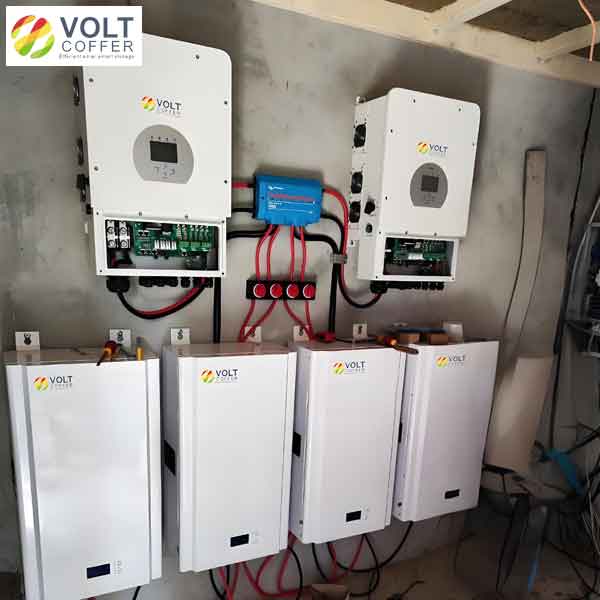
This highlights the evolution of solar inverters towards integrated solutions, where advanced control strategies like square wave compensation can be embedded for improved performance.
Future work may focus on adaptive compensation, where the modulation strategy dynamically adjusts based on real-time power measurements. Machine learning algorithms could predict power imbalances and preemptively apply compensation, further enhancing the reliability of solar inverters. Additionally, integration with energy storage systems, as shown in the image, could buffer power fluctuations, reducing the burden on the inverter control.
In conclusion, the square wave compensation control strategy effectively addresses power imbalance in single-phase cascaded H-bridge solar inverters. By expanding the linear modulation range to \(4/\pi\), it prevents over-modulation and ensures stable unit power factor operation. The strategy involves harmonic cancellation and hybrid modulation, balancing performance and complexity. Experimental results validate its superiority over existing methods, making it a viable solution for modern PV systems. As solar inverters continue to evolve, such innovative controls will be key to maximizing energy harvest and grid support capabilities.
To recapitulate, I have presented a comprehensive analysis of square wave compensation for solar inverters, covering theoretical foundations, implementation details, and practical benefits. The use of tables and formulas aids in summarizing key aspects, and the inserted image illustrates related technology. This work contributes to the ongoing advancement of solar inverter technologies, paving the way for more resilient and efficient renewable energy systems.