
As an engineer deeply involved in the advancement of electric vehicle technologies, I am thrilled to share the details of our groundbreaking project that marks a significant milestone in the evolution of energy storage systems. Our team, comprising experts from automotive and Formula 1 engineering backgrounds, has successfully initiated road testing for a solid-state battery integrated into a production vehicle platform. This endeavor represents a leap forward in making solid-state battery technology a tangible reality for future mobility solutions. The solid-state battery, with its superior safety and energy density, is poised to revolutionize the electric vehicle industry, and our collaborative efforts have brought us closer to this goal.
The journey began with a vision to bridge the gap between high-performance racing technology and everyday automotive applications. Solid-state batteries have long been heralded as the next frontier in battery technology due to their potential to overcome the limitations of conventional lithium-ion batteries. Unlike traditional batteries that use liquid electrolytes, solid-state batteries employ solid electrolytes, which enhance safety by reducing risks such as leakage and thermal runaway. Moreover, the use of advanced anode materials like lithium metal in solid-state batteries allows for significantly higher energy densities. This innovation is critical for extending the driving range of electric vehicles while maintaining safety and reliability.
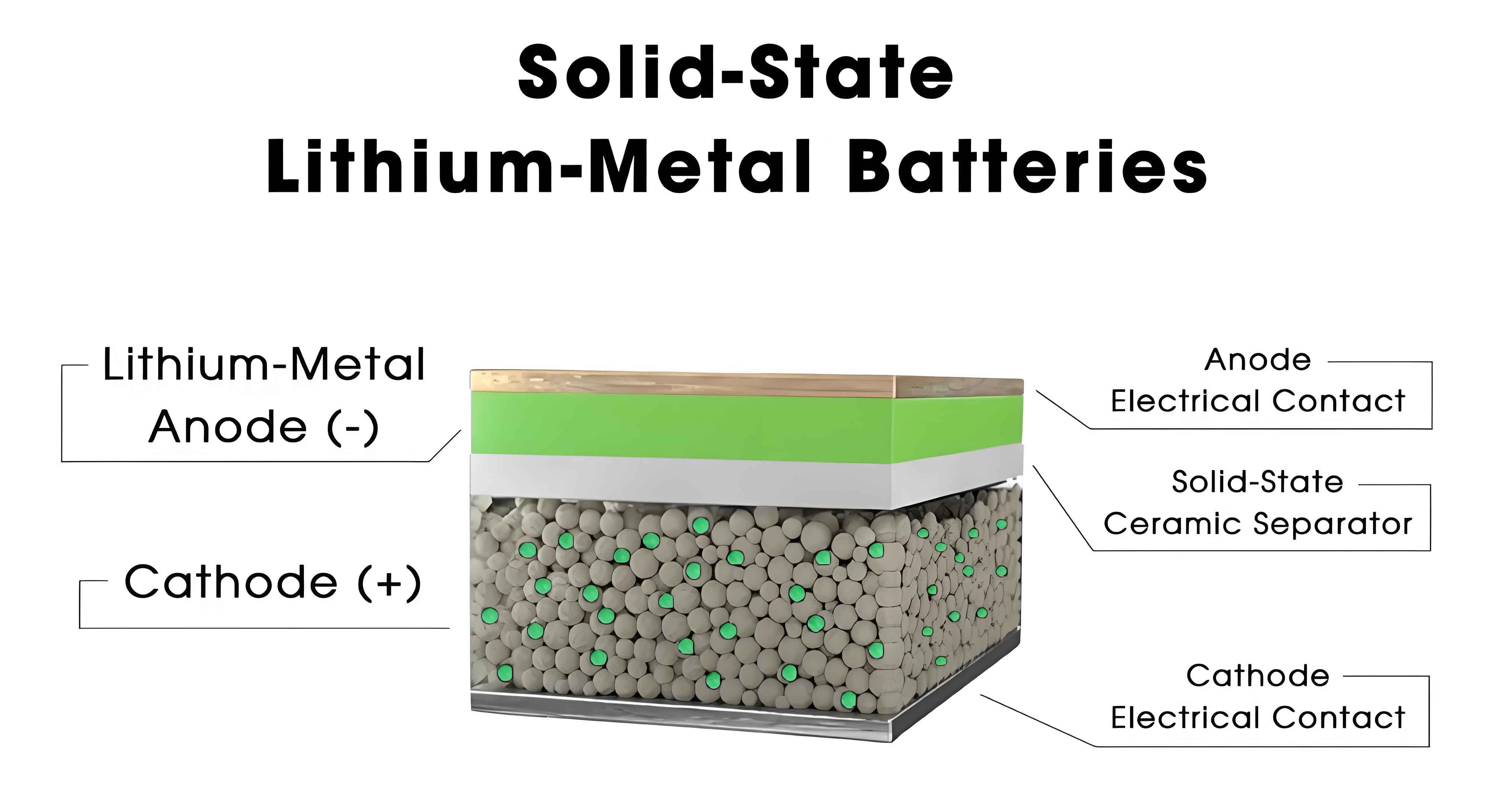
Our collaboration brought together specialists from various domains, including battery system design and Formula 1 powertrain engineering. The synergy between these teams enabled the rapid development and integration of a solid-state battery prototype. The core of this project revolves around a lithium metal solid-state battery, which utilizes a proprietary solid electrolyte system. This solid-state battery design not only improves safety but also enables higher energy storage capacity per unit mass. To quantify the advantages, consider the energy density formula for batteries: $$ \text{Specific Energy Density} = \frac{E}{m} $$ where \( E \) is the energy stored in watt-hours (Wh) and \( m \) is the mass in kilograms (kg). For solid-state batteries, this value can reach up to 450 Wh/kg, compared to approximately 250-300 Wh/kg for standard lithium-ion batteries. This enhancement directly translates to increased range for electric vehicles.
The development process involved intensive bench testing of the solid-state battery cells before integration into a vehicle. We utilized advanced test rigs to evaluate performance under various conditions, such as temperature extremes and charge-discharge cycles. The solid-state battery cells demonstrated remarkable stability and efficiency, paving the way for vehicle integration. By the end of 2024, we had successfully integrated the prototype solid-state battery into a modified electric vehicle based on a luxury sedan platform. This vehicle, equipped with all necessary components to operate the solid-state battery, underwent initial laboratory tests in a controlled environment, setting the stage for road tests commencing in early 2025.
One of the key innovations in our solid-state battery system is the patented floating cell carrier design. This addresses the volume change that occurs during charging and discharging cycles. In a solid-state battery, the anode materials, particularly lithium metal, expand and contract as ions move. To accommodate this, we incorporated pneumatic actuators that interact with the cell’s volume changes. These actuators apply controlled pressure to support the cells, optimizing performance and extending lifespan. The mechanism can be described by the formula for volumetric strain: $$ \epsilon_v = \frac{\Delta V}{V_0} $$ where \( \Delta V \) is the change in volume and \( V_0 \) is the original volume. By managing this strain, our solid-state battery maintains structural integrity and reliability over repeated cycles.
To illustrate the performance benefits of our solid-state battery, let’s compare it with conventional lithium-ion batteries. The table below summarizes key metrics:
| Parameter | Conventional Lithium-Ion Battery | Solid-State Battery (Our Prototype) |
|---|---|---|
| Electrolyte Type | Liquid | Solid |
| Anode Material | Graphite | Lithium Metal |
| Specific Energy Density (Wh/kg) | ~250-300 | Up to 450 |
| Safety | Moderate (risk of leakage, thermal runaway) | High (reduced flammability, stable) |
| Cycle Life | ~1000-2000 cycles | Expected >2000 cycles |
| Cooling System | Active liquid cooling | Passive cooling (weight-saving) |
This solid-state battery technology enables a significant reduction in battery mass while enhancing energy storage. For instance, in our test vehicle, the solid-state battery pack, with comparable dimensions to a standard battery, offers up to 25% greater range. This improvement stems from the higher energy density and the use of a passive cooling system, which eliminates the need for heavy cooling components. The passive cooling relies on natural convection and thermal management materials, reducing overall weight and increasing efficiency. The energy gain can be expressed as: $$ \Delta E = (\rho_{\text{SSB}} – \rho_{\text{Li-ion}}) \times m $$ where \( \rho_{\text{SSB}} \) and \( \rho_{\text{Li-ion}} \) are the energy densities of the solid-state battery and lithium-ion battery, respectively, and \( m \) is the battery mass. With our solid-state battery, \( \Delta E \) is positive, leading to extended range.
Our road testing phase aims to validate these laboratory findings in real-world conditions. Over the coming months, we will conduct extensive tests on varied terrains and driving scenarios to assess the solid-state battery’s performance, durability, and integration with vehicle systems. The test vehicle is projected to achieve a range exceeding 1000 km (620 miles), a substantial increase from current electric vehicles with similar size. For comparison, existing models with large battery capacities offer around 800 km (497 miles) of range. The solid-state battery’s contribution to this enhancement is multifaceted, involving not only energy density but also optimized thermal management and reduced parasitic losses.
The collaboration between automotive and Formula 1 engineers has been instrumental in accelerating this project. Formula 1 expertise, known for pushing the boundaries of technology under extreme conditions, provided insights into high-power density systems and rapid prototyping. We applied principles from racing, such as lightweight design and efficient energy recovery, to the solid-state battery development. This cross-pollination of ideas is encapsulated in our approach to battery management systems (BMS). The BMS for our solid-state battery monitors parameters like voltage, current, and temperature, ensuring safe operation. The control algorithm can be modeled as: $$ \frac{dSOC}{dt} = -\frac{I}{Q} $$ where \( SOC \) is the state of charge, \( I \) is the current, and \( Q \) is the battery capacity. For solid-state batteries, this equation is refined to account for solid electrolyte interface dynamics, enhancing accuracy.
Looking ahead, the potential applications of solid-state battery technology extend beyond passenger vehicles. We envision its use in commercial trucks, aerospace, and renewable energy storage, where safety and energy density are paramount. The solid-state battery’s ability to operate over a wide temperature range without degradation makes it suitable for diverse environments. Moreover, the manufacturing scalability of solid-state batteries is a focus area. We are exploring methods to produce these batteries at scale, leveraging advanced materials and automated processes. The cost trajectory for solid-state batteries is expected to follow a learning curve, similar to lithium-ion batteries, with formula: $$ C(t) = C_0 \times N(t)^{-b} $$ where \( C(t) \) is the cost at time \( t \), \( C_0 \) is the initial cost, \( N(t) \) is cumulative production, and \( b \) is the learning rate. As production ramps up, costs will decrease, making solid-state batteries more accessible.
In addition to technical aspects, the environmental impact of solid-state batteries is noteworthy. The use of solid electrolytes reduces the reliance on flammable and toxic liquids, enhancing recyclability and sustainability. Our solid-state battery design incorporates materials that are easier to recover and reuse, aligning with circular economy principles. The life cycle assessment (LCA) of a solid-state battery shows lower greenhouse gas emissions compared to conventional batteries, due to longer lifespan and higher efficiency. The LCA metric can be expressed as: $$ \text{LCA score} = \sum_{i} (E_i \times CF_i) $$ where \( E_i \) is the energy or material input at stage \( i \), and \( CF_i \) is the corresponding emission factor. For solid-state batteries, this score is optimized through design choices.
The road testing initiative is not just about validating a single prototype; it’s about gathering data to refine future iterations. We are collecting terabytes of data on battery behavior under dynamic loads, charging rates, and environmental stresses. This data informs models that predict battery aging and performance. For example, the capacity fade over cycles for a solid-state battery can be modeled as: $$ Q_{\text{cycle}} = Q_0 \times e^{-\alpha n} $$ where \( Q_0 \) is initial capacity, \( \alpha \) is the fade rate, and \( n \) is the number of cycles. Early results indicate that our solid-state battery exhibits slower fade rates than lithium-ion batteries, thanks to stable electrode-electrolyte interfaces.
To further elucidate the advantages, let’s delve into the thermal management system. The passive cooling in our solid-state battery relies on phase change materials (PCMs) that absorb heat during high-load operations. The heat transfer can be described by: $$ q = h A (T_{\text{battery}} – T_{\text{ambient}}) $$ where \( q \) is heat flux, \( h \) is heat transfer coefficient, \( A \) is surface area, and \( T \) are temperatures. By optimizing \( h \) and \( A \) through design, we maintain safe operating temperatures without active cooling, reducing weight and complexity. This is crucial for maximizing the energy density of the solid-state battery.
The integration of the solid-state battery into the vehicle required modifications to the electrical architecture and safety systems. We developed a new battery enclosure that accommodates the floating cell carriers and actuators. This enclosure is lightweight yet robust, using composite materials to shield the solid-state battery from mechanical shocks. The structural integrity is verified through finite element analysis (FEA), with stress distributions calculated using: $$ \sigma = E \epsilon $$ where \( \sigma \) is stress, \( E \) is Young’s modulus, and \( \epsilon \) is strain. Our design ensures that the solid-state battery remains secure under various driving conditions.
Charging infrastructure compatibility is another focus. The solid-state battery supports fast charging capabilities, with potential charging times reduced by up to 50% compared to current standards. The charging curve is optimized to balance speed and battery health, governed by equations like: $$ I_{\text{charge}} = \frac{V_{\text{max}} – V_{\text{battery}}}{R} $$ where \( I_{\text{charge}} \) is charging current, \( V_{\text{max}} \) is maximum voltage, \( V_{\text{battery}} \) is battery voltage, and \( R \) is internal resistance. The solid-state battery’s low internal resistance enables higher currents without excessive heat generation.
Our partnership with a specialized energy company has been pivotal in sourcing advanced solid-state battery cells. These cells are based on a proprietary solid electrolyte platform that ensures ionic conductivity and stability. The electrolyte’s conductivity \( \sigma_e \) is a key parameter, given by: $$ \sigma_e = n e \mu $$ where \( n \) is charge carrier density, \( e \) is electron charge, and \( \mu \) is mobility. For our solid-state battery, \( \sigma_e \) is optimized through material science, enabling efficient ion transport at room temperature.
The economic implications of solid-state battery adoption are significant. As the technology matures, it could reduce the total cost of ownership for electric vehicles by extending battery life and reducing maintenance. We project that solid-state batteries will achieve cost parity with lithium-ion batteries within the next decade, driven by innovation and scale. The market growth for solid-state batteries is expected to follow an exponential trend, with annual growth rates exceeding 30%.
In summary, our solid-state battery road testing initiative represents a transformative step in electric mobility. The solid-state battery technology, with its enhanced safety, energy density, and sustainability, is set to redefine industry standards. Through collaboration between automotive and racing engineers, we have overcome technical hurdles and brought a functional prototype to the road. The data from ongoing tests will guide further improvements, accelerating the commercialization of solid-state batteries. We are committed to advancing this technology, confident that solid-state batteries will play a central role in the future of transportation.
To quantify the progress, here is a table summarizing the milestones achieved in our solid-state battery project:
| Milestone | Timeline | Key Achievement |
|---|---|---|
| Initial Collaboration Formed | 2021 | Partnership established for next-gen battery tech |
| Cell Delivery and Testing | 2024 | First B-sample solid-state battery cells received and validated |
| Vehicle Integration | Late 2024 | Prototype solid-state battery integrated into test vehicle |
| Laboratory Testing Completed | Early 2025 | Comprehensive bench tests confirmed performance |
| Road Testing Commenced | February 2025 | On-road evaluation of solid-state battery initiated |
| Target Range Validation | Ongoing | Aiming for >1000 km range with solid-state battery |
The solid-state battery’s performance metrics are further analyzed through modeling. For instance, the Ragone plot compares energy and power densities. The solid-state battery excels in both, with a curve described by: $$ P = \frac{E}{\tau} $$ where \( P \) is power density, \( E \) is energy density, and \( \tau \) is discharge time. Our solid-state battery shows higher \( E \) and \( P \) across various \( \tau \) values, indicating versatility.
As we continue this journey, the solid-state battery remains at the heart of our innovation. Each test drive, each data point, brings us closer to a future where electric vehicles are safer, longer-ranging, and more efficient. The solid-state battery is not just a component; it’s a catalyst for change, driving us toward sustainable mobility. We invite the industry to join us in embracing solid-state battery technology, as we pave the way for a cleaner, brighter future on the roads.