
The electrolyte is the design pivot
Two constraints dominate cell design for electric vehicles and stationary storage: safety and usable energy per kilogram. In a conventional lithium-ion cell, both constraints run through the same component — the electrolyte, an organic solvent carrying a lithium salt. It is the medium that makes room-temperature operation possible, and it is also the material that sets the failure mode. A short circuit, an overcharge, or a mechanical intrusion heats the cell; the solvent then vaporizes and decomposes exothermically, and the reaction can become self-sustaining.
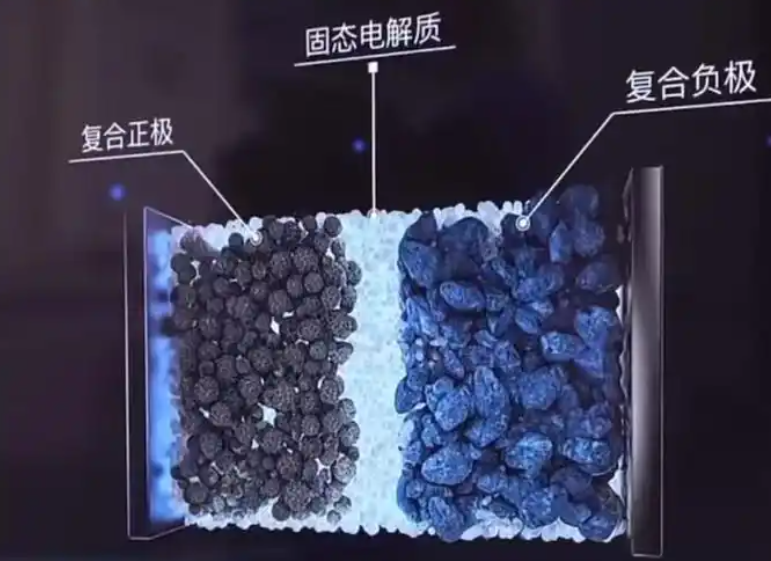
Replace the liquid with a solid ionic conductor and the flammable reservoir disappears. Both electrodes and the separator-electrolyte are solid, so the cell contains no liquid fuel to drive a high-temperature chain reaction. That single substitution is the reason solid-state batteries are treated as a distinct technology rather than an incremental cell improvement — it changes what can go wrong, not merely how much energy the cell stores.
Lithium nitride and the 1976 entry point
The materials question is older than the current industrial interest. In 1976 the Chinese Academy of Sciences sent Chen Liquan, then a crystallographer working on crystal growth, to the Max Planck Institute for Solid State Research in Stuttgart. The institute was working intensively on a single material: lithium nitride, Li3N. Chen’s colleagues described it as an ionic conductor intended for the solid battery of an electric car — a claim that redirected his research from crystal growth to solid electrolytes, with the academy’s approval.
Two visitors shaped the field’s direction during that twenty-month stay: R. Huggins of Stanford, on sabbatical at the institute, and W. Weppner, who had just completed a postdoc in Huggins’s laboratory. The episode marks the point at which solid-state batteries moved from a curiosity about fast ionic conduction in a crystalline solid to an explicit cell-level engineering target.
On returning to China in 1978, Chen submitted a report to the Chinese Academy of Sciences and the Ministry of Science and Technology urging national attention to solid electrolyte materials. Solid-state batteries subsequently appeared as a key topic in three consecutive academy five-year plans and were later folded into the 863 Program. On that record, Chinese work on solid electrolytes began at roughly the same time as work abroad, which is why the field is not starting from zero in any of the countries now competing in it.
Why energy density decides the range argument
Range and safety are usually described as separate problems, but the range side reduces to a mass balance. For a required pack energy, the mass that must be carried is set by the specific energy of the cell:
$$m_{\text{pack}} = \frac{E_{\text{required}}}{e_{\text{specific}}}$$
The often-repeated claim that long-range electric vehicles are inherently inefficient holds only at low specific energy. At 100 Wh/kg, a 500 km pack is heavy; the added mass raises rolling resistance and consumption, so efficiency falls. Raise the cell to 300 Wh/kg and the same 500 km requires roughly one third of the pack mass — the efficiency penalty largely disappears because the mass is no longer there. The argument about long range is really an argument about specific energy.
Intercalation chemistry sets a ceiling on that number. A high-nickel ternary cathode paired with a silicon-carbon anode supports cells in the region of 300 Wh/kg without departing from the lithium-ion architecture. Pushing toward 500 Wh/kg and beyond is considerably harder within the same architecture, because the anode must move to lithium metal — and lithium metal reintroduces the problem the liquid electrolyte had obscured.
Dendrites: what a solid electrolyte does not fix
Charging converts lithium at the anode into ions that cross the electrolyte and react at the cathode; discharging returns them, and they deposit on the lithium surface. Ideal deposition is uniform and parallel. A cell is a large-area electrode, however, and uniformity depends on a uniform electric field and uniform heat distribution. Once either becomes non-uniform, some regions protrude. A protrusion concentrates the field further, so it grows faster than its surroundings, and the cycle repeats: the morphology that emerges is a dendrite.
A dendrite can penetrate the solid electrolyte and contact the cathode, producing an internal short. That is a real safety pathway, and suppressing it is an active research problem rather than a solved one. What changes is the consequence of the short. In a liquid-electrolyte cell, a short or an accident brings the electrodes into contact and the temperature rises quickly; the rise triggers thermal chemical reactions, and those reactions can generate species absent from the normal system, some of them highly toxic. In a solid-state cell there is no liquid to burn, so the short does not automatically escalate into a high-temperature combustion chemistry. Lithium metal remains a reactive material, which is why claims of absolute safety are difficult to sustain; the honest statement is that solid electrolytes remove one failure chain while leaving another to be engineered.
| Attribute | Liquid-electrolyte lithium-ion cell | Solid-electrolyte cell |
|---|---|---|
| Ionic transport medium | Organic solvent with dissolved lithium salt | Solid ionic conductor; transport governed by bulk and grain-boundary conduction |
| Flammable inventory | Substantial: the solvent is the fuel | None in liquid form |
| Consequence of an internal short | Joule heating, solvent decomposition, self-accelerating thermal reactions, possible toxic products | Short is possible via dendrite penetration, but no liquid fuel to sustain combustion chemistry |
| Principal degradation and failure modes | Interfacial film growth, gas evolution, thermal runaway | Interfacial resistance, dendrite penetration, cracking and contact loss under cycling |
| Anode accessible | Graphite, silicon-carbon; lithium metal impractical | Lithium metal becomes a design option, subject to dendrite control |
The 1991 lesson in manufacturability
Solid-state prototypes existed early — cells of roughly 100 cm² were demonstrated — but they could not be manufactured at scale, and the field’s centre of gravity moved elsewhere. When Sony announced commercialization of the lithium-ion battery in 1991, the effect was decisive: the new cell performed well on several metrics at once, and every other country, China included, moved to follow.
Chen visited a Sony plant during that period and described the line as a shock. Automation on the 18650 cylindrical cell was already high: inspection identified poorly welded sections directly, sorting was strict, and the electrode line ran with one or two operators where Chinese factories of the time staffed a line with many. The comparison was not about chemistry but about process control — a gap that had to be closed before any domestic chemistry could compete. China’s decision to concentrate on lithium-ion rather than persist with solid-state prototypes avoided a long period of dependence on foreign supply, at the cost of pausing solid-state work for a stretch of years.
From following to parallel running
The market-share dynamics were already visible by 2010. At a lithium-battery industry forum in Beijing that year, Chen presented world market-share curves: Japan near 100 percent and declining, Korea rising steadily, China climbing slowly from a much lower base, with the Japanese and Korean curves converging. The question posed was how Chinese lithium-battery manufacturing could break out of the follower position. The honorary chairman of CATL, present at the forum, was confident the breakout would start with his company.
Within about four years, China’s share of the global power-battery market had passed Korea’s and reached first place. The mechanism was capacity and cost at scale rather than a new chemistry — the same pattern that had allowed Japan and then Korea to lead.
That position is now exposed to a different pressure. With purchase subsidies withdrawn, manufacturers compete on a more level field, and Japanese and Korean brands enter the Chinese market directly. The relevant question is whether the lead survives the removal of the policy support that helped create it. Chen’s characterisation of the current stage is “parallel running”: having moved from following to running alongside, the industry has not yet reached the leading position, and the transition is expected to take years and to include setbacks.
Where solid-state industrialization actually stands
Around 2016 Chen argued that solid-state batteries would industrialize within five years, that is, by 2020. Measured against that target, the outcome by 2021 was partial: five or six domestic solid-state battery companies had been founded and were moving toward production, but the field remained at an early stage of industrialization rather than in volume manufacturing. The near-term probability of industrialization was still judged high; the timetable was not met in the sense of shipped product at scale.
The strategic conclusion drawn from that record is incremental rather than substitutive. Rather than abandoning lithium-ion, the argument runs, solid-state development should proceed by improving on the existing lithium-ion platform — leveraging established electrode manufacturing, cell format experience and supply chains — because that path moves faster and with fewer discontinuities. Several chemistries will coexist for a period, each with its own trade-offs, but the long-run expectation is that solid electrolytes dominate.
What determines the outcome
The competitive picture is not static. Japan, Korea, Europe and the United States all have active solid-state programs aimed at capturing the future market, so the window for establishing a position is limited. The technical agenda that decides who gets there first is largely shared: lowering interfacial resistance between solid electrolyte and electrode, suppressing dendrite initiation and growth at practical current densities, maintaining mechanical contact and stack pressure over cycle life, and achieving acceptable yield in large-format cells.
Safety and specific energy are the two levers, and they act through the same material decision. A solid electrolyte removes the flammable liquid that makes liquid-electrolyte cells prone to thermal escalation, and it opens the door to lithium metal anodes that intercalation chemistry cannot reach. It does not, by itself, eliminate internal shorts. Whether solid-state batteries become the default or remain a premium option depends less on the promise of the concept — which has been understood since the lithium nitride work of the 1970s — than on whether dendrites, interfaces and manufacturing yield can be brought under control at production scale.