
In my analysis of contemporary power systems, I have observed that the integration of renewable energy sources, particularly solar systems, is pivotal for enhancing grid reliability and sustainability. This article delves into key aspects of power network design and operation, with a focus on solar system applications. I will explore fault analysis in electrical equipment, the adoption of solar photovoltaic building integration, and critical issues in grid planning. Throughout, I emphasize the role of solar systems in transforming our energy landscape, using tables and formulas to summarize insights.
The incident involving a ring main unit fault, as described in the provided materials, highlights the importance of precise installation practices. In July 2018, a phase B cable head installation error led to an explosion, causing combustion and damage. From my perspective, this underscores the need for stringent quality control in electrical connections, which is equally relevant for solar system integrations. For instance, improper installation of solar system components can lead to similar failures, compromising safety and efficiency. To summarize the fault causes, I present the following table:
| Failure Factor | Impact | Preventive Measure |
|---|---|---|
| Incorrect cable head installation | Overheating and combustion | Training and certification of personnel |
| Substandard cable accessories | Reduced durability and safety | Use of qualified, tested products |
| Lack of验收 testing | Undetected defects | Rigorous post-installation inspections |
This analysis reveals that adherence to installation protocols is crucial, not only for traditional equipment but also for solar systems. In fact, the solar system’s performance heavily depends on proper mounting and wiring, as I will discuss later.
Transitioning to solar photovoltaic building integration, I define it as the seamless incorporation of solar energy systems into architectural structures. Unlike standalone solar panels, this approach embeds photovoltaic devices as building materials, enhancing aesthetics and functionality. From my research, solar system integration can be categorized into two types: attachment, where solar devices are mounted on buildings, and integration, where they become intrinsic parts like roofs or walls. The solar system here refers to photovoltaic arrays designed for building use.
The evolution of solar system applications in buildings has been remarkable globally. In China, projects like Shanghai Hongqiao Transportation Hub and Beijing South Station demonstrate the potential of solar systems for large-scale energy generation. For example, the Shanghai hub’s solar system capacity reaches 6.5 MW, contributing to grid stability. I have compiled key milestones in solar system development:
| Year | Project | Solar System Capacity | Significance |
|---|---|---|---|
| 2003 | Beijing Ecological Building | N/A | Early integration of renewables |
| 2004 | Shenzhen Solar Plant | 1 MW | Asia’s largest at the time |
| Recent | Various Residential Trials | 1-5 kW per unit | Scaling to household level |
The promotion of solar systems in residential housing offers immense value. From my viewpoint, solar systems provide clean, renewable energy that aligns with urban sustainability goals. They reduce grid pressure during peak hours, as summer high demand coincides with abundant sunlight. Moreover, a solar system can power common areas like stairwells, enhancing safety during outages. The economic and environmental benefits are quantifiable. For instance, the power output of a solar system can be modeled using the formula: $$ P = \eta \cdot A \cdot G $$ where \( P \) is the power generated, \( \eta \) is the photovoltaic efficiency, \( A \) is the surface area, and \( G \) is the solar irradiance. This formula highlights how optimizing solar system design boosts energy yield.
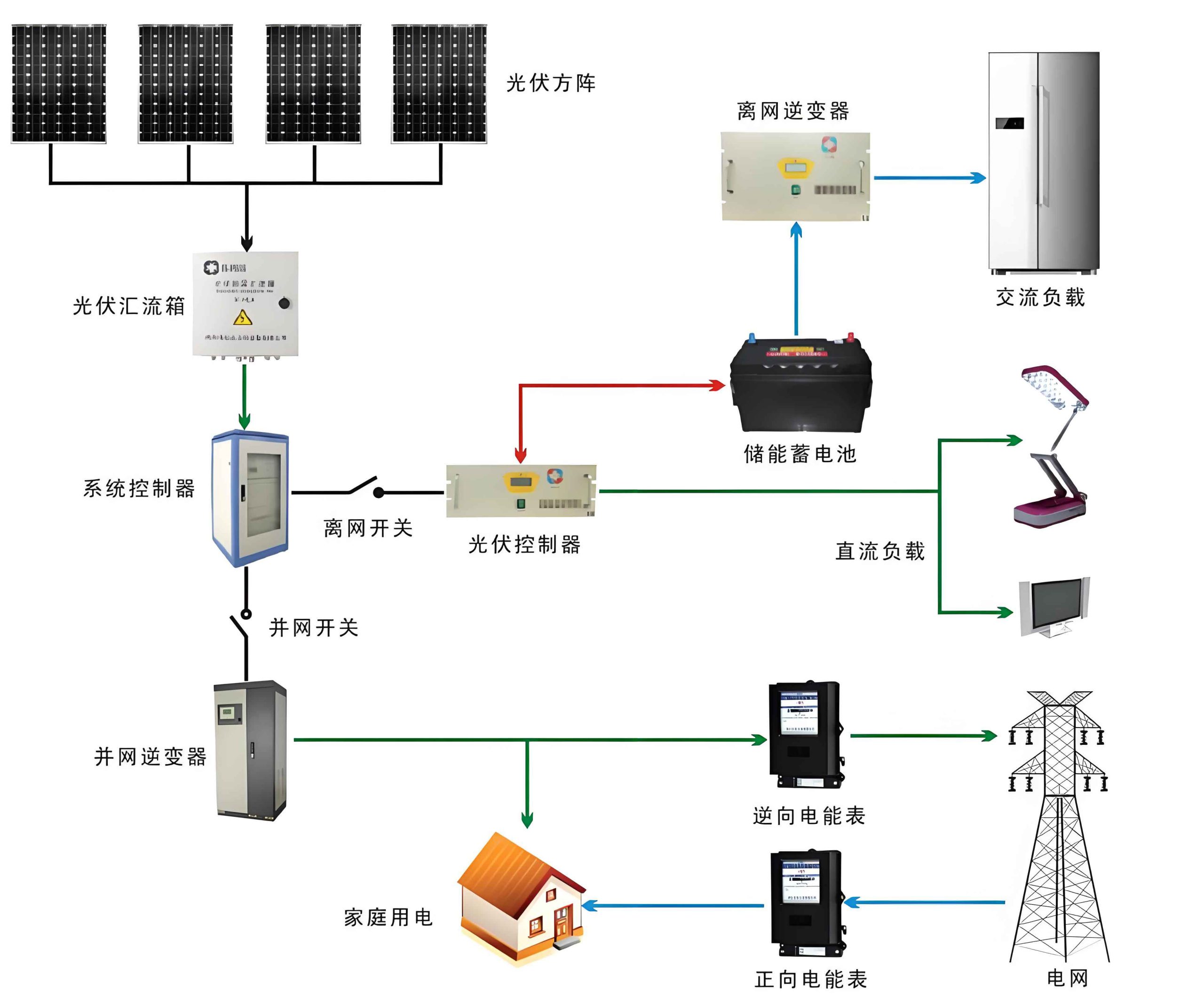
As shown in the image, a well-integrated solar system can blend into building exteriors, maximizing space utilization. This visual underscores the practicality of solar system deployments.
However, implementing solar systems requires meeting specific technical criteria. Based on my assessment, solar system components must fulfill both electrical and construction standards. For building-integrated photovoltaics (BIPV), key requirements include structural load-bearing, thermal insulation, and waterproofing. I have detailed these in the following table:
| Component | Requirements | Solar System Relevance |
|---|---|---|
| Batteries | Minimal for grid-tied systems; capacity scaling based on load | Solar system stability without storage focus |
| PV Modules | Durability, weather resistance, architectural compatibility | Core of solar system; must withstand environmental stress |
| Mounting Angles | Optimized for max output; flexibility for design constraints | Solar system efficiency depends on orientation |
| Inverters | Convert DC to AC; ensure grid compatibility and safety | Critical for solar system integration with power networks |
Furthermore, the economic evaluation of solar system projects involves cost-benefit analysis. A simple formula for return on investment (ROI) is: $$ ROI = \frac{\text{Net Benefits}}{\text{Cost}} \times 100\% $$ where net benefits include energy savings and incentives. This emphasizes the financial viability of solar systems.
Despite advantages, solar system integration faces challenges. From my experience, high initial costs, weather-dependent variability, and maintenance difficulties hinder widespread adoption in residences. For example, solar system output fluctuates with cloud cover, necessitating grid backup. I propose solutions such as advanced forecasting models and decentralized maintenance networks. To quantify variability, the standard deviation of solar system output can be expressed as: $$ \sigma = \sqrt{\frac{1}{N} \sum_{i=1}^{N} (P_i – \bar{P})^2} $$ where \( P_i \) is hourly power and \( \bar{P} \) is the mean. This helps in grid planning for solar system intermittency.
Turning to grid planning and design, I identify load forecasting as a critical issue. Accurate predictions are essential for integrating solar systems effectively. Uncertainty arises from economic trends, weather, and seasonal changes. In my approach, I employ statistical methods like regression analysis: $$ L = \alpha + \beta_1 X_1 + \beta_2 X_2 + \epsilon $$ where \( L \) is load, \( X_i \) are factors like GDP or temperature, and \( \epsilon \) is error. This model aids in anticipating demand surges that solar systems can mitigate.
Grid planning also involves scheme analysis and economic assessment. For rural networks, limited investment demands optimized structures. I evaluate plans using reliability indices and cost-benefit ratios. A solar system can enhance grid resilience by providing distributed generation. The economic impact is gauged through net present value (NPV): $$ NPV = \sum_{t=0}^{T} \frac{C_t}{(1 + r)^t} $$ where \( C_t \) are cash flows and \( r \) is the discount rate. Positive NPV indicates a beneficial solar system project.
In conclusion, the integration of solar systems into power infrastructure is transformative. From fault prevention in equipment to building applications and grid planning, solar systems offer sustainable solutions. I advocate for rigorous standards, innovative technologies, and holistic planning to overcome barriers. The future of energy lies in harnessing solar systems for a stable, green supply.
To further elaborate, I delve into technical details. The efficiency of a solar system is influenced by factors like temperature and shading. The temperature coefficient can be modeled as: $$ \eta(T) = \eta_0 \cdot [1 – \gamma (T – T_0)] $$ where \( \eta_0 \) is efficiency at reference temperature \( T_0 \), and \( \gamma \) is the coefficient. This underscores the need for thermal management in solar system designs.
Additionally, the lifecycle assessment of solar systems involves environmental metrics. The energy payback time (EPBT) calculates how long a solar system takes to generate the energy used in its production: $$ EPBT = \frac{E_{\text{manufacturing}}}{E_{\text{annual}}} $$ where \( E_{\text{manufacturing}} \) is embodied energy and \( E_{\text{annual}} \) is yearly output. Modern solar systems have EPBTs of 1-3 years, highlighting their sustainability.
In grid contexts, solar system penetration affects stability. The inertia constant \( H \) for a grid with solar inputs can be approximated as: $$ H_{\text{total}} = \frac{\sum H_i S_i}{\sum S_i} $$ where \( H_i \) and \( S_i \) are inertia and rating of conventional generators, adjusted for solar system contributions. This formula aids in dynamic simulations.
For residential solar systems, sizing is crucial. The required capacity \( C \) can be estimated based on household consumption \( D \) and solar fraction \( f \): $$ C = \frac{D \cdot f}{\text{CF} \cdot 8760} $$ where CF is capacity factor and 8760 is hours per year. This ensures the solar system meets energy needs.
Moreover, policy incentives accelerate solar system adoption. Feed-in tariffs and tax credits improve economics. I summarize global policies in a table:
| Country | Policy | Impact on Solar System Growth |
|---|---|---|
| Germany | Feed-in Tariffs | High residential uptake |
| USA | Investment Tax Credit | Reduced installation costs |
| China | Subsidies and mandates | Rapid market expansion |
Looking ahead, advancements like perovskite solar cells promise higher efficiencies for solar systems. Research into building-integrated photovoltaics (BIPV) will further blur lines between architecture and energy generation. I envision a future where every home features a solar system, contributing to a decentralized, resilient grid.
In summary, my analysis underscores the multifaceted role of solar systems in modern power networks. By addressing technical, economic, and planning challenges, we can unlock their full potential. The integration of solar systems is not just an option but a necessity for sustainable development.