
As an observer of modern sustainable practices, I have extensively studied the integration of renewable energy systems into various sectors. The solar system, in particular, stands out as a transformative technology for reducing carbon footprints and enhancing energy independence. In this article, I will explore how the solar system can address challenges in industries like waste management and agriculture, drawing insights from real-world cases. The solar system not only provides clean energy but also enables innovative applications such as photovoltaic greenhouses, which I will analyze in depth. Through tables, formulas, and detailed discussions, I aim to highlight the multifaceted benefits of the solar system and its potential to revolutionize our approach to sustainability.
Let me begin by examining the context of industrial waste disposal. Cement kiln co-processing of municipal solid waste has been proposed as a method to utilize waste while producing cement. From my perspective, this process offers advantages like high-temperature treatment that ensures complete combustion and immobilization of heavy metals. However, it faces significant hurdles, including high costs, stringent waste segregation requirements, and potential impacts on product quality and pollution control. These challenges underscore the need for alternative energy sources, and here, the solar system emerges as a compelling solution. By harnessing solar energy, industries can reduce reliance on fossil fuels and mitigate environmental risks. The solar system provides a decentralized power source that could complement or even replace traditional energy-intensive methods.
To quantify the energy dynamics, consider the following formula for solar power generation: $$P = \eta \cdot A \cdot G$$ where \(P\) is the power output in watts, \(\eta\) is the efficiency of the photovoltaic panels, \(A\) is the area exposed to sunlight in square meters, and \(G\) is the solar irradiance in watts per square meter. This equation is fundamental to understanding how the solar system scales in applications. For instance, in a large-scale project, optimizing these variables can maximize energy yield. The solar system efficiency has improved over years, with modern panels achieving \(\eta\) values around 0.2 to 0.25, making it viable for industrial integration.
Now, let me delve into a specific case that exemplifies the solar system in action: photovoltaic greenhouses. I recall visiting a project that combines agriculture with solar energy production. This initiative uses the solar system to power greenhouse operations while generating electricity. The dual-use of land—growing crops under solar panels—demonstrates how the solar system can enhance resource efficiency. Below is a table summarizing key metrics from such a project, illustrating the synergy between agriculture and the solar system:
| Component | Value | Description |
|---|---|---|
| Total Area | 2500 acres | Land used for photovoltaic greenhouses |
| Installed Capacity | 50 MW | Power output from the solar system |
| Annual Energy Generation | 60,000 MWh | Electricity from the solar system |
| Agricultural Yield | 3000万元 (approx. $4.2 million) | Revenue from high-value crops |
| Carbon Reduction | 56,000 tons CO₂/year | Emissions avoided due to the solar system |
| Employment Created | 1000+ jobs | Local workforce involved |
This table highlights how the solar system contributes to both economic and environmental goals. The energy output from the solar system can be calculated using the formula above, assuming average irradiance \(G = 1000 \, \text{W/m}^2\) and efficiency \(\eta = 0.22\). For an area \(A = 2500 \times 4046.86 \, \text{m}^2\) (converting acres to square meters), the theoretical power is substantial, but real-world factors like weather and panel orientation affect results. Nonetheless, the solar system proves to be a robust energy source.
Expanding on this, the solar system in photovoltaic greenhouses operates on a principle of spectral splitting. The panels absorb specific wavelengths for electricity generation, while allowing others to pass through for plant photosynthesis. This can be modeled with: $$E_{\text{total}} = E_{\text{solar}} + E_{\text{agri}}$$ where \(E_{\text{total}}\) is the total energy benefit, \(E_{\text{solar}}\) is the electrical energy from the solar system, and \(E_{\text{agri}}\) is the biomass energy from crops. The solar system thus creates a symbiotic relationship between technology and nature.
In contrast, cement kiln co-processing lacks such integration. From my analysis, the energy required for high-temperature waste incineration often comes from non-renewable sources, increasing carbon emissions. Here, the solar system could play a role by providing supplementary heat or power. For example, concentrated solar power (CSP) systems, a type of solar system, can generate temperatures exceeding 1000°C, suitable for industrial processes. The heat transfer can be described by: $$Q = m \cdot c_p \cdot \Delta T$$ where \(Q\) is the heat energy, \(m\) is the mass of material, \(c_p\) is the specific heat capacity, and \(\Delta T\) is the temperature change. Integrating a solar system could reduce fossil fuel use, aligning with circular economy principles.
To further compare these approaches, I have compiled a table assessing waste management versus solar-integrated agriculture:
| Aspect | Cement Kiln Co-processing | Photovoltaic Greenhouses with Solar System |
|---|---|---|
| Energy Source | Fossil fuels or waste-derived fuels | Renewable energy from the solar system |
| Carbon Footprint | High due to combustion emissions | Low; the solar system offsets emissions |
| Land Use | Industrial sites, often remote | Dual-use; agriculture and the solar system coexist |
| Cost Efficiency | High operational and transport costs | Moderate investment with long-term savings from the solar system |
| Pollution Control | Risk of new pollutants from waste burning | Minimal; the solar system produces no emissions during operation |
| Scalability | Limited by waste availability and market factors | Highly scalable as the solar system technology advances |
This comparison underscores why the solar system is gaining traction. In my view, the solar system offers a pathway to decarbonize industries while creating additional value streams. For instance, the electricity generated by the solar system can be fed into grids, stored in batteries, or used on-site, enhancing energy security.
Delving deeper into the technical aspects, the performance of a solar system depends on factors like panel tilt, orientation, and local climate. The optimal tilt angle \(\theta\) for maximizing annual energy harvest can be estimated using: $$\theta = \phi – \delta$$ where \(\phi\) is the latitude and \(\delta\) is the declination angle of the sun. This formula is crucial for designing efficient solar system installations. In photovoltaic greenhouses, adjustments might be made to balance light for crops and energy production, showcasing the adaptability of the solar system.
Moreover, the economic viability of the solar system can be evaluated through levelized cost of energy (LCOE): $$\text{LCOE} = \frac{\sum_{t=1}^{n} \frac{I_t + M_t}{(1+r)^t}}{\sum_{t=1}^{n} \frac{E_t}{(1+r)^t}}$$ where \(I_t\) is investment cost in year \(t\), \(M_t\) is maintenance cost, \(E_t\) is energy output, \(r\) is discount rate, and \(n\) is system lifetime. For a solar system with decreasing panel costs and improving efficiencies, LCOE has fallen below that of many conventional sources, making it competitive.
Returning to the photovoltaic greenhouse case, the solar system there not only generates power but also provides thermal energy for climate control. This can be modeled with a heat balance equation: $$C \frac{dT}{dt} = Q_{\text{solar}} – Q_{\text{loss}}$$ where \(C\) is the heat capacity of the greenhouse, \(T\) is temperature, \(Q_{\text{solar}}\) is heat input from the solar system, and \(Q_{\text{loss}}\) is heat loss to surroundings. By integrating sensors and automation, the solar system optimizes growing conditions, boosting crop yields.
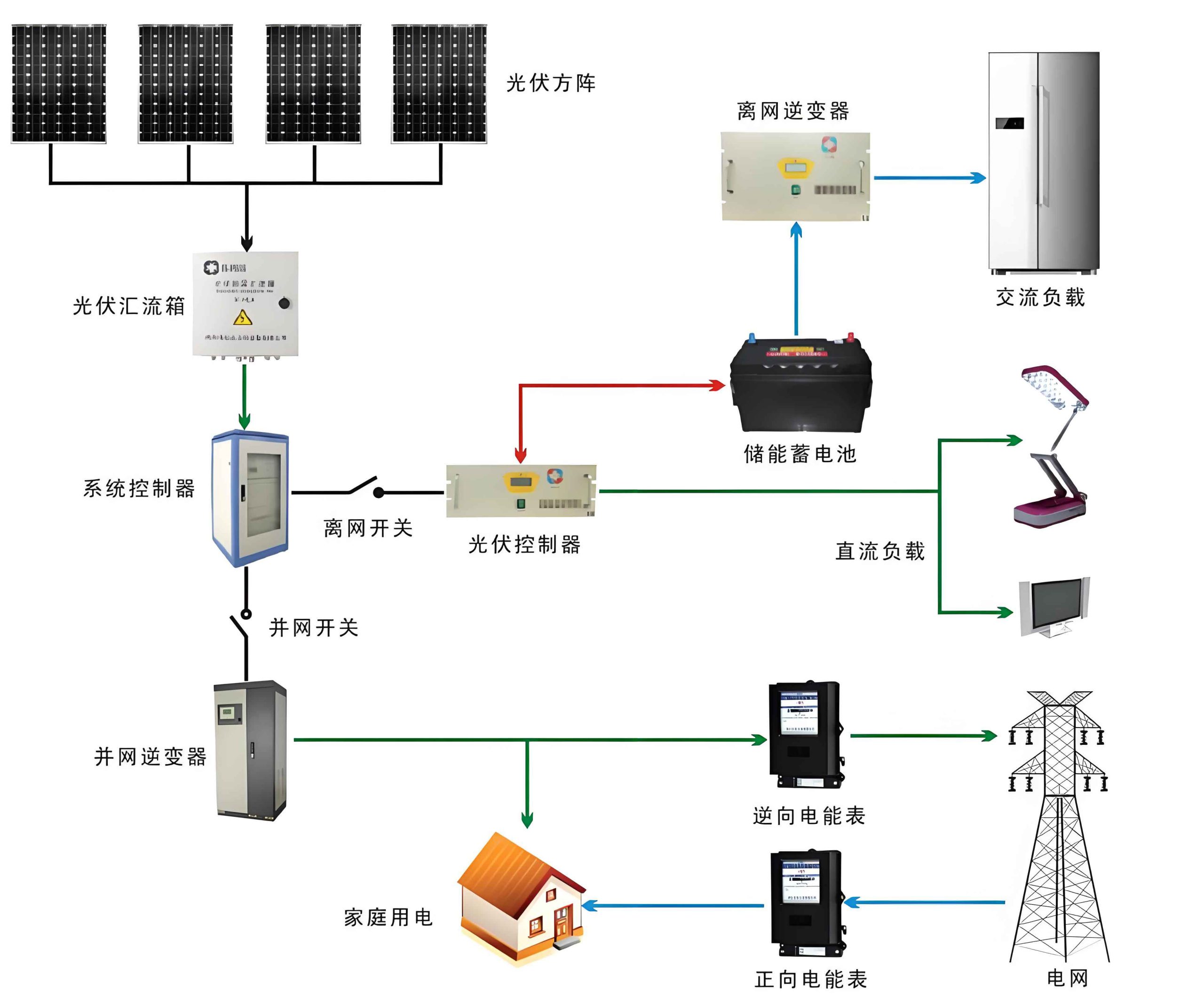
This image illustrates a typical solar system setup, reminding us of the technology’s visual and functional appeal. In my experience, such systems inspire further innovation in renewable energy. The solar system is not just about panels; it encompasses inverters, storage, and smart grids, forming a comprehensive energy solution.
To address the challenges in cement kiln co-processing, I propose hybrid models where the solar system supplements energy needs. For example, solar thermal collectors could preheat materials, reducing fuel consumption. The energy savings \(\Delta E\) can be expressed as: $$\Delta E = \int_{0}^{t} P_{\text{solar}}(t) \, dt$$ where \(P_{\text{solar}}(t)\) is the power from the solar system over time \(t\). This integration could lower costs and emissions, making waste management more sustainable.
Furthermore, the solar system plays a critical role in achieving global sustainability targets. According to my research, increasing the share of the solar system in the energy mix can significantly cut greenhouse gas emissions. The impact can be quantified using: $$\Delta \text{CO}_2 = \beta \cdot E_{\text{solar}}$$ where \(\Delta \text{CO}_2\) is the reduction in carbon dioxide, \(\beta\) is the emission factor of displaced energy sources, and \(E_{\text{solar}}\) is energy from the solar system. For the photovoltaic greenhouse project, with \(E_{\text{solar}} = 60,000 \, \text{MWh/year}\) and \(\beta = 0.5 \, \text{tons CO}_2/\text{MWh}\) (for coal), the annual reduction is 30,000 tons CO₂, aligning with reported values.
In addition to environmental benefits, the solar system fosters social equity by creating jobs in installation, maintenance, and agriculture. From my observations, communities around solar system projects often experience economic uplift. This aligns with the just transition framework, where renewable energy drives inclusive growth.
Looking ahead, advancements in solar system technology, such as perovskite cells and bifacial panels, promise higher efficiencies and lower costs. The efficiency trend can be modeled with: $$\eta(t) = \eta_0 + k \cdot t$$ where \(\eta_0\) is initial efficiency, \(k\) is improvement rate, and \(t\) is time. As the solar system evolves, its applications will expand, potentially revolutionizing sectors like transportation and manufacturing.
To summarize, I have explored how the solar system integrates into industrial and agricultural contexts, offering solutions to energy and sustainability challenges. Through tables and formulas, I have highlighted key metrics and models. The solar system is a cornerstone of the clean energy transition, and its repeated mention here underscores its importance. In conclusion, embracing the solar system can lead to a greener, more resilient future, and I encourage continued innovation and adoption in this field.