
As I reflect on the global energy landscape, it becomes increasingly clear that our reliance on traditional, non-renewable resources is unsustainable. The environmental degradation and supply constraints associated with fossil fuels necessitate a urgent transition to cleaner alternatives. In this context, solar photovoltaic (PV) technology emerges as a cornerstone of the renewable energy revolution. From my perspective, the advancement of solar silicon casting and module manufacturing processes is pivotal to harnessing the sun’s power efficiently and economically. This article aims to provide a comprehensive, first-person examination of these processes, integrating theoretical foundations, practical applications, and future innovations. Throughout this discussion, I will emphasize the importance of a well-designed solar system, as the overall performance of any PV installation hinges on the synergy between high-quality components and optimal system design. A robust solar system begins with the mastery of material science and manufacturing techniques detailed here.
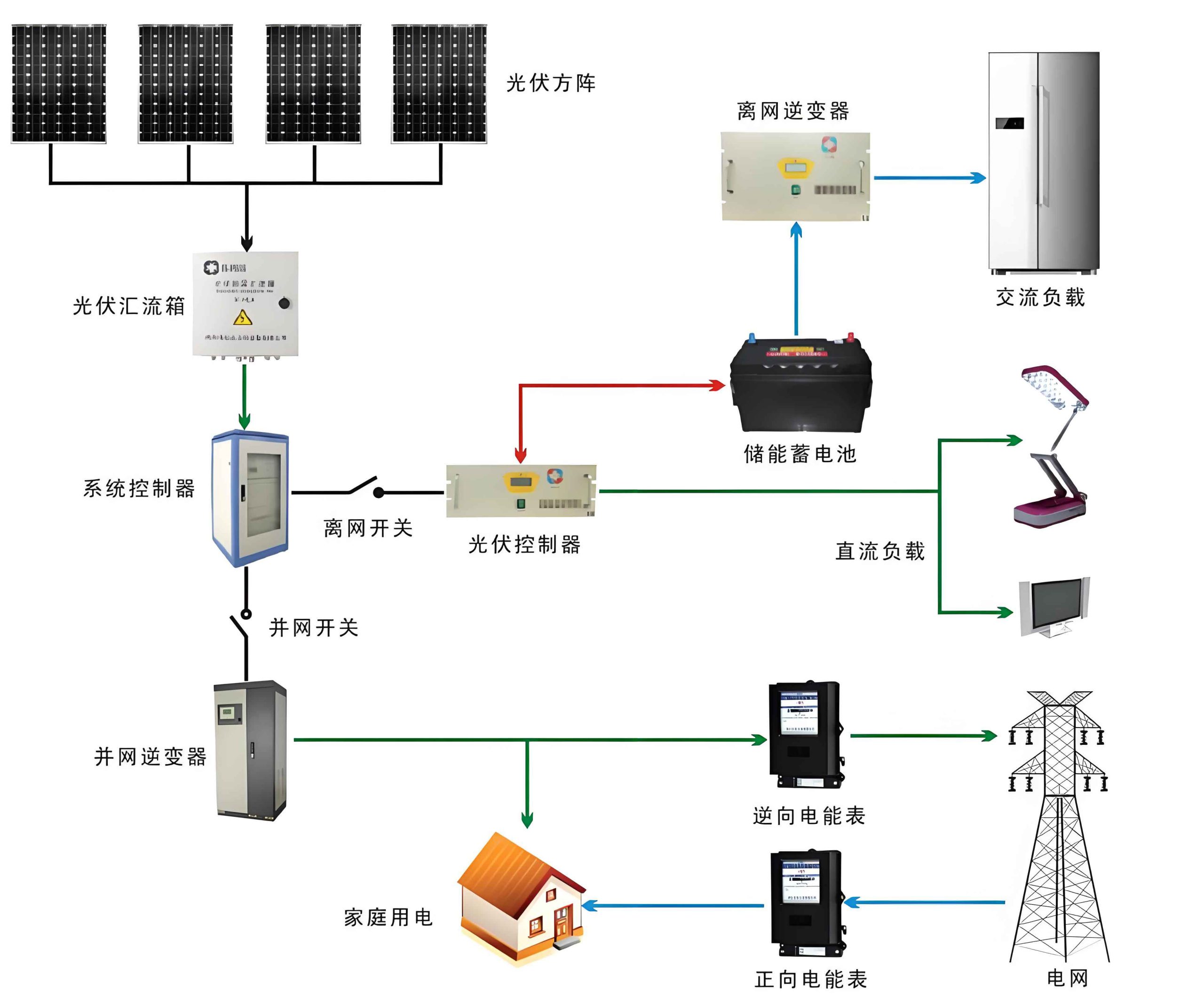
The theoretical underpinnings of solar photovoltaics are vast and multifaceted. I find that a solid grasp of semiconductor physics and solar cell principles is indispensable for anyone involved in this field. The core of a silicon-based solar system is the photovoltaic cell, which operates on the principle of the photovoltaic effect. The fundamental equation governing the current-voltage (I-V) characteristic of an ideal solar cell is given by the diode equation:
$$ I = I_{ph} – I_0 \left[ \exp\left(\frac{qV}{nkT}\right) – 1 \right] $$
Here, \(I_{ph}\) is the photogenerated current, \(I_0\) is the reverse saturation current, \(q\) is the electron charge, \(V\) is the voltage, \(n\) is the ideality factor, \(k\) is Boltzmann’s constant, and \(T\) is the temperature. The efficiency \(\eta\) of a solar cell, a critical parameter for any solar system, is calculated as:
$$ \eta = \frac{P_{max}}{P_{in}} = \frac{J_{sc} \times V_{oc} \times FF}{P_{in}} $$
where \(P_{max}\) is the maximum power point, \(P_{in}\) is the incident solar power density (often taken as 1000 W/m² under standard test conditions), \(J_{sc}\) is the short-circuit current density, \(V_{oc}\) is the open-circuit voltage, and \(FF\) is the fill factor. To systematically understand the journey from raw material to a functional module in a solar system, I have organized the key manufacturing stages and their theoretical aspects into the following table.
| Manufacturing Stage | Key Theoretical Concepts | Primary Objectives | Impact on Final Solar System |
|---|---|---|---|
| Polysilicon Production (Siemens or Fluidized Bed Reactor Process) | Chemical Vapor Deposition (CVD), Thermodynamics of Silane or Trichlorosilane reduction. | Produce high-purity (99.9999%+) polycrystalline silicon. | Determines the base material quality; impurities directly affect cell efficiency and solar system longevity. |
| Crystal Growth (Czochralski for Mono-Si, Directional Solidification for Multi-Si) | Phase diagrams, Solid-liquid interface kinetics, Heat and mass transfer. | Grow large, defect-free single-crystal or multi-crystal silicon ingots. | Crystal quality defines the electronic properties; mono-Si typically yields higher-efficiency cells for the solar system. |
| Wafering (Wire Sawing) | Fracture mechanics, Abrasive machining, Slurry dynamics. | Slice ingots into thin wafers (∼180µm) with minimal kerf loss and surface damage. | Wafer thickness and quality impact mechanical strength and optical absorption in the solar system modules. |
| Surface Texturing (Wet Chemical Etching) | Optics of light trapping, Ray tracing, Reduction of surface reflectance. | Create pyramidal or crater-like structures to minimize light reflection. | Enhances light absorption, directly boosting the current output of the solar system. |
| Diffusion (Phosphorus or Boron Doping) | Fick’s laws of diffusion, Formation of p-n junction, Semiconductor doping statistics. | Create the p-n junction essential for charge separation. | Junction depth and profile critically determine \(V_{oc}\) and \(J_{sc}\) of the cell in the solar system. |
| Anti-Reflection Coating (ARC) & Passivation (PECVD SiNx) | Thin-film optics, Interference, Surface recombination velocity. | Further reduce reflection and passivate surface defects. | ARC increases photon capture; passivation improves voltage, enhancing overall solar system yield. |
| Metallization (Screen Printing, Plating) | Ohmic contact formation, Series resistance, Grid design optimization. | Apply front and rear contacts to collect current. | Minimizes power loss due to series resistance, a key factor in solar system performance under real operating conditions. |
| Module Assembly (Lamination, Framing) | Thermal expansion, Mechanical stress, Optical encapsulation. | Protect cells, provide electrical insulation, and ensure mechanical durability. | Determines the reliability and lifetime of the entire solar system in harsh environmental conditions. |
Moving from theory to practice, I cannot overstate the importance of operational know-how in manufacturing. A theoretical understanding of surface texturing, for instance, must be translated into a reproducible, high-yield process. The goal is to minimize reflectance \(R\). For a planar silicon surface, the reflectance at normal incidence is given by:
$$ R = \left( \frac{n_{Si} – n_{air}}{n_{Si} + n_{air}} \right)^2 $$
With \(n_{Si} \approx 3.5\) and \(n_{air}=1\), \(R\) exceeds 30%. Texturing creates a graded index layer, effectively lowering the reflectance. The process often uses an alkaline solution (e.g., KOH or NaOH) for monocrystalline silicon, which anisotropically etches the (100) crystal plane to form random pyramids. The reaction can be summarized as:
$$ Si + 2OH^- + 2H_2O \rightarrow SiO_2(OH)_2^{2-} + 2H_2 \uparrow $$
For a multi-crystalline silicon wafer, which lacks a uniform crystal orientation, an isotropic acid mixture (e.g., HF/HNO3) is used to create a porous, crater-textured surface. The key process parameters I must control include solution concentration, temperature, etching time, and wafer agitation. To illustrate the practical steps and critical control points (CCPs) in the cell fabrication line, I present the following detailed table. This hands-on framework is essential for building a cost-effective and reliable solar system.
| Process Step | Equipment Used | Key Parameters (CCPs) | Target Value / Range | Monitoring Method |
|---|---|---|---|---|
| Wafer Cleaning (RCA Clean) | Wet bench, Ultrasonic bath | SC1 (NH4OH:H2O2:H2O) ratio, temperature, time; SC2 (HCl:H2O2:H2O) ratio. | SC1: 1:1:5 @ 75°C, 10 min; SC2: 1:1:6 @ 75°C, 10 min. | Particle count, Contact angle measurement. |
| Texturing (Alkaline for Mono-Si) | Temperature-controlled etch bath, Circulation system | KOH concentration (wt%), IPA concentration, Temperature, Etch time. | 2% KOH, 5% IPA, 80°C, 30 min. | Pyramid size inspection via SEM, Reflectance measurement (≤12%). |
| Phosphorus Diffusion (Tube Furnace) | Horizontal diffusion furnace, POCl3 source | Temperature profile, Gas flow rates (N2, O2, POCl3), Time. | 820-860°C, 20-40 min, Sheet resistance target: 50-70 Ω/□. | Four-point probe sheet resistance mapping. |
| PSG Removal & Edge Isolation | HF dip bath, Plasma etcher | HF concentration, Etch time; Plasma power, CF4/O2 flow ratio. | 10% HF, 5 min; or Plasma etch for 2 min. | Visual inspection for water break test, I-V test for shunt resistance. |
| PECVD SiNx ARC | Plasma-Enhanced Chemical Vapor Deposition system | SiH4/NH3 flow ratio, Pressure, RF power, Temperature, Deposition time. | Refractive index n ~ 2.0-2.1, Thickness ~ 75-80 nm. | Ellipsometry for n & thickness, Reflectance spectrum. |
| Front & Rear Contact Printing | Automatic screen printer, Drying oven | Screen mesh, Paste viscosity, Squeegee pressure/speed, Print alignment, Drying temperature. | Align within ±30 µm, Ag paste for front, Al paste for rear. | 2D vision system for alignment, Resistance measurement after firing. |
| Co-firing (Fast Firing Furnace) | Infrared belt furnace | Peak temperature, Belt speed, Temperature profile zones. | Peak: 700-800°C for Ag, >800°C for Al; Time above peak: 1-3 sec. | Thermocouple profiling, I-V testing for series resistance and \(FF\). |
| Cell Testing & Sorting | Solar simulator, I-V tracer | Light intensity (1000 W/m²), Spectrum (AM1.5G), Temperature (25°C). | Measure \(J_{sc}\), \(V_{oc}\), \(FF\), \(\eta\); Bin cells by efficiency. | Calibrated reference cell, Temperature-controlled stage. |
The ultimate measure of these manufacturing efforts is their integration into a functional solar system. The performance of a grid-connected solar system depends not only on module efficiency but also on system-level parameters. The annual energy yield \(E_{annual}\) of a solar system can be estimated using:
$$ E_{annual} = P_{STC} \times \frac{H_{inc}}{G_{STC}} \times PR \times (1 – \gamma)^{t} $$
where \(P_{STC}\) is the total module power at Standard Test Conditions, \(H_{inc}\) is the annual in-plane irradiation (kWh/m²), \(G_{STC}\) is the reference irradiance (1 kW/m²), \(PR\) is the performance ratio (accounting for losses), \(\gamma\) is the annual degradation rate, and \(t\) is the number of years. Optimizing a solar system requires careful balance between component cost and performance. To this end, I have analyzed the cost breakdown and technological trade-offs in the following table, which is crucial for planning a large-scale solar system deployment.
| Component / Process | Current Dominant Technology | Efficiency Contribution to Solar System | Approximate Cost Share (of module) | Emerging Alternatives / Innovations |
|---|---|---|---|---|
| Polysilicon | Siemens Process | Base material purity limits cell voltage & current. | 15-20% | Fluidized Bed Reactor (FBR) for lower energy cost. |
| Ingot/Wafer | Cz Mono-Si & Grown-cast Multi-Si | Mono-Si: ~22% cell efficiency; Multi-Si: ~19.5%. | 25-30% | Continuous Czochralski (CCz), Diamond wire sawing for thinner wafers. |
| Cell Structure | Al-BSF (Back Surface Field), moving to PERC (Passivated Emitter Rear Cell) | PERC adds 1-1.5% absolute efficiency gain over Al-BSF. | Processing cost increase for PERC ~5%. | TOPCon (Tunnel Oxide Passivated Contact), HJT (Heterojunction), IBC (Interdigitated Back Contact). |
| Metallization | Screen-printed Ag contacts | High series resistance losses; limits \(FF\). | Ag paste constitutes ~10% of module cost. | Plated contacts (Cu electroplating), Multi-wire soldering, Smart wire connection. |
| Module Encapsulation | EVA encapsulant, Tempered glass, Al frame | Protects cells; optical coupling losses ~3%. | 30-35% (glass, frame, EVA, backsheet). | Double-glass modules, POE encapsulant for better durability, Frameless designs. |
| Balance of Solar System (BOS) | String inverters, Mounting structures, Cabling | Inverter efficiency ~98%, wiring losses ~1-2%. | 40-50% of total solar system cost (excluding modules). | Micro-inverters, DC optimizers, Bifacial modules with tracking. |
Looking ahead, innovation is the lifeblood of progress in photovoltaics. While silicon dominates the market, maintaining its competitiveness requires relentless pursuit of higher efficiency and lower cost. The roadmap for silicon PV involves pushing the practical efficiency closer to the theoretical Shockley-Queisser limit, which for a single junction under AM1.5 spectrum is approximately 33%. Advanced cell architectures like TOPCon and HJT are promising paths. Their advantage can be seen in improved passivation, reducing saturation current \(J_0\). The open-circuit voltage is related to \(J_0\) and \(J_{sc}\):
$$ V_{oc} = \frac{nkT}{q} \ln\left(\frac{J_{sc}}{J_0} + 1\right) $$
Thus, lowering \(J_0\) through superior surface passivation directly boosts \(V_{oc}\) and efficiency. Furthermore, the integration of perovskite-silicon tandem cells represents a frontier. In a tandem configuration, the top perovskite cell absorbs high-energy photons, while the bottom silicon cell absorbs lower-energy photons, potentially breaking the single-junction limit. The current matching condition for a two-terminal tandem is critical:
$$ J_{sc, top} = J_{sc, bottom} $$
This requires careful tuning of the bandgap and thickness of each sub-cell. However, the long-term stability of perovskite materials and the scalability of tandem manufacturing remain significant hurdles. Beyond the cell, the intelligence of the overall solar system is evolving. The future solar system will likely incorporate advanced power electronics, energy storage, and digital monitoring to maximize energy yield and grid services. The levelized cost of electricity (LCOE) for a solar system is the ultimate metric driving adoption:
$$ LCOE = \frac{\sum_{t=1}^{n} \frac{I_t + M_t}{(1+r)^t}}{\sum_{t=1}^{n} \frac{E_t}{(1+r)^t}} $$
where \(I_t\) is the investment cost in year \(t\), \(M_t\) is the operation and maintenance cost, \(E_t\) is the electricity generated, \(r\) is the discount rate, and \(n\) is the system lifetime. Every manufacturing improvement discussed here ultimately aims to reduce this LCOE.
In conclusion, the journey from sand to a functioning solar system encapsulates one of the most remarkable engineering endeavors of our time. I have explored the deep theoretical roots, the intricate practical steps, and the exciting innovative horizons of solar silicon manufacturing. Mastery of casting, wafering, cell processing, and module assembly is non-negotiable for producing high-performance, durable photovoltaic products. As we refine these processes and integrate them into smarter, more resilient energy systems, the role of solar photovoltaics in our global energy mix will only grow. The continuous improvement of each link in this chain ensures that the solar system of tomorrow will be more efficient, affordable, and ubiquitous, solidifying its position as a cornerstone of a sustainable energy future.