
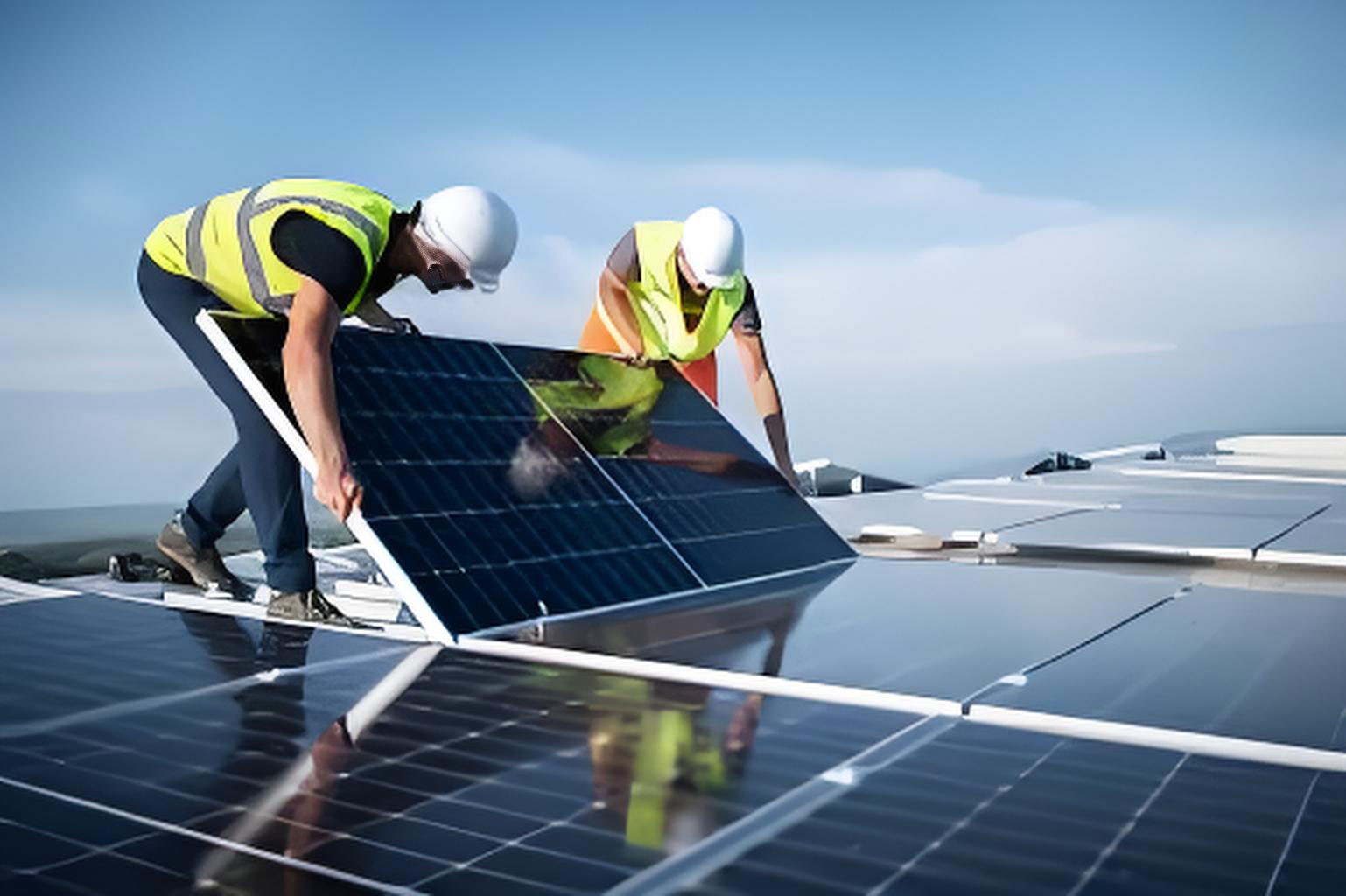
The exponential growth of solar energy adoption has positioned solar panels as a cornerstone of global renewable energy strategies. However, with an estimated 140 million metric tons of decommissioned solar panels projected by 2030 and 2,000 million metric tons by 2040, sustainable recycling solutions are critical. This article examines the technical, economic, and regulatory dimensions of solar panel recycling through quantitative models and comparative analyses.
1. Material Composition and Recycling Potential
A typical crystalline silicon solar panel comprises:
$$ \text{Solar Panel Mass Distribution} = \begin{cases}
\text{Glass} & 70-75\% \\
\text{Aluminum Frame} & 10-15\% \\
\text{Silicon Cells} & 4-5\% \\
\text{EVA Encapsulant} & 5-8\% \\
\text{Backsheet (PVDF/PET)} & 2-3\%
\end{cases} $$
| Component | Recyclability | Market Value (USD/kg) |
|---|---|---|
| High-Purity Silicon | 95% | 15-25 |
| Silver Paste | 85% | 600-800 |
| Tempered Glass | 100% | 0.3-0.5 |
| Copper Ribbons | 90% | 6-8 |
| Aluminum Frame | 100% | 1.8-2.2 |
2. Recycling Efficiency Models
The material recovery rate (MRR) for solar panels can be expressed as:
$$ MRR = \frac{\sum (m_i \cdot \eta_i)}{M_{total}} \times 100\% $$
Where \( m_i \) = mass of component i, \( \eta_i \) = separation efficiency of component i.
Current industrial processes achieve:
$$ MRR_{current} = 75-82\% $$
$$ \text{Energy Payback Time (EPBT)} = \frac{\text{Energy Input for Recycling}}{\text{Energy Content in Recovered Materials}} \approx 1.8-2.4 \text{ years} $$
3. Technological Comparison
| Method | Efficiency | Cost (USD/panel) | CO₂ Footprint (kg/panel) |
|---|---|---|---|
| Mechanical Separation | 74% | 8-12 | 4.2 |
| Thermal Delamination (500°C) | 88% | 15-18 | 6.8 |
| Chemical Etching (HF/HNO₃) | 93% | 22-28 | 3.1 |
| Hybrid Pyrolysis | 91% | 19-24 | 5.6 |
4. Economic Viability Analysis
The net present value (NPV) for solar panel recycling plants:
$$ NPV = -C_0 + \sum_{t=1}^{n} \frac{(R_t – O_t)}{(1 + r)^t} $$
Where:
\( C_0 \) = Initial capital ($20M-$50M)
\( R_t \) = Revenue from materials
\( O_t \) = Operational costs
\( r \) = Discount rate (8-12%)
Break-even analysis shows scalability requirements:
$$ \text{Minimum Throughput} = \frac{\text{Fixed Costs}}{\text{Revenue per Panel} – \text{Variable Costs}} > 50,000 \text{ panels/year} $$
5. Global Policy Framework
| Region | Recycling Target | EPR Scheme | Subsidies |
|---|---|---|---|
| EU | 85% by mass (WEEE Directive) | Mandatory | €0.12/W |
| China | 90% by 2030 | Pilot Programs | ¥0.08/W |
| USA | Voluntary 75% | State-level | Tax Credits |
6. Emerging Solutions
Advanced separation technologies are enhancing solar panel recycling efficiency:
$$ \text{Electrostatic Separation Efficiency} = 1 – e^{-k \cdot \frac{V}{d}} $$
Where V = voltage (20-50kV), d = particle size (50-200µm), k = material constant.
Robotic disassembly systems achieve:
$$ \text{Throughput} = 120-150 \text{ panels/hour} $$
$$ \text{Component Recognition Accuracy} = 99.2\% \text{ (CV-based)} $$
The solar panel recycling industry is projected to follow an S-curve adoption model:
$$ P(t) = \frac{K}{1 + e^{-r(t – t_0)}} $$
Where:
K = Market saturation ($120B by 2040)
r = Growth rate (18-22% CAGR)
\( t_0 \) = Inflection point (2028-2030)
7. Environmental Impact Mitigation
Lifecycle analysis demonstrates recycling benefits:
$$ \Delta \mathrm{CO}_2 = \text{Embodied Carbon} – \text{Recycling Emissions} = 480 – 210 = 270 \, \text{kg} \, \mathrm{CO}_2/\text{panel} $$
Toxic substance reduction through recycling:
$$ \text{Pb Leaching} = C_0 \cdot e^{-kt} $$
Where \( k = 0.42 \, \text{day}^{-1} \) for stabilized glass, t = time in landfill.
As solar panels reach end-of-life, the integration of artificial intelligence and advanced robotics promises to transform recycling economics. With optimized processes, the industry could recover 98% of panel materials by 2035, converting today’s environmental challenge into a circular economy opportunity.