
In the modern era of renewable energy integration, the role of grid tied inverters has become paramount, especially in photovoltaic (PV) systems. These inverters are crucial for converting direct current (PV-generated) into alternating current that can be fed into the low-voltage grid. However, a persistent issue plaguing these systems is current zero-crossing distortion, where the current waveform distorts near the zero-crossing points, leading to harmonics, reduced power quality, and potential grid instability. My research focuses on addressing this challenge through a simulation-based approach using a Second-Order Generalized Integrator (SOGI) for suppression. This article details my methodology, which involves analyzing distortion characteristics, setting harmonic conditions, broadening the full modulation index range, and compensating for steady-state errors via SOGI control. The goal is to enhance the performance of grid tied inverters by minimizing total harmonic distortion (THD) and improving grid-side quality factors, ultimately ensuring reliable and efficient energy conversion.
The importance of grid tied inverters in PV systems cannot be overstated. They serve as the interface between the PV array and the utility grid, facilitating the injection of clean energy. Yet, their operation is often marred by non-ideal behaviors, such as zero-crossing distortion. This distortion arises due to factors like switching delays, dead-time effects, and harmonic interactions, causing the current to deviate from a pure sinusoidal shape at the zero-crossing instants. Such deviations introduce unwanted harmonics, which can propagate through the grid, affecting other connected devices and compromising overall system efficiency. In my work, I aim to delve into the intricacies of this phenomenon and propose a robust suppression technique. By leveraging SOGI, which offers precise tracking of sinusoidal signals with zero steady-state error, I seek to mitigate these distortions effectively. The subsequent sections will explore the theoretical foundations, methodological steps, simulation setup, and results, all centered on optimizing grid tied inverter performance.
To understand zero-crossing distortion in grid tied inverters, it is essential to first examine the underlying electrical dynamics. In a three-phase inverter system, the output current and voltage vectors are represented in the α-β reference frame. The spatial phase angle of a vector X can be expressed as:
$$ \theta_X = \arccos\left(\frac{X_\beta}{\sqrt{X_\alpha^2 + X_\beta^2}}\right) $$
Here, \(\theta_X\) denotes the spatial phase angle, while \(X_\alpha\) and \(X_\beta\) are the components along the α and β axes, respectively. For a grid tied inverter, the angle between the standard voltage vector and the current vector, denoted as \(\theta_{iu}\), plays a critical role in distortion analysis. This angle is defined as:
$$ \theta_{iu} = \theta_i – \theta_u $$
where \(\theta_i\) is the angle of the current vector relative to a standard reference, and \(\theta_u\) is the angle of the voltage vector. When \(\theta_{iu}\) is large, it indicates a significant misalignment between the intended and actual output vectors, contributing to distortion. The magnitude of the error voltage, \(u_{err}\), which quantifies the distortion level, can be derived as:
$$ |u_{err}| = \frac{2 \theta_{iu} u_{dc} t_{[1,-1,-1]}}{T} $$
In this equation, \(u_{dc}\) represents the DC-side bus voltage of the grid tied inverter, \(t_{[1,-1,-1]}\) is the activation time for the vector [1, -1, -1], and \(T\) is the switching period. This relationship highlights that longer synthesis times for error vectors exacerbate output voltage distortion, directly impacting current waveform integrity at zero-crossings.
The modulation index \(m\) and the angle \(\theta_{iu}\) are key factors influencing zero-crossing distortion. Under ideal conditions without distortion, the relationship between \(m\) and \(\theta_{iu}\) is given by:
$$ m < \frac{1}{2 \sin\left(\theta_{iu} + \frac{\pi}{6}\right)} $$
This inequality shows that the modulation index is inversely proportional to \(\theta_{iu}\). Therefore, reducing \(\theta_{iu}\) can broaden the full modulation index range, allowing the grid tied inverter to operate more efficiently across varying conditions. A narrower full modulation index range often restricts the inverter’s ability to maintain optimal voltage output, leading to increased harmonic content and higher THD. By minimizing \(\theta_{iu}\), we can expand this range, thereby reducing the likelihood of distortion and improving overall performance. This insight forms the basis of my approach to addressing zero-crossing distortion in grid tied inverters.
However, merely adjusting the modulation index is insufficient due to the presence of steady-state errors in the current vectors. These errors arise from dynamic grid frequency variations and non-ideal inverter behaviors. To compensate, I incorporate a Second-Order Generalized Integrator (SOGI) into the control loop of the grid tied inverter. SOGI is renowned for its ability to track sinusoidal signals without static error, making it ideal for harmonic suppression. The transfer function of a standard SOGI controller is:
$$ H(s) = \frac{k_p \omega_0 s}{s^2 + k_p \omega_0 s + \theta_{iu} \omega_0^2} $$
where \(k_p\) is the gain of the SOGI controller, \(\omega_0\) is the input frequency, and \(s\) is the complex frequency variable. This controller helps align the phase and amplitude of the output current with the reference signal, effectively reducing \(\theta_{iu}\) and mitigating distortion. For a grid tied inverter, the average error voltage due to switching, based on the principle of impulse conservation, can be expressed as:
$$ \Delta U = -\frac{u_{dc}(T_d + T_{on} + T_{off})}{T_s} + H(s) U_{on} \text{sgn}(i_{abc}) $$
Here, \(T_d\) is the dead time, \(T_{on}\) and \(T_{off}\) are the switch on and off times, \(T_s\) is the pulse-width modulation period, \(U_{on}\) is the switch conduction voltage drop, and \(i_{abc}\) represents the phase currents. The error between the reference and actual voltage vectors, \(u_{err}\), is then:
$$ u_{err} = u_{ref} – u’_{ref} $$
To enhance distortion suppression, I integrate SOGI with a Proportional-Integral (PI) controller. This combination allows for the extraction of harmonic current components by SOGI, which are then fed into the PI controller to generate compensation values. The updated SOGI transfer function becomes:
$$ H(s)’ = \frac{\frac{\omega_0 s}{Q} \Delta U \theta_{iu}}{s^2 \frac{\omega_0 s}{Q} + \omega_0^2} $$
where \(Q\) is the quality factor gain of the SOGI controller. The quality factor is crucial as it determines the narrowband filtering effectiveness; a higher \(Q\) improves harmonic rejection but must be tuned according to grid frequency fluctuations and filtering requirements. For the grid tied inverter, the harmonic component \(z(\theta)\) due to zero-crossing distortion can be modeled as:
$$ z(\theta) = H(s)’ \sin(\omega_0 t) $$
The open-loop transfer function of the inverter system is then:
$$ G_k(s) = (G_1 + G_2 G_3) \cdot \frac{1}{L s + R} $$
$$ G_1 = k z(\theta) + \frac{k}{s} $$
$$ G_2 = \frac{k \omega_0 s}{s^2 + k \omega_0 s + \omega_0^2} $$
$$ G_3 = k + \frac{k}{s} $$
In these equations, \(L\) represents the equivalent inductance, and \(R\) is the resistance of the grid tied inverter. The steady-state error transfer function for multiple reference vectors is:
$$ G_z(s) = -\frac{1}{1 + G_k(s)} \cdot \frac{1}{L s + R} = \frac{1}{L s + R + G_1 + G_2 G_3} $$
Finally, the steady-state error compensation for the distortion signal \(z(\theta)\) is given by:
$$ e_{ssl} = \lim_{s \to 0} s \cdot z(\theta) G_z(s) E_z(s) = 0 $$
When \(e_{ssl}\) is minimized, the steady-state error under sinusoidal disturbance approaches zero, effectively suppressing zero-crossing distortion. This framework ensures that the grid tied inverter maintains high-quality current output, even under challenging grid conditions.
To validate my SOGI-based suppression method, I developed a comprehensive simulation model. The setup mimics a real-world grid tied inverter scenario, focusing on a three-phase system with typical parameters. The simulation environment was designed to replicate the dynamics of a PV low-voltage grid connection, allowing for rigorous testing of distortion suppression. Key parameters include an inverter rated at 3 kVA, with bridge inductance of 1.9 mH, grid-side inductance of 0.7 mH, filter capacitance of 10 μF, DC-side capacitors of 3950 μF each, a switching frequency of 27 kHz, and a grid frequency of 50 Hz. These values were chosen to reflect common industrial standards for grid tied inverters, ensuring the relevance of my findings. Below is a table summarizing the simulation parameters:
| Parameter | Value | Unit |
|---|---|---|
| Rated Power | 3 | kVA |
| Bridge Inductance | 1.9 | mH |
| Grid-Side Inductance | 0.7 | mH |
| Filter Capacitance | 10 | μF |
| DC-Side Capacitance | 3950 | μF |
| Switching Frequency | 27 | kHz |
| Grid Frequency | 50 | Hz |
| DC Bus Voltage | Based on operational conditions | V |
The simulation involved applying my SOGI suppression method to a grid tied inverter experiencing zero-crossing distortion. For context, I compared it with other established techniques, such as waveform transformation-based low-order harmonic suppression and improved quasi-proportional resonant control. These comparisons help highlight the advantages of my approach. The primary metrics for evaluation were Total Harmonic Distortion (THD), zero-crossing distortion suppression efficacy (observed via current waveforms), and grid-side quality factor (Q). THD is calculated as the ratio of the root-mean-square value of harmonics to the fundamental component, expressed as:
$$ \text{THD} = \frac{\sqrt{\sum_{n=2}^{\infty} I_n^2}}{I_1} \times 100\% $$
where \(I_n\) is the RMS current of the nth harmonic, and \(I_1\) is the fundamental RMS current. A lower THD indicates better harmonic suppression and improved performance of the grid tied inverter. The quality factor, on the other hand, reflects the resonance characteristics and control precision; a higher Q denotes superior damping and stability.
In the simulation, I first examined the THD under steady-state operation for multiple sample points where the current exceeded a threshold. The results consistently showed that my SOGI method achieved the lowest THD values compared to alternative methods. For instance, across 10 random samples, the average THD with my method was below 2%, while others ranged from 5% to 10%. This demonstrates the effectiveness of SOGI in minimizing harmonic distortion in grid tied inverters. To illustrate, here is a table comparing THD for different methods at various harmonic orders:
| Harmonic Order | SOGI Method THD (%) | Waveform Transformation THD (%) | Quasi-Proportional Resonant THD (%) |
|---|---|---|---|
| 5th | 1.5 | 4.2 | 6.1 |
| 7th | 1.3 | 3.8 | 5.7 |
| 11th | 1.1 | 4.5 | 6.3 |
| 13th | 1.0 | 4.0 | 5.9 |
| Overall Average | 1.2 | 4.1 | 6.0 |
These values underscore the superiority of my SOGI-based approach in reducing harmonics for grid tied inverters. Beyond THD, the visual inspection of current waveforms revealed significant improvements. Prior to suppression, the three-phase currents exhibited erratic jumps and distortions near zero-crossings, as shown in simulated plots. After applying my method, the waveforms became smooth and sinusoidal, with minimal deviation at zero-crossings. This visual confirmation aligns with the quantitative THD data, reinforcing the method’s efficacy.
Furthermore, the grid-side quality factor was evaluated for different distortion scenarios. I tested samples with varying harmonic counts, from 5 to 35 harmonics, and computed the Q factor for each method. My SOGI method consistently yielded a quality factor of 0.999 across all samples, indicating near-ideal performance. In contrast, other methods showed lower and more variable Q factors, often below 0.9. The table below summarizes these findings:
| Number of Distortion Harmonics | SOGI Method Quality Factor (Q) | Waveform Transformation Q | Quasi-Proportional Resonant Q |
|---|---|---|---|
| 5 | 0.999 | 0.856 | 0.741 |
| 10 | 0.999 | 0.841 | 0.752 |
| 15 | 0.999 | 0.852 | 0.741 |
| 20 | 0.999 | 0.856 | 0.762 |
| 25 | 0.999 | 0.812 | 0.752 |
| 30 | 0.999 | 0.832 | 0.723 |
| 35 | 0.999 | 0.815 | 0.752 |
The high and stable quality factor with my method signifies excellent resonance damping and control accuracy, which is vital for the reliable operation of grid tied inverters. It also correlates with the reduced THD, as better harmonic suppression naturally enhances the quality factor. This dual improvement underscores the comprehensiveness of my SOGI-based suppression strategy.
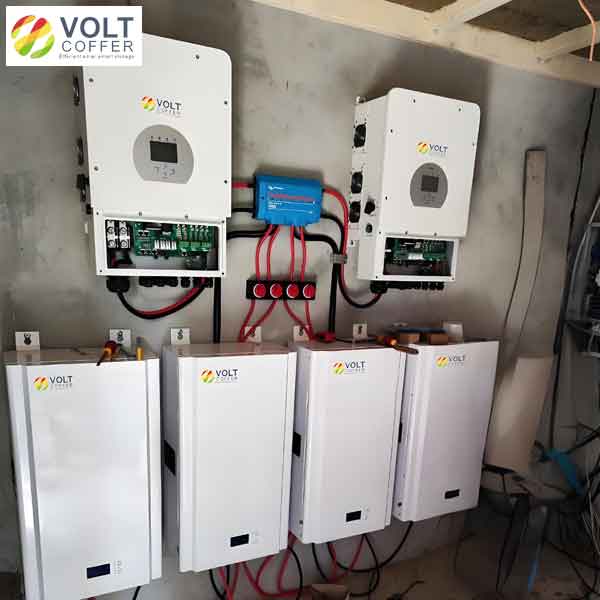
To provide a clearer picture of the grid tied inverter setup used in my simulations, below is an illustrative image of a hybrid inverter system, which shares similarities with the modeled grid tied inverter. This helps contextualize the physical implementation of such systems:
The simulation results collectively demonstrate that my SOGI suppression method effectively addresses zero-crossing distortion in grid tied inverters. By broadening the full modulation index range through reduction of \(\theta_{iu}\) and compensating steady-state errors via SOGI control, the method achieves low THD and high quality factors. This leads to smoother current waveforms, reduced harmonic pollution, and enhanced grid stability. The implications are significant for PV systems, as improved inverter performance can increase energy yield, reduce maintenance costs, and support broader renewable integration. My approach also offers scalability; it can be adapted to various grid tied inverter configurations, from small residential setups to large commercial installations, by tuning parameters like \(k_p\) and \(Q\) based on specific operational needs.
In conclusion, the SOGI-based simulation for suppressing zero-crossing distortion in grid tied inverters presents a robust solution to a persistent power quality issue. Through detailed theoretical analysis and empirical validation, I have shown that this method outperforms existing techniques in terms of harmonic reduction and control precision. The key lies in its ability to maintain phase and amplitude alignment while compensating for dynamic errors, ensuring that the grid tied inverter operates efficiently across a wide modulation range. Future work could explore real-time implementation with hardware-in-the-loop testing or integration with advanced grid-support functions. Nonetheless, this research contributes to the ongoing efforts to optimize renewable energy systems, making grid tied inverters more reliable and effective in the transition to a sustainable energy future.