
In recent years, the integration of solar energy generation with agricultural practices, often termed agrivoltaics or solar farming, has gained significant traction. This synergy aims to optimize land use by combining clean energy production with crop cultivation, thereby promoting sustainable development. However, a critical challenge arises during summer months when temperatures under solar panels can soar to extreme levels, adversely affecting both the efficiency of the solar panels and the growth of underlying crops. High ambient temperatures not only reduce the power conversion efficiency of solar panels but also create a hostile microclimate for plants, potentially leading to reduced yields. To address this issue, spray cooling technology has been proposed as a viable solution to mitigate heat buildup under solar panels. This study employs computational fluid dynamics (CFD) simulations using Fluent software to model the thermal environment under solar panel arrays with spray cooling, aiming to evaluate its effectiveness and provide insights for practical applications in solar farming systems.
The primary objective of this research is to simulate the thermal dynamics under solar panels when spray cooling is applied. By developing a detailed three-dimensional model of a solar panel array and incorporating spray cooling mechanisms, we seek to analyze temperature distribution, humidity changes, and cooling efficiency. The simulation focuses on understanding how water droplets from spray nozzles interact with the air under solar panels, leading to evaporative cooling and heat dissipation. This investigation is crucial for designing efficient spray cooling systems that can enhance both energy output from solar panels and agricultural productivity in solar farming setups. The use of CFD allows for a comprehensive analysis of fluid flow, heat transfer, and mass transfer processes, providing a robust foundation for optimizing spray cooling strategies under solar panels.
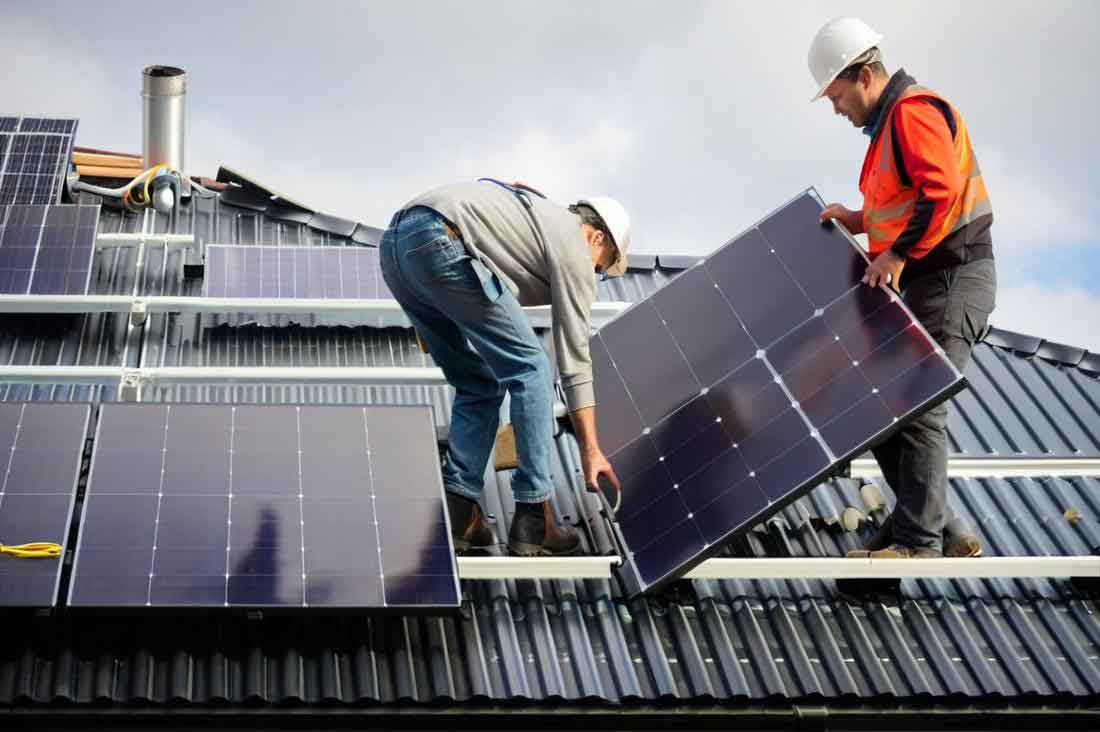
To begin, we constructed a geometric model representing a typical solar panel array based on a real-world solar farming project. The array consists of multiple rows of solar panels, each with dimensions of 2279 mm × 1134 mm × 30 mm, arranged at an angle of 16 degrees and elevated at least 2.5 meters above the ground. The spacing between arrays is set at 7.0 meters to allow for agricultural activities and adequate airflow. For simulation purposes, we modeled a simplified domain with three rows of solar panels covering an area of 96 meters by 20 meters. This configuration captures the essential features of a solar farming environment while reducing computational complexity. The solar panels are treated as solid surfaces with thermal properties that account for solar radiation absorption and heat conduction.
The numerical simulation involves solving governing equations for fluid flow, heat transfer, and species transport under the solar panels. We assume the air under the solar panels is incompressible, and the flow is turbulent due to natural convection and spray-induced motions. The simulation incorporates multiphase flow to model the spray droplets, radiation heat transfer from the solar panels, and wall functions to handle near-surface effects. Key models and equations used in the simulation are summarized below.
For the spray cooling simulation, we adopted an Euler-Lagrangian approach to model the two-phase flow of air and water droplets. The air phase is treated as a continuous fluid, while the water droplets are tracked as discrete particles. The motion of each droplet is governed by Newton’s second law, accounting for forces such as drag, gravity, lift, and wall interactions. The equation for droplet motion is expressed as:
$$m_i \frac{du_i}{dt} = F_D + F_G + F_{lift} + F_{wall}$$
where \(m_i\) is the mass of the droplet, \(u_i\) is its velocity, \(F_D\) is the drag force, \(F_G\) is the gravitational force, \(F_{lift}\) is the lift force, and \(F_{wall}\) is the force due to wall interactions. The drag force is calculated using Stokes’ law for small particles:
$$\vec{F}_D = 6\pi \eta d \vec{v}$$
where \(\eta\) is the dynamic viscosity of air, \(d\) is the droplet diameter, and \(\vec{v}\) is the relative velocity between the droplet and air. The turbulence in the air phase is modeled using the standard k-ε turbulence model, which solves transport equations for turbulent kinetic energy \(k\) and its dissipation rate \(\epsilon\). This model is suitable for simulating turbulent flows under solar panels where mixing and diffusion play significant roles.
Radiation heat transfer from the solar panels to the environment is critical for accurate temperature predictions. We use the radiation transport equation (RTE) to account for absorption and scattering of thermal radiation. The RTE is given by:
$$\frac{dI}{ds} = -k_s I + k_\alpha B(T)$$
where \(I\) is the radiation intensity, \(s\) is the path length, \(k_s\) is the scattering coefficient, \(k_\alpha\) is the absorption coefficient, and \(B(T)\) is the blackbody radiation intensity at temperature \(T\). This equation is solved using the discrete ordinates (DO) method, which discretizes the directional dependence of radiation intensity. The solar radiation input is based on the geographical location of the solar farming site, with solar position calculated for typical summer conditions.
Near the surfaces of the solar panels and the ground, wall functions are employed to resolve the boundary layer effects without requiring excessively fine meshes. We use enhanced wall treatment that combines a two-layer model with pressure-gradient effects. This approach accurately captures heat and momentum transfer in the viscous sublayer and log-law region, which is essential for predicting temperature gradients under solar panels. The wall functions are implemented by modifying the turbulence model equations near walls, ensuring that shear stress and heat flux are properly represented.
To model the transport of water vapor and droplets under the solar panels, we use species transport equations. The mass conservation equation for each species (e.g., dry air, water vapor) is:
$$\frac{\partial \rho_i}{\partial t} + \nabla (\rho_i \vec{u}) = D_i \nabla^2 \rho_i + \dot{m}_i$$
where \(\rho_i\) is the mass concentration of species \(i\), \(\vec{u}\) is the fluid velocity vector, \(D_i\) is the diffusion coefficient, and \(\dot{m}_i\) is the mass source term due to spray evaporation or condensation. For droplet evaporation, we assume a rapid mixing model where droplets instantly evaporate upon contact with hot air, adding water vapor to the air phase. This simplification is valid for small droplets and high temperatures commonly found under solar panels. Additionally, the transport of droplet particles is described by a diffusion equation to account for their dispersion and deposition:
$$\frac{\partial \rho_p}{\partial t} + \nabla (\rho_p \vec{u}) = D_p \nabla^2 \rho_p + \rho_p \vec{g} \cdot \vec{e}_z$$
where \(\rho_p\) is the mass concentration of droplets, \(D_p\) is the droplet diffusion coefficient, \(\vec{g}\) is gravity, and \(\vec{e}_z\) is the unit vector in the vertical direction. This equation captures the settling of droplets due to gravity and their spread due to turbulent diffusion.
The simulation parameters are based on typical conditions for solar farming in warm climates. We set the initial ambient temperature to 40°C, representing a hot summer day. The solar panels are assumed to have a surface temperature of 60°C due to solar absorption. Spray cooling is activated with nozzles of diameter 0.75 mm operating at a pressure of 0.30 MPa, similar to experimental setups in agricultural cooling studies. The spray is applied intermittently, with cycles of one minute on and one minute off, to mimic practical operational strategies. The water flow rate is calculated based on nozzle characteristics, and droplet size distribution is assumed to follow a Rosin-Rammler distribution with a mean diameter of 100 microns. Key simulation parameters are summarized in the table below.
| Parameter | Value | Description |
|---|---|---|
| Solar panel dimension | 2279 mm × 1134 mm × 30 mm | Size of individual solar panel |
| Array angle | 16 degrees | Tilt angle of solar panels |
| Array spacing | 7.0 m | Distance between solar panel rows |
| Initial air temperature | 40°C | Ambient temperature under solar panels |
| Solar panel surface temperature | 60°C | Temperature of solar panel due to heating |
| Spray nozzle diameter | 0.75 mm | Diameter of spray nozzles |
| Spray pressure | 0.30 MPa | Operating pressure of spray system |
| Spray cycle | 1 min on / 1 min off | Intermittent spray operation |
| Droplet mean diameter | 100 μm | Average size of water droplets |
| Simulation domain | 96 m × 20 m × 10 m | Size of computational domain |
The simulation results reveal significant cooling effects under the solar panels due to spray application. Temperature contours at different time intervals show the evolution of the thermal environment. At the start of spray (0.12 seconds), the temperature under the solar panels displays non-uniform distribution, with cooler regions near the spray nozzles and hotter areas along the edges. As spray continues (0.24 seconds), the cooler regions expand, and temperatures become more homogeneous. After sustained spray cooling (e.g., several minutes), the entire area under the solar panels shows reduced temperatures, with the lowest temperatures observed directly below the nozzles. The cooling effect is primarily attributed to evaporative cooling, where water droplets absorb heat from the air as they vaporize. This process lowers the air temperature and increases humidity, creating a more favorable microclimate for crops under the solar panels.
To quantify the cooling performance, we analyzed temperature data at various points under the solar panels. The average temperature reduction achieved with spray cooling is approximately 5-8°C, depending on the location and spray duration. The table below summarizes temperature changes at key positions under the solar panels after 5 minutes of spray operation.
| Position | Temperature without Spray (°C) | Temperature with Spray (°C) | Temperature Reduction (°C) |
|---|---|---|---|
| Center under solar panel | 55.2 | 48.7 | 6.5 |
| Edge under solar panel | 58.5 | 52.1 | 6.4 |
| Midway between panels | 45.3 | 40.1 | 5.2 |
| Near spray nozzle | 50.8 | 42.3 | 8.5 |
The cooling efficiency can be further assessed using the cooling effectiveness parameter, defined as the ratio of actual temperature drop to the maximum possible drop. For evaporative cooling, the theoretical maximum temperature reduction is limited by the wet-bulb temperature. The cooling effectiveness \(\eta_c\) is calculated as:
$$\eta_c = \frac{T_{initial} – T_{final}}{T_{initial} – T_{wetbulb}}$$
where \(T_{initial}\) is the initial air temperature, \(T_{final}\) is the temperature after cooling, and \(T_{wetbulb}\) is the wet-bulb temperature. In our simulation, with an initial temperature of 40°C and a wet-bulb temperature of 25°C (assuming moderate humidity), the cooling effectiveness ranges from 0.4 to 0.6, indicating moderate efficiency due to factors like droplet evaporation rate and air mixing.
In addition to temperature reduction, spray cooling affects humidity levels under the solar panels. The increase in relative humidity can benefit crops by reducing water stress, but excessive humidity may promote fungal diseases. Our simulation shows that relative humidity rises from an initial 50% to around 70-80% in the cooled zones. This change is modeled using the species transport equations for water vapor, with source terms from droplet evaporation. The humidity distribution correlates with temperature patterns, with higher humidity in cooler areas. Managing humidity is crucial for solar farming, and spray systems can be controlled to maintain optimal conditions.
The simulation also provides insights into the fluid flow patterns under the solar panels. The spray induces air currents that enhance mixing and heat dissipation. Velocity vectors show that cool air descends from the spray zones and spreads laterally, displacing hotter air. This natural convection, combined with forced motion from spray momentum, improves the overall cooling uniformity. The turbulent kinetic energy under the solar panels increases with spray activity, facilitating faster heat transfer. These flow dynamics are essential for designing spray nozzle placement and orientation to maximize coverage under solar panels.
From an economic perspective, spray cooling systems involve initial investment and operational costs. Based on typical market data, the capital cost for a spray system under solar panels is approximately $8,000, covering components like a 4 kW spray host, nozzles, pipes, and fittings. Operational costs include electricity for the spray host and water consumption. Assuming daily operation of 8 hours with intermittent cycling, the daily cost is around $110, depending on local utility rates. The table below breaks down the cost components for a spray cooling system in solar farming.
| Cost Component | Estimated Value | Notes |
|---|---|---|
| Spray host (4 kW) | $2,000 | Electric pump for pressurizing water |
| Nozzles and fittings | $1,500 | Stainless steel nozzles and connectors |
| Piping and installation | $3,000 | High-pressure pipes and labor |
| Control system | $1,500 | Automated controls for spray cycles |
| Daily electricity cost | $30 | Based on 8 hours at $0.15/kWh |
| Daily water cost | $80 | Based on water usage and local rates |
| Total daily operational cost | $110 | Sum of electricity and water costs |
Despite the benefits, spray cooling under solar panels has limitations. The increase in humidity may not be suitable for all crops, and over-spraying can lead to waterlogging or disease. Moreover, the cooling effect is highly dependent on ambient conditions like wind speed and solar radiation. Our simulation assumes calm conditions, but in reality, wind can disperse spray droplets and reduce cooling efficiency. Future studies should incorporate variable environmental factors to improve model accuracy. Additionally, the simulation simplifies droplet evaporation and heat transfer processes; more detailed models could include phase change dynamics and droplet collision effects.
To optimize spray cooling for solar panels, control strategies are vital. The intermittent spray cycle used in this simulation (1 min on/off) helps balance cooling and water usage. However, adaptive control based on real-time temperature and humidity sensors could enhance efficiency. For example, spray can be activated only when temperatures exceed a threshold or when humidity is below a certain level. Integrating smart control systems with solar farming operations can minimize costs while maintaining optimal growing conditions under solar panels.
In conclusion, this study demonstrates the potential of spray cooling to mitigate high temperatures under solar panels in solar farming systems. Through CFD simulations, we show that spray cooling can reduce temperatures by 5-8°C, improving the microclimate for crops and potentially enhancing solar panel efficiency by lowering operating temperatures. The simulation models, including multiphase flow, radiation, and species transport, provide a comprehensive framework for analyzing thermal environments under solar panels. While spray cooling involves costs and humidity management challenges, it offers a practical solution for sustainable solar farming. Future work should focus on experimental validation, optimization of spray parameters, and integration with renewable energy systems to maximize the synergies between solar energy and agriculture. By advancing spray cooling technology, we can support the growth of solar farming and contribute to global efforts in clean energy and food security.
The formulas and tables presented in this article summarize key aspects of the simulation. For instance, the droplet motion equation highlights the forces acting on spray particles under solar panels, while the cost table provides insights into economic feasibility. Repeated use of the term “solar panel” throughout the text emphasizes the focus on these structures in agrivoltaic systems. Overall, this research lays the groundwork for further investigations into cooling strategies for solar panels, ultimately aiming to create more resilient and productive solar farming environments.