
Lithium ion batteries (LIBs) have dominated energy storage technologies due to their high energy density, power density, and cycling stability. However, conventional graphite anodes (372 mAh/g) approach their theoretical limits, driving research toward high-capacity alternatives like silicon (3579 mAh/g) and lithium metal (3860 mAh/g). These materials face critical challenges including volume expansion (300% for Si), dendrite growth, and unstable solid-electrolyte interphases (SEI). Scaffold materials – three-dimensional frameworks with tunable porosity and mechanical resilience – emerge as transformative solutions. This article systematically explores their applications across battery components through structural equations and comparative analysis.
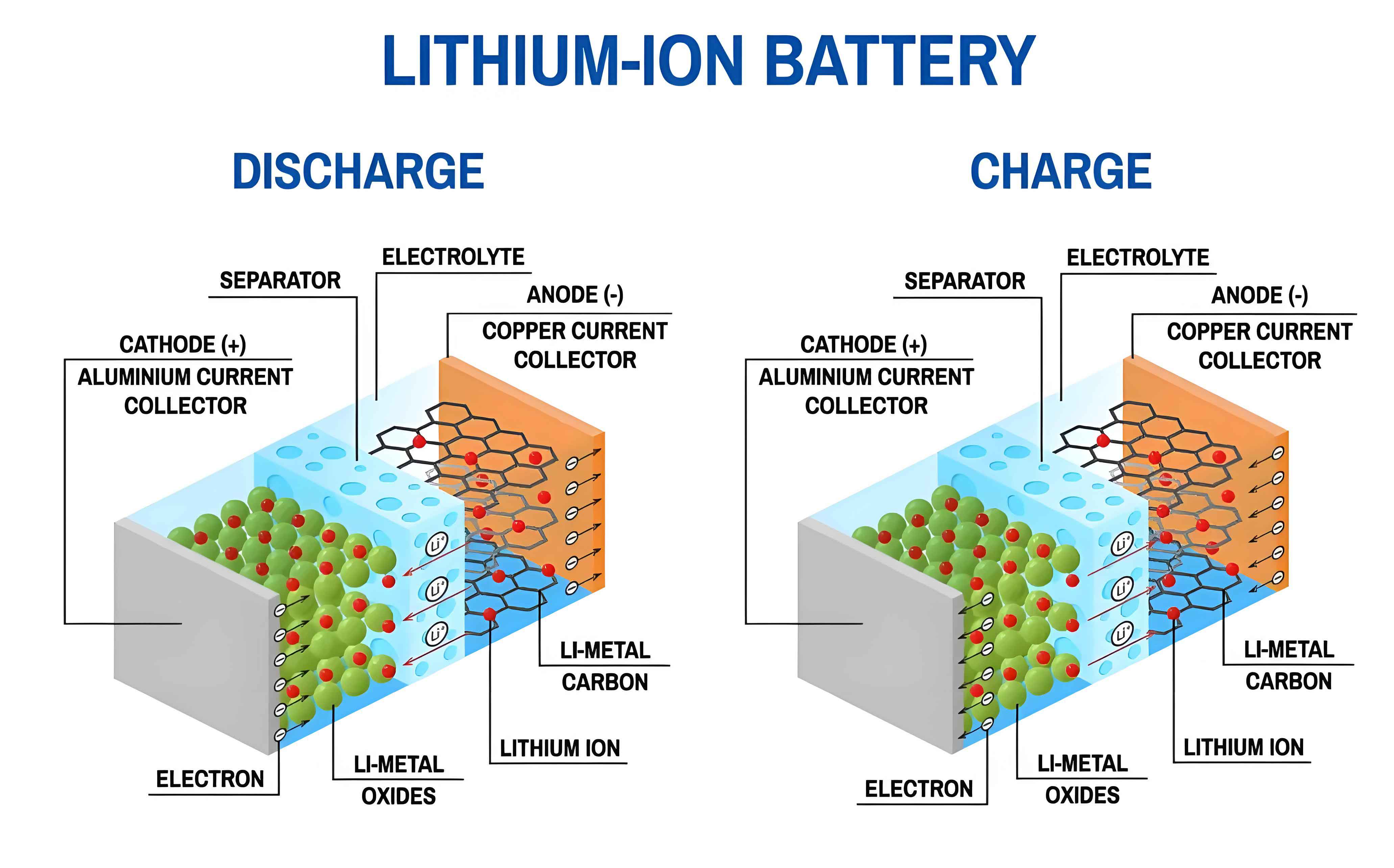
1. Structural Taxonomy of Scaffold Materials
Scaffold architectures are classified by composition and functionality:
| Category | Examples | Pore Size (nm) | Ionic Conductivity (S/cm) |
|---|---|---|---|
| Molecular Frameworks | MOFs, COFs, HOFs | 0.5-3.0 | 10-6-10-3 |
| Carbon-Based | Graphene aerogels, CNTs | 2-50 | 10-4-10-2 |
| Polymeric | PI, PVDF, PAN | 0.1-5.0 | 10-5-10-3 |
| Metallic | Ni foam, CuZn alloys | 50-500 | N/A |
The ionic transport in porous scaffolds follows the modified Nernst-Planck equation:
$$ J_i = -D_i \nabla c_i – \frac{z_i F}{RT} D_i c_i \nabla \phi + c_i v $$
where \( J_i \) is ion flux, \( D_i \) diffusion coefficient, and \( \phi \) electric potential. Scaffold confinement alters both \( D_i \) and migration terms through pore-wall interactions.
2. Cathode Engineering Strategies
In lithium ion batteries, high-voltage cathodes like LiNi0.8Co0.1Mn0.1O2 (NCM811) require stabilization against transition metal dissolution. MOF coatings (e.g., NH2-MIL-53) demonstrate dual functionality:
$$ \text{Dissolution Rate} = k_0 \exp\left(-\frac{E_a}{RT}\right) [\text{TM}^{n+}] $$
where MOFs reduce \( [\text{TM}^{n+}] \) through Lewis acid-base interactions. For sulfur cathodes, COFs with thiol-functionalized pores (\( \text{-SH} \)) chemically anchor polysulfides:
$$ \text{Li}_2\text{S}_x + \text{Scaffold-SH} \rightarrow \text{Scaffold-S-S}_x\text{Li} + \text{Li}^+ $$
3. Separator Innovations
Conventional polyolefin separators (20-25 μm thickness) exhibit limited thermal stability (\( \Delta L > 50\% @ 150°C \)). ZIF-8 modified separators achieve:
- Shrinkage < 5% @ 200°C
- Li+ transference number \( t_+ = 0.80 \) (vs. 0.3 baseline)
The improved performance stems from size-exclusion ion transport:
$$ \frac{r_{\text{Li}^+}}{r_{\text{PF}_6^-}} = \frac{0.076\ \text{nm}}{0.254\ \text{nm}} \approx 0.3 $$
MOF pores (0.34 nm) permit Li+ passage while restricting larger anions.
4. Solid-State Electrolyte Breakthroughs
Scaffold-reinforced polymer electrolytes overcome the trade-off between mechanical strength (\( G’ \)) and ionic conductivity (\( \sigma \)):
$$ \sigma = \sigma_0 \exp\left(-\frac{E_a}{k_B T}\right) $$
$$ G’ = \frac{E}{3(1-2\nu)} $$
where \( E \) is Young’s modulus and \( \nu \) Poisson’s ratio. PI-reinforced PEO electrolytes achieve \( \sigma = 1.2 \times 10^{-3}\ \text{S/cm} \) with \( G’ > 1\ \text{GPa} \).
5. Anode Architecture Revolution
For silicon anodes, yolk-shell structures buffer volume changes:
$$ \frac{\Delta V}{V_0} = \frac{\pi d^3/6 – \pi (d-2\delta)^3/6}{\pi d^3/6} \approx 1 – \left(1-\frac{2\delta}{d}\right)^3 $$
where \( \delta \) is expansion thickness. At \( d = 150\ \text{nm} \) and \( \delta = 50\ \text{nm} \), strain reduces from 300% to 60%. Lithium metal anodes benefit from 3D Cu scaffolds:
$$ i_{\text{lim}} = nFD\frac{C_0}{\delta} $$
Porous substrates increase effective surface area, lowering local current density from 10 mA/cm² to 0.5 mA/cm².
6. Future Perspectives
The lithium ion battery industry requires scaffold materials with:
- Multi-scale porosity (\( \epsilon > 70\% \)) for ion transport
- Fracture toughness \( K_{IC} > 2\ \text{MPa·m}^{1/2} \)
- Electrochemical stability window \( > 5\ \text{V} \)
Emerging COF-based single-ion conductors demonstrate promise:
$$ t_+ = \frac{\sigma_+}{\sigma_+ + \sigma_-} \approx 0.97 $$
with \( \sigma = 8.8\ \text{mS/cm} \) at 60°C. Continued innovation in scaffold materials will enable lithium ion batteries exceeding 500 Wh/kg while maintaining safety and cycle life.