
In modern photovoltaic (PV) power generation systems, the grid connected inverter plays a pivotal role in converting DC power from solar panels into AC power suitable for grid integration. Among various inverter topologies, the LCL-type grid connected inverter is widely adopted due to its superior filtering performance, which effectively attenuates high-frequency harmonics and ensures smooth current injection into the grid. However, this configuration is prone to resonance issues, which can destabilize the grid and degrade power quality. In this article, we explore the resonance mechanisms and propose effective suppression strategies for LCL-type grid connected inverters, focusing on both inherent resonance and resonance in weak grid conditions. We establish mathematical models, analyze resonance causes, and validate strategies through simulations, emphasizing the importance of robust control for reliable grid integration.
The LCL filter, comprising inductors and a capacitor, is a core component of the grid connected inverter. Its advantages include excellent harmonic attenuation, but it introduces resonance peaks at specific frequencies, leading to potential instability. In practical engineering, mitigating these resonances is crucial for maintaining grid stability and power quality. We begin by developing a mathematical model for the LCL-type grid connected inverter, which serves as the foundation for understanding its dynamics and designing control strategies.
Mathematical Modeling of LCL-Type Grid Connected Inverters
The mathematical model of an LCL-type grid connected inverter is closely related to the coordinate system used for analysis. Two common coordinate systems are the two-phase stationary frame and the synchronous rotating frame, each yielding different modeling results. For instance, in the two-phase stationary frame, the inverter model can be expressed using the following equations. We consider a three-phase system where key parameters such as current, voltage, and power are used to compute output voltages, optimizing the inverter’s operational state. Precise calculation and adjustment of these parameters enable the grid connected inverter to maintain optimal performance under varying conditions.
The mathematical model in the two-phase stationary frame is given by:
$$
\begin{aligned}
V_{xN\_abc}(t) &= V_{cx\_abc}(t) + L_1 p i_{1x\_abc}(t) \\
V_{cx\_abc}(t) &= V_{gx\_abc}(t) + V_{N’N}(t) + L_2 p i_{2x\_abc}(t) \\
i_{1x\_abc}(t) &= i_{2x\_abc}(t) + C p V_{cx\_abc}(t)
\end{aligned}
$$
where \( V_{xN\_abc}(t) \) is the output voltage of the three-phase inverter bridge at time \( t \), \( V_{cx\_abc}(t) \) is the voltage drop across the three-phase filter capacitor, \( L_1 \) is the inverter-side inductance, \( i_{1x\_abc}(t) \) is the three-phase inductor current on the inverter side, \( p \) represents the power operator, \( V_{gx\_abc}(t) \) is the three-phase grid voltage, \( V_{N’N}(t) \) is the voltage drop between the filter capacitor neutral point and the grid neutral point, \( L_2 \) is the grid-side inductance, \( i_{2x\_abc}(t) \) is the three-phase grid-connected current, and \( C \) is the filter capacitance. This model allows us to analyze the impact of capacitor voltage drops on output voltage, assess the filter’s role in harmonic suppression, and evaluate dynamic characteristics under grid fluctuations or load changes.
To simplify analysis, we convert these parameters into vector form, facilitating matrix operations for real-time control and fault diagnosis. The vector representations are:
$$
\begin{aligned}
V_{xN\_abc}(t) &= [V_{aN}(t), V_{bN}(t), V_{cN}(t)]^T \\
V_{cx\_abc}(t) &= [V_{ca}(t), V_{cb}(t), V_{cc}(t)]^T \\
V_{gx\_abc}(t) &= [V_{g-a}(t), V_{g-b}(t), V_{g-c}(t)]^T
\end{aligned}
$$
where \( V_{aN}(t) \), \( V_{bN}(t) \), and \( V_{cN}(t) \) are the phase output voltages of the inverter bridge, \( V_{ca}(t) \), \( V_{cb}(t) \), and \( V_{cc}(t) \) are the phase voltage drops across the filter capacitor, and \( V_{g-a}(t) \), \( V_{g-b}(t) \), and \( V_{g-c}(t) \) are the grid phase voltages. This vector approach enhances control strategy design by integrating state-space models, enabling rapid response to voltage changes and efficient fault detection through deviation analysis.
Resonance Problem Analysis in LCL-Type Grid Connected Inverters
The LCL filter, while effective for harmonic filtering, introduces resonance due to interactions between inductors and the capacitor. Resonance occurs at specific frequencies where the filter’s impedance approaches zero, causing phase jumps of -180° in the frequency response and distorting output current waveforms. This phenomenon can destabilize the grid connected inverter and compromise grid stability. We analyze resonance by examining the filter’s frequency characteristics, where the resonant frequency \( f_r \) is given by:
$$
f_r = \frac{1}{2\pi \sqrt{L_{eq} C}}
$$
with \( L_{eq} \) representing the equivalent inductance. When the system operating frequency nears \( f_r \), severe resonance arises, leading to energy backflow and potential damage. This is critical for grid connected inverters in PV systems, as it affects power quality and reliability. Understanding this resonance is essential for developing suppression techniques that ensure stable operation of the grid connected inverter.
Inherent Resonance Suppression Strategies for Grid Connected Inverters
To address inherent resonance in LCL-type grid connected inverters, we explore passive and active damping methods. These strategies aim to dampen resonance peaks without compromising filtering performance.
Passive Damping Approach
Passive damping involves inserting resistors into the filter circuit to dissipate resonant energy. For a single-phase LCL filter, resistors can be placed in various configurations, such as in series or parallel with components. We evaluate different damping placements to identify optimal designs. A common effective method is connecting a damping resistor in parallel with the filter capacitor, as it minimally affects high-frequency and low-frequency signals. The damping resistor \( R_d \) modifies the filter impedance, reducing resonance amplitude. However, passive damping incurs power losses, which may lower efficiency in grid connected inverters.
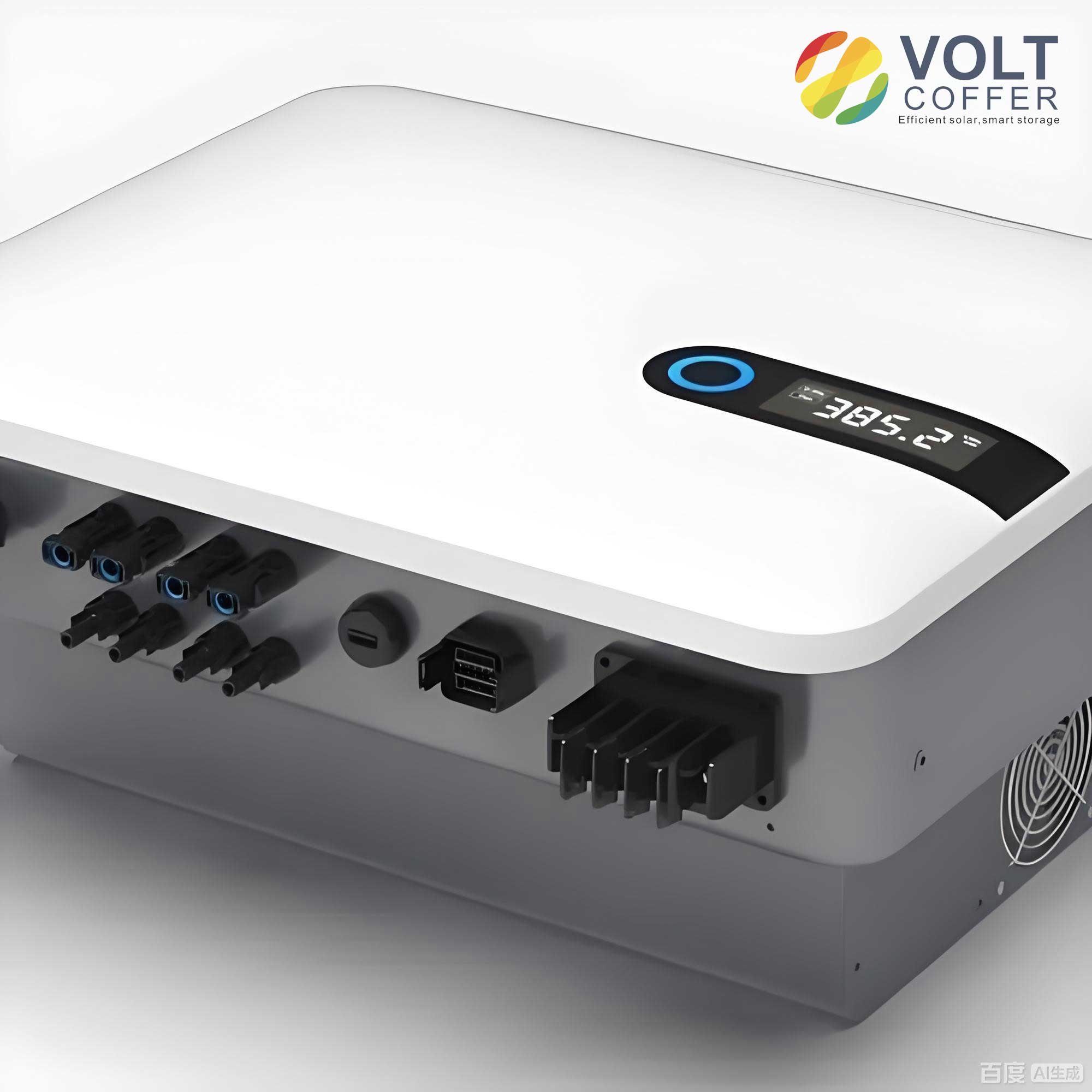
The table below summarizes different passive damping configurations and their impacts on resonance suppression for grid connected inverters:
| Damping Configuration | Resistor Placement | Effect on Resonance | Power Loss |
|---|---|---|---|
| Rd1 | Series with inverter-side inductor | Moderate damping | High |
| Rd2 | Series with grid-side inductor | Moderate damping | High |
| Rd3 | Parallel with inverter-side inductor | Low damping | Low |
| Rd4 | Parallel with grid-side inductor | Low damping | Low |
| Rd5 | Series with capacitor | High damping | Medium |
| Rd6 | Parallel with capacitor | Optimal damping | Low |
From this, we conclude that parallel damping with the capacitor (Rd6) offers the best trade-off for grid connected inverters, minimizing resonance while reducing losses.
Active Damping Approach
Active damping overcomes power loss limitations by using control algorithms to emulate damping resistors, often through virtual impedance techniques. We implement active damping via feedback loops, such as capacitor current proportional feedback, to adjust virtual resistance and suppress resonance. The basic principle involves a virtual resistor \( R_v \) in the control loop, with its value tuned to dampen resonance without physical losses. However, digital control delays can degrade performance, turning the system into a non-minimum phase system. To compensate, we introduce a first-order lead compensator:
$$
G_{cq}(s) = \frac{k s}{s + \omega_j}
$$
where \( G_{cq}(s) \) is the transfer function, \( k \) is the gain equivalent to the virtual resistor feedback coefficient, \( s \) is the complex frequency, and \( \omega_j \) is the cutoff angular frequency. This compensator mitigates phase delays, enhancing stability for grid connected inverters. We determine \( \omega_j \) based on the sampling angular frequency \( \omega_s \) and the boundary angular frequency \( \omega_f \), using the relation:
$$
\cos\left(\frac{3\pi \omega_f}{\omega_s}\right) + \sin\left(\frac{3\pi \omega_f}{\omega_s}\right) = \frac{\omega_j}{\omega_f}
$$
The table below shows numerical relationships between \( \omega_j/\omega_s \) and \( \omega_f/\omega_s \), aiding in parameter selection for grid connected inverters:
| \( \omega_j/\omega_s \) | \( \omega_f/\omega_s \) | \( \omega_j/\omega_s \) | \( \omega_f/\omega_s \) |
|---|---|---|---|
| 0.5 | 0.280 | 2.5 | 0.320 |
| 1.0 | 0.300 | 3.0 | 0.321 |
| 1.5 | 0.311 | 3.5 | 0.322 |
| 2.0 | 0.318 | 4.0 | 0.322 |
By setting \( \omega_j/\omega_s = 0.5 \), we obtain \( \omega_f/\omega_s = 0.280 \), allowing calculation of \( \omega_j \) and \( \omega_f \) from known \( \omega_s \). This improved active damping strategy effectively suppresses resonance in grid connected inverters with minimal delay.
Resonance Suppression Strategies for Grid Connected Inverters in Weak Grids
As PV penetration increases, grids often transition from strong to weak conditions, exacerbating resonance issues in grid connected inverters. We define weak grids based on the short-circuit current ratio and propose impedance reshaping techniques to maintain stability.
Weak Grid Criteria
A grid is classified as weak or strong by comparing the short-circuit current \( I_{SC} \) at the point of common coupling (PCC) to the rated grid-connected current \( I_N \). The criteria are summarized in the table below, which guides the assessment for grid connected inverters:
| Criterion | Parameter | Description | Range |
|---|---|---|---|
| Weak Grid | \( I_{SC}/I_N \) | Ratio less than 10 | \( I_{SC}/I_N < 10 \) |
| Strong Grid | \( I_{SC}/I_N \) | Ratio greater than 25 | \( I_{SC}/I_N > 25 \) |
| Medium Grid | \( I_{SC}/I_N \) | Ratio between 10 and 25 | \( 10 \leq I_{SC}/I_N \leq 25 \) |
For weak grids, where \( I_{SC}/I_N < 10 \), the grid connected inverter faces heightened resonance risks due to increased grid impedance variability.
Output Impedance Reshaping for Grid Connected Inverters
To suppress resonance in weak grids, we reshape the output impedance of the grid connected inverter by improving grid voltage feedforward control. Traditional feedforward is susceptible to noise, so we incorporate a band-pass filter (BPF) to enhance signal quality. The BPF transfer function is:
$$
BPF(s) = A_o \frac{s \omega_{Lc}}{s^2 + \frac{\omega_{Lc}}{\zeta} s + \omega_{Lc}^2} \cdot \frac{s \omega_{hc}}{s^2 + \frac{\omega_{hc}}{\zeta} s + \omega_{hc}^2}
$$
where \( A_o \) is the gain, \( \omega_{Lc} \) and \( \omega_{hc} \) are the lower and upper cutoff angular frequencies, and \( \zeta = 0.07 \) is the damping coefficient. This filter allows only a specific frequency band to pass, reducing interference and improving the feedforward response for grid connected inverters.
Additionally, to simultaneously suppress grid voltage harmonics and inverter resonance, we add harmonic compensators in the controller. The harmonic compensator transfer function is:
$$
HC(s) = \frac{A_{o1} \omega_b s}{s^2 + \omega_b s + \omega_h^2}
$$
where \( A_{o1} \) is the gain, \( \omega_b \) is the bandwidth, and \( \omega_h \) is the compensation angular frequency. This approach boosts the phase margin of the grid connected inverter’s output impedance, enhancing stability in weak grids.
Simulation Study for Grid Connected Inverters
We validate our strategies using MATLAB simulations, with parameters set for a typical grid connected inverter in a PV system. The table below lists key simulation parameters:
| Parameter | Value | Parameter | Value |
|---|---|---|---|
| DC-side voltage (V) | 800 | Carrier amplitude (V) | 1 |
| Grid voltage (V) | 220 | Grid current feedback coefficient | 0.05 |
| Switching frequency (kHz) | 20 | Capacitor current feedback coefficient | 0.18 |
| Rated power (kW) | 20 | Grid voltage sampling coefficient | 1.0 |
| Filter capacitance (µF) | 10 | Proportional coefficient \( K_p \) | 0.65 |
| Inverter-side inductance (µH) | 600 | Proportional coefficient \( K_r \) | 75 |
| Grid-side inductance (µH) | 110 | Grid equivalent resistance (mH) | 1.0 |
| Sampling frequency (kHz) | 40 | Inherent resonance frequency (kHz) | 0.125 |
We simulate four scenarios to compare resonance suppression for grid connected inverters:
- Traditional grid voltage feedforward with zero grid impedance.
- Traditional feedforward with 1 mH grid impedance.
- Improved feedforward with 1 mH grid impedance.
- Improved feedforward with 3 mH grid impedance.
In Scenario 1, the grid connected inverter operates stably with negligible harmonics. Scenario 2 shows reduced stability and evident resonance. Scenario 3 demonstrates high stability with concentrated harmonic distribution near the impedance intersection frequency, achieving a total harmonic distortion (THD) of 1.8%, meeting grid standards. Scenario 4 maintains stability despite higher grid impedance, with THD at 1.27%, also compliant. These results confirm that improved feedforward effectively suppresses resonance in weak grids for grid connected inverters.
Conclusion
Resonance in LCL-type grid connected inverters stems from the filter’s dynamic impedance characteristics, which can cause instability and poor power quality in PV systems. We propose suppression strategies for both inherent resonance and weak grid conditions. For inherent resonance, passive damping via resistor placement offers simplicity but incurs losses, while active damping using virtual impedance minimizes losses with enhanced control. In weak grids, reshaping the output impedance through improved grid voltage feedforward with band-pass filters and harmonic compensators proves effective. Simulations validate these approaches, showing reduced THD and stable operation. This work underscores the importance of tailored control strategies for reliable performance of grid connected inverters in evolving power networks. Future efforts may focus on adaptive techniques for varying grid conditions, ensuring robustness for widespread deployment of grid connected inverters in renewable energy systems.