
As a critical component in photovoltaic (PV) systems, solar inverters play a pivotal role in converting direct current (DC) from solar panels into alternating current (AC) for grid integration. The performance of solar inverters directly impacts the safety, reliability, and efficiency of the entire system. Compared to traditional inverters, solar inverters offer advantages such as higher efficiency, lower cost, and compact size. In recent years, the declining cost of solar power generation has made it increasingly competitive with conventional thermal power, leading to widespread adoption. However, the high-frequency switching operations in solar inverters can generate varying common-mode voltages between the PV modules and the ground. These fluctuating voltages, coupled with parasitic capacitances, can induce residual currents, particularly in adverse conditions like rainy weather, compromising power quality and operational safety. Inadequate residual current fault protection can pose risks to personnel and property. Installation standards in certain regions mandate the use of Type B residual current devices (RCDs) in the external AC circuits of PV inverters to mitigate such faults. This article explores various types of RCDs, analyzes the role of residual current detection in non-isolated solar inverters, and provides guidelines for selecting appropriate RCDs in PV systems.
Residual current refers to leakage current flowing from an electrical system to the ground, often resulting from insulation failures or ground faults. If this current passes through the human body, it can cause electric shock, injury, or even fatalities, while also potentially leading to overheating and fire hazards. RCDs are designed to detect such leakage currents and disconnect the circuit from the power supply when the current exceeds predefined thresholds. Residual current monitoring units (RCMUs) function similarly but lack disconnection capabilities, serving only to trigger alarms. The IEC 60755:2017 standard categorizes RCDs into three types: AC-type, sensitive to sinusoidal AC residual currents; A-type, sensitive to sinusoidal AC or pulsating DC residual currents; and B-type, sensitive to sinusoidal AC, pulsating DC, or smooth DC residual currents. Proper selection of RCDs based on the expected residual current type is essential for effective protection.
| RCD Type | Sensitivity to AC Residual Current | Sensitivity to Pulsating DC Residual Current | Sensitivity to Smooth DC Residual Current |
|---|---|---|---|
| AC-Type | Yes | No | No |
| A-Type | Yes | Yes | No |
| B-Type | Yes | Yes | Yes |
In PV systems, the integration of RCDs or RCMUs into solar inverters is often required by regulations to prevent ground faults. For non-isolated grid-tied solar inverters, the embedded RCD/RCMU must detect continuous residual currents of 300 mA or higher and sudden changes in residual current as per standards like DIN/VDE 0126-1-1 and EN/IEC 62109-2. The following table summarizes the standard limits for residual current protection in solar inverters.
| Leakage Current Type | Current Value (mA) | Inverter Disconnection Time (s) |
|---|---|---|
| Sudden Leakage Current | 30 | 0.3 |
| Sudden Leakage Current | 60 | 0.15 |
| Sudden Leakage Current | 150 | 0.04 |
| Continuous Leakage Current | ≥300 | 0.3 |
The residual current detection functionality in solar inverters is crucial for safeguarding the PV array side. However, it cannot replace external RCDs in the AC circuit, as the internal RCD/RCMU does not protect the segment between the power source and the solar inverter. The need for external RCDs—whether AC-type, A-type, or B-type—depends on the inverter design, particularly its ability to prevent DC residual currents from flowing into the AC side. Isolated solar inverters inherently block DC residual currents, whereas non-isolated solar inverters may allow such currents to propagate unless specifically designed to limit them.
To illustrate the application of RCDs in solar inverters, consider a non-isolated grid-tied PV system. In such systems, a ground fault on the DC side, such as at the positive terminal of the PV array, can generate DC residual currents. These currents may flow through the ground connection at the AC neutral point and return to the DC circuit via the non-isolated solar inverter. The RCMU integrated into the solar inverter can detect this current, but its threshold is typically set at 300 mA for continuous leakage, which is far above the 6 mA limit for AC-type or A-type RCDs. Consequently, if the solar inverter does not restrict DC residual currents to 6 mA or below, a B-type RCD must be installed in the AC circuit to ensure safety.
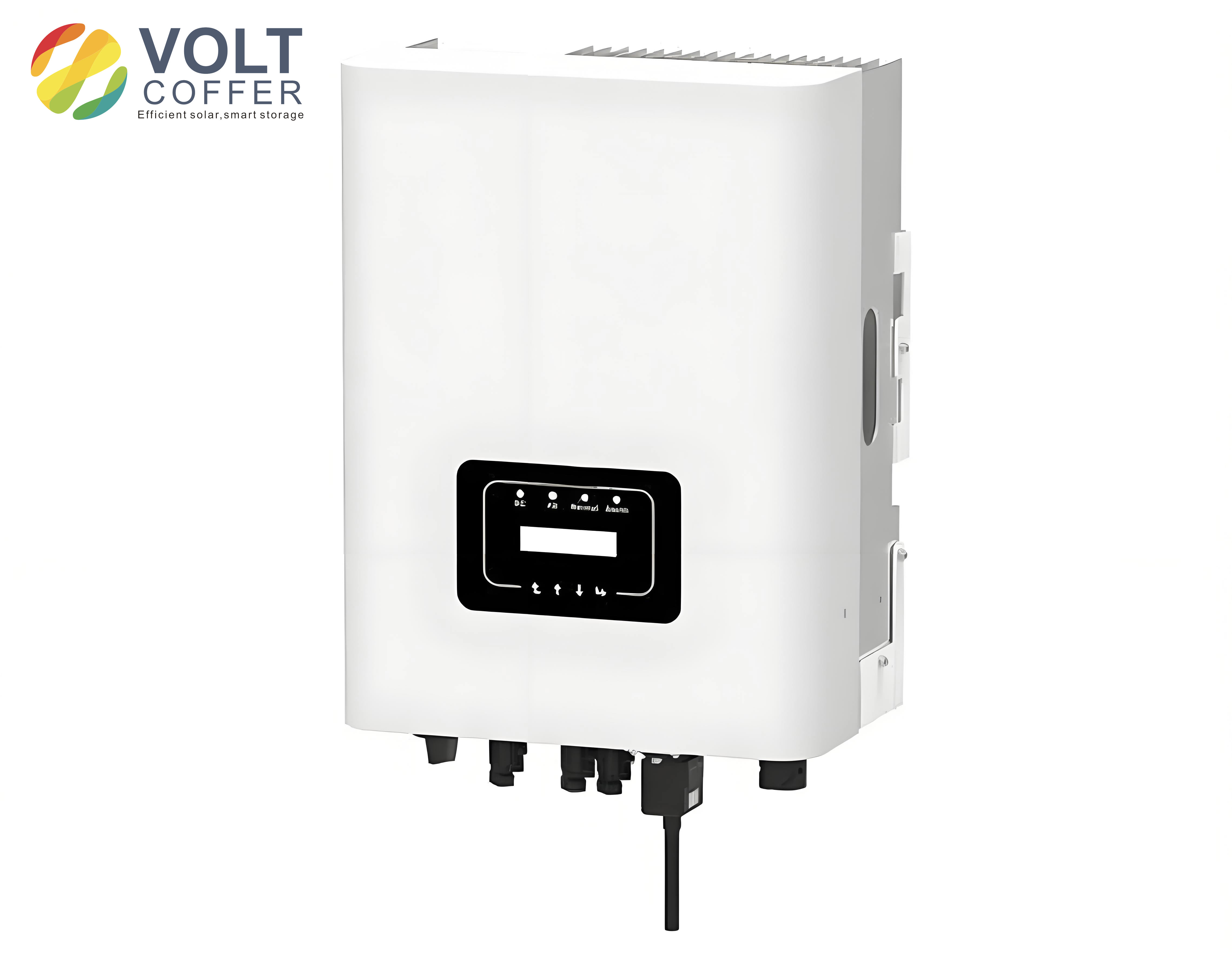
The selection of RCDs for solar inverters is governed by standards such as VDE-0100-712 and IEC 60364-7-712, which stipulate that if a PV system lacks separation between AC and DC sides, a B-type RCD must be used for fault protection. The maximum DC residual current that can appear in the AC circuit must be evaluated to determine the appropriate RCD type. Solar inverter manufacturers often specify compatible RCDs, but installers should verify the inverter’s capability to limit DC leakage. The residual current in a solar inverter system can be modeled using the formula for leakage current, which accounts for system capacitance and voltage fluctuations: $$ I_{leakage} = C \frac{dV}{dt} $$ where \( I_{leakage} \) is the leakage current, \( C \) is the parasitic capacitance, and \( \frac{dV}{dt} \) is the rate of change of common-mode voltage. In non-isolated solar inverters, this current can include DC components, necessitating B-type RCDs for comprehensive protection.
Efficiency is a key metric for solar inverters, often expressed as: $$ \eta = \frac{P_{out}}{P_{in}} \times 100\% $$ where \( \eta \) is the efficiency, \( P_{out} \) is the AC output power, and \( P_{in} \) is the DC input power. High-efficiency solar inverters minimize energy losses but must still address residual current risks. The table below compares general characteristics of solar inverters relevant to residual current protection.
| Inverter Type | Isolation | DC Residual Current Propagation to AC Side | Recommended RCD Type |
|---|---|---|---|
| Isolated Solar Inverter | Yes (e.g., with transformer) | No | AC-type or A-type |
| Non-Isolated Solar Inverter | No | Yes, unless limited by design | B-type (if DC > 6 mA) |
In practice, the installation of solar inverters requires careful assessment of residual current paths. For instance, in a non-isolated solar inverter system, the DC residual current magnitude depends on factors like insulation resistance and environmental conditions. The risk assessment should include calculations based on Ohm’s law and fault scenarios: $$ I_{fault} = \frac{V_{DC}}{R_{insulation}} $$ where \( I_{fault} \) is the fault current, \( V_{DC} \) is the DC voltage, and \( R_{insulation} \) is the insulation resistance. If this current exceeds 6 mA in the AC circuit, B-type RCDs are indispensable.
Furthermore, the integration of smart technologies in modern solar inverters enhances residual current monitoring. Advanced solar inverters may include algorithms for real-time detection of ground faults, but they cannot substitute for external RCDs in the AC circuit. The evolution of solar inverter designs focuses on improving safety, such as by incorporating DC injection clamping circuits that limit residual currents. However, until such features become standard, external B-type RCDs remain a critical safeguard.
In summary, the use of RCDs in solar inverter systems is essential for ensuring electrical safety. Solar inverters, particularly non-isolated types, can introduce DC residual currents into AC circuits, requiring B-type RCDs for effective protection. Internal RCD/RCMUs in solar inverters protect only the PV array side and cannot replace external devices. As solar inverter technology advances, stricter adherence to standards and thorough evaluation of residual current limits will mitigate risks, fostering safer and more reliable PV installations globally.