
In recent years, the integration of residential photovoltaic (PV) systems into power distribution networks has become increasingly common due to the global push for clean energy. However, this integration often leads to operational challenges such as phase voltage unbalance and node overvoltage, which can compromise system stability. Traditional voltage management devices are inadequate for handling the rapid fluctuations inherent in PV generation, necessitating reliance on energy storage systems and static synchronous compensators. This paper addresses these issues by proposing a reactive power control-based voltage regulation strategy for solar inverters. The approach leverages solar inverters to absorb or inject reactive power as a function of voltage, thereby controlling voltage magnitude and mitigating unbalance. By maintaining voltage unbalance below specified limits and keeping voltage variations within standard ranges, the method enhances the hosting capacity of distribution systems for PV generation. Simulation tests using the IEEE 37-node system, combined with real PV generation and load demand data, validate the effectiveness of the proposed strategy. The results demonstrate significant improvements in voltage regulation and reduced operational stress on residential solar inverters.
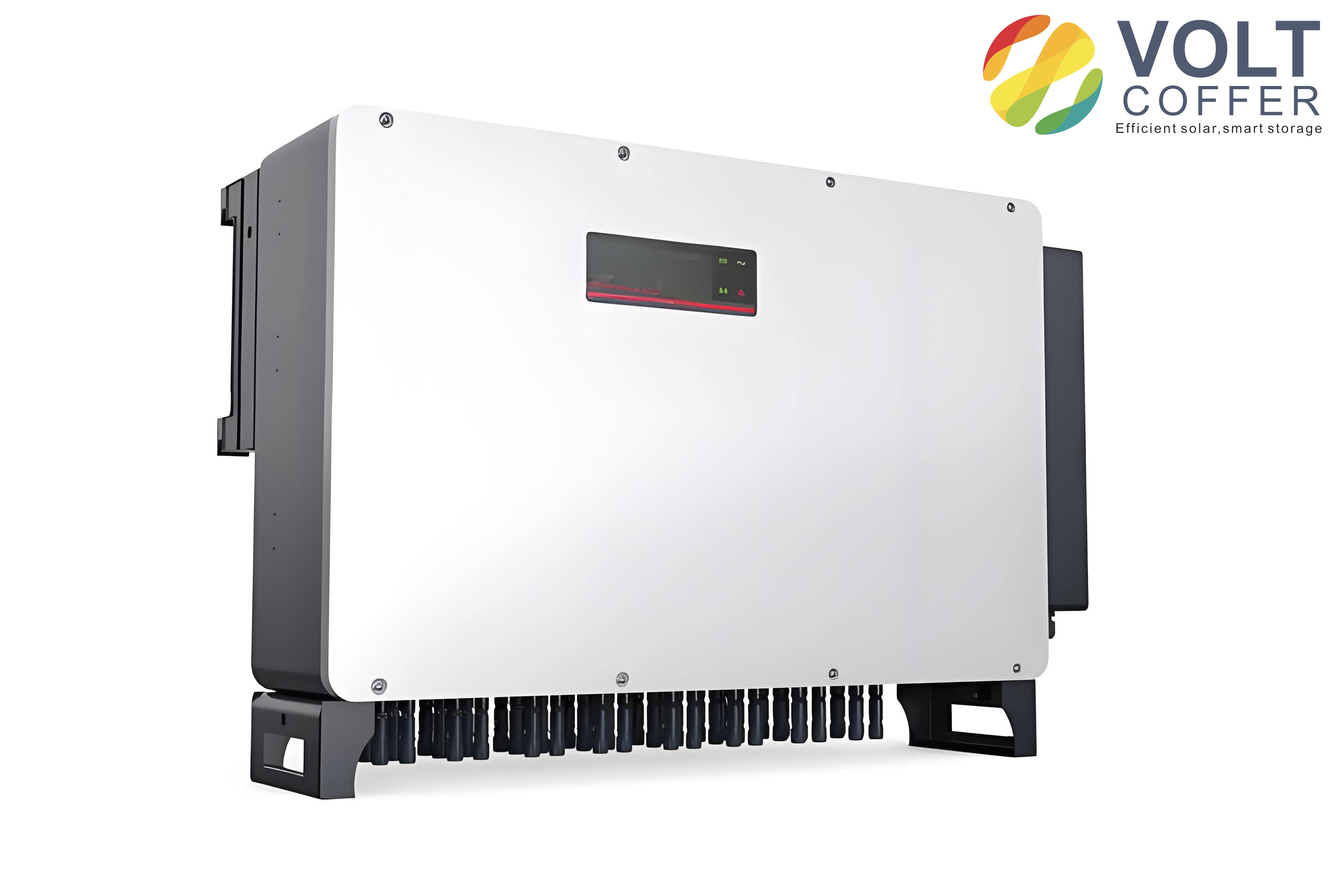
The structure of a typical PV system integrated into a distribution network is illustrated below, highlighting key components such as the solar inverter, which plays a critical role in reactive power control:
Voltage distribution in distribution systems is inherently complex due to the unbalanced nature of three-phase four-wire networks. The integration of PV systems alters power flow directions, potentially causing voltage fluctuations that exceed standard limits, typically set at ±10% or ±5% for voltage magnitude variations. Voltage unbalance, defined as the ratio of the maximum deviation of phase voltage from the average phase voltage, is a key metric. It can be expressed as:
$$ VU = \frac{\max\left( |U_a – U_{\text{avg}}|, |U_b – U_{\text{avg}}|, |U_c – U_{\text{avg}}| \right)}{U_{\text{avg}}} \times 100\% $$
where \( U_{\text{avg}} = \frac{1}{3} \sum_{p=a,b,c} U_p \). For PV systems, controlling voltage magnitude is crucial to limit unbalance, with a common threshold set below 2%. In unbalanced systems, the voltage at the point of common coupling (PCC) can be modeled as:
$$ V_s^p = V_o^p + \sum_{q=a,b,c} Z^{pq} \left( \frac{P_n^q + jQ_n^q}{V_o^q} \right) $$
where \( V_s^p \) and \( V_o^p \) are the PCC and transformer low-side voltages for phase p, respectively, \( Z^{pq} \) is the impedance matrix element, and \( P_n^q \) and \( Q_n^q \) are the net active and reactive power injections. This equation shows that voltage variations depend on line impedance and net power injection, underscoring the importance of controlling reactive power via solar inverters.
The proposed voltage regulation strategy focuses on utilizing the reactive power capabilities of solar inverters. A solar inverter can operate within a defined power factor range to inject or absorb reactive power. The maximum reactive power \( Q_{\text{PV-max}} \) for a given inverter is determined by its rated active power \( P_{\text{PV-rated}} \) and an oversizing factor \( \alpha \):
$$ Q_{\text{PV-max}} = P_{\text{PV-rated}} \sqrt{\alpha^2 – 1} $$
For instance, with \( \alpha = 1.25 \), the inverter can handle up to \( \pm 0.75 \times P_{\text{PV-rated}} \) in reactive power, allowing operation at power factors as low as 0.8. The capability curve of a typical solar inverter is shown in Table 1, which outlines the operational boundaries based on power factor and available reactive power.
| Parameter | Value |
|---|---|
| Rated Active Power (\( P_{\text{PV-rated}} \)) | 1.0 pu |
| Oversizing Factor (\( \alpha \)) | 1.25 |
| Maximum Reactive Power (\( Q_{\text{PV-max}} \)) | ±0.75 pu |
| Power Factor Range | 0.8 to 1.0 |
The power control strategy employs a stepwise adjustment of the power factor based on voltage measurements. Unlike linear droop control, which can cause continuous inverter operation and increased stress, this method divides the power factor range into four segments. Each segment corresponds to specific voltage thresholds, enabling adaptive reactive power control while minimizing voltage unbalance. For example, if the voltage difference between any phase and the average exceeds 0.02 pu, the inverter adjusts its power factor to inject or absorb reactive power, thereby reducing the unbalance. The power factor \( \text{PF}^p \) for phase p is set as a function of voltage magnitude \( U^p \):
$$ \text{PF}^p = f(U^p) =
\begin{cases}
1.0 & \text{if } U^p \leq 1.02 \, \text{pu} \\
0.95 & \text{if } 1.02 < U^p \leq 1.04 \, \text{pu} \\
0.9 & \text{if } 1.04 < U^p \leq 1.06 \, \text{pu} \\
0.8 & \text{if } U^p > 1.06 \, \text{pu}
\end{cases} $$
The reactive power \( Q_{\text{PV}}^p \) for each phase is then calculated as:
$$ Q_{\text{PV}}^p = P_{\text{PV}}^p \times \tan\left(\cos^{-1}(\text{PF}^p)\right) $$
This approach ensures that solar inverters respond only when necessary, reducing operational strain. To evaluate the strategy, a three-phase load flow analysis is performed using a modified Newton-Raphson method. The mismatch equations for current and power injections are linearized through a Jacobian matrix. For load buses, the current injection mismatches are:
$$ \Delta (I_r^i)^p = (I_{r,sp}^i)^p – \sum_{j=1}^n \sum_{q=a,b,c} \left( G_{ij}^{pq} (V_r^j)^q – B_{ij}^{pq} (V_m^j)^q \right) $$
$$ \Delta (I_m^i)^p = (I_{m,sp}^i)^p – \sum_{j=1}^n \sum_{q=a,b,c} \left( G_{ij}^{pq} (V_m^j)^q – B_{ij}^{pq} (V_r^j)^q \right) $$
For generator buses, the real power injection mismatch is:
$$ \Delta (P^i)^p = (P_{sp}^i)^p – (P_{\text{cal}}^i)^p $$
where \( (P_{\text{cal}}^i)^p = \sum_{j=1}^n \sum_{q=a,b,c} |V_i^p| |V_j^q| \left( G_{ij}^{pq} \cos(\delta_i^p – \delta_j^q) + B_{ij}^{pq} \sin(\delta_i^p – \delta_j^q) \right) \). The specified power terms account for PV generation and load demand:
$$ (P_{sp}^i)^p = P_{g}^i^p – P_{l}^i^p $$
$$ (Q_{sp}^i)^p = Q_{g}^i^p – Q_{l}^i^p $$
The integration of solar inverter reactive power control into this framework allows for dynamic voltage regulation. The computational process, summarized in Table 2, involves iterative solving of these equations to update voltage magnitudes and angles.
| Step | Description |
|---|---|
| 1 | Initialize voltage magnitudes and angles for all buses. |
| 2 | Calculate current and power mismatches using the above equations. |
| 3 | Form the Jacobian matrix based on partial derivatives. |
| 4 | Solve the linear system for voltage updates. |
| 5 | Repeat until mismatches are below tolerance. |
| 6 | Update reactive power of solar inverters based on voltage control strategy. |
Simulation studies are conducted using the IEEE 37-node unbalanced radial distribution feeder. The PV penetration level (PL) is defined as the ratio of peak PV active power to peak load apparent power:
$$ \text{PL} = \frac{P_{\text{PV-peak}}}{S_{\text{L-peak}}} \times 100\% $$
Tests are performed at low (25%) and high (85% to 150%) penetration levels to assess voltage regulation performance. At low penetration, the proposed method effectively reduces voltage unbalance without excessive reactive power injection. The power factor angles of solar inverters over a 24-hour period are shown in Table 3, indicating minimal adjustments and reduced operational stress.
| Time (h) | Phase A (degrees) | Phase B (degrees) | Phase C (degrees) |
|---|---|---|---|
| 6:00 | 0 | -5 | 3 |
| 12:00 | 2 | -8 | 1 |
| 18:00 | -1 | -6 | 4 |
At high penetration levels, such as 85%, traditional methods often result in voltage magnitudes exceeding 1.07 pu on certain phases. Applying the proposed strategy, the maximum recorded voltages across all buses remain within 1.06 pu, as detailed in Table 4. Additionally, voltage unbalance is kept below 2%, fulfilling standard requirements.
| Bus Number | Phase A (pu) | Phase B (pu) | Phase C (pu) |
|---|---|---|---|
| 31 | 1.04 | 1.05 | 1.03 |
| 32 | 1.05 | 1.06 | 1.04 |
| 33 | 1.03 | 1.05 | 1.02 |
A comparative analysis with traditional linear droop control reveals the advantages of the proposed method. While both approaches manage voltage magnitudes, the stepwise control reduces the frequency of power factor changes, thus lowering the operational strain on solar inverters. For instance, under linear droop control, power factor angles fluctuate frequently, whereas the proposed method maintains stable angles for extended periods. The maximum voltage unbalance across buses is summarized in Table 5, demonstrating superior performance of the proposed strategy.
| Control Method | Maximum VU (%) |
|---|---|
| Linear Droop Control | 2.45 |
| Proposed Method | 1.98 |
Furthermore, the proposed method enables higher PV penetration levels—up to 150%—without violating voltage limits. The reactive power injected or absorbed by solar inverters is comparable in both methods, leading to similar network power losses. However, the reduced operational adjustments in the proposed approach enhance the longevity and reliability of solar inverters.
In conclusion, the reactive power control-based voltage regulation strategy for solar inverters effectively addresses voltage unbalance and overvoltage issues in unbalanced distribution systems. By leveraging adaptive power factor adjustments, the method maintains voltage magnitudes and unbalance within standards while minimizing the operational stress on residential solar inverters. Simulation results confirm its efficacy across various penetration levels and weather conditions, promoting increased PV integration capacity in distribution networks. Future work could explore hybrid control schemes combining active and reactive power management for enhanced performance.