
Off-grid solar systems are increasingly vital for providing reliable electricity in remote areas where grid connectivity is challenging. However, the intermittent and unstable nature of photovoltaic (PV) output, influenced by environmental factors like sunlight and temperature, necessitates the integration of energy storage systems to balance power supply and demand. This paper addresses the need for efficient power management in off-grid solar systems by proposing a novel three-port converter based on a Boost circuit topology. Unlike traditional Buck/Boost converters that require multiple switching devices, our design minimizes component count, reduces costs, and simplifies control while enabling bidirectional energy flow for storage. We begin by detailing the system topology and operational principles, including dual-input and dual-output modes, and discuss the control strategies employed. Simulation and experimental results validate the effectiveness of our approach in enhancing the stability and efficiency of off-grid solar systems.
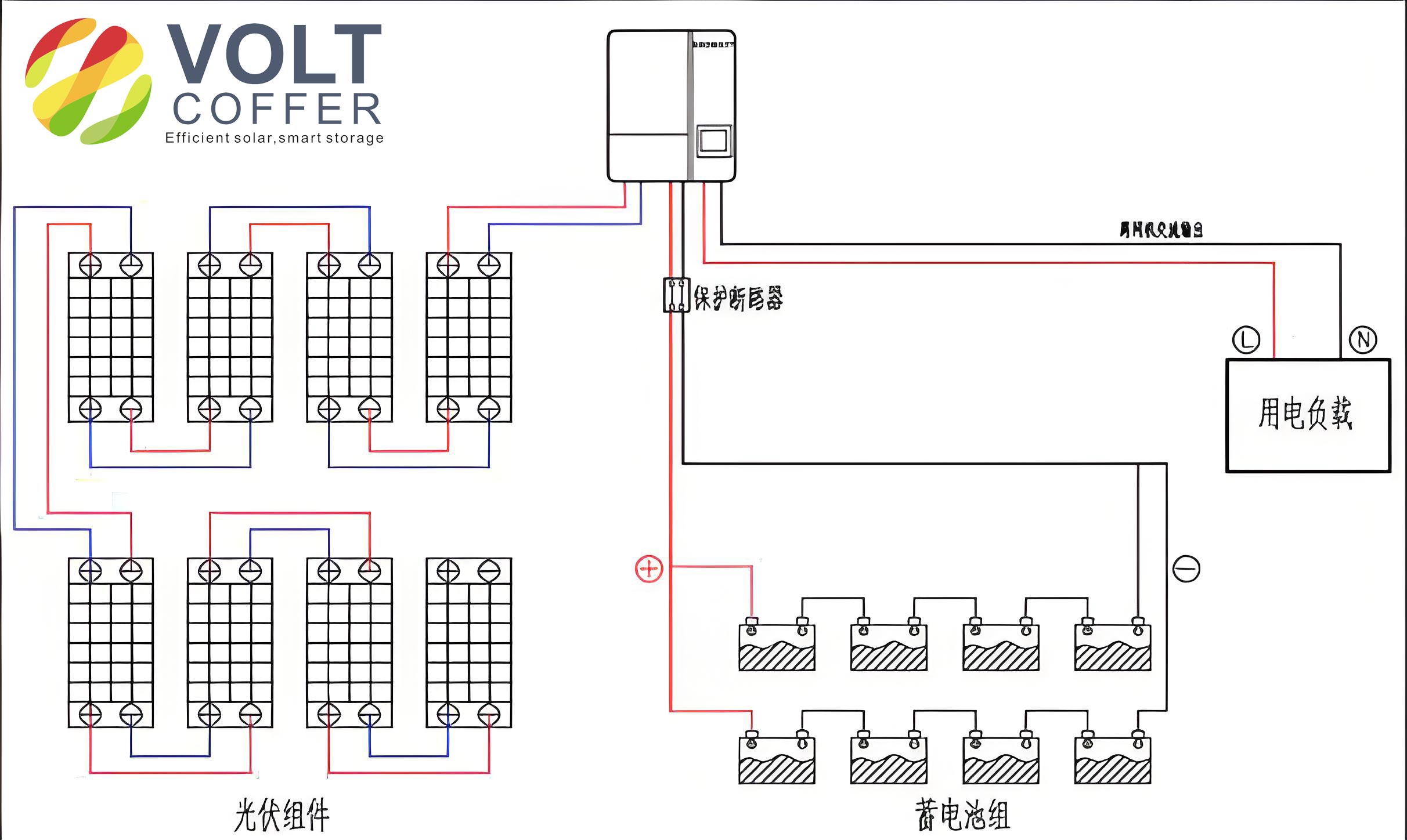
The core of our proposed three-port converter is a Boost circuit that serves as the primary energy transfer path between the PV source, battery storage, and load. This topology is particularly suited for off-grid solar systems due to its ability to handle varying power conditions seamlessly. In the dual-output mode, when PV generation exceeds load demand, surplus energy is stored in the battery via a dedicated path involving diodes and switches. Conversely, in the dual-input mode, during periods of low PV output, the battery supplements the load by discharging through a parallel path. This flexibility ensures continuous power supply, which is critical for the reliability of off-grid solar systems. Key advantages include reduced semiconductor count, lower manufacturing costs, and straightforward control implementation, making it an ideal solution for decentralized energy applications.
To understand the operational dynamics, we analyze the energy flow in both modes. In dual-output mode, the system operates in three distinct sub-modes: (a) the Boost switch is turned on, allowing the PV source to charge the inductor; (b) the Boost switch turns off, and energy from both the PV and inductor is delivered to the load; and (c) an auxiliary switch is activated to divert excess energy to the battery. The voltage relationship in this mode can be derived from inductor volt-second balance. Let \( U_{pv} \) represent the PV voltage, \( U_o \) the load voltage, \( U_{bat} \) the battery voltage, \( D_{sboost} \) the duty cycle of the Boost switch, and \( D_{s2} \) the duty cycle of the storage switch. The output voltage is given by:
$$ U_o = \frac{U_{pv} – U_{bat} D_{s2}}{1 – D_{s2} – D_{sboost}} $$
This equation highlights how the converter maintains voltage regulation while managing energy distribution in an off-grid solar system. For dual-input mode, the analysis involves four sub-modes: (a) PV charges the inductor with the Boost switch on; (b) the battery charges a second inductor via an auxiliary switch; (c) both sources supply the load when the Boost switch turns off; and (d) the system reverts to PV-only operation once the battery inductor current reaches zero. The output voltage in this mode is expressed as:
$$ U_o = \frac{U_{pv}}{1 – D_{sboost}} $$
Additionally, the charging time for the battery inductor in discontinuous conduction mode depends on the transformation ratio, load current, and circuit parameters, as shown below:
$$ D_c = M \sqrt{\frac{M – 1}{2 L f_s} \cdot \frac{I_o}{U_o}} $$
where \( M = U_o / U_{bat} \), \( L \) is the inductance, \( f_s \) the switching frequency, and \( I_o \) the load current. These formulas are essential for designing efficient off-grid solar systems with reliable energy storage integration.
| Mode | Description | Key Equations | Energy Flow |
|---|---|---|---|
| Dual-Output | PV power exceeds load demand; excess energy charges battery | $$ U_o = \frac{U_{pv} – U_{bat} D_{s2}}{1 – D_{s2} – D_{sboost}} $$ | PV → Load and PV → Battery |
| Dual-Input | PV power insufficient; battery supplements load | $$ U_o = \frac{U_{pv}}{1 – D_{sboost}} $$ | PV + Battery → Load |
Control strategies are pivotal for optimizing the performance of off-grid solar systems. We employ a perturb and observe (P&O) algorithm for maximum power point tracking (MPPT), which continuously adjusts the Boost switch duty cycle to maximize PV energy harvest. The algorithm compares successive power measurements to determine the direction of perturbation, ensuring rapid convergence to the maximum power point even under varying environmental conditions. For energy management, a proportional-integral (PI) controller processes the load current error to generate duty cycle adjustments for the auxiliary switches. In dual-output mode, the battery switch duty cycle \( D_{S2} \) is computed as:
$$ D_{S2} = 1 – D_{mppt} – D_{io} $$
where \( D_{mppt} \) is the MPPT-derived duty cycle and \( D_{io} \) is the PI output. In dual-input mode, the battery discharge switch duty cycle \( D_{S3} \) is given by:
$$ D_{S3} = 1 – D_{mppt} + D_{io} $$
This control framework ensures seamless transitions between modes, enhancing the reliability of off-grid solar systems. The use of simple arithmetic operations and standard control loops minimizes computational overhead, making it suitable for low-cost implementations in remote areas.
Simulation studies were conducted using PSIM software to validate the converter’s performance in an off-grid solar system. The parameters included a switching frequency of 20 kHz, PV voltage ranging from 23 V to 25 V, PV power between 30 W and 60 W, load voltage of 50 V, load power of 50 W, and battery voltage of 36 V. In dual-output mode, the simulation demonstrated that the MPPT algorithm successfully tracked the maximum power point of 60 W from the PV source, with the load drawing 50 W and the battery absorbing the surplus 10 W. Waveforms confirmed the theoretical analysis, showing proper switching sequences and inductor current profiles. For dual-input mode, when PV output dropped to 30 W, the battery supplied the deficit of 20 W to maintain a stable load power of 50 W. The battery inductor charging time \( D_c \) was measured at 0.092, aligning with predictions from the discontinuous conduction model.
| Parameter | Value |
|---|---|
| Switching Frequency | 20 kHz |
| PV Voltage Range | 23–25 V |
| PV Power Range | 30–60 W |
| Load Voltage | 50 V |
| Load Power | 50 W |
| Battery Voltage | 36 V |
Experimental validation was performed with a hardware prototype matching the simulation parameters. Key waveforms for both operational modes were captured, illustrating the switching signals and inductor currents. In dual-output mode, the Boost switch and battery switch drives aligned with the simulated sequences, and the inductor current exhibited continuous conduction with minimal ripple. For dual-input mode, the battery inductor current displayed discontinuous characteristics, as expected, with the Boost switch controlling the MPPT function independently. The results confirmed the converter’s ability to maintain stable operation in off-grid solar systems, with efficient energy transfer and rapid response to load variations.
In conclusion, the proposed three-port converter offers a robust solution for managing power in off-grid solar systems. By leveraging a Boost-based topology, it reduces component count and cost while providing bidirectional energy flow for storage integration. The control strategy, centered on MPPT and PI loops, ensures high precision and simplicity, making it adaptable to various off-grid applications. Simulation and experimental outcomes validate the design’s correctness and feasibility, highlighting its potential to enhance the reliability of off-grid solar systems in remote locations. Future work could explore scalability to higher power levels and integration with hybrid renewable sources to further improve the resilience of off-grid solar systems.
The development of such converters is crucial for advancing off-grid solar systems, as they address the inherent variability of solar energy. By efficiently balancing supply and demand through intelligent storage management, these systems can provide uninterrupted power, supporting economic and social development in isolated communities. As off-grid solar systems continue to evolve, innovations in power electronics like this three-port converter will play a key role in making renewable energy more accessible and dependable worldwide.