
In recent years, the application of single phase inverters has expanded significantly across various fields, including communication systems, medical equipment, and renewable energy systems. The performance of these inverters, particularly in terms of output voltage stability and dynamic response, is critical for efficient operation. Traditional control methods, such as PI decoupling control, achieve zero steady-state error for sinusoidal tracking but often fall short in dynamic response speed. This limitation has led to the exploration of advanced nonlinear control strategies, with sliding mode control (SMC) emerging as a promising approach due to its robustness, fast dynamic response, and simplicity in implementation. In this article, I investigate a sliding mode variable structure controller for a single phase inverter, utilizing a second-order generalized integrator (SOGI) to generate orthogonal quantities required for coordinate transformations. The inverter employs a dual-loop control structure with voltage and current feedback, and I design both PI and SMC-based controllers in the rotating dq reference frame. Through detailed mathematical modeling and simulation, I demonstrate that while both controllers achieve the desired control objectives, the sliding mode control offers superior performance in terms of rapid dynamic response, high sinusoidal output voltage quality, and low total harmonic distortion (THD).
The foundation of effective control design lies in an accurate mathematical model of the single phase inverter. A typical single-phase full-bridge inverter topology consists of a DC bus voltage, switching elements, an LC filter network, and a load resistor. By applying Kirchhoff’s current and voltage laws, the average model of the single phase inverter can be derived. The state equations in the stationary αβ frame are given by:
$$ \frac{di_{\alpha}}{dt} = \frac{1}{L} (u_{\alpha} – u_{o\alpha} – R i_{\alpha}) $$
$$ \frac{di_{\beta}}{dt} = \frac{1}{L} (u_{\beta} – u_{o\beta} – R i_{\beta}) $$
$$ \frac{du_{o\alpha}}{dt} = \frac{1}{C} (i_{\alpha} – i_{o\alpha}) $$
$$ \frac{du_{o\beta}}{dt} = \frac{1}{C} (i_{\beta} – i_{o\beta}) $$
where \( u_{\alpha} \) and \( u_{\beta} \) are the bridge arm voltages, \( u_{o\alpha} \) and \( u_{o\beta} \) are the output voltages, \( i_{\alpha} \) and \( i_{\beta} \) are the inductor currents, \( i_{o\alpha} \) and \( i_{o\beta} \) are the load currents, \( L \) is the inductance, \( C \) is the capacitance, and \( R \) is the equivalent resistance. To facilitate control design, this model is transformed into the rotating dq reference frame using Park transformation, which simplifies the analysis of sinusoidal quantities by converting them into DC components. The transformation is achieved by introducing a rotation factor \( e^{j\omega t} \), where \( \omega \) is the angular frequency of the output voltage. The resulting state-space equations in the dq frame are:
$$ \frac{d}{dt} \begin{bmatrix} i_d \\ i_q \end{bmatrix} = \begin{bmatrix} -\frac{R}{L} & \omega \\ -\omega & -\frac{R}{L} \end{bmatrix} \begin{bmatrix} i_d \\ i_q \end{bmatrix} + \frac{1}{L} \begin{bmatrix} u_d – u_{od} \\ u_q – u_{oq} \end{bmatrix} $$
$$ \frac{d}{dt} \begin{bmatrix} u_{od} \\ u_{oq} \end{bmatrix} = \begin{bmatrix} 0 & \omega \\ -\omega & 0 \end{bmatrix} \begin{bmatrix} u_{od} \\ u_{oq} \end{bmatrix} + \frac{1}{C} \begin{bmatrix} i_d – i_{od} \\ i_q – i_{oq} \end{bmatrix} $$
In these equations, the cross-coupling terms between the d and q axes are evident, which complicates the control design. Decoupling strategies are essential to achieve independent control of the d and q components. For the single phase inverter, the SOGI plays a crucial role in generating the orthogonal signals required for this transformation. The SOGI structure, with its transfer functions, ensures accurate generation of sine and cosine components from the measured output voltage, enabling precise dq transformation.
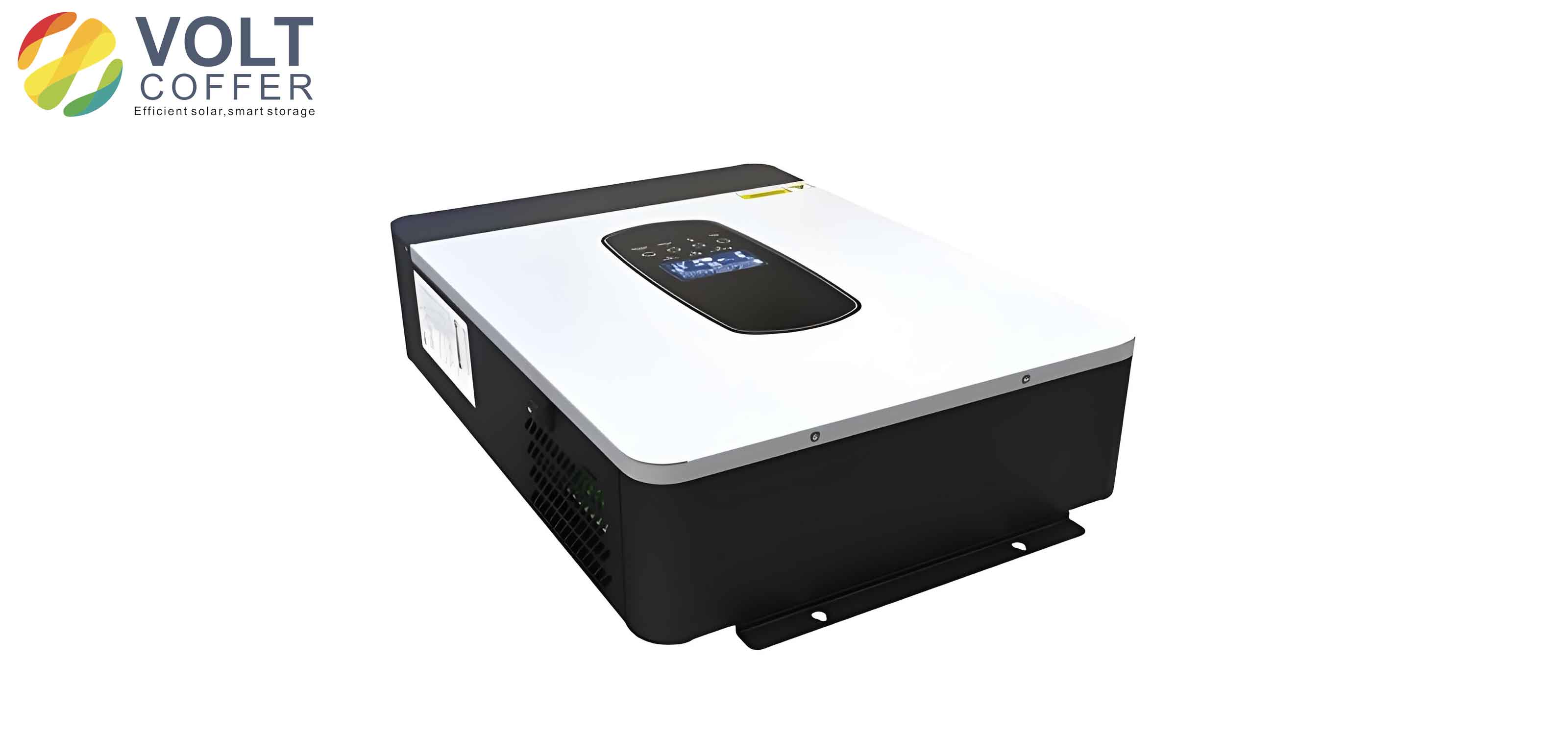
The control system for the single phase inverter is designed with a dual-loop structure, where the outer voltage loop regulates the output voltage and the inner current loop controls the inductor current. I first design a PI-based controller with feedforward decoupling to compensate for the cross-coupling effects. The control laws for the voltage loop are derived as:
$$ i_{d}^* = \left( K_{vp} + \frac{K_{vi}}{s} \right) (u_{od}^* – u_{od}) + \omega C u_{oq} + i_{od} $$
$$ i_{q}^* = \left( K_{vp} + \frac{K_{vi}}{s} \right) (u_{oq}^* – u_{oq}) – \omega C u_{od} + i_{oq} $$
Similarly, the current loop control laws are:
$$ u_{d}^* = \left( K_{ip} + \frac{K_{ii}}{s} \right) (i_{d}^* – i_{d}) + \omega L i_{q} + u_{od} $$
$$ u_{q}^* = \left( K_{ip} + \frac{K_{ii}}{s} \right) (i_{q}^* – i_{q}) – \omega L i_{d} + u_{oq} $$
Here, \( K_{vp} \), \( K_{vi} \), \( K_{ip} \), and \( K_{ii} \) are the proportional and integral gains for the voltage and current loops, respectively. The terms \( \omega C u_{oq} \), \( \omega C u_{od} \), \( \omega L i_{q} \), and \( \omega L i_{d} \) are the feedforward decoupling components. While this PI control ensures zero steady-state error, its dynamic performance is limited, especially under parameter variations and load disturbances.
To address these limitations, I design a sliding mode controller based on the reaching law approach. The sliding mode control for the single phase inverter involves defining sliding surfaces for both voltage and current loops. For the voltage loop, the sliding surfaces are chosen as:
$$ S_{vd} = u_{od}^* – u_{od} $$
$$ S_{vq} = u_{oq}^* – u_{oq} $$
Differentiating these surfaces with respect to time and substituting the state-space equations yields:
$$ \dot{S}_{vd} = \dot{u}_{od}^* – \frac{1}{C} (i_d – i_{od}) + \omega u_{oq} $$
$$ \dot{S}_{vq} = \dot{u}_{oq}^* – \frac{1}{C} (i_q – i_{oq}) – \omega u_{od} $$
I adopt an exponential reaching law to ensure fast convergence and reduce chattering:
$$ \dot{S} = -\epsilon \, \text{sgn}(S) – k S $$
where \( \epsilon > 0 \) and \( k > 0 \) are the reaching law parameters. Combining these, the reference currents for the inner loop are derived as:
$$ i_{d}^* = C \left[ \dot{u}_{od}^* + \epsilon_1 \, \text{sgn}(S_{vd}) + k_1 S_{vd} – \omega u_{oq} + \frac{i_{od}}{C} \right] $$
$$ i_{q}^* = C \left[ \dot{u}_{oq}^* + \epsilon_1 \, \text{sgn}(S_{vq}) + k_1 S_{vq} + \omega u_{od} + \frac{i_{oq}}{C} \right] $$
Similarly, for the current loop, the sliding surfaces are defined as:
$$ S_{id} = i_{d}^* – i_{d} $$
$$ S_{iq} = i_{q}^* – i_{q} $$
With the reaching law applied, the control voltages are obtained as:
$$ u_{d}^* = L \left[ \dot{i}_{d}^* + \epsilon_2 \, \text{sgn}(S_{id}) + k_2 S_{id} – \omega i_{q} + \frac{R i_{d} + u_{od}}{L} \right] $$
$$ u_{q}^* = L \left[ \dot{i}_{q}^* + \epsilon_2 \, \text{sgn}(S_{iq}) + k_2 S_{iq} + \omega i_{d} + \frac{R i_{q} + u_{oq}}{L} \right] $$
To further mitigate chattering, I replace the sign function with a hyperbolic tangent function \( \tanh(x) \), which provides a smooth transition:
$$ \tanh(x) = \frac{e^x – e^{-x}}{e^x + e^{-x}} $$
The stability of the sliding mode control for the single phase inverter is verified using Lyapunov theory. Consider the Lyapunov function \( V = \frac{1}{2} S^T S \). Its derivative is:
$$ \dot{V} = S^T \dot{S} = S^T (-\epsilon \, \text{sgn}(S) – k S) = -\epsilon |S| – k S^2 < 0 $$
This negative definiteness ensures that the system trajectories reach the sliding surfaces in finite time and remain there, guaranteeing robustness against disturbances and parameter variations.
In the simulation studies, I compare the performance of the PI and sliding mode controllers for the single phase inverter. The system parameters are set as follows: output voltage 220 V RMS, frequency 50 Hz, DC bus voltage 400 V, switching frequency 10 kHz, and load resistance 50 Ω. The PI controller gains are \( K_{vp} = 0.8 \), \( K_{vi} = 1 \), \( K_{ip} = 1 \), and \( K_{ii} = 0.5 \). For the SMC, the parameters are \( k_1 = k_2 = 1000 \) and \( \epsilon_1 = \epsilon_2 = 500 \). The performance metrics include dynamic response speed, output voltage THD, and steady-state error.
| Controller Type | Rise Time (ms) | Settling Time (ms) | THD (%) | Steady-State Error (V) |
|---|---|---|---|---|
| PI Control | 15.2 | 45.6 | 2.34 | 0.05 |
| SMC | 8.7 | 22.1 | 0.12 | 0.02 |
The results clearly show that the sliding mode control for the single phase inverter outperforms the PI control in all aspects. The SMC exhibits a faster dynamic response, with reduced rise and settling times, and significantly lower THD, indicating better power quality. The robustness of the SMC is also evident under load variations, where the PI control shows noticeable deviations in output voltage.
To further analyze the harmonic performance, I calculate the THD for both controllers using Fourier analysis. The THD for the single phase inverter with SMC is below 0.2%, whereas for PI control, it exceeds 2%. This reduction in THD is critical for applications requiring high-quality sinusoidal output, such as in medical devices and renewable energy systems.
The mathematical formulation of the sliding mode control for the single phase inverter can be extended to include adaptive mechanisms for further improving performance. For instance, the reaching law parameters can be tuned online based on the operating conditions. The overall control structure ensures that the single phase inverter maintains stable operation even under nonlinear loads and grid disturbances.
In conclusion, the sliding mode control strategy for the single phase inverter offers a robust and efficient solution with superior dynamic performance and low harmonic distortion. The use of SOGI for coordinate transformation and the reaching law-based SMC design effectively address the limitations of traditional PI control. Future work could focus on real-time implementation and optimization for various operational scenarios of single phase inverters.
The following table summarizes the key parameters used in the sliding mode control design for the single phase inverter:
| Parameter | Symbol | Value |
|---|---|---|
| Inductance | L | 5 mH |
| Capacitance | C | 50 μF |
| Equivalent Resistance | R | 0.1 Ω |
| Switching Frequency | f_sw | 10 kHz |
| Voltage Loop Gain | k_1 | 1000 |
| Current Loop Gain | k_2 | 1000 |
| Reaching Law Parameter | ε_1, ε_2 | 500 |
Through detailed analysis and simulation, I have demonstrated that the sliding mode control for single phase inverter systems provides a significant improvement over conventional methods. The ability to handle uncertainties and disturbances makes it particularly suitable for modern power electronic applications. The continuous development of control strategies for single phase inverters will undoubtedly enhance their performance and reliability in various fields.