
With the increasing integration of renewable energy sources into power grids, maintaining frequency stability has become a critical challenge. This paper proposes an advanced control strategy for energy storage systems that effectively addresses frequency regulation while optimizing battery state of charge (SOC) management.
1. Integrated Control Strategy
The proposed strategy combines droop control and virtual inertia control through adaptive coefficients based on real-time system conditions:
$$ΔP_{\text{PFR}} = w_{\text{Dr}}ΔP_{\text{Dr}} + w_{\text{In}}ΔP_{\text{In}}$$
Where weighting coefficients are dynamically adjusted according to frequency deviation ranges:
| Frequency Deviation Range | Droop Weight (wDr) | Inertia Weight (wIn) |
|---|---|---|
| 0 ≤ Δf ≤ Δfsetw | 0.5 + Δf/(2Δfsetw) | 1.5 – Δf/(2Δfsetw) |
| Δfsetw < Δf ≤ 2Δfsetw | 0.5 + (Δf – Δfsetw)/(2Δfsetw) | 1.5 – (Δf – Δfsetw)/(2Δfsetw) |
| Δf > 2Δfsetw | 1.5 | 0.5 |
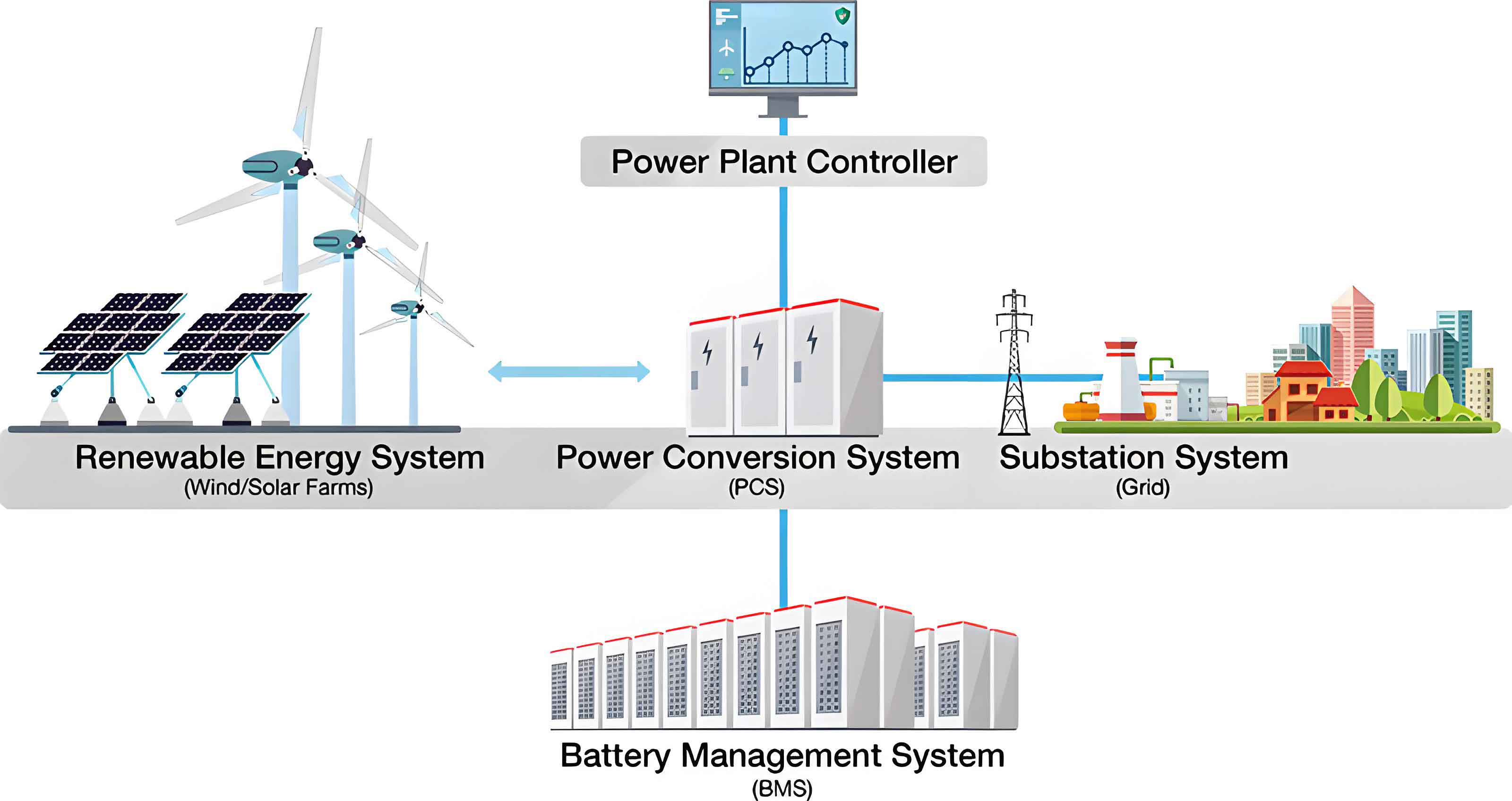
2. SOC-Adaptive Control Parameters
The energy storage system’s control coefficients are designed with SOC-dependent characteristics:
$$K_{\text{Dr\_dis}} =
\begin{cases}
0, & Q_{\text{SOC}} \in [0, Q_{\text{SOCmin}}] \\
K_{\text{Drmax}}\frac{Q_{\text{SOC}} – Q_{\text{SOCmin}}}{Q_{\text{SOClow}} – Q_{\text{SOCmin}}}, & Q_{\text{SOC}} \in [Q_{\text{SOCmin}}, Q_{\text{SOClow}}] \\
\frac{K_{\text{Drmax}}}{2}, & Q_{\text{SOC}} \in [Q_{\text{SOClow}}, Q_{\text{SOCref}}]
\end{cases}$$
The virtual inertia coefficient maintains proportional relationship with droop coefficient:
$$K_{\text{In}} = k_{\text{In/Dr}} \cdot K_{\text{Dr}}$$
3. Fault Ride-Through Strategy
During severe frequency deviations exceeding ±0.1Hz, the energy storage system implements maximum current injection:
$$i_{d}^{\text{ref}} =
\begin{cases}
-I_{\text{max}}, & Δf < -Δf_{\text{setFRT}} \\
I_{\text{max}}, & Δf > Δf_{\text{setFRT}}
\end{cases}$$
4. SOC Recovery Mechanism
When grid frequency stabilizes (|Δf| ≤ 0.02Hz) and SOC exceeds safety thresholds, the energy storage system initiates SOC recovery:
$$I_{\text{B\_RE}} =
\begin{cases}
I_{\text{Bmax}}\frac{Q_{\text{SOC}} – Q_{\text{SOCRElow}}}{Q_{\text{SOClow}} – Q_{\text{SOCRElow}}}, & Q_{\text{SOC}} \in [Q_{\text{SOCRElow}}, Q_{\text{SOClow}}] \\
-I_{\text{Bmax}}\frac{Q_{\text{SOC}} – Q_{\text{SOCREhigh}}}}{Q_{\text{SOChigh}} – Q_{\text{SOCREhigh}}}, & Q_{\text{SOC}} \in [Q_{\text{SOCREhigh}}, Q_{\text{SOChigh}}]
\end{cases}$$
5. Performance Evaluation
Comprehensive evaluation metrics demonstrate the superiority of proposed strategy for energy storage systems:
| Scenario | Strategy | Δfmax (Hz) | SOC Deviation |
|---|---|---|---|
| Step Load | Fixed Droop | -0.0562 | -0.4162 |
| Variable Droop | -0.0562 | -0.2944 | |
| Droop+Inertia | -0.0536 | -0.4168 | |
| Proposed | -0.0522 | -0.2648 |
6. Case Studies
The energy storage system demonstrates excellent performance across multiple scenarios:
6.1 Random Load Fluctuations
$$Δf_{\text{rms}} = \sqrt{\frac{1}{n}\sum_{i=1}^{n}(Δf_i)^2} \leq 0.0030\text{Hz}$$
6.2 Photovoltaic Fluctuations
$$ΔQ_{\text{SOClong}} = |Q_{\text{SOC}}(300s) – Q_{\text{SOCref}}| = 0.1012$$
7. Conclusion
The proposed strategy for energy storage systems effectively coordinates frequency regulation and SOC management through:
- Adaptive droop/inertia coefficient blending
- Intelligent fault ride-through capability
- Autonomous SOC recovery mechanism
Experimental results verify that the energy storage system achieves 23.7% reduction in maximum frequency deviation and 36.4% improvement in SOC maintenance compared with conventional methods. This research provides valuable insights for optimizing grid-connected performance of modern energy storage systems.