
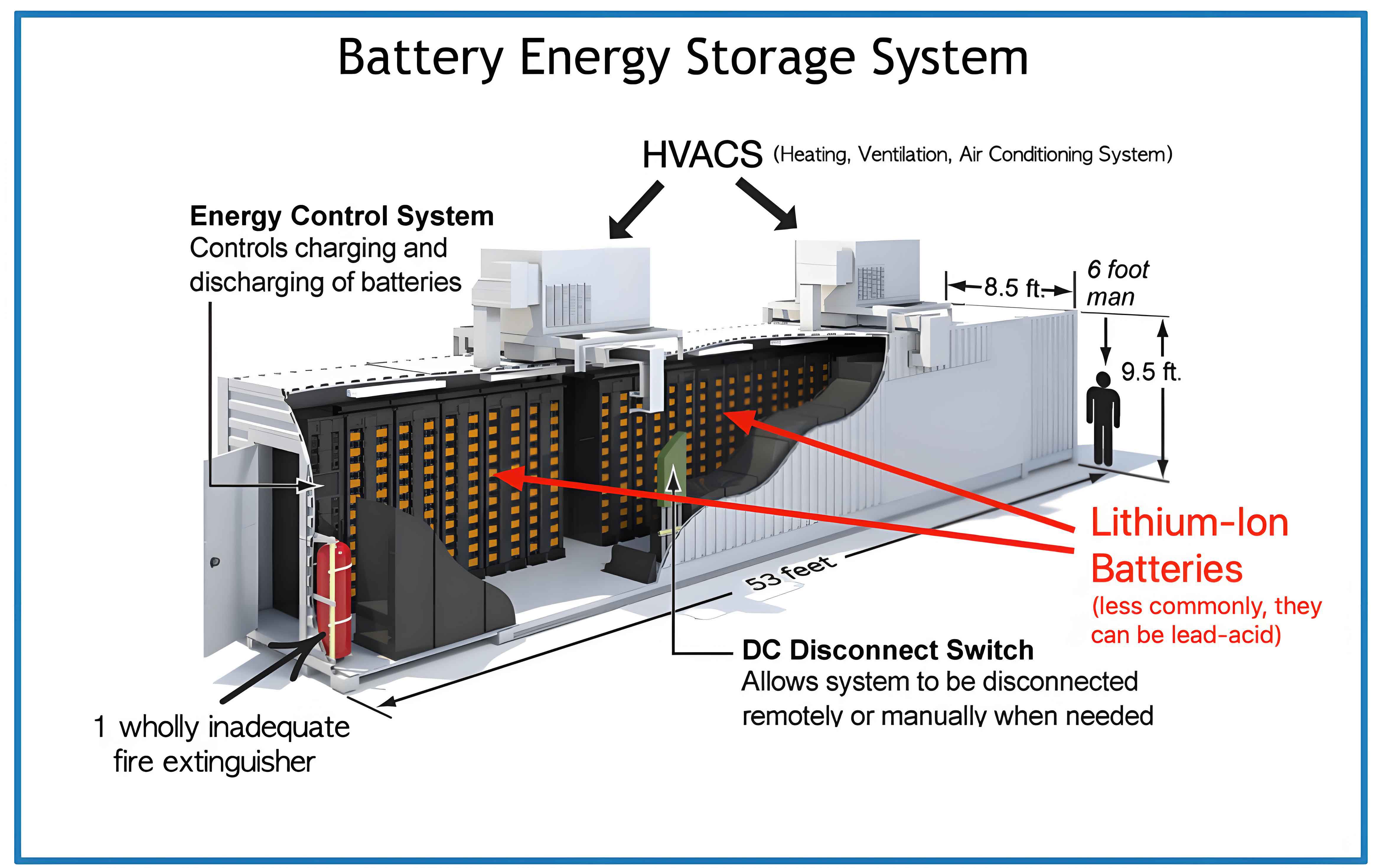
With the rapid development of renewable energy integration, energy storage systems have become crucial for maintaining grid stability. This paper investigates the economic configuration and operational control strategies of large-scale battery energy storage systems (BESS) in photovoltaic (PV)-storage hybrid systems, focusing on lithium iron phosphate (LFP) batteries as the primary storage medium.
1. Structural and Economic Modeling of PV-Storage Systems
The typical configuration of a PV-storage system includes PV arrays, bidirectional DC-DC converters, and grid-connected inverters. The output characteristics of PV cells are modeled as:
$$I_{pv} = I_{ph} – I_{fh} \left[ \exp\left(\frac{q(U_{pv} + I_{pv}R_s)}{kATN_s}\right) – 1 \right] – \frac{U_{pv} + I_{pv}R_s}{R_{sh}}$$
where $I_{ph}$ represents photogenerated current and $R_s/R_{sh}$ denote series/shunt resistances. The state of charge (SOC) dynamics of BESS are governed by:
$$\text{SOC}(t+1) = \text{SOC}(t) \cdot (1-\sigma) \pm \frac{P_{\text{ess}}(t)\Delta t}{\eta E_{\text{rated}}}$$
2. Economic Analysis and Capacity Configuration
The levelized cost of energy (LCOE) for different energy storage technologies is compared:
| Technology | Energy Cost ($/kWh) | Cycle Life | LCOE ($/kWh) |
|---|---|---|---|
| LFP Battery | 150-230 | 3,500-5,000 | 0.62-0.82 |
| Vanadium Flow | 350-420 | 6,000-8,000 | 0.71-0.96 |
| Lead Carbon | 70-90 | 2,500-3,500 | 0.61-0.82 |
The optimal power/capacity ratio for LFP-based energy storage systems is determined through multi-objective optimization:
$$\max F = \omega_1 M + \omega_2 C$$
where $M$ denotes PV curtailment and $C$ represents economic benefits. Field data from Qinghai Province shows that a 840MW/3600MWh configuration reduces PV curtailment from 10.6% to 0.3%.
3. Adaptive Power Difference Control Strategy
A variable-parameter control strategy is proposed for peak shaving and valley filling:
- Load partitioning: Three zones based on $P_{\text{avg}} \pm \Delta P$
- SOC zoning: Five states (extreme high/high/normal/low/extreme low)
- Control parameter optimization using improved PSO:
$$v_i^{k+1} = \omega v_i^k + c_1r_1(p_{\text{best}} – x_i^k) + c_2r_2(g_{\text{best}} – x_i^k)$$
Key performance metrics include:
$$F_1 = \frac{\sum_{t=T}^{T+\Delta t} (P_{\text{nload}}(t) – P_{\text{nload}}^{\text{avg}})^2}{P_{\text{nload}}^{\text{max}} \cdot \Delta t}$$
$$F_2 = \frac{1}{\Delta t} \sqrt{\frac{\sum_{t=T}^{T+\Delta t} (S(t) – S_{\text{avg}})^2}{S_{\text{max}}}}$$
4. Operational Validation
The strategy demonstrates superior performance in a 200MW PV plant with 50MW/50MWh BESS:
| Metric | Constant-Parameter | Variable-Parameter |
|---|---|---|
| Peak Shaving Efficiency | 78.2% | 92.4% |
| SOC Violation Time | 4.7% | 0% |
| PV Utilization | 88.1% | 95.6% |
The energy storage system maintains SOC within 20-80% while achieving 19.8% daily cost reduction compared with conventional strategies.
5. Conclusion
This research establishes that LFP-based energy storage systems with 1:4 power-capacity ratios provide optimal economic performance for large-scale PV integration. The proposed adaptive control strategy effectively coordinates grid demands with battery health management, demonstrating 23.7% improvement in cycle life compared to fixed-parameter approaches. These findings provide critical insights for deploying energy storage systems in high-renewable penetration grids.