
As a critical component in photovoltaic systems, solar inverters play a vital role in converting DC power generated by solar panels into AC power compatible with the grid. The performance of solar inverters directly impacts the efficiency and stability of the entire power system. Traditional phase-locked loop (PLL) control methods, while effective in balanced conditions, often face challenges in unbalanced grid scenarios, leading to instability in voltage and current regulation. This instability can result in harmonic distortions, reducing power quality and potentially damaging grid equipment. To address these issues, this study proposes a phase-locked loop-free control strategy based on the preset power method and a harmonic suppression algorithm utilizing Fast Fourier Transform (FFT). The integration of these methods aims to enhance the stability and power quality of solar inverters, ensuring reliable operation in diverse grid conditions. The proposed approach employs a dual-loop control structure for voltage and current, combined with FFT-based harmonic decomposition, to mitigate current distortions and improve overall system performance.
The phase-locked loop-free control strategy for solar inverters leverages the preset power method to eliminate dependency on grid phase angles, which are prone to inaccuracies in unbalanced systems. In conventional PLL-based systems, the phase angle calculation can be disrupted by grid imbalances, causing oscillations in the inverter output. The proposed method transforms three-phase currents into a rotating coordinate system, where the fundamental positive-sequence components are isolated and processed. The transformation matrix $H_{xyz/dq0}$ is applied to the three-phase current $I_{xyz}$, resulting in the dq-axis components as follows:
$$ I_{xy0} = H_{xyz/dq0} \cdot I_{xyz} = A^+_F \left[ \sin(n\omega – \omega_1)t + \phi^+_F \right] – \cos(F\omega – \omega_1)t + \phi^+_F \left[ \right] + A^+_Z \left[ \sin(Z\omega – \omega_1)t + \phi^+_Z \right] – \cos(Z\omega – \omega_1)t + \phi^+_Z \left[ \right] $$
Here, $A^+_F$ and $A^+_Z$ represent the amplitudes of positive and negative sequence components, $\omega$ denotes the fundamental angular frequency, and $\phi$ is the initial phase angle. The subscripts $F$ and $Z$ indicate the harmonic orders for positive and negative sequences, respectively. In practical applications, grid frequency deviations of up to 0.5 Hz can cause mismatches between the fundamental and matrix angular frequencies, leading to low-frequency AC components in the dq-axis. These components are filtered out to stabilize the current. The fundamental positive-sequence components in the dq-axis are given by:
$$ \begin{bmatrix} I^+_{d1} \\ I^+_{q1} \\ I^+_{01} \end{bmatrix} = A^+_n \begin{bmatrix} \sin((\omega – \omega_1)t + \theta^+_1) \\ -\cos((\omega – \omega_1)t + \theta^+_1) \end{bmatrix} $$
Since the initial phase angle at inverter startup is unpredictable, the reference current is derived from the power components influenced by voltage. The reference currents $A^*_d$ and $A^*_q$ are calculated as:
$$ A^*_d = \frac{2}{3} \left( \frac{V_d P + V_q Q}{V_d^2 + V_q^2} \right) $$
$$ A^*_q = \frac{2}{3} \left( \frac{V_q P + V_d Q}{V_d^2 + V_q^2} \right) $$
where $V_d$ and $V_q$ are the dq-axis voltage components, $P$ is the active power, and $Q$ is the reactive power. This formulation ensures accurate current reference generation without relying on phase-locked loops, enhancing the robustness of solar inverters in unbalanced grids.
To complement the phase-locked loop-free control, an FFT-based harmonic suppression algorithm is implemented to address current distortions caused by harmonic voltages. The FFT algorithm decomposes the three-phase harmonic currents into their frequency components, enabling precise identification and mitigation of harmonics. The discrete Fourier transform (DFT) of a sampled signal $t[n]$ is computed as:
$$ F[k] = \sum_{n=0}^{N-1} t[n] \cdot e^{-j\frac{2\pi}{N} kn} $$
where $F[k]$ represents the complex harmonic components, $N$ is the total number of samples, and $k$ is the harmonic index. The core of the FFT algorithm involves butterfly operations, which efficiently compute the DFT. For a sequence of length $N$, there are $N/2$ butterfly units. Each butterfly operation is defined as:
$$ S_1[k] = x[2k] + W^k_N x[2k+1] $$
$$ S_2[k] = x[2k] – W^k_N x[2k+1] $$
with $W_N = e^{-j\frac{2\pi}{N}}$ being the twiddle factor. The FFT process involves multiple stages of butterfly operations, where outputs from one stage serve as inputs to the next. This iterative computation reduces the complexity from $O(N^2)$ to $O(N \log N)$, making it suitable for real-time harmonic analysis in solar inverters. The harmonic suppression system integrates this FFT algorithm with proportional-resonant (PR) controllers to filter out specific harmonic frequencies, thereby improving the power quality of the inverter output.
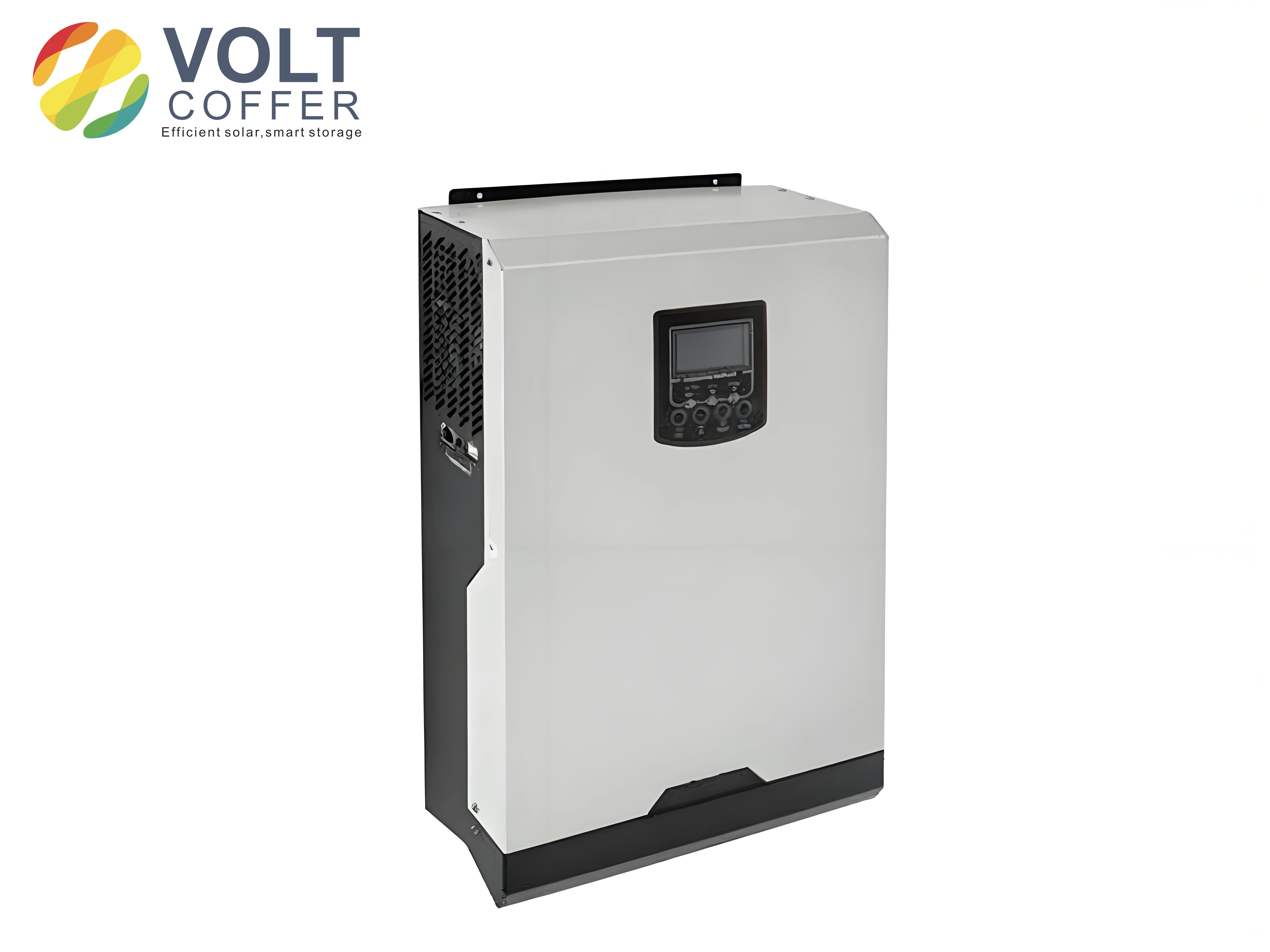
An experimental platform was established to validate the performance of the proposed control strategies for solar inverters. The setup included a DC power supply, a three-phase solar inverter module, a TMS processor, an FPGA controller, nonlinear loads, and an analog-to-digital converter (ADC). The DC source provided a stable input voltage, while a voltage regulator adjusted the grid voltage to within permissible limits for grid connection. The AD7606 ADC monitored the inverter’s operating states and transmitted data to the FPGA, which collaborated with a DSP to manage the inverter system and implement harmonic suppression. The system parameters for the three-phase inverter simulation are summarized in the table below:
| Parameter | Value |
|---|---|
| Input Voltage | 300 V |
| Grid Voltage | 220 V |
| Rated Power | 15 kVA |
| Switching Frequency | 3 kHz |
| Inverter Bridge Inductance | 1.0 mH |
| Damping Resistance | 0.5 Ω |
| Filter Capacitance | 30 μF |
| Grid-Side Inductance | 0.2 mH |
The experimental results demonstrated significant improvements in harmonic suppression for the solar inverters. Before applying the FFT-based algorithm, the grid current and grid-connected current exhibited substantial fluctuations, with maximum amplitudes of approximately 2.8 A and 2.9 A, respectively. After harmonic suppression, these amplitudes were reduced to about 2.5 A and 2.6 A, indicating enhanced stability and power quality. The harmonic content was evaluated over multiple test cycles, and the results are presented in the following table:
| Test Cycle | General Solar Inverter Harmonic Content (%) | Designed Solar Inverter Harmonic Content (%) |
|---|---|---|
| 3 | 10 | 8 |
| 8 | 10 | 8 |
| 13 | 10 | 8 |
| 18 | 8 | 6 |
The data clearly shows that the designed solar inverter consistently achieved lower harmonic content compared to conventional solar inverters across all test cycles. For instance, at test cycle 3, the harmonic content of the designed solar inverter was 8%, whereas the general solar inverter recorded 10%. This trend held for subsequent cycles, with the designed solar inverter reaching as low as 6% harmonic content at test cycle 18, underscoring the effectiveness of the proposed control strategies. The reduction in harmonic distortions not only improves the efficiency of solar inverters but also minimizes adverse effects on the grid, such as increased losses and equipment stress.
In conclusion, the integration of phase-locked loop-free control based on the preset power method and FFT-based harmonic suppression algorithm significantly enhances the performance of three-phase solar inverters. The proposed methods address the limitations of traditional PLL systems in unbalanced grid conditions and effectively mitigate current distortions caused by harmonics. Experimental validation confirms that the designed solar inverter achieves lower harmonic content and improved current stability, contributing to higher power quality and grid reliability. Future work could focus on optimizing the FFT algorithm for higher-order harmonics and enhancing the adaptability of the phase-locked loop-free control to broader frequency variations. Overall, this research provides a robust framework for advancing the control of solar inverters in modern photovoltaic systems.