
In my extensive research into the manufacturing processes of new energy vehicle energy storage systems, I have focused on the assembly segment equipment for Lithium Iron Phosphate (LFP) prismatic aluminum shell li-ion battery cells. This segment is critical for ensuring the performance, safety, and efficiency of li-ion batteries, which are the backbone of modern electric vehicles. The assembly segment encompasses a series of sophisticated procedures including winding, hot pressing, welding, Mylar wrapping, casing, and inspection. Each step involves precise engineering to maintain the integrity and functionality of the li-ion battery. Through this study, I aim to dissect the workflow, subsystem modules, and technical parameters of these equipment, providing a comprehensive overview that can aid in the development and application of new technologies in li-ion battery production.
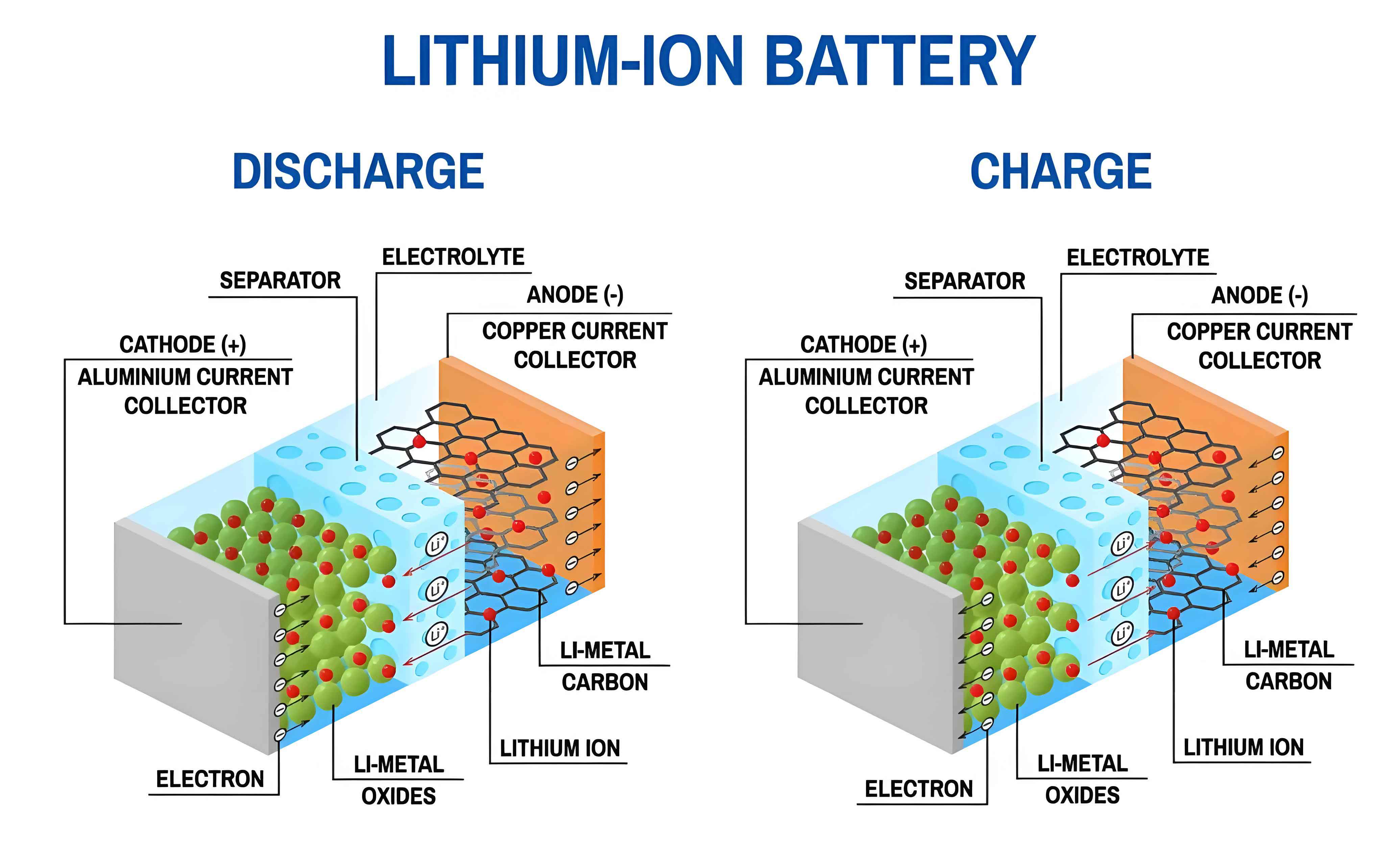
The li-ion battery manufacturing process is complex, requiring high precision and automation to meet the demands of scalability and quality. My research delves into the assembly segment, which transforms electrode materials into functional battery cells. This segment is pivotal for the overall performance of the li-ion battery, as it directly affects parameters such as energy density, cycle life, and safety. In this article, I will explore each major equipment type in detail, utilizing tables and formulas to summarize key technical aspects. The goal is to enhance understanding of core devices like winding machines, hot presses, welders, and inspection systems, thereby fostering innovation in li-ion battery production lines.
Winding Equipment for LFP Prismatic Aluminum Shell Li-ion Battery Cells
Winding is a fundamental process in the assembly segment of li-ion battery manufacturing. It involves coiling the positive electrode sheet, separator, and negative electrode sheet together to form the core of the li-ion battery. The winding equipment must ensure precise alignment, tension control, and dimensional accuracy to produce consistent and reliable li-ion battery cells. My analysis of winding equipment covers its workflow, functional modules, mechanical principles, and technical specifications.
The workflow of winding equipment, as illustrated in my studies, begins with the unwinding of electrode and separator rolls, proceeds through various correction and tension control stages, and culminates in the winding, cutting, and taping of the core. Each module plays a vital role in maintaining the quality of the li-ion battery. For instance, the unwinding module uses servo motors and ball screws to control unwinding speed and correction, with an unwinding speed exceeding 2.5 m/s and correction accuracy of ±0.1 mm. The automatic roll change module enables seamless transition between rolls, minimizing downtime in li-ion battery production.
Key functional modules include:
- Unwinding Module: Fixes and unwinds electrode and separator rolls. Servo motors control speed, with correction via servo and ball screw mechanisms.
- Automatic Roll Change Module: Switches electrode rolls automatically, with misalignment ≤1 mm during changeover.
- Automatic Correction Module: Monitors and corrects edge deviations in real-time, achieving accuracies of ±0.1 mm for unwinding and process correction, and ±0.01 mm for feeding correction.
- Tension Control Module: Regulates material tension to prevent deformation of the bare li-ion battery core. Tension range for electrode sheets is 200-2000 N, with fluctuations within 5%.
- Tension Detection Module: Measures and displays tension values and curves, storing data correlated with production time and core barcodes. Measurement error ≤1.0% at a frequency ≥30 Hz.
- Tab Folding Detection and Sheet Length Counting Module: Detects tab folding before and during winding, and measures lengths of electrode sheets and separators. Length counting error is ±2 mm.
- Embossing Roller Module: Creates indentations or protrusions on the cathode sheet to increase interlayer spacing in the li-ion battery core. Interlayer gap is controlled at (20±10) μm.
- Feeding Module: Guides electrode sheets into the winding needle. Positioning accuracy of the sheet head in the core is ±0.5 mm, with feeding deviation ≤0.1 mm.
- Cutting Module: Precisely cuts electrode sheets and separators. Electrode sheet cutting uses guillotine-style knives with a lifespan ≥2 million cycles, and burr height ≤10 μm. Separator cutting employs hot knives with a lifespan ≥500,000 cycles.
- Termination Tape Pasting Module: Cuts and applies tape to the tail of the bare core. Pasting position accuracy is ±3.0 mm, with no wrinkles allowed.
- Winding Module: Performs the winding process using multiple servo motors and winding needles. Alignment accuracy for electrode sheets is ±0.3 mm, and for separators is ±0.5 mm, with tension fluctuations within ±5%.
To summarize the technical parameters, I have compiled the following table:
| Module | Key Function | Technical Parameters |
|---|---|---|
| Unwinding | Unwind and correct rolls | Speed >2.5 m/s, correction accuracy ±0.1 mm |
| Automatic Roll Change | Switch rolls automatically | Misalignment ≤1 mm |
| Correction | Real-time edge correction | Accuracies: ±0.1 mm (unwinding/process), ±0.01 mm (feeding) |
| Tension Control | Regulate material tension | Range 200-2000 N, fluctuation ±5% |
| Tension Detection | Measure and display tension | Error ≤1.0%, frequency ≥30 Hz |
| Tab Detection & Length Counting | Detect folds and measure length | Length error ±2 mm |
| Embossing Roller | Create interlayer spacing | Interlayer gap (20±10) μm |
| Feeding | Guide sheets into winding | Position accuracy ±0.5 mm, deviation ≤0.1 mm |
| Cutting | Cut sheets and separators | Electrode knife life ≥2M cycles, burr ≤10 μm; separator knife life ≥500K cycles |
| Tape Pasting | Apply termination tape | Position accuracy ±3.0 mm, no wrinkles |
| Winding | Coil sheets into core | Alignment: ±0.3 mm (electrode), ±0.5 mm (separator), tension fluctuation ±5% |
In terms of principles, the tension control can be modeled using the formula for web tension, which is crucial for li-ion battery winding: $$T = \frac{E \cdot A \cdot \Delta L}{L}$$ where \(T\) is tension, \(E\) is Young’s modulus, \(A\) is cross-sectional area, \(\Delta L\) is elongation, and \(L\) is original length. This ensures uniform winding without damaging the li-ion battery materials.
Hot Pressing Equipment for LFP Prismatic Aluminum Shell Li-ion Battery Cells
After winding, the bare li-ion battery core undergoes hot pressing to shape and consolidate its structure. This process enhances the density and uniformity of the li-ion battery, which is essential for optimal electrochemical performance. My research into hot pressing equipment involves analyzing preheating methods, hot pressing mechanisms, and testing modules.
The workflow typically includes preheating the core, transferring it via robotic hands, hot pressing for整形, and finally conducting thickness and Hi-pot tests. Preheating can be achieved through contact or convection methods. Contact preheating uses heating plates with films, where the core contacts the heating surface directly. The interlayer gap is ≤5 mm, temperature uniformity is ±4°C, and heating to 90°C takes ≤20 minutes. Convection preheating, on the other hand, uses a forced-air oven where cores move stepwise on a conveyor. The oven temperature is adjustable from 80-130°C with a precision of 1°C, ensuring gentle and uniform heating for the li-ion battery core.
The hot pressing module applies heat and pressure to shape the core. Servo motors and ball screws provide pressure, while heating rods supply heat through upper and lower plates. Key parameters include temperature uniformity of ±3°C, temperature stability of ±3°C, pressure control accuracy of ±3% of set value, and parallelism of plates ≤0.1 mm. The thickness and Hi-pot testing module then measures the core under pressure, with pressure accuracy of ±3% and thickness detection accuracy of ±0.02 mm. These steps are critical for ensuring the li-ion battery meets dimensional and electrical safety standards.
I have summarized the technical aspects in the table below:
| Process | Method | Technical Parameters |
|---|---|---|
| Preheating (Contact) | Heating plates with films | Interlayer gap ≤5 mm, temperature uniformity ±4°C, heating time to 90°C ≤20 min |
| Preheating (Convection) | Forced-air oven | Temperature range 80-130°C, adjustment precision 1°C |
| Hot Pressing | Servo + ball screw, heating plates | Temperature uniformity ±3°C, stability ±3°C, pressure accuracy ±3%, plate parallelism ≤0.1 mm |
| Thickness & Hi-pot Test | Pressure application with sensors | Pressure accuracy ±3%, thickness detection accuracy ±0.02 mm |
The heat transfer during hot pressing can be described by Fourier’s law, which is vital for understanding li-ion battery processing: $$q = -k \nabla T$$ where \(q\) is heat flux, \(k\) is thermal conductivity, and \(\nabla T\) is temperature gradient. This principle ensures efficient energy use in shaping the li-ion battery core.
Welding Equipment for LFP Prismatic Aluminum Shell Li-ion Battery Cells
Welding is a key step in assembling li-ion battery components, such as connecting tabs to busbars or sealing the casing. My study covers both ultrasonic welding and laser welding equipment, which are used for different stages in li-ion battery production.
Ultrasonic welding equipment handles the joining of cell tabs to busbars and protection sheets. Its functions include scanning and loading cells, feeding busbars, welding anode and cathode tabs, post-weld cleaning, taping, weld inspection, and sorting. Key modules are the busbar feeding module, ultrasonic welding module, welding protection module, and taping module. The ultrasonic welding process relies on high-frequency vibrations to create solid-state welds, which are essential for the electrical conductivity and mechanical strength of the li-ion battery.
Laser welding equipment, on the other hand, is used for welding the top cover to the busbars after ultrasonic welding. It involves a cyclic fixture that assembles the coded top cover, welded cell group, and protection plate, then uses a galvanometer to direct laser beams for welding. Modules include top cover laser coding, laser welding, weld cleaning, and taping. Laser welding offers high precision and speed, crucial for the密封性 of the li-ion battery.
Technical parameters for welding are critical for li-ion battery quality. For ultrasonic welding, parameters like amplitude, pressure, and time must be controlled. For laser welding, key factors include welding speed, power, and focal position. Welding speed for laser welding is adjustable from 20-200 mm/s with an accuracy of ±3 mm/s, maximum melt depth ≥700 μm, width ≥1200 μm, effective melt depth ≥550 μm, and tensile strength ≥0.8 MPa. These ensure reliable connections in the li-ion battery assembly.
The energy input in welding can be expressed as: $$E = P \cdot t$$ where \(E\) is energy, \(P\) is power, and \(t\) is time. For laser welding in li-ion batteries, this relates to the heat input affecting weld quality.
Mylar Wrapping Equipment for LFP Prismatic Aluminum Shell Li-ion Battery Cells
Mylar wrapping provides insulation and protection for the li-ion battery core before casing. My research on this equipment involves processes like automatic loading, scanning, fusion of bottom tabs and Mylar, positioning, wrapping, taping, and inspection.
The main modules include the bottom tab and Mylar thermal fusion module, side thermal fusion module, and bottom taping module. The thermal fusion module uses heated wires made of materials like molybdenum or titanium to melt and bond Mylar to components. Parameters include fusion pressure of 0.2-0.7 MPa, temperature stability of ±3°C, and fusion position accuracy of ±0.5 mm. The side fusion module wraps Mylar around the cell sides, with position accuracy of ±0.5 mm. The bottom taping module applies L-shaped tape to secure the Mylar at the bottom, with taping accuracy of ±1 mm. These steps ensure the li-ion battery is properly insulated against short circuits.
A summary table for Mylar wrapping equipment is as follows:
| Module | Function | Technical Parameters |
|---|---|---|
| Bottom Tab & Mylar Fusion | Fuse Mylar to bottom tab and top bracket | Pressure 0.2-0.7 MPa, temperature stability ±3°C, position accuracy ±0.5 mm |
| Side Fusion | Wrap and fuse Mylar to sides | Position accuracy ±0.5 mm |
| Bottom Taping | Secure Mylar at bottom with tape | Taping accuracy ±1 mm |
The thermal fusion process can be modeled using the heat conduction equation, which is important for li-ion battery safety: $$\frac{\partial T}{\partial t} = \alpha \nabla^2 T$$ where \(\alpha\) is thermal diffusivity. This ensures controlled melting without damaging the li-ion battery materials.
Casing Equipment for LFP Prismatic Aluminum Shell Li-ion Battery Cells
Casing equipment inserts the Mylar-wrapped li-ion battery core into the aluminum shell and performs pre-welding of the top cover. This step is vital for the mechanical integrity and密封性 of the li-ion battery. My analysis covers the workflow from cell loading and cleaning to casing, pressing, step detection, pre-welding, and Hi-pot testing.
Key modules include the cell insertion module, cell pressing module, step detection module, and laser pre-welding module. The insertion module uses guiding mechanisms to push the cell into the shell, with positioning accuracy of ±0.05 mm and insertion force ≤100 N. The pressing module ensures the top cover is properly seated, with a step between cover and shell ≤0.3 mm. The step detection module uses 3D profilometers to scan the cell periphery, with a misjudgment rate ≤0.1% and detection accuracy of ±0.02 mm. The laser pre-welding module pre-fuses the cover and shell with laser beams, with gaps ≤0.06 mm on long sides and ≤0.1 mm on short sides.
For laser welding, after pre-welding, full welding is performed using marble-based platforms with auto-focusing via displacement sensors. Welding speed is 20-200 mm/s with accuracy ±3 mm/s, max melt depth ≥700 μm, width ≥1200 μm, effective depth ≥550 μm, and tensile strength ≥0.8 MPa. These parameters are crucial for producing a robust li-ion battery casing.
The table below encapsulates the technical details:
| Module | Function | Technical Parameters |
|---|---|---|
| Cell Insertion | Insert cell into shell | Positioning accuracy ±0.05 mm, force ≤100 N |
| Cell Pressing | Press cover into shell | Step ≤0.3 mm |
| Step Detection | Detect cover-shell step | Misjudgment rate ≤0.1%, accuracy ±0.02 mm |
| Laser Pre-welding | Pre-fuse cover and shell | Gaps: long side ≤0.06 mm, short side ≤0.1 mm |
| Laser Welding | Fully weld cover and shell | Speed 20-200 mm/s ±3 mm/s, melt depth ≥700 μm, width ≥1200 μm, strength ≥0.8 MPa |
The laser welding depth can be estimated using the formula: $$d = \frac{P}{\pi r^2 v \rho C_p \Delta T}$$ where \(d\) is depth, \(P\) is laser power, \(r\) is beam radius, \(v\) is speed, \(\rho\) is density, \(C_p\) is specific heat, and \(\Delta T\) is temperature rise. This is key for optimizing li-ion battery welding processes.
Other Equipment in the Assembly Segment for LFP Prismatic Aluminum Shell Li-ion Battery Cells
Beyond the core equipment, the assembly segment for li-ion batteries includes sealing pin welding devices and inspection systems. These are essential for final sealing and quality assurance of the li-ion battery.
Sealing pin welding equipment laser-welds the sealing pin to the electrolyte filling hole on the top cover. It consists of loading/unloading mechanisms, laser cleaning for the filling hole, pin feeding, laser welding, and post-weld inspection. The laser cleaning module uses pulsed lasers to evaporate electrolyte residue, ensuring a clean surface for welding. The pin feeding module uses CCD positioning for accuracy, and the welding module performs pre-welding and full welding. This process guarantees the密封性 of the li-ion battery, preventing leakage.
Inspection equipment includes X-RAY and helium leak detectors. X-RAY devices use X-ray imaging to check electrode sheet alignment and layer count inside the li-ion battery, ensuring structural integrity. Helium leak detectors,分为 primary and secondary, test the airtightness of the li-ion battery after top cover welding and sealing pin welding, respectively. These tests are critical for safety and performance of the li-ion battery, as any leak can lead to failure or hazards.
The inspection principles can be described using formulas. For X-RAY, the attenuation follows Beer-Lambert law: $$I = I_0 e^{-\mu x}$$ where \(I\) is transmitted intensity, \(I_0\) is incident intensity, \(\mu\) is attenuation coefficient, and \(x\) is thickness. For helium leak detection, the leak rate \(Q\) can be modeled as: $$Q = \frac{\Delta P \cdot V}{t}$$ where \(\Delta P\) is pressure change, \(V\) is volume, and \(t\) is time. These are vital for quality control in li-ion battery manufacturing.
Conclusion
In my comprehensive research on the assembly segment equipment for LFP prismatic aluminum shell li-ion battery cells, I have systematically analyzed the workflows, functional modules, mechanical principles, and technical parameters of key devices. From winding and hot pressing to welding, Mylar wrapping, casing, and inspection, each step plays a crucial role in producing high-quality li-ion batteries. The integration of automation, precision control, and advanced technologies like laser welding and real-time monitoring is essential for meeting the growing demands of the electric vehicle industry. My study highlights the importance of continuous innovation in li-ion battery assembly equipment, driving trends toward higher flexibility, efficiency, energy savings, and intelligence. As li-ion battery technology evolves, further research into these equipment systems will be pivotal for enhancing production capabilities and ensuring the reliability and safety of li-ion batteries in new energy applications.
Throughout this article, I have emphasized the term ‘li-ion battery’ to underscore its centrality in modern energy storage. By summarizing data in tables and explaining principles with formulas, I aim to provide a valuable resource for engineers and researchers working on li-ion battery manufacturing. The future of li-ion battery production lies in optimizing these assembly processes, and my research contributes to that goal by deepening the understanding of core equipment and fostering technological advancements in the field.