
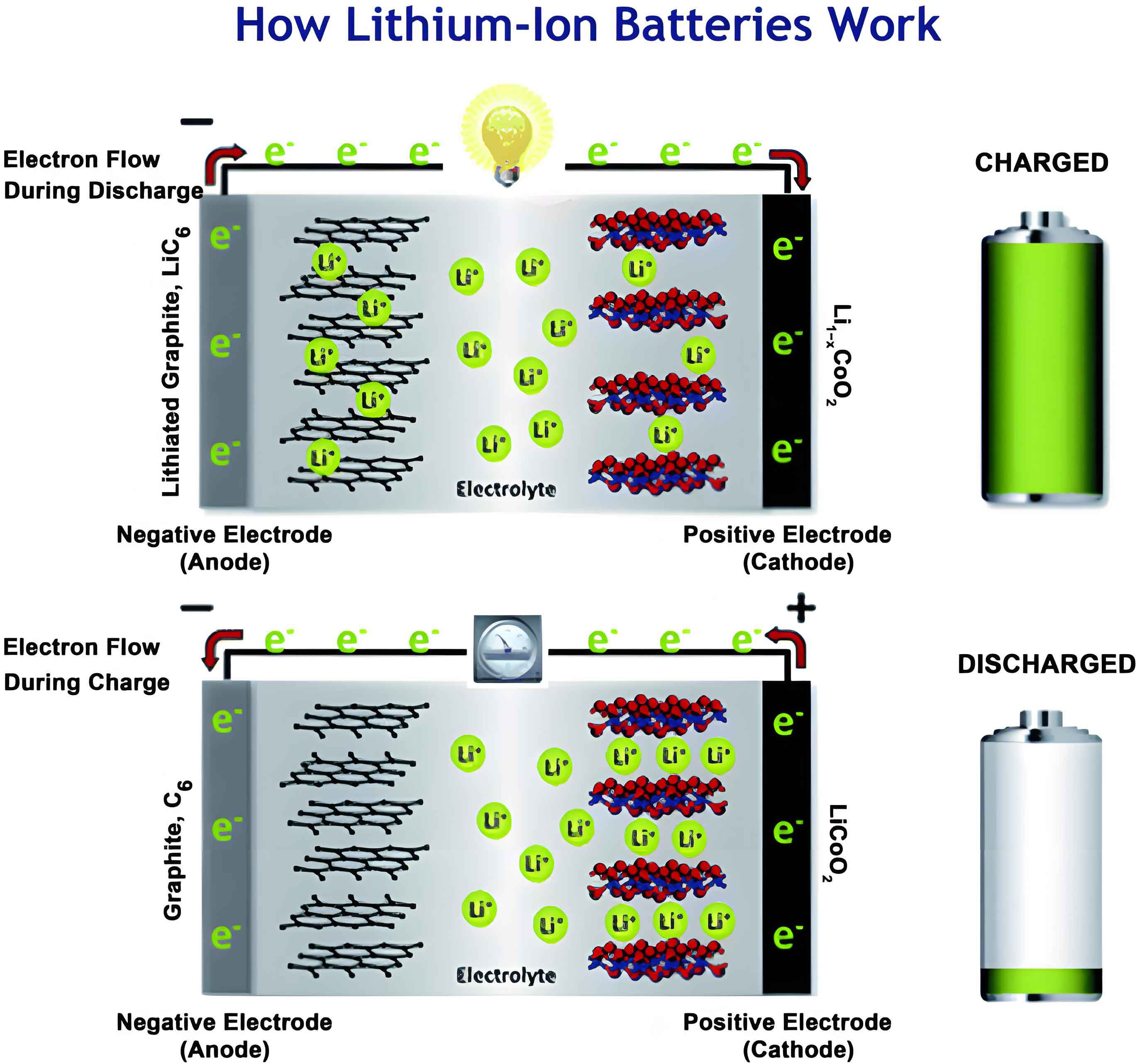
The widespread adoption of lithium-ion batteries (LIBs) across consumer electronics, electric vehicles (EVs), and grid-scale energy storage systems is a cornerstone of the modern clean energy transition. A typical li ion battery consists of a casing housing a core assembly of a cathode (e.g., LiCoO2, LiNixCoyMn1-x-yO2, LiFePO4), an anode (primarily graphite), a porous separator, and a lithium salt-based organic electrolyte. The fundamental working principle involves the shuttling of Li+ ions between the cathode and anode during charge and discharge cycles. During charging, Li+ ions de-intercalate from the cathode lattice, travel through the electrolyte, and are inserted into the anode structure. The discharge process reverses this path. The general electrochemical reactions for a cell with a LiCoO2 cathode can be represented as:
Cathode: $$LiCoO_2 \leftrightarrow Li_{1-x}CoO_2 + xLi^+ + xe^-$$
Anode: $$6C + xLi^+ + xe^- \leftrightarrow Li_xC_6$$
Overall: $$LiCoO_2 + 6C \leftrightarrow Li_{1-x}CoO_2 + Li_xC_6$$
The finite lifespan of a li ion battery, typically 3-8 years, coupled with the explosive growth in demand, is leading to a tidal wave of spent batteries. This presents a dual challenge: a significant environmental threat and a critical resource opportunity. Spent li ion batteries contain hazardous materials like toxic heavy metals (e.g., Co, Ni, Mn) and fluorinated electrolytes, posing serious risks of soil and water contamination if disposed of improperly. Conversely, these batteries are a concentrated source of valuable metals, often containing higher grades of cobalt, nickel, and lithium than primary ores, earning them the title of “urban mines.” For instance, a spent LiNi1/3Co1/3Mn1/3O2 li ion battery may contain ~15% Ni and ~8% Co, far exceeding the 1.5-3% Ni and 0.05-1% Co found in typical sulfide ores. With soaring demand and geopolitical concerns over the supply chains for critical metals like cobalt and lithium, the efficient recycling of spent li ion batteries is no longer optional but essential for the sustainable and circular economy of the battery industry. This article provides a comprehensive review of state-of-the-art recycling technologies, focusing on pyrometallurgical and hydrometallurgical routes, with an in-depth analysis of the hydrometallurgical process chain, and offers perspectives on future trends.
1. Pyrometallurgical Recovery
Pyrometallurgy is a high-temperature process where discharged spent li ion batteries are fed into smelting furnaces at temperatures exceeding 1000°C. Organic components such as the electrolyte, separator, binder (e.g., PVDF), and graphite anode are combusted, providing energy and reducing atmosphere. Valuable metals like cobalt, nickel, and copper are reduced to their metallic states and form a molten alloy phase (often with added iron or copper as collectors), while lithium, aluminum, and manganese report to a slag phase. Low-boiling-point metals may be recovered via condensation from the off-gas. The core reduction reactions, for example using aluminum or carbon as a reductant, can be summarized as:
$$4LiCoO_2 + 2Al \rightarrow 2Li_2O + 4Co + Al_2O_3$$
$$2LiNi_{0.5}Co_{0.2}Mn_{0.3}O_2 + 1.7C \rightarrow Li_2O + Ni_{0.5}Co_{0.2}Mn_{0.3} + 1.7CO_{(g)}$$
The slag chemistry is crucial for metal recovery efficiency. Research has shown that using tailored slag systems like FeO-SiO2-Al2O3 or MnO-SiO2-Al2O3 can optimize the partitioning of metals, achieving recovery rates >98% for Co, Ni, and Cu into the alloy. However, a significant portion of lithium and manganese reports to the slag, representing a loss unless further processed.
The primary advantage of pyrometallurgy is its robustness; it can accept mixed and unsorted li ion battery feed without complex pretreatment. It is the core of industrial processes like Umicore’s Val’Eas® technology, which produces a Co-Ni-Cu-Fe alloy for further refining. The major drawbacks include the loss of lithium and manganese to slag, the non-recovery of graphite and aluminum, high energy consumption, and the need for extensive gas cleaning systems to treat emissions from burning plastics and organics.
2. Hydrometallurgical Recovery
Hydrometallurgy is the dominant research and increasingly industrial focus for recycling spent li ion batteries due to its flexibility, high metal recovery rates, and lower energy intensity compared to pyrometallurgy. The process typically involves four key stages: pretreatment, leaching, purification/separation, and material regeneration.
2.1 Pretreatment: Liberation and Enrichment
The goal of pretreatment is to separate the “black mass” (a mixture of cathode and anode active materials) from other components like steel casing, copper current collector (anode foil), and aluminum current collector (cathode foil). This step reduces the complexity and reagent consumption in subsequent leaching.
Physical Methods: These rely on differences in physical properties. The most common approach is a multi-step mechanical process involving crushing/shredding, sieving, magnetic separation (to remove steel), and air classification or sieving again to concentrate the black mass. While effective for liberation, intense grinding often leads to fine copper and aluminum fragments reporting to the black mass, introducing impurities (>5%) that complicate later purification.
Chemical Methods: These offer higher selectivity.
- Organic Solvent Dissolution: Uses solvents like N-Methyl-2-pyrrolidone (NMP) to dissolve the PVDF binder, freeing electrode powders from intact foils. Effective but costly and requires solvent recovery.
- Alkaline Dissolution: Uses NaOH solution to selectively dissolve the aluminum cathode foil, leaving the cathode powder. Simple and scalable, but generates alkaline wastewater containing Al, F, Li, and heavy metals.
- Thermal Treatment: Heats electrode scraps to ~500°C in inert or air atmosphere to decompose organic binders and electrolytes, making the electrode powders brittle and easily detached. Energy-intensive and requires off-gas treatment.
The development of efficient, low-cost, and environmentally benign pretreatment remains a critical need for the li ion battery recycling industry.
2.2 Leaching: Dissolution of Valuable Metals
Leaching aims to transfer target metals from the solid black mass into an aqueous solution. It can be categorized into chemical leaching (acid/alkaline) and bioleaching.
2.2.1 Chemical Leaching
Acid Leaching: This is the most prevalent method.
- Inorganic Acids: HCl, H2SO4, and HNO3 are commonly used. HCl acts as both acid and reductant (oxidizing to Cl2), dissolving LiCoO2 efficiently. For H2SO4, a reducing agent like H2O2 is essential to reduce high-valence metals (Co3+, Mn4+) for rapid and complete dissolution. The reaction with H2SO4/H2O2 is:
$$2LiMO_2 + 3H_2SO_4 + H_2O_2 \rightarrow Li_2SO_4 + 2MSO_4 + 4H_2O + O_{2(g)} \quad (M = Ni, Co, Mn)$$
While highly efficient, inorganic acids are corrosive and generate secondary wastes (e.g., SOx, Cl2). - Organic Acids: Citric, oxalic, malic, and ascorbic acids offer a “greener” alternative, often with H2O2 as a reductant. They achieve leaching efficiencies comparable to inorganic acids (>95% for major metals) under optimized conditions (temperature, concentration, time) but at a higher reagent cost.
The effects of key parameters on cobalt leaching efficiency in different acid systems are summarized conceptually below:
| Parameter | Effect on Leaching Efficiency |
|---|---|
| Acid Concentration | Increases up to an optimum, then plateaus or decreases due to side reactions. |
| Temperature | Significantly enhances kinetics and final recovery. |
| Time | Increases until dissolution equilibrium is reached. |
| Solid/Liquid Ratio | Higher ratios generally decrease efficiency due to reagent limitation. |
| Reductant (H2O2) Dosage | Critical for inorganic acids; increases efficiency by facilitating reduction dissolution. |
Alkaline Leaching (Ammoniacal): This method exploits the selective complexation of Ni, Co, and Cu with ammonia (NH3/NH4+) to form stable ammine complexes (e.g., [Ni(NH3)6]2+), while leaving impurities like Fe, Al, and Li in the residue or solution. A reducing agent like (NH4)2SO3 is often added. It offers intrinsic selectivity but faces challenges with ammonia volatility, lithium co-dissolution, and the generation of ammonia-nitrogen wastewater.
2.2.2 Bioleaching
Bioleaching employs microorganisms (e.g., Acidithiobacillus ferrooxidans, Acidithiobacillus thiooxidans, Aspergillus niger) to metabolically produce leaching agents. Chemolithotrophic bacteria generate Fe3+ and H2SO4 from Fe2+ and sulfur, while fungi like A. niger excrete organic acids (citric, oxalic). Although capable of achieving high recoveries (>95% Li, >90% Co) under controlled conditions, the process is notoriously slow (days to weeks), sensitive to operational conditions (pH, toxicity), and difficult to scale for the high-volume recycling of spent li ion battery streams.
| Microorganism | Key Conditions | Reported Efficiency |
|---|---|---|
| Acidophilic Consortium (e.g., A. caldus, L. ferriphilum) | FeSO4 + S, 45°C, 2 days | >99% Co, >99% Ni, ~84% Li |
| Aspergillus niger | 1% pulp density, 30°C, 30 days | 100% Li, 94% Cu, 72% Mn, 38-45% Co/Ni |
| Acidithiobacillus ferrooxidans & A. thiooxidans | Iron sulfate + sulfur, pH 1.5, 16 days | ~99% Li, ~89% Ni, ~50% Co |
2.3 Separation and Purification of Metals
The leachate from a spent li ion battery is a complex multi-metal solution containing Co, Ni, Mn, Li, along with impurities like Cu, Al, and Fe. Separating these chemically similar transition metals (Co, Ni, Mn) is a major challenge. Common techniques include:
Solvent Extraction (SX): The industry-standard method for separating and purifying metals at scale. It uses organic extractants selective for specific metals. A typical flowsheet might involve: (1) Using Cyanex 272 or P507 to selectively extract Co2+ over Ni2+ and Mn2+ at a specific pH; (2) Extracting Ni2+ from the Co-depleted raffinate with another extractant like Versatic 10; (3) Recovering Mn2+ and finally Li+ from the aqueous stream via precipitation. SX offers high selectivity and purity but involves multiple stages, large reagent inventories, and generates organic waste.
Chemical Precipitation: A simpler method where pH adjustment or addition of specific precipitants causes selective deposition. NaOH can remove Al/Fe/Cu as hydroxides. Carbonate (Na2CO3) precipitation is effective for Li2CO3 recovery. Oxalate can precipitate CoC2O4. While operationally straightforward, it often yields lower-purity products and can suffer from co-precipitation.
Ion Exchange & Electrodeposition: Ion exchange uses functional resins to adsorb target ions but can be slow and expensive for high-capacity applications. Electrodeposition recovers pure metals directly (e.g., Co plating) but is energy-intensive and best suited for final purification.
| Technique | Advantages | Disadvantages |
|---|---|---|
| Solvent Extraction | High selectivity and purity; Scalable; Continuous operation. | Complex multi-stage setup; Large organic inventory; Secondary waste generation. |
| Chemical Precipitation | Simple, low capital cost; Easy to operate. | Lower product purity; Co-precipitation issues; High reagent consumption. |
| Ion Exchange | Very high selectivity; Can handle dilute solutions. | Slow kinetics; Limited capacity; Resin cost and regeneration. |
| Electrodeposition | Produces high-purity metal directly. | Very high energy consumption; Limited to specific metals; Low current efficiency for mixed solutions. |
2.4 Direct Material Regeneration
Moving beyond the production of metal salts, direct regeneration of cathode materials from the leachate is a promising route to shorten the process and maximize value. This approach bypasses complex individual metal separation by using the purified multi-metal solution directly as feedstock for synthesizing new cathode materials.
Co-precipitation & Solid-State Synthesis: This is the most common and industrially adopted method. The leachate is purified to remove impurities (Al, Cu, Fe). The molar ratios of Ni, Co, Mn (and optionally Li) are adjusted by adding supplement salts. A precipitating agent (like NaOH/Na2CO3 or oxalate) is added under controlled pH and temperature to synthesize a spherical (Ni,Co,Mn)(OH)2 or (Ni,Co,Mn)C2O4 precursor. This precursor is then mixed with a Li source (Li2CO3, LiOH) and calcined at high temperature (700-900°C) to regenerate layered LiNixCoyMn1-x-yO2 materials. Regenerated cathodes have demonstrated electrochemical performance comparable to those made from virgin materials.
Other Methods: Sol-gel processes use chelating agents (e.g., citric acid) to form a gel from the solution, which is then calcined. Spray pyrolysis atomizes the solution into a hot reactor for one-step synthesis of precursor/cathode particles. While offering good control over morphology, these methods are less common industrially due to complexity or cost.
The success of direct regeneration hinges on precise control over solution chemistry and the removal of trace impurities (e.g., Na, Ca, Al, Fe) that can degrade the electrochemical performance and longevity of the regenerated li ion battery cathode.
3. Industrial Application Landscape
The evolution of recycling technology has progressed from recovering only high-value metals (Co, Ni) to full-element recovery and now toward direct cathode regeneration. Pioneering pyrometallurgical plants, like Umicore’s Val’Eas® process, demonstrated large-scale feasibility, producing a Co-Ni alloy. The rise of hydrometallurgy enabled the full recovery of Co, Ni, Mn, and Li as separate chemical products (sulfates, carbonates). This is the model for many recycling facilities today. The current frontier is the integration of hydrometallurgical leaching with direct precursor/cathode synthesis. Leading companies in Asia, Europe, and North America are now operating or commissioning facilities that produce battery-grade nickel-cobalt-manganese (NCM) or lithium iron phosphate (LFP) precursor materials directly from spent li ion battery feedstock, effectively “closing the loop” for critical battery materials and enhancing the sustainability of the entire li ion battery value chain.
4. Conclusions and Future Perspectives
Recycling technologies for spent li ion batteries have advanced significantly, with established pyrometallurgical and hydrometallurgical routes capable of recovering valuable metals. However, to meet the demands of a circular economy for the burgeoning li ion battery industry, further innovation is required in several key areas:
- Intelligent and Precision Pretreatment: Developing smart, automated disassembly and sorting lines to achieve cleaner separation of components (steel, Al/Cu foils, plastics, black mass) will drastically reduce impurity loads in downstream processes and improve overall economics.
- Pollution Control and Electrolyte Recovery: Holistic management of emissions and waste streams throughout the recycling lifecycle is critical. Specifically, efficient and safe methods for the recovery and destruction of toxic and flammable electrolytes must be developed to mitigate environmental and safety hazards, which remain a significant bottleneck.
- Short-Cycle Green Processes and High-Value Regeneration: The future lies in shortened, integrated flowsheets that minimize waste and energy consumption. Focus should be on “direct-to-cathode” regeneration processes with robust impurity control. Fundamental research is needed to understand the impact of trace impurities from the spent li ion battery stream on the structure and performance of regenerated materials, enabling the consistent production of high-performance, battery-grade cathodes. This will transform li ion battery recycling from a waste management service into a core material supply pillar for the sustainable li ion battery industry.