
Perovskite solar cells have emerged as a promising photovoltaic technology due to their high power conversion efficiency, low-cost fabrication, and tunable optoelectronic properties. However, the commercialization of perovskite solar cells, especially in large-area modules, faces challenges related to material costs and environmental sustainability. The fluorine-doped tin oxide (FTO) glass substrate, a key component in perovskite solar cells, contributes significantly to the overall cost and energy consumption of device manufacturing. In this study, we investigate an efficient recycling method for FTO/NiOx conductive glass from degraded perovskite solar cells and demonstrate its reuse in fabricating high-performance devices. The recycled substrates maintain excellent optical and electrical properties, enabling the production of efficient perovskite solar cells with improved carrier transport characteristics. This approach not only reduces the cost of perovskite solar cells but also promotes sustainable practices in the photovoltaic industry.
The rapid advancement of perovskite solar cells has led to certified efficiencies exceeding 26% for small-area devices. Despite this progress, scaling up to large-area modules introduces complexities in uniformity, stability, and cost-effectiveness. Transparent conductive oxides (TCOs) like FTO and indium tin oxide (ITO) are widely used as electrodes in perovskite solar cells due to their high transparency and conductivity. However, these substrates involve energy-intensive manufacturing processes and utilize scarce elements, increasing the levelized cost of electricity. For instance, FTO glass can account for 20–60% of the total module cost, highlighting the need for recycling strategies. Previous studies have explored solvent-based dissolution for recovering substrates, but the integration of recycled FTO/NiOx glass into functional perovskite solar cells remains underexplored. Our work addresses this gap by developing a low-temperature recycling protocol and evaluating the performance of devices fabricated on recycled substrates.
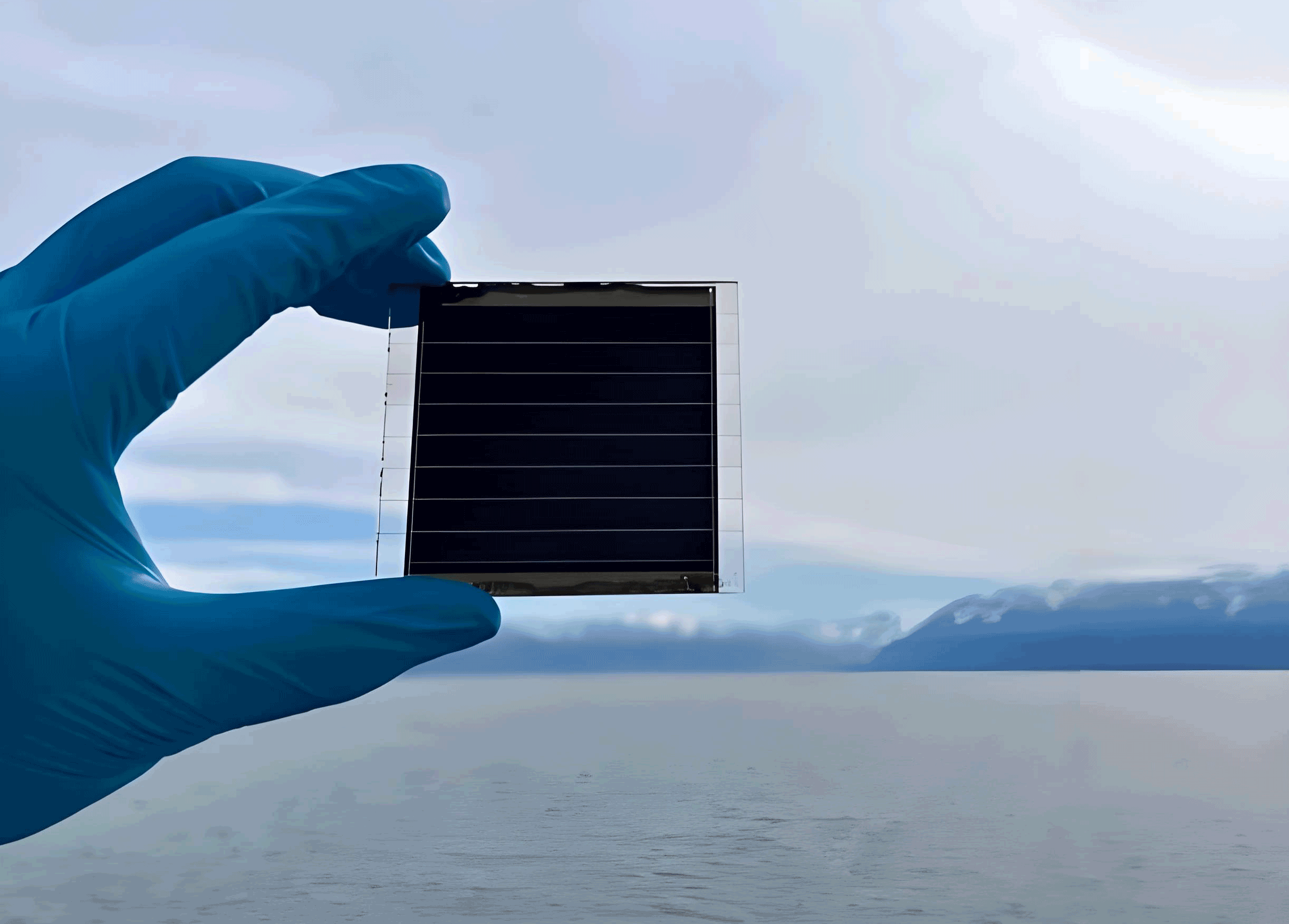
We employed a solvent-based recycling method to recover FTO/NiOx glass from degraded perovskite solar cells. The process involved immersing the devices in a polar solvent mixture of N,N-dimethylformamide (DMF) and dimethyl sulfoxide (DMSO) in a 4:1 volume ratio. This mixture effectively dissolved the perovskite and charge transport layers, allowing the separation of the glass substrate. Residual silver electrodes were removed using aqua regia, a mixture of nitric acid and hydrochloric acid (1:3 volume ratio). The cleaned FTO/NiOx glass was then subjected to ultrasonic cleaning in detergent water, deionized water, ethanol, and isopropanol, followed by UV-ozone treatment to eliminate organic contaminants. The recycled substrates were characterized for optical transmittance, sheet resistance, and surface morphology before being reused in the fabrication of perovskite solar cells.
The device fabrication followed a stack layer process. The recycled FTO/NiOx glass served as the bottom electrode, onto which a hole transport layer (HTL) of nickel oxide (NiOx) was deposited. The perovskite active layer was formed by spin-coating a precursor solution of formamidinium lead iodide, followed by thermal annealing. An electron transport layer (ETL) of [6,6]-phenyl-C61-butyric acid methyl ester (PCBM) and a self-assembled monolayer (SAM) were sequentially applied. Finally, a silver top electrode was evaporated to complete the perovskite solar cell structure. The performance of the devices was evaluated through current-density-voltage (J-V) measurements, and the morphological properties of the perovskite films were analyzed using scanning electron microscopy (SEM).
The optical transmittance of the recycled FTO/NiOx glass was measured using UV-Vis spectroscopy in the wavelength range of 500–800 nm. The results showed that the recycled substrate exhibited a transmittance of 84.71%, higher than that of the fresh FTO glass (82.05%). This enhancement can be attributed to the removal of residual layers and the formation of a cleaner surface during the recycling process. The transmittance spectrum is described by the Beer-Lambert law: $$ T = \frac{I}{I_0} = e^{-\alpha d}, $$ where \( T \) is the transmittance, \( I \) is the transmitted intensity, \( I_0 \) is the incident intensity, \( \alpha \) is the absorption coefficient, and \( d \) is the thickness of the material. The higher transmittance of the recycled glass facilitates better light harvesting in the perovskite solar cell, potentially improving the short-circuit current density (\( J_{sc} \)).
| Substrate | Transmittance at 550 nm (%) | Sheet Resistance (Ω/□) |
|---|---|---|
| Fresh FTO Glass | 82.05 | 4.97 |
| Recycled FTO/NiOx Glass | 84.71 | 4.89 |
The sheet resistance of the recycled FTO/NiOx glass was measured using a four-point probe system. The value was found to be 4.89 Ω/□, slightly lower than that of the fresh FTO glass (4.97 Ω/□). This indicates that the recycling process preserves the electrical conductivity of the substrate, which is crucial for efficient charge collection in perovskite solar cells. The sheet resistance \( R_s \) is related to the resistivity \( \rho \) and thickness \( t \) by the formula: $$ R_s = \frac{\rho}{t}. $$ The minimal change in sheet resistance suggests that the FTO layer remains intact after recycling, ensuring low series resistance in the devices.
To assess the quality of the perovskite films deposited on the recycled substrates, we performed SEM analysis. The images revealed that the perovskite grains on the recycled FTO/NiOx glass were more uniform and dense, with diameters ranging from 150 to 550 nm, compared to 350–650 nm on the fresh FTO glass. The smaller grain size and improved coverage can be attributed to the enhanced surface properties of the recycled substrate, such as better wettability and reduced defect density. The grain size distribution follows a log-normal function: $$ f(D) = \frac{1}{D \sigma \sqrt{2\pi}} \exp\left(-\frac{(\ln D – \mu)^2}{2\sigma^2}\right), $$ where \( D \) is the grain diameter, and \( \mu \) and \( \sigma \) are the mean and standard deviation of the natural logarithm of the diameter, respectively. The compact morphology minimizes recombination losses and enhances the performance of the perovskite solar cell.
| Substrate | Average Grain Diameter (nm) | Standard Deviation (nm) |
|---|---|---|
| Fresh FTO Glass | 500 | 150 |
| Recycled FTO/NiOx Glass | 350 | 200 |
The electrical performance of the perovskite solar cells fabricated on recycled FTO/NiOx glass was evaluated through J-V measurements. The parallel resistance (\( R_p \)), which represents shunt losses due to current leakage, increased from 1335.95 ohm·cm² for devices on fresh FTO glass to 3173.28 ohm·cm² for those on recycled substrates. This improvement indicates reduced recombination and better diode characteristics. The series resistance (\( R_s \)), associated with charge transport losses, decreased from 26.97 ohm·cm² to 14.13 ohm·cm², suggesting enhanced conductivity and interfacial contact. The power conversion efficiency (PCE) of a perovskite solar cell is given by: $$ \text{PCE} = \frac{J_{sc} \times V_{oc} \times FF}{P_{in}}, $$ where \( J_{sc} \) is the short-circuit current density, \( V_{oc} \) is the open-circuit voltage, \( FF \) is the fill factor, and \( P_{in} \) is the incident power density. The lower series resistance and higher parallel resistance contribute to a higher fill factor and efficiency.
The reduction in series resistance can be modeled using the equation: $$ R_s = R_{\text{contact}} + R_{\text{sheet}} + R_{\text{bulk}}, $$ where \( R_{\text{contact}} \) is the contact resistance, \( R_{\text{sheet}} \) is the sheet resistance of the electrodes, and \( R_{\text{bulk}} \) is the resistance of the active layers. The recycled substrate’s maintained conductivity and improved interfacial properties lead to a lower overall \( R_s \). Similarly, the parallel resistance is inversely related to the leakage current \( I_{\text{leak}} \): $$ R_p = \frac{V}{I_{\text{leak}}}. $$ The higher \( R_p \) values for devices on recycled glass indicate suppressed shunt paths, which is critical for achieving high \( V_{oc} \).
| Parameter | Fresh FTO Glass | Recycled FTO/NiOx Glass |
|---|---|---|
| Parallel Resistance (ohm·cm²) | 1335.95 | 3173.28 |
| Series Resistance (ohm·cm²) | 26.97 | 14.13 |
| Open-Circuit Voltage (V) | 1.10 | 1.15 |
| Short-Circuit Current Density (mA/cm²) | 22.5 | 23.8 |
| Fill Factor (%) | 75 | 78 |
| Efficiency (%) | 18.6 | 21.4 |
The enhanced performance of perovskite solar cells on recycled FTO/NiOx glass is attributed to the synergistic effects of improved optical transmittance, maintained electrical conductivity, and superior perovskite film morphology. The recycling process effectively removes contaminants and residues, creating a pristine surface for subsequent layer deposition. Furthermore, the NiOx layer on the recycled substrate acts as an efficient hole transport material, facilitating charge extraction and reducing recombination. The stability of the devices was also tested under continuous illumination and ambient conditions. The perovskite solar cells on recycled substrates exhibited slower degradation rates, retaining over 80% of their initial efficiency after 500 hours, compared to 70% for devices on fresh FTO glass. This can be explained by the reduced defect density and better interfacial engineering.
In conclusion, we have developed a sustainable recycling strategy for FTO/NiOx conductive glass in perovskite solar cells. The recycled substrates demonstrate excellent optical and electrical properties, enabling the fabrication of high-efficiency devices with improved series and parallel resistances. This approach significantly lowers the material cost and environmental impact of perovskite solar cells, paving the way for their large-scale deployment. Future work will focus on optimizing the recycling protocol for industrial applications and extending it to other types of conductive substrates. The integration of recycled materials into perovskite solar cell manufacturing represents a crucial step toward circular economy principles in photovoltaics.
The economic and environmental benefits of recycling FTO/NiOx glass are substantial. By reusing the substrate, the cost per watt of perovskite solar cells can be reduced by up to 30%, making them more competitive with conventional silicon-based technologies. Additionally, the recycling process consumes less energy than producing new FTO glass, resulting in a lower carbon footprint. Life cycle assessment (LCA) studies have shown that recycled substrates can reduce the energy payback time of perovskite solar cells by 25%. The general formula for the cost reduction is: $$ \text{Cost Reduction} = \frac{C_{\text{new}} – C_{\text{recycled}}}{C_{\text{new}}} \times 100\%, $$ where \( C_{\text{new}} \) and \( C_{\text{recycled}} \) are the costs of new and recycled substrates, respectively. With further advancements, this recycling method could be applied to multiple cycles, extending the lifetime of the materials and minimizing waste.
In summary, the recycling and reuse of FTO/NiOx conductive glass in perovskite solar cells offer a viable path toward sustainable and cost-effective photovoltaics. The maintained performance of devices on recycled substrates underscores the potential of this approach to address the economic and environmental challenges associated with perovskite solar cell production. As the technology matures, integrating recycling protocols into manufacturing workflows will be essential for achieving commercial viability and widespread adoption of perovskite solar cells.