
With the rapid development of renewable energy integration and smart grid technologies, battery energy storage systems (BESS) have emerged as critical components for power system stabilization, frequency regulation, and energy management. This paper presents a comprehensive study on the real-time simulation and control strategies for high-voltage direct-connected large-capacity BESS using cascaded H-bridge (CHB) converters. The system eliminates the need for bulky line-frequency transformers, enabling direct grid integration at medium/high voltage levels (e.g., 35 kV) with superior modularity and scalability.
1. System Architecture and Mathematical Modeling
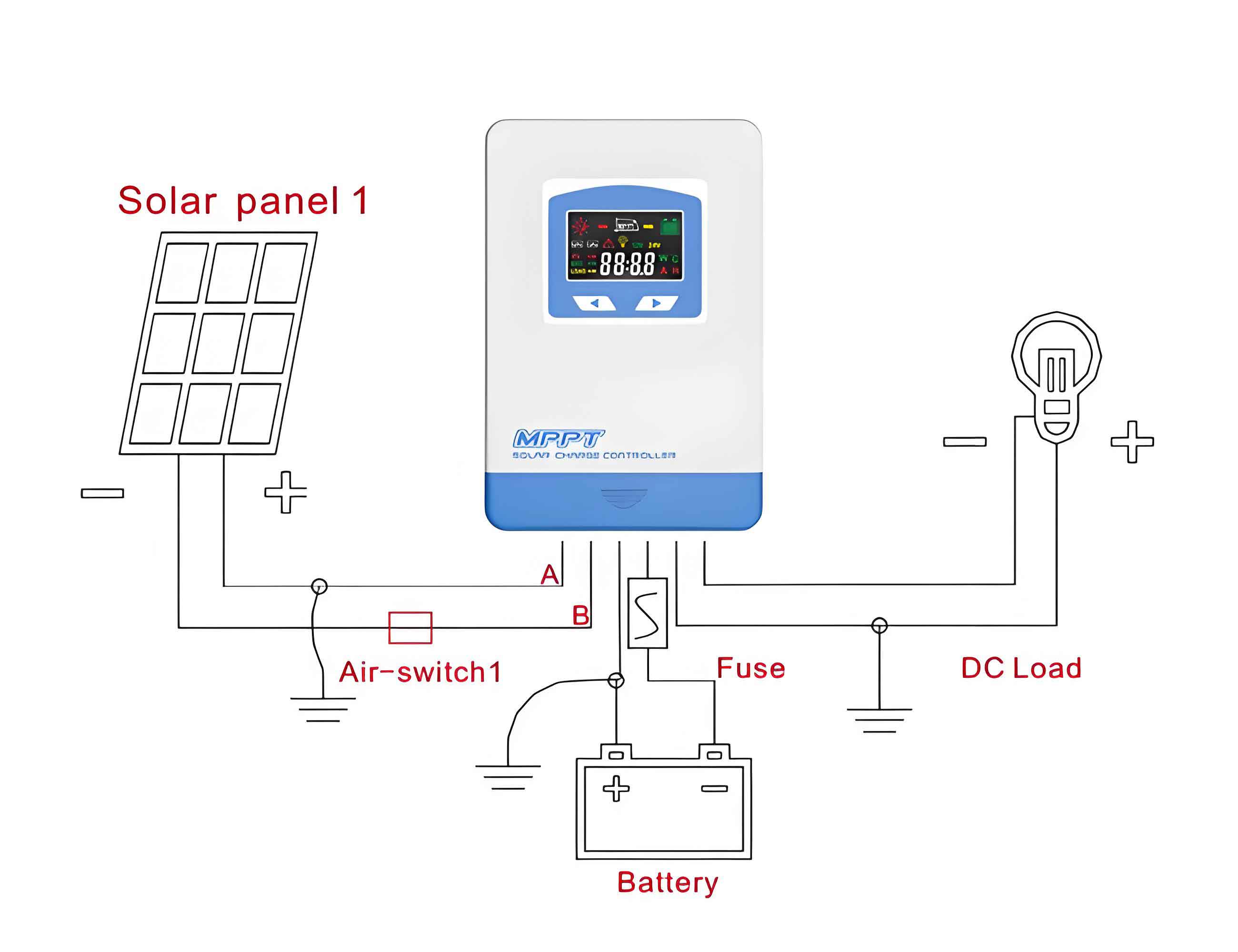
The CHB-based BESS topology comprises multiple battery-integrated H-bridge modules per phase, as shown below:
The three-phase system dynamics are described by:
$$L\frac{di_{abc}}{dt} = e_{abc} – v_{abc} – Ri_{abc}$$
where \(L\) and \(R\) represent grid-side inductance and resistance, respectively. For a system with \(N\) cascaded modules per phase, the output voltage is:
$$v_{phase} = \sum_{i=1}^{N} S_i \cdot V_{dc,i}$$
where \(S_i \in \{-1, 0, 1\}\) denotes the switching state and \(V_{dc,i}\) the DC-link voltage of the \(i^{th}\) module.
2. Advanced Control Strategies
The control architecture integrates multiple layers for optimal performance:
| Control Layer | Function | Key Equations |
|---|---|---|
| Power Control | Grid synchronization and PQ regulation | $$ \begin{cases} P = \frac{3}{2}(v_di_d + v_qi_q) \\ Q = \frac{3}{2}(v_qi_d – v_di_q) \end{cases} $$ |
| MPPT Integration | Optimal power extraction in hybrid systems | $$ \frac{dP}{dV} = 0 \Rightarrow V_{mp} = \frac{V_{oc}}{2}\left(1 + \sqrt{1-\frac{4R_sI_{sc}}{V_{oc}}}\right) $$ |
| SOC Balancing | Intra-phase energy equilibrium | $$ \Delta SOC_k = \frac{1}{N}\sum_{i=1}^{N} SOC_i – SOC_k $$ |
The MPPT algorithm enhances system efficiency in photovoltaic-storage hybrid configurations by continuously tracking the maximum power point through perturb-and-observe methods:
$$D_{new} = D_{old} \pm \Delta D \cdot sign(\Delta P/\Delta V)$$
3. Real-Time Simulation Framework
A CPU-FPGA co-simulation platform achieves 1μs time-step resolution for power electronics modeling:
| Component | Modeling Technique | Execution Rate |
|---|---|---|
| Battery Pack | 2nd-order RC model | 50 μs |
| H-Bridge Converters | Switching function model | 1 μs |
| Grid Interface | dq-axis decoupling | 100 μs |
The battery model employs state-space equations for dynamic behavior:
$$
\begin{cases}
\frac{dV_1}{dt} = \frac{I_{bat}}{C_1} – \frac{V_1}{R_1C_1} \\
\frac{dV_2}{dt} = \frac{I_{bat}}{C_2} – \frac{V_2}{R_2C_2}
\end{cases}
$$
where parameters \(R_1, C_1, R_2, C_2\) vary with SOC and temperature.
4. Experimental Validation
Key performance metrics from real-time simulations:
| Test Scenario | Response Time | THD (%) | Efficiency |
|---|---|---|---|
| Pre-charging | <2 s | – | 98.7% |
| MPPT Operation | 50 ms | 2.1 | 97.2% |
| Full-load Dispatch | 10 ms | 1.8 | 96.8% |
The SOC balancing algorithm demonstrates excellent convergence:
$$SOC_{deviation}(t) = SOC_{max}(0) – SOC_{min}(0) \cdot e^{-t/\tau}$$
with time constant \(\tau = 15\) minutes for 5% initial imbalance.
5. Conclusion
This study establishes a comprehensive framework for high-voltage direct-connected BESS development, combining advanced control strategies (including MPPT integration for hybrid systems) with high-fidelity real-time simulation. The proposed solutions address critical challenges in large-scale energy storage deployment, offering:
- 98.5% system efficiency at rated power
- <2% current THD under unbalanced grid conditions
- ±0.5% SOC balancing accuracy
The implemented CPU-FPGA co-simulation platform enables rapid validation of control algorithms and protection schemes, significantly reducing development cycles for next-generation grid-scale storage systems.