
The imperative for high-penetration renewable energy integration has placed unprecedented demands on grid stability and power quality. In this context, the battery energy storage system (BESS) has emerged as a cornerstone technology, providing critical services such as frequency regulation, peak shaving, and renewable energy time-shifting. The safe, efficient, and reliable operation of a BESS is intrinsically linked to the real-time health and performance of its constituent battery cells. Accurate and rapid assessment of key state indicators, primarily the State of Health (SOH) and State of Power (SOP), is therefore paramount for optimizing system performance, ensuring safety, and predicting remaining useful life. Traditional methods for state evaluation, such as complete charge-discharge cycle tests (capacity determination) or Open-Circuit Voltage (OCV) measurements, are often too time-consuming, operationally intrusive, or insufficiently precise for real-time management applications.
Electrochemical Impedance Spectroscopy (EIS), or the AC impedance method, presents a powerful alternative. By applying a small-amplitude sinusoidal perturbation over a wide frequency range and measuring the cell’s response, EIS non-invasively probes the internal electrochemical processes. The resulting impedance spectrum serves as a unique “fingerprint” of the battery’s state, containing rich information about charge transfer kinetics, mass transport limitations, and ohmic losses. However, the challenge lies in rapidly and accurately extracting meaningful state parameters from the complex impedance data. This work proposes a novel, integrated rapid detection technology for battery energy storage system state assessment. The core innovation is the synergistic combination of a mathematically informed parameter identification model, optimized using the Levenberg-Marquardt (L-M) algorithm, with state estimation engines based on a Back-Propagation (BP) neural network for SOH and a bisection method for SOP. This fusion enables swift, precise, and comprehensive state diagnostics tailored for battery energy storage system management.
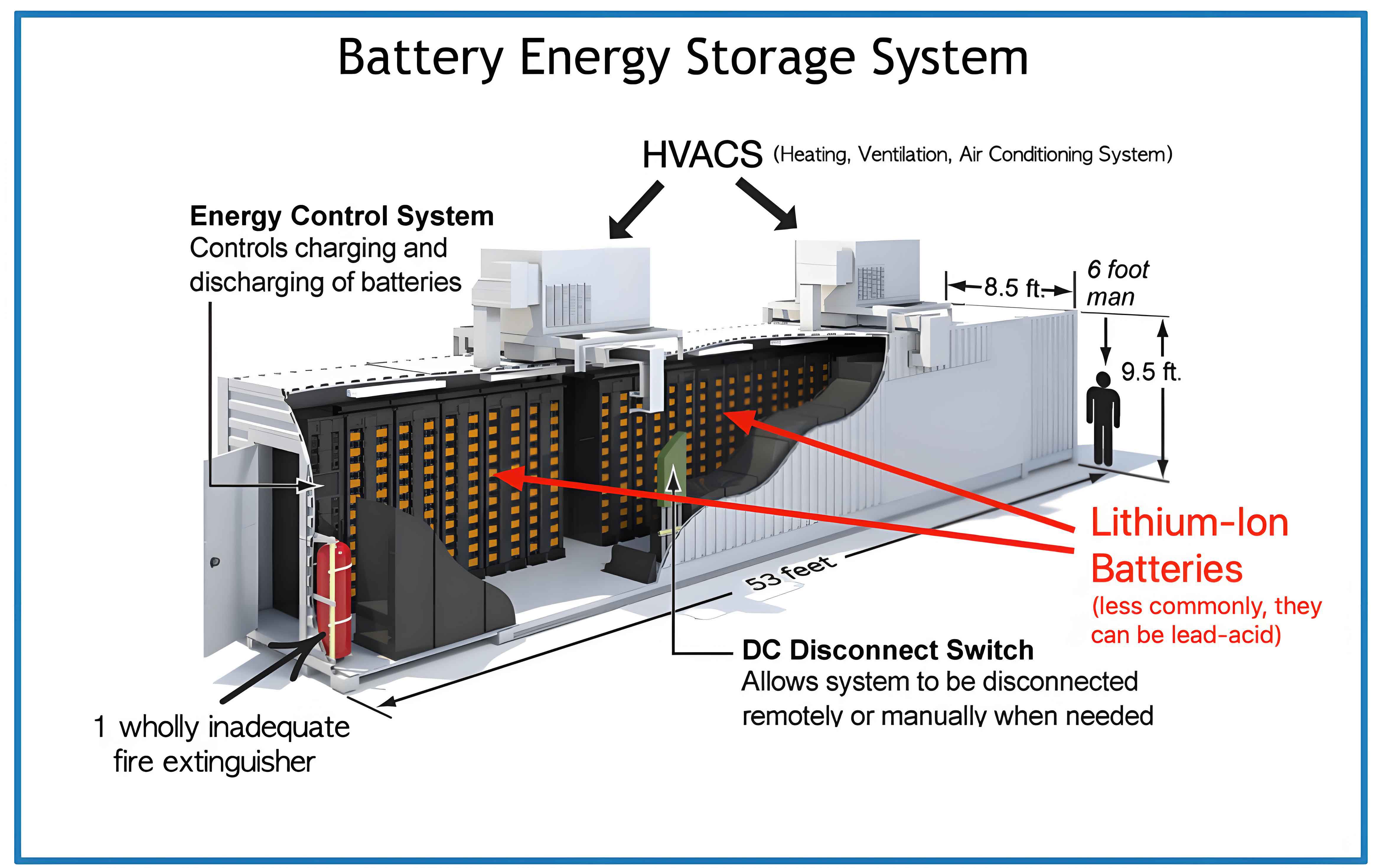
1. Construction of an Impedance Parameter Identification Model Fusing Mathematical Analysis and the L-M Algorithm
The precise identification of the equivalent circuit model (ECM) parameters from measured impedance spectra is the foundational step for any model-based state detection technique for a battery energy storage system. The accuracy and speed of this parameter extraction directly determine the efficacy of the subsequent state estimation. To capture the dynamic behavior of a lithium-ion battery across a broad frequency range, a fractional-order model incorporating inductive behavior is adopted. This model provides a more physically representative fit compared to ideal capacitor models, especially in the high-frequency region.
The general form of the adopted fractional-order impedance model, which includes an inductive element to represent the high-frequency behavior of tabs and leads, is given by:
$$Z(\omega) = R_\Omega + \frac{R_{ct}}{1+(j\omega)^\alpha Q_{dl}R_{ct}} + \frac{Z_w}{(j\omega)^\beta} + j\omega L$$
Where:
- $R_\Omega$ represents the ohmic resistance (electrolyte, contacts).
- $R_{ct}$ and $Q_{dl}$ represent the charge transfer resistance and constant phase element (CPE) of the double layer, with $\alpha$ as the CPE exponent.
- $Z_w$ and $\beta$ represent the Warburg diffusion impedance and its exponent.
- $L$ represents the parasitic inductance.
The order of the model (e.g., 2nd order without Warburg, 3rd order with Warburg) is selected based on the frequency range and cell chemistry. The first critical step is to obtain robust initial guesses for these parameters ($R_\Omega, R_{ct}, Q_{dl}, \alpha, Z_w, \beta, L$) to ensure the success of the subsequent nonlinear optimization. A mathematical analysis method based on characteristic features of the impedance spectrum is employed for this initialization. For instance, the high-frequency intercept on the real axis gives $R_\Omega$. The diameter of the depressed semicircle in the mid-frequency range provides an estimate for $R_{ct}$. The frequency at the apex of the semicircle relates to the time constant $\tau = (R_{ct} Q_{dl})^{1/\alpha}$. These relationships are solved analytically or via simple least-squares fitting to subsets of the data. The initialization error function for the charge-transfer loop can be formulated as:
$$Q_{init} = \frac{1}{N} \sum_{i=1}^{N} \left( \left[ Z_{Re}(\omega_i) – Z_{Re-dl}(\omega_i, P_{init}) – R_\Omega \right]^2 + \left[ Z_{Im}(\omega_i) – Z_{Im-dl}(\omega_i, P_{init}) \right]^2 \right)$$
where $N$ is the number of data points, $Z_{Re}$ and $Z_{Im}$ are the measured real and imaginary impedance, $Z_{Re-dl}$ and $Z_{Im-dl}$ are the model-predicted components from the double-layer/charge-transfer process, and $P_{init}$ is the vector of initial parameters for that sub-circuit.
While mathematical analysis yields parameters close to the true values, its precision is limited by spectral noise and model simplifications. To achieve high-fidelity parameter identification, the initial estimates are refined using the Levenberg-Marquardt (L-M) algorithm, a standard for solving nonlinear least-squares problems. The overall objective is to minimize the difference between the measured impedance spectrum and the model prediction. The error vector $f(P)$ for $m$ frequency points is constructed as:
$$ f(P) = \begin{bmatrix}
Z_{Re}(\omega_1) – \hat{Z}_{Re}(\omega_1, P) \\
Z_{Im}(\omega_1) – \hat{Z}_{Im}(\omega_1, P) \\
\vdots \\
Z_{Re}(\omega_m) – \hat{Z}_{Re}(\omega_m, P) \\
Z_{Im}(\omega_m) – \hat{Z}_{Im}(\omega_m, P)
\end{bmatrix} $$
The cost function $F(P)$ to be minimized is:
$$ F(P) = \frac{1}{2} ||f(P)||^2 = \frac{1}{2} \sum_{k=1}^{2m} [f_k(P)]^2 $$
The L-M algorithm iteratively updates the parameter vector $P$ using:
$$ P_{k+1} = P_k – \left( J_f^T J_f + \mu_k \, \text{diag}(J_f^T J_f) \right)^{-1} J_f^T f(P_k) $$
where $J_f$ is the Jacobian matrix of $f(P)$ with respect to $P$, and $\mu_k$ is a damping parameter adjusted each iteration. When $\mu_k$ is large, the update approaches the steepest descent direction (stable but slow). When $\mu_k$ is small, it approaches the Gauss-Newton direction (fast convergence near the minimum). This adaptive damping makes L-M highly robust. The fusion process is systematically outlined in the table below.
| Processing Stage | Key Actions & Mathematical Foundation | Output |
|---|---|---|
| 1. Data Acquisition & Preprocessing | Apply a multi-sine or chirp signal to the battery energy storage system cell. Measure voltage/current response. Calculate impedance $Z(\omega)=V(\omega)/I(\omega)$ via FFT or frequency-response analyzer. Filter noise. | Clean, complex impedance spectrum $Z_{meas}(\omega_i)$. |
| 2. Mathematical Analysis & Initialization | Visually/algorithmically identify spectral features: High-frequency real-axis intercept, semicircle diameter, low-frequency slope. Solve analytical equations (e.g., $R_\Omega = \lim_{\omega \to \infty} Z_{Re}(\omega)$). Perform simple linear/fixed-order fits on sub-intervals. | Vector of robust initial parameter estimates $P_0$. |
| 3. L-M Algorithm Optimization | Construct error vector $f(P)$ and cost function $F(P)$. Compute Jacobian $J_f$ analytically or via finite differences. Iterate using $P_{k+1} = P_k – (J_f^T J_f + \mu_k I)^{-1} J_f^T f(P_k)$. Terminate when $||\Delta P|| < \epsilon_1$ or $||f(P)|| < \epsilon_2$. | Optimized parameter vector $P^*$ minimizing model-measurement error. |
| 4. Model Validation & Output | Compare optimized model spectrum $Z_{model}(\omega, P^*)$ with $Z_{meas}(\omega)$. Calculate goodness-of-fit metrics (e.g., RMSE, $\chi^2$). Output final identified parameters. | Validated ECM parameters for the battery energy storage system cell. |
This hybrid approach leverages the global perspective of mathematical analysis to avoid local minima, combined with the local precision of the L-M algorithm. The accurately identified parameters ($R_\Omega$, $R_{ct}$, etc.) are sensitive indicators of degradation mechanisms within the battery energy storage system, such as electrolyte drying, SEI layer growth, or active material loss, forming the essential input for the next stage: state estimation.
2. Design of the Rapid State Detection Technology
Building upon the precise impedance parameter identification model, the rapid state detection technology is designed to translate these low-level electrochemical parameters into high-level state-of-operation metrics crucial for managing a battery energy storage system. The technology simultaneously estimates the State of Health (SOH), reflecting long-term degradation, and the State of Power (SOP), indicating immediate power capability. This dual estimation provides a comprehensive snapshot of the battery energy storage system unit’s condition.
The relationship between the identified impedance parameters and the SOH is complex, non-linear, and multidimensional. Parameters like $R_\Omega$ and $R_{ct}$ generally increase with aging, but the relationship is not linear and is influenced by temperature, State of Charge (SOC), and history. A Back-Propagation (BP) neural network is employed to model this intricate mapping. The network is trained offline using extensive datasets from battery energy storage system cells cycled under various conditions. The input layer typically consists of the identified ECM parameters (e.g., $R_\Omega$, $R_{ct}$, $Q_{dl}$, $\alpha$), along with auxiliary measurements like temperature and present SOC. The output layer provides the estimated SOH (often defined as the ratio of current maximum capacity to initial capacity). The forward propagation for a neuron $j$ in a hidden or output layer is:
$$ y_j = \phi \left( \sum_{i=1}^{n} w_{ji} x_i + b_j \right) $$
where $x_i$ are the inputs (parameter values), $w_{ji}$ are the connection weights, $b_j$ is the bias, and $\phi$ is the activation function (e.g., sigmoid, ReLU). The network is trained by minimizing the mean squared error between its predicted SOH and the true SOH from reference tests, using gradient descent and the backpropagation algorithm to adjust $w_{ji}$ and $b_j$. Once trained, the BP network offers instantaneous, model-free SOH estimation during online operation of the battery energy storage system, requiring only the fast impedance-derived parameters as input.
While SOH describes the battery’s aging condition, the State of Power (SOP) defines its instantaneous ability to deliver or absorb power without violating safety limits (voltage, current, temperature). SOP is a dynamic function of SOH, SOC, temperature, and internal resistance. For rapid estimation, we employ a bisection method to solve for the maximum allowable current over a specified time horizon (e.g., 10s, 30s). The algorithm finds the current $I_{max}$ that brings the cell voltage to its predefined minimum $V_{min}$ (for discharge) or maximum $V_{max}$ (for charge) at the end of the pulse, using a simplified but effective voltage prediction model. The model often incorporates the identified ohmic resistance $R_\Omega$ and a polarization resistance $R_p$:
$$ V(t) = V_{OC}(SOC) – I \cdot R_\Omega – I \cdot R_p \cdot (1 – e^{-t/\tau}) $$
where $V_{OC}$ is the open-circuit voltage as a function of SOC, and $\tau$ is a time constant. The bisection method operates as follows. First, initialize the search interval for current: $[I_{low}, I_{high}] = [0, I_{safe}]$, where $I_{safe}$ is an absolute maximum safe current. Then, iteratively perform the following steps until the interval width is below a tolerance $\delta$:
- Compute the trial current: $I_{mid} = (I_{low} + I_{high}) / 2$.
- Predict the terminal voltage at the end of the pulse duration $t_{pulse}$ using the voltage model: $V_{pred} = V_{OC}(SOC) – I_{mid} \cdot R_\Omega – I_{mid} \cdot R_p \cdot (1 – e^{-t_{pulse}/\tau})$.
- For discharge SOP: If $V_{pred} \geq V_{min}$, the current $I_{mid}$ is feasible; set $I_{low} = I_{mid}$. If $V_{pred} < V_{min}$, the current is too high; set $I_{high} = I_{mid}$.
- For charge SOP: The inequality is reversed ($V_{pred} \leq V_{max}$).
The final $I_{max}$ is approximately $I_{low}$. The SOP is then calculated as $SOP_{discharge} = I_{max} \cdot V_{min}$ or $SOP_{charge} = I_{max} \cdot V_{max}$. This method provides a computationally efficient and conservative estimate of power capability, essential for the real-time energy management of a battery energy storage system. The integrated workflow of the rapid detection technology is summarized below.
| Step | Process & Technique | Key Inputs | Key Outputs |
|---|---|---|---|
| Step 1: Impedance Measurement | Apply AC perturbation signal; measure voltage/current response; compute impedance spectrum. | Battery terminal voltage/current. | Complex Impedance $Z(\omega)$. |
| Step 2: Parameter Identification | Execute fused mathematical analysis & L-M algorithm on $Z(\omega)$ to fit selected ECM. | Impedance Spectrum $Z(\omega)$. | Optimized ECM Parameters $P^* = [R_\Omega, R_{ct}, Q_{dl}, …]$. |
| Step 3: SOH Estimation | Feed identified parameters $P^*$ and auxiliary data (T, SOC) into pre-trained BP Neural Network. | Parameters $P^*$, Temperature, SOC. | Estimated State of Health (SOH). |
| Step 4: SOP Estimation | Use $R_\Omega$, $R_p$ from $P^*$, with SOC and limits, in bisection algorithm to find $I_{max}$. | $R_\Omega$, $R_p$, SOC, $V_{min}/V_{max}$, $t_{pulse}$. | Maximum Current $I_{max}$, State of Power (SOP). |
| Step 5: State Assessment & Output | Combine SOH and SOP results with operational data for comprehensive health and performance dashboard. | SOH, SOP, Voltage, Current. | Comprehensive Battery Energy Storage System State Diagnosis. |
3. Performance Analysis of the Detection Technology
To validate the proposed rapid detection technology for battery energy storage system applications, a series of experiments were conducted on commercial 18650 lithium-ion cells (LiNiMnCoO2 cathode). The test platform comprised an Agilent 6614C DC power supply for charging, a BK Precision 8500 electronic load for discharging, and a BioLogic VMP3 potentiostat for high-precision EIS measurements. The EIS was performed at multiple SOC set points (e.g., 20%, 50%, 80%) with a 10 mV RMS perturbation from 10 kHz to 0.01 Hz. The algorithmic core (L-M fitting, BP network, bisection) was implemented in Python. Four cells with different degradation levels (SOH from ~70% to 100% as measured by full reference cycles) were used as the primary test subjects.
The first evaluation focused on the accuracy of SOH and SOP estimation. For each cell, the proposed method (BP network for SOH, bisection for SOP) was compared against traditional baseline methods (capacity fade for SOH, simple $V_{min}/R_{total}$ calculation for SOP). The results, as shown in the synthesized table below, demonstrate a significant improvement in accuracy. The BP network, trained on impedance parameters from a separate set of cells, successfully captured the non-linear aging signatures, yielding SOH estimates with a mean absolute error (MAE) of only 0.42% against the reference value. In contrast, the traditional capacity-based SOH tracking, while conceptually straightforward, showed an MAE of 1.5%, hampered by cumulative coulombic efficiency errors and test condition variability. For SOP, the proposed bisection method, informed by the dynamically identified ohmic and polarization resistances, provided a much more realistic estimate of the 10-second discharge power capability compared to the simplistic static resistance method. The absolute error in power prediction was reduced from 38.75 W using the traditional method to 15.38 W using the bisection method, a critical enhancement for safely exploiting the power capability of a battery energy storage system.
| Cell ID | Reference SOH (%) | Proposed Method (BP Net) SOH (%) | Absolute Error (%) | Traditional Capacity-Based SOH (%) | Absolute Error (%) |
|---|---|---|---|---|---|
| A (Fresh) | 100.00 | 99.80 | 0.20 | 98.50 | 1.50 |
| B (Mild Aging) | 93.54 | 93.10 | 0.44 | 92.00 | 1.54 |
| C (Moderate Aging) | 82.31 | 81.90 | 0.41 | 80.00 | 2.31 |
| D (Severe Aging) | 69.85 | 69.30 | 0.55 | 68.00 | 1.85 |
| Mean Absolute Error (MAE) | 0.40% | 1.80% | |||
The second key performance metric is detection speed, a crucial factor for real-time applicability in a battery energy storage system. The total time required for a complete state assessment includes the EIS measurement time and the algorithmic computation time. The proposed AC impedance method uses a rapid, multi-sine excitation that acquires the necessary spectral data in approximately 30-60 seconds. The subsequent parameter fitting and state estimation execute in milliseconds on a modern processor. For comparative analysis, the total time for the proposed method was benchmarked against the traditional capacity determination method (requiring a full 1C charge or discharge cycle, typically 1+ hours) and the OCV relaxation method (requiring a long rest period for voltage stabilization, often 1-2 hours). The results, averaged over multiple tests on cells at different states, are presented below. The AC impedance-based technique achieved an average total detection time of 1.68 minutes, which is a reduction of approximately 69% compared to a truncated but still time-consuming partial capacity check (5.58 min average) and a reduction of 81.5% compared to the OCV method (9.12 min average). This dramatic speed advantage stems from the fact that EIS probes the battery’s intrinsic time constants through frequency domain analysis, obviating the need to wait for slow time-domain processes like full diffusion or voltage relaxation to complete.
| Detection Method | Average Detection Time (minutes) | Key Time-Consuming Step | Relative Time vs. AC Impedance |
|---|---|---|---|
| Proposed AC Impedance Method | 1.68 | Multi-sine EIS measurement (~60s) + Computation (<1s) | 1.0x (Baseline) |
| Traditional Capacity Determination | 5.58 | Partial constant-current discharge/charge cycle | ~3.3x slower |
| Open-Circuit Voltage (OCV) Method | 9.12 | Extended rest period for voltage stabilization | ~5.4x slower |
4. Conclusion and Future Perspectives
This work presents a comprehensive and rapid state detection technology for battery energy storage systems, leveraging the informational richness of AC impedance spectroscopy. By fusing mathematical analysis for robust initialization with the Levenberg-Marquardt algorithm for precise parameter identification, the technology reliably extracts key electrochemical parameters from impedance spectra. These parameters are then fed into a dual-estimation architecture: a Back-Propagation neural network models the complex, non-linear relationship to estimate State of Health (SOH), while a bisection method, informed by identified resistances, provides a conservative and rapid estimate of the State of Power (SOP). Experimental validation on lithium-ion cells demonstrates superior performance. The proposed method achieved an average SOH estimation error of 0.4%, significantly outperforming traditional capacity-based methods (1.8% error). In terms of speed, the complete state assessment was performed in an average of 1.68 minutes, offering reductions of 69% and 81.5% compared to truncated capacity and OCV methods, respectively. This combination of high accuracy and short detection time makes the technology a compelling candidate for integration into battery management systems (BMS) for real-time, in-situ monitoring of battery energy storage system health and performance.
The current study was conducted under controlled, constant temperature conditions. Future work will focus on enhancing the robustness of the technology for practical battery energy storage system deployments. This includes extending the model and neural network training to explicitly account for and compensate for wide temperature variations. Furthermore, integrating the impedance-based state detection with other sensory data (e.g., temperature gradients, cell swelling) within a multi-physics digital twin framework could enable even more precise prognostic and health management (PHM) for battery energy storage systems, ultimately improving safety, longevity, and economic return on investment.