
In the context of global efforts toward carbon neutrality and sustainable energy systems, lithium-ion batteries have emerged as a cornerstone technology due to their high energy density, long cycle life, and low self-discharge rates. These batteries are extensively deployed in electric vehicles, portable electronics, aerospace applications, and grid-scale energy storage systems. However, the gradual degradation of lithium-ion battery performance over time remains a critical challenge, impacting both economic viability and system reliability. Aging in lithium-ion batteries manifests through two primary mechanisms: cycle aging, which occurs during charge-discharge operations, and calendar aging, which proceeds even when the battery is idle. Calendar aging, driven by parasitic electrochemical reactions such as electrolyte decomposition, solid electrolyte interphase (SEI) growth, and cathode-electrolyte interface (CEI) formation, leads to capacity fade and impedance rise. Understanding and quantifying the factors influencing calendar aging is essential for predicting battery lifespan, optimizing storage conditions, and enhancing safety. This study focuses on analyzing the impact of key storage parameters—specifically temperature and state-of-charge (SOC)—on the calendar aging of lithium-ion batteries using electrochemical impedance spectroscopy (EIS) data. By leveraging impedance-based diagnostics, we aim to develop quantitative models that describe the evolution of ohmic impedance under varied environmental conditions, thereby providing insights into degradation mechanisms and facilitating improved battery management strategies.
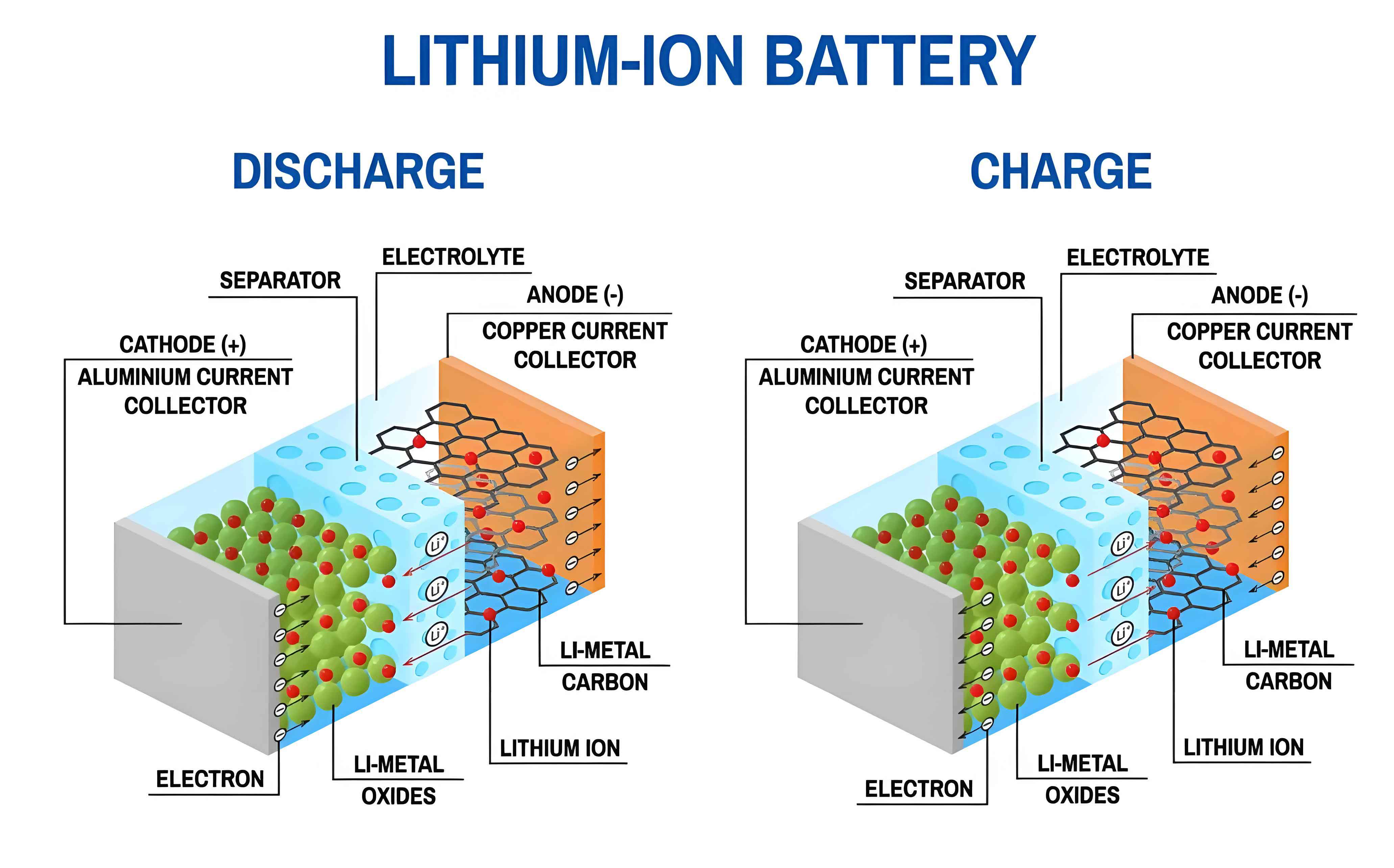
The performance degradation of lithium-ion batteries is a complex interplay of multiple physicochemical processes. Calendar aging, in particular, is influenced by storage conditions such as temperature and SOC, which accelerate side reactions within the cell. At elevated temperatures, the kinetics of degradation reactions, including SEI growth and transition metal dissolution, are enhanced, leading to rapid impedance increase and capacity loss. Conversely, low temperatures can induce lithium plating and increase charge transfer resistance, while moderate SOC levels may mitigate some aging effects compared to high SOC states. Electrochemical impedance spectroscopy serves as a powerful non-invasive tool to probe these aging mechanisms, as it provides a frequency-domain representation of the battery’s internal resistance components. By analyzing EIS data, we can decouple the contributions of ohmic resistance, charge transfer resistance, and diffusion processes, each linked to specific degradation modes. This approach allows for a detailed investigation of how storage factors modulate impedance characteristics over time. In this work, we utilize a comprehensive dataset from the CALCE battery research group to examine impedance evolution across a wide range of temperatures and SOC levels. Through cluster analysis, variance analysis, and empirical modeling, we quantify the relative significance of temperature and SOC on calendar aging and establish predictive models for ohmic impedance increment. The findings underscore the dominant role of temperature in driving lithium-ion battery degradation and offer a framework for assessing battery health under diverse storage scenarios.
To lay the groundwork for our analysis, we first review the fundamentals of electrochemical impedance spectroscopy and its application to lithium-ion battery aging. EIS involves applying a small-amplitude sinusoidal perturbation to the battery and measuring the resulting current response across a spectrum of frequencies. The impedance, denoted as \(Z(\omega)\), is a complex function that can be expressed in terms of its real and imaginary components:
$$Z(\omega) = \text{Re}(Z(\omega)) + j\text{Im}(Z(\omega)) = \frac{U_{\text{est}}^F(t)}{I_{\text{est}}^F(t)}$$
where \(\omega\) is the angular frequency, \(\text{Re}(Z(\omega))\) and \(\text{Im}(Z(\omega))\) are the real and imaginary parts of impedance, respectively, and \(U_{\text{est}}^F(t)\) and \(I_{\text{est}}^F(t)\) represent the Fourier-transformed voltage and current signals. The EIS spectrum typically exhibits distinct regions corresponding to different electrochemical processes: the high-frequency region reflects ohmic resistance from electrolyte and contacts; the mid-frequency semicircle relates to charge transfer resistance and SEI/CEI dynamics; and the low-frequency tail indicates diffusion limitations. For lithium-ion batteries, aging mechanisms such as SEI growth, electrode cracking, and electrolyte decomposition manifest as shifts in these regions. Validating EIS data requires ensuring linearity, causality, and stability, often assessed using Kramers-Kronig relations. In calendar aging studies, EIS measurements are taken periodically on stored batteries to track impedance changes without disruptive cycling, providing a direct indicator of degradation progression.
Our experimental data is sourced from the CALCE battery dataset, which includes EIS measurements from lithium-ion cells subjected to various storage conditions. The dataset comprises two groups: one with reference performance tests every three weeks and another with tests after three months of storage. Each group involves batteries stored at temperatures of \(-40^\circ\text{C}\), \(-5^\circ\text{C}\), \(25^\circ\text{C}\), and \(50^\circ\text{C}\), and at SOC levels of 0%, 50%, and 100%. Multiple cells are used per condition to ensure statistical robustness. The EIS tests are conducted at 100% SOC and \(25^\circ\text{C}\) to maintain consistency, capturing the impedance spectrum from high to low frequencies. The ohmic resistance, extracted from the high-frequency intercept on the real axis of the Nyquist plot, serves as a key metric for quantifying calendar aging effects. We calculate the ohmic impedance increment \(\Delta R\) as the difference between the resistance after storage and the initial resistance:
$$\Delta R = R_n – R_0$$
where \(R_n\) is the ohmic impedance after storage time \(n\), and \(R_0\) is the initial ohmic impedance. This increment reflects the degradation-induced increase in internal resistance, which correlates with power capability loss in lithium-ion batteries.
We begin our analysis by examining the impedance characteristics of lithium-ion batteries after three months of storage across different temperatures and SOC levels. A cluster analysis of the EIS data reveals distinct patterns in impedance magnitude and phase. The Bode plots show that batteries stored at \(50^\circ\text{C}\) exhibit significantly higher impedance magnitudes compared to those at lower temperatures, with a pronounced increase in the mid-frequency range. At \(25^\circ\text{C}\), the impedance is moderately elevated, while at \(-40^\circ\text{C}\) and \(-5^\circ\text{C}\), the impedance values are lower but display nonlinear variations. The phase angle plots further highlight temperature-dependent behavior, with broader phase angle spreads at higher temperatures indicating more complex interfacial processes. Nyquist plots illustrate the shifting of semicircles and real-axis intercepts, underscoring the impact of storage conditions on both ohmic and charge transfer resistances. To summarize these observations, we present a table categorizing common degradation phenomena in lithium-ion batteries and their associated EIS signatures:
| Degradation Phenomenon | Primary EIS Region Affected | Impact on Lithium-Ion Battery |
|---|---|---|
| SEI Growth | Mid-frequency semicircle | Increases charge transfer resistance |
| Electrolyte Decomposition | High-frequency intercept | Raises ohmic resistance |
| Cathode-Electrolyte Interface (CEI) Formation | Mid-frequency semicircle | Enhances interfacial resistance |
| Electrode Cracking | Low-frequency diffusion tail | Reduces active material availability |
| Lithium Plating | Mid-to-low frequency | Increases polarization resistance |
Next, we delve into the specific effects of SOC on calendar aging. By comparing EIS spectra before and after storage at fixed temperatures, we observe that SOC influences impedance evolution in a nonlinear manner. At \(-40^\circ\text{C}\), batteries stored at 50% and 100% SOC show more pronounced increases in ohmic and charge transfer resistances compared to 0% SOC. At \(-5^\circ\text{C}\), the impact is similar, with 50% SOC causing the greatest ohmic impedance rise. In contrast, at \(25^\circ\text{C}\), SOC variations yield minimal changes, suggesting that room-temperature storage may partially mitigate SOC-dependent degradation. However, at \(50^\circ\text{C}\), high SOC (100%) dramatically accelerates impedance growth, followed by 50% SOC, while 0% SOC shows the least effect. This indicates that the interplay between SOC and temperature is critical: at extreme temperatures, SOC becomes a significant factor, whereas at moderate temperatures, its influence diminishes. To quantify these trends, we compute the average ohmic impedance increments for each SOC condition across temperatures, as shown in the table below:
| Storage Temperature | \(\Delta R\) at 0% SOC (\(\Omega\)) | \(\Delta R\) at 50% SOC (\(\Omega\)) | \(\Delta R\) at 100% SOC (\(\Omega\)) |
|---|---|---|---|
| \(-40^\circ\text{C}\) | 0.00434 | 0.00470 | 0.00501 |
| \(-5^\circ\text{C}\) | 0.00669 | 0.00642 | 0.00694 |
| \(25^\circ\text{C}\) | 0.00454 | 0.00490 | 0.00494 |
| \(50^\circ\text{C}\) | 0.01210 | 0.01580 | 0.02050 |
The data highlights that at \(50^\circ\text{C}\), the impedance increments are an order of magnitude larger than at other temperatures, emphasizing the severe impact of high-temperature storage on lithium-ion battery health.
We now turn to the effect of temperature on calendar aging. Comparative EIS analysis across temperatures for fixed SOC levels reveals that temperature is a dominant driver of impedance increase. At 0% SOC, storage at \(50^\circ\text{C}\) leads to the largest rightward shift in Nyquist plots, indicating substantial ohmic and charge transfer resistance growth. At \(25^\circ\text{C}\), changes are negligible, while at \(-5^\circ\text{C}\) and \(-40^\circ\text{C}\), moderate increases occur. Similar patterns are observed at 50% and 100% SOC, with high temperature consistently causing the most degradation. The nonlinear behavior at low temperatures suggests that mechanisms like lithium plating or electrolyte viscosity changes may contribute. To statistically assess the relative importance of temperature and SOC, we perform a variance analysis (ANOVA) on the ohmic impedance increment data. The ANOVA evaluates the null hypothesis that group means (e.g., across temperature or SOC levels) are equal, using the F-statistic and p-value. The results are summarized as follows:
| Factor | Degrees of Freedom | Sum of Squares | Mean Square | F-value | p-value |
|---|---|---|---|---|---|
| SOC | 2 | \(2.9609 \times 10^{-7}\) | \(1.4805 \times 10^{-8}\) | 3.7649 | 0.1204 |
| Temperature | 2 | \(7.5662 \times 10^{-6}\) | \(3.7831 \times 10^{-6}\) | 96.2069 | \(4.1474 \times 10^{-4}\) |
The analysis indicates that temperature has a highly significant effect (p-value << 0.05), with an F-value far exceeding that of SOC. This confirms that temperature is the primary factor influencing calendar aging in lithium-ion batteries, while SOC’s impact is less pronounced under the tested conditions. However, interaction effects between temperature and SOC may exist, particularly at extremes, warranting further investigation.
Building on these insights, we develop empirical models for the ohmic impedance increment as a function of storage time, tailored to different temperature regimes. The models are derived from the first group of experimental data, with measurements taken every three weeks. For low-temperature storage (\(-40^\circ\text{C}\) and \(-5^\circ\text{C}\)), the impedance increment exhibits nonlinear behavior over time, which we fit using a sixth-degree polynomial to capture complex degradation kinetics:
$$\Delta R_L = A + B_1 t + B_2 t^2 + B_3 t^3 + B_4 t^4 + B_5 t^5 + B_6 t^6$$
where \(\Delta R_L\) is the ohmic impedance increment at low temperatures, \(t\) is the storage time in weeks, and \(A\), \(B_1\) to \(B_6\) are coefficients determined via least-squares regression. The fitting parameters for each low-temperature condition are provided in the table below:
| Temperature | \(A\) (\(\times 10^{-4}\)) | \(B_1\) (\(\times 10^{-4}\)) | \(B_2\) (\(\times 10^{-6}\)) | \(B_3\) (\(\times 10^{-7}\)) | \(B_4\) (\(\times 10^{-9}\)) | \(B_5\) (\(\times 10^{-11}\)) | \(B_6\) (\(\times 10^{-14}\)) | \(R^2\) |
|---|---|---|---|---|---|---|---|---|
| \(-5^\circ\text{C}\) | 16.20 | -1.75 | 32.70 | -10.20 | 12.70 | -7.02 | 14.30 | 0.99847 |
| \(-40^\circ\text{C}\) | 8.92 | 1.08 | 7.81 | -3.26 | 4.41 | -2.54 | 5.32 | 0.80572 |
The high \(R^2\) values indicate good model accuracy, especially for \(-5^\circ\text{C}\), while the lower \(R^2\) for \(-40^\circ\text{C}\) suggests more scattered data, possibly due to measurement variability or complex low-temperature phenomena. For room-temperature storage (\(25^\circ\text{C}\)), the impedance increment shows a linear relationship with time, reflecting a steady degradation rate. The linear model is expressed as:
$$\Delta R_{25} = a + b t$$
with coefficients \(a = -0.00377\) and \(b = 9.05444 \times 10^{-5}\), and an \(R^2\) of 0.98727. This simplicity implies that at moderate temperatures, calendar aging proceeds in a predictable, gradual manner, likely dominated by slow SEI growth or minor electrolyte changes. For high-temperature storage (\(50^\circ\text{C}\)), the impedance increment rises exponentially, indicating accelerated aging processes. The exponential model is given by:
$$\Delta R_{50} = \alpha \beta^t$$
where \(\alpha = 0.00269\) and \(\beta = 1.02698\), with an \(R^2\) of 0.97631. This model captures the rapid increase in ohmic resistance due to enhanced side reactions, such as SEI thickening or cathode decomposition, which are thermally activated. The exponential trend underscores the critical need to avoid high-temperature storage for lithium-ion batteries to prolong lifespan.
To integrate these models into a comprehensive framework, we propose a piecewise function for predicting ohmic impedance increment across a wide temperature range:
$$\Delta R(T, t) =
\begin{cases}
A(T) + \sum_{i=1}^{6} B_i(T) t^i & \text{for } T < 0^\circ\text{C} \\
a + b t & \text{for } T \approx 25^\circ\text{C} \\
\alpha \beta^t & \text{for } T \geq 50^\circ\text{C}
\end{cases}$$
where \(T\) is the storage temperature and \(t\) is time. This approach allows for tailored predictions based on environmental conditions, aiding in battery health monitoring and storage management. The models highlight that temperature not only affects the magnitude of impedance increase but also its temporal evolution—from nonlinear at low temperatures, linear at room temperature, to exponential at high temperatures. These patterns align with Arrhenius-type behavior, where reaction rates scale with temperature, and with possible phase transitions or kinetic limitations at cold extremes.
Our findings have significant implications for the design and operation of lithium-ion battery systems. The dominance of temperature over SOC in calendar aging suggests that thermal management should be prioritized in storage protocols. For instance, maintaining lithium-ion batteries at cool, stable temperatures (e.g., around \(25^\circ\text{C}\)) can drastically slow degradation, while avoiding high SOC levels during long-term storage can provide additional benefits, especially in non-temperature-controlled environments. The impedance-based models developed here offer a practical tool for estimating remaining useful life or scheduling maintenance based on storage history. Furthermore, the use of EIS as a diagnostic technique enables non-destructive assessment, making it suitable for field applications. Future work could extend this analysis to other battery chemistries, such as lithium iron phosphate or nickel-rich cathodes, and incorporate cycling effects to develop holistic aging models. Additionally, machine learning techniques could be employed to refine predictions using larger datasets.
In conclusion, this study quantitatively analyzes the calendar aging influence factors in lithium-ion batteries through impedance spectroscopy. Using data from the CALCE dataset, we demonstrate that temperature exerts a significantly greater impact on ohmic impedance increase than SOC, with high-temperature storage causing exponential degradation, room-temperature storage leading to linear changes, and low-temperature storage resulting in nonlinear behavior. Variance analysis statistically validates the preeminence of temperature, while empirical models provide predictive capabilities for impedance increment across different thermal regimes. These insights underscore the importance of temperature control in preserving lithium-ion battery health and contribute to the development of robust aging models for enhanced battery management. As the demand for reliable energy storage grows, continued research into degradation mechanisms will be vital for optimizing the performance and longevity of lithium-ion batteries in diverse applications.