
In recent years, perovskite solar cells have garnered significant attention due to their exceptional photovoltaic properties, leading to rapid improvements in power conversion efficiency. The tunable bandgap of perovskite materials allows for the development of wide-bandgap perovskite solar cells, which can be integrated with narrow-bandgap semiconductors like crystalline silicon to form tandem solar cells. These tandem devices enhance solar spectrum utilization and surpass the theoretical efficiency limits of single-junction solar cells. However, wide-bandgap perovskites, typically achieved through cesium or bromine incorporation, suffer from fast crystallization rates, resulting in poor film quality, high defect densities, and reduced performance. To address these challenges, we explore a mild gas quenching method combined with propylamine hydrochloride (PACl) as an additive to improve the crystallization and uniformity of wide-bandgap perovskite films. This approach facilitates the formation of high-quality films with enhanced optoelectronic properties, enabling efficient perovskite solar cells and large-area applications.
The gas quenching technique, which utilizes flowing gases like nitrogen to promote solvent evaporation during spin-coating, offers a reproducible and scalable alternative to antisolvent methods. It reduces the reliance on toxic solvents and is better suited for large-area perovskite film fabrication. In this study, we employ gas quenching to prepare wide-bandgap perovskite films with a composition of Cs0.22FA0.78Pb(I0.85Br0.15)3, achieving a bandgap of approximately 1.68 eV. The incorporation of PACl as an additive plays a critical role in modulating the crystallization kinetics, leading to uniform nucleation, preferred orientation, and enlarged grain sizes. We systematically investigate the effects of PACl on film morphology, crystallinity, and device performance, demonstrating a significant improvement in efficiency and scalability.
Our experimental procedure begins with the preparation of the perovskite precursor solution. We dissolve stoichiometric amounts of CsI, FAI, PbI2, and PbBr2 in a mixed solvent of DMF and NMP, with the addition of CsPbCl3 as an additive. PACl is introduced at varying molar ratios to study its impact. The solution is heated at 60°C for 2 hours and filtered before use. For film deposition, ITO-coated glass substrates are cleaned and treated with UV ozone. The perovskite precursor is spin-coated at 3000 rpm for 50 seconds, with nitrogen gas quenching applied at the 20-second mark for 10 seconds. The films are then annealed at 130°C for 20 minutes to form the crystalline perovskite layer. For device fabrication, we deposit a nickel oxide hole transport layer, followed by a 2PACz layer, the perovskite active layer, a PDAI2 passivation layer, PCBM electron transport layer, BCP interlayer, and a silver electrode through thermal evaporation.
To evaluate the influence of PACl on film properties, we characterize the perovskite films using scanning electron microscopy (SEM), X-ray diffraction (XRD), ultraviolet-visible spectroscopy (UV-vis), photoluminescence (PL), and time-resolved photoluminescence (TRPL). The SEM images reveal that PACl-treated films exhibit more uniform and larger grains compared to the control films, which show irregular grain sizes. The XRD patterns indicate enhanced (100) and (200) diffraction peaks in PACl-modified films, suggesting preferred orientation and improved crystallinity. Additionally, the PbI2 peak at 12.6° is reduced, confirming better conversion to the perovskite phase. UV-vis spectra demonstrate increased absorption in the visible range for PACl-treated films, correlating with improved film quality.
The PL spectra show higher intensity for PACl-treated films, indicating reduced non-radiative recombination. TRPL measurements further support this, with the average carrier lifetime increasing from 667.7 ns for control films to 1077.1 ns for PACl-treated films. The TRPL data are fitted using a bi-exponential decay function:
$$f(t) = A_1 e^{-t/\tau_1} + A_2 e^{-t/\tau_2}$$
where $\tau_1$ and $\tau_2$ represent the fast and slow decay lifetimes, respectively, and $A_1$ and $A_2$ are their relative amplitudes. The average carrier lifetime $\tau_{\text{ave}}$ is calculated as:
$$\tau_{\text{ave}} = \frac{A_1 \tau_1^2 + A_2 \tau_2^2}{A_1 \tau_1 + A_2 \tau_2}$$
The fitting parameters are summarized in Table 1.
| Sample | $\tau_1$ (ns) | $\tau_2$ (ns) | $A_1$ (%) | $A_2$ (%) | $\tau_{\text{ave}}$ (ns) |
|---|---|---|---|---|---|
| Control | 64.9 | 732.3 | 9.69 | 90.31 | 667.7 |
| PACl | 62.8 | 1115.5 | 3.65 | 96.35 | 1077.1 |
We investigate the crystallization mechanism by analyzing the XRD patterns of precursor films annealed at different temperatures. In control films, the intermediate phase persists until annealing at 50°C, while PACl-treated films fully transform to the α-phase at lower temperatures. This suggests that PACl reduces the formation energy of the α-phase perovskite. Notably, a two-dimensional (2D) perovskite phase (PA2FAPb2X7, where X = I/Br/Cl) forms in the precursor stage, acting as a template for oriented growth. Upon annealing, PACl volatilizes as propylamine and HCl, leaving behind high-quality 3D perovskite films with reduced defects.
The device performance of perovskite solar cells is evaluated through current density-voltage (J-V) measurements, external quantum efficiency (EQE), and stabilized power output (SPO). We compare devices prepared under four conditions: without nitrogen quenching and PACl, with nitrogen quenching only, with PACl only, and with both nitrogen quenching and PACl. The J-V curves show that both nitrogen quenching and PACl addition enhance the photovoltaic parameters. The optimal PACl concentration is found to be 7 mol%, yielding the best performance. The champion device with PACl achieves a power conversion efficiency of 21.48%, with an open-circuit voltage ($V_{\text{OC}}$) of 1.246 V, short-circuit current density ($J_{\text{SC}}$) of 20.61 mA/cm², and fill factor (FF) of 83.64%. In contrast, the control device exhibits an efficiency of 19.38%, with $V_{\text{OC}}$ = 1.180 V, $J_{\text{SC}}$ = 20.06 mA/cm², and FF = 81.83%. The J-V parameters are summarized in Table 2.
| Device | $V_{\text{OC}}$ (V) | $J_{\text{SC}}$ (mA/cm²) | FF (%) | PCE (%) |
|---|---|---|---|---|
| W/O N₂ & PACl | 1.096 | 18.70 | 73.85 | 15.14 |
| With N₂ | 1.184 | 19.66 | 81.61 | 18.99 |
| With PACl | 1.177 | 19.63 | 80.33 | 18.56 |
| With N₂ & PACl | 1.226 | 20.65 | 82.87 | 20.99 |
The EQE spectra confirm higher photocurrent generation in PACl-treated devices, with integrated $J_{\text{SC}}$ values matching the J-V measurements. SPO tests demonstrate stable output efficiencies of 18.44% for control devices and 20.64% for PACl-treated devices, highlighting the improved operational stability. Dark J-V curves reveal lower leakage currents in PACl-modified devices, indicating reduced defect-assisted recombination. Light intensity-dependent $V_{\text{OC}}$ measurements yield ideal factors (n) of 1.74 for control devices and 1.53 for PACl-treated devices, further confirming suppressed non-radiative recombination.
To quantify the defect density, we fabricate electron-only devices with the structure ITO/SnO2/perovskite/PCBM/Ag and perform space-charge-limited current (SCLC) measurements. The defect density $N_t$ is calculated using the formula:
$$N_t = \frac{2 \epsilon \epsilon_0 V_{\text{TFL}}}{q L^2}$$
where $\epsilon$ is the perovskite dielectric constant, $\epsilon_0$ is the vacuum permittivity, $V_{\text{TFL}}$ is the trap-fill limit voltage, $q$ is the electron charge, and $L$ is the film thickness (~500 nm). The $V_{\text{TFL}}$ values are 3.23 V for control films and 1.92 V for PACl-treated films, corresponding to defect densities of $2.97 \times 10^{16}$ cm⁻³ and $1.77 \times 10^{16}$ cm⁻³, respectively. This reduction in defect density underscores the role of PACl in improving film quality.
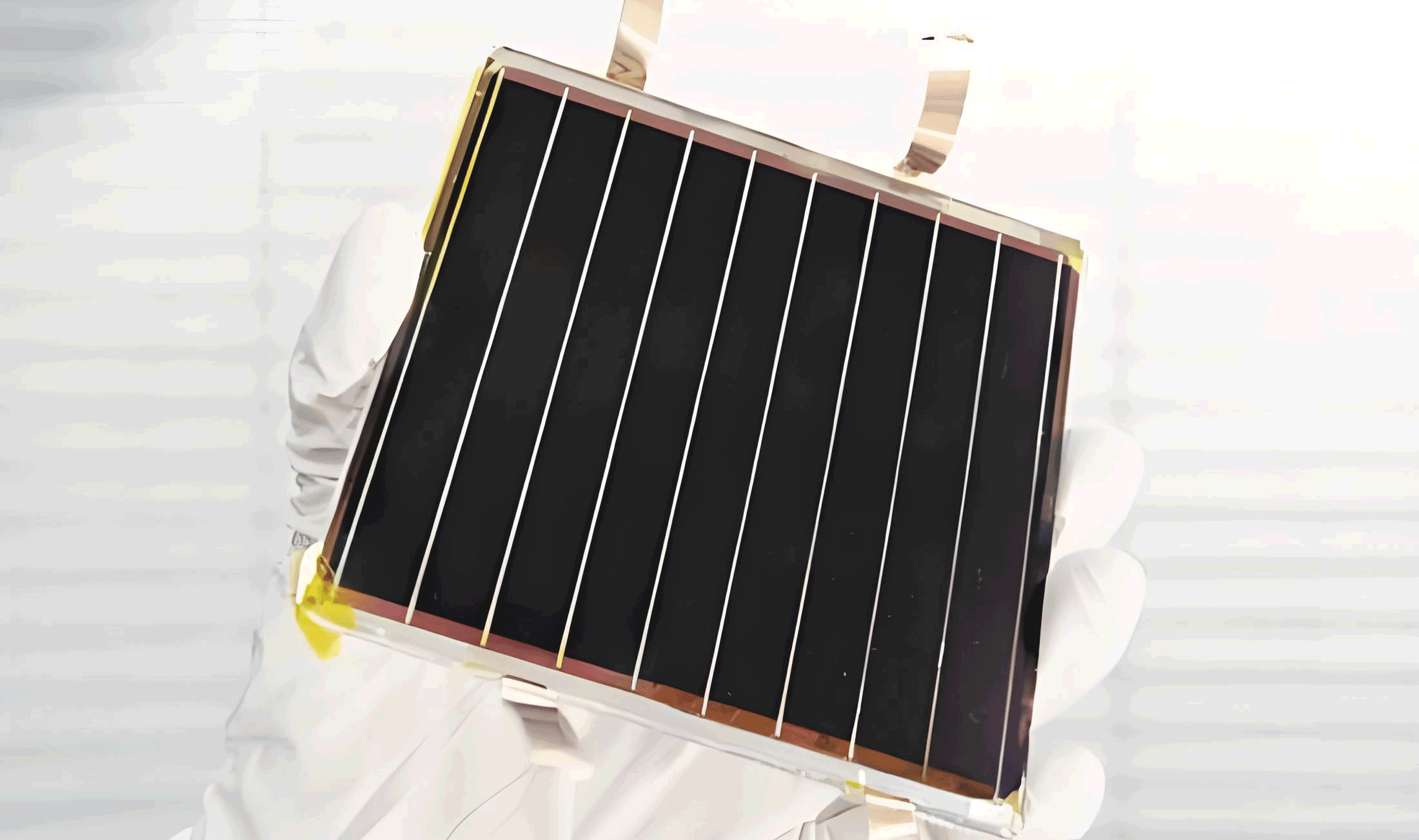
For large-area applications, we prepare 8 cm × 8 cm perovskite films using the same gas quenching and PACl strategy. UV-vis absorption spectra taken at different positions on the film show minimal variation in absorption intensity for PACl-treated films, whereas control films exhibit significant inhomogeneity. Cross-sectional SEM images confirm that PACl-treated films have consistent thickness and vertically aligned large grains, reducing grain boundaries and enhancing uniformity. This demonstrates the scalability of our approach for producing high-quality wide-bandgap perovskite films for tandem solar cells.
In conclusion, our work demonstrates that propylamine hydrochloride-assisted gas quenching is an effective strategy for fabricating high-efficiency wide-bandgap perovskite solar cells. The addition of PACl promotes the formation of a 2D perovskite template, which lowers the energy barrier for α-phase crystallization, leading to uniform films with large grains and reduced defects. This results in enhanced photovoltaic performance, with champion devices achieving 21.48% efficiency. Moreover, the method enables the production of uniform large-area films, paving the way for scalable perovskite-based tandem solar cells. Future work will focus on optimizing the additive concentration and extending this approach to other perovskite compositions for broader applications in photovoltaics.
The development of efficient perovskite solar cells relies heavily on understanding and controlling the crystallization process. Our findings highlight the importance of additives like PACl in modulating film growth and reducing defect densities. By combining gas quenching with strategic additive engineering, we can overcome the limitations of wide-bandgap perovskites and realize their full potential in next-generation photovoltaic technologies. The continuous improvement in perovskite solar cell performance will drive the adoption of this technology in commercial applications, contributing to sustainable energy solutions.