
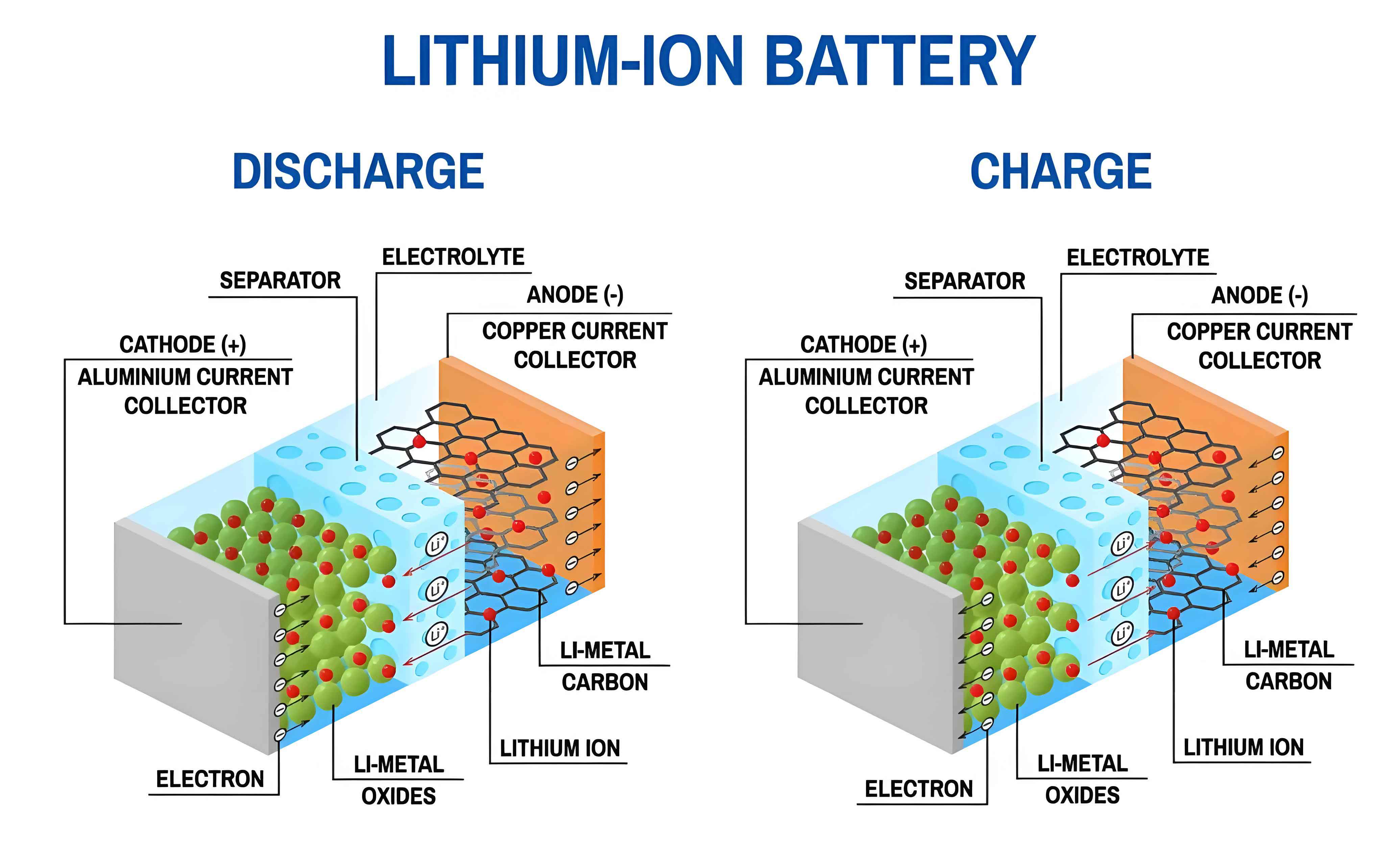
The transition in the global energy structure and the pursuit of “dual-carbon” goals have positioned the lithium-ion battery as a cornerstone for electric vehicles, renewable energy storage systems, and portable electronics, owing to its high energy density, long cycle life, and low self-discharge rate. However, complex electrochemical aging during long-term charge-discharge cycles leads to capacity fade and State of Health (SOH) degradation, directly impacting system safety and economics. Accurately predicting the Remaining Useful Life (RUL) of lithium-ion battery packs is therefore of paramount engineering significance for optimizing maintenance strategies, mitigating failure risks, and extending equipment service life.
Current RUL prediction methodologies are primarily categorized into model-driven, data-driven, and hybrid approaches. Model-driven methods, which construct degradation models based on electrochemical mechanisms, often rely on precise physical parameters and suffer from high computational complexity, making them less adaptable to dynamic uncertainties in real-world operating conditions. Data-driven methods, such as Long Short-Term Memory (LSTM) networks and Support Vector Machines (SVM), mine historical data features for prediction, bypassing the limitations of mechanism modeling. Nevertheless, they can be sensitive to data noise and may exhibit limited generalization capability under highly nonlinear degradation patterns. Recently, intelligent algorithms that fuse fuzzy logic with neural networks have garnered attention for their robust handling of uncertain information. However, traditional Type-1 fuzzy systems exhibit significant shortcomings, such as fixed rule weights and rigid boundaries for membership functions, which constrain modeling accuracy for complex dynamic systems like lithium-ion battery aging.
To address these challenges, this work proposes a novel RUL prediction framework for lithium-ion battery based on an Interval Type-2 Takagi-Sugeno-Kang Fuzzy Neural Network (IT2 TSK FNN) optimized by the Biogeography-Based Optimization (BBO) algorithm. A Deep Belief Network (DBN) is first employed for feature extraction from raw battery aging data, reducing data dimensionality and complexity. The IT2 fuzzy sets are then utilized to describe input-output uncertainties inherent in the battery degradation process. By employing adaptive upper and lower membership functions, the model effectively captures the boundaries of data distribution, thereby reducing noise interference. A hierarchical fuzzy inference network structure is designed, enabling the joint training of fuzzy rules and neural network weights. This achieves a synergistic optimization between the nonlinear mapping of degradation features and the interpretability of fuzzy logic. The proposed DBN-BBO-IT2 TSK FNN model is validated using the publicly available CALCE lithium-ion battery dataset. Comparative analyses against LSTM, SVM, and traditional Type-1 fuzzy models demonstrate the superior prediction accuracy, robustness against noise, and early warning capability of the proposed method.
Theoretical Framework
1. Feature Extraction via Deep Belief Network (DBN)
The DBN is a semi-supervised learning architecture constructed from stacked Restricted Boltzmann Machines (RBMs). An RBM is a two-layer, undirected graphical model comprising a visible layer (for input data) and a hidden layer (for learning latent features), with full connections between layers but no connections within a layer. The probability of a joint configuration (v, h) is given by the energy function:
$$E(\mathbf{v}, \mathbf{h}) = -\sum_{i=1}^{V} a_i v_i – \sum_{j=1}^{H} b_j h_j – \sum_{i=1}^{V} \sum_{j=1}^{H} v_i w_{ij} h_j$$
where \(v_i\) and \(h_j\) are the binary states of visible unit \(i\) and hidden unit \(j\), \(a_i\) and \(b_j\) are their biases, and \(w_{ij}\) is the weight between them. The network learns parameters by maximizing the likelihood of the training data, typically using the Contrastive Divergence (CD) algorithm.
In our framework, a three-layer DBN is employed. The first RBM (with 500 hidden neurons) learns preliminary features from the raw input data (e.g., discharge current, voltage, temperature, time). Its hidden layer activations then serve as the “visible” input for the second RBM (300 neurons), which extracts higher-order features. This process repeats for the third RBM (100 neurons). This hierarchical, unsupervised pre-training effectively reduces data complexity and discovers robust feature representations crucial for subsequent RUL modeling.
2. Parameter Optimization using Biogeography-Based Optimization (BBO)
BBO is a population-based metaheuristic algorithm inspired by the migration of species between habitats. Each solution candidate (habitat) is characterized by a Habitat Suitability Index (HSI), analogous to fitness. High-HSI habitats (good solutions) have low immigration rates (\(\lambda\)) and high emigration rates (\(\mu\)), while low-HSI habitats exhibit the opposite. The migration and mutation operations facilitate information sharing and exploration within the population.
For a habitat with \(n\) suitability index variables (SIVs, representing model parameters), the immigration rate \(\lambda_i\) and emigration rate \(\mu_i\) for the \(i\)-th individual are often modeled as linear functions of its rank or fitness. A mutation rate is also applied based on species count probability. During optimization, information (SIVs) migrates from high-HSI habitats to low-HSI ones, while mutation introduces random changes to maintain diversity. In this work, BBO is employed to optimize the parameters of the IT2 TSK FNN, including the antecedents (membership function parameters) and consequents (polynomial coefficients). The algorithm settings are detailed in Table 1.
| Algorithm | Parameter | Value |
|---|---|---|
| BBO | Population Size | 30 |
| Maximum Generations | 80 | |
| Mutation Probability | 0.05 | |
| DBN | RBM Layer Structure | 500-300-100 |
| Pre-training Algorithm | Contrastive Divergence (CD-1) | |
| IT2 TSK FNN | Number of Fuzzy Rules | 4 |
3. Interval Type-2 TSK Fuzzy Neural Network (IT2 TSK FNN)
An A2-C1 type IT2 TSK FNN is constructed to handle uncertainties in the lithium-ion battery degradation process. Unlike Type-1 systems, IT2 FLSs use fuzzy sets with fuzzy membership grades, providing an extra degree of freedom for modeling uncertainties.
Consider a dataset with \(M\) input-output pairs: \(\{ (\mathbf{x}^{(1)}, y^{(1)}), …, (\mathbf{x}^{(M)}, y^{(M)}) \}\), where \(\mathbf{x} = [x_1, x_2, …, x_p]^T\). The \(h\)-th fuzzy rule in a first-order TSK model is formulated as:
$$R^h: \text{IF } x_1 \text{ is } \tilde{F}_1^h \text{ and } … \text{ and } x_p \text{ is } \tilde{F}_p^h, \text{ THEN } Y^h = C_0^h + \sum_{k=1}^{p} C_k^h x_k$$
Here, \(\tilde{F}_k^h\) is an Interval Type-2 fuzzy set for the \(k\)-th input in rule \(h\). Its membership function is characterized by a Gaussian primary membership function with an uncertain mean:
$$\mu_{\tilde{F}_k^h}(x_k) = \exp\left(-\frac{1}{2}\left(\frac{x_k – m_k^h}{\sigma_k^h}\right)^2\right), \quad m_k^h \in [m_{k,1}^h, m_{k,2}^h]$$
The upper \(\overline{\mu}\) and lower \(\underline{\mu}\) membership functions are:
$$\overline{\mu}_{\tilde{F}_k^h}(x_k) =
\begin{cases}
N(m_{k,1}^h, \sigma_k^h; x_k) & x_k < m_{k,1}^h \\
1 & m_{k,1}^h \leq x_k \leq m_{k,2}^h \\
N(m_{k,2}^h, \sigma_k^h; x_k) & x_k > m_{k,2}^h
\end{cases}$$
$$\underline{\mu}_{\tilde{F}_k^h}(x_k) =
\begin{cases}
N(m_{k,2}^h, \sigma_k^h; x_k) & x_k \leq \frac{m_{k,1}^h+m_{k,2}^h}{2} \\
N(m_{k,1}^h, \sigma_k^h; x_k) & x_k > \frac{m_{k,1}^h+m_{k,2}^h}{2}
\end{cases}$$
where \(N(m, \sigma; x) = \exp(-\frac{1}{2}(\frac{x-m}{\sigma})^2)\).
The consequent \(C_k^h\) is also an interval set: \(C_k^h = [c_k^h – s_k^h, c_k^h + s_k^h]\), where \(c_k^h\) is the center and \(s_k^h\) is the spread. For an input \(\mathbf{x}\), the firing strength for rule \(h\) is the interval \(F^h(\mathbf{x}) = [\underline{f}^h(\mathbf{x}), \overline{f}^h(\mathbf{x})]\), calculated using the product t-norm:
$$\underline{f}^h(\mathbf{x}) = \underline{\mu}_{\tilde{F}_1^h}(x_1) \cdot \underline{\mu}_{\tilde{F}_2^h}(x_2) \cdot … \cdot \underline{\mu}_{\tilde{F}_p^h}(x_p)$$
$$\overline{f}^h(\mathbf{x}) = \overline{\mu}_{\tilde{F}_1^h}(x_1) \cdot \overline{\mu}_{\tilde{F}_2^h}(x_2) \cdot … \cdot \overline{\mu}_{\tilde{F}_p^h}(x_p)$$
The rule output \(Y^h\) is an interval: \(Y^h = [y_l^h, y_r^h]\), where:
$$y_l^h = c_0^h – s_0^h + \sum_{k=1}^{p} (c_k^h – s_k^h)x_k, \quad y_r^h = c_0^h + s_0^h + \sum_{k=1}^{p} (c_k^h + s_k^h)x_k$$
The final output of the IT2 TSK FLS is computed by performing type-reduction followed by defuzzification. The Karnik-Mendel (KM) algorithms are typically used to find the endpoints \(y_l\) and \(y_r\) of the type-reduced set. The crisp output is then:
$$y(\mathbf{x}) = \frac{y_l(\mathbf{x}) + y_r(\mathbf{x})}{2}$$
This structure enables the model to simultaneously capture intra-rule (parameter) and inter-rule uncertainties present in lithium-ion battery aging data, such as those arising from measurement noise and capacity regeneration phenomena.
4. Integrated RUL Prediction Framework
The proposed RUL prediction framework integrates the above components, as outlined below:
- Data Preprocessing: Raw cycling data (discharge current, voltage, temperature, time, capacity) are normalized and relevant health indicators are calculated.
- Deep Feature Extraction: The normalized multi-dimensional data are fed into the pre-trained DBN. The activations of the final hidden layer (100 neurons) are extracted as the deep degradation feature vector, which serves as the input \(\mathbf{x}\) to the prediction model.
- Model Training: The dataset is split at a predefined prediction starting point (PSP). Data before the PSP is used for training. The BBO algorithm optimizes all parameters \(\theta\) of the IT2 TSK FNN (antecedent parameters \(m_{k,1}^h, m_{k,2}^h, \sigma_k^h\) and consequent parameters \(c_k^h, s_k^h\)) by minimizing the error between predicted capacity \(\hat{y}_t\) and actual capacity \(y_t\) over the training cycles:
$$\min_{\theta} \frac{1}{N_{train}} \sum_{t=1}^{N_{train}} (y_t – \hat{y}_t(\mathbf{x}_t; \theta))^2$$ - RUL Prediction & Evaluation: The trained DBN-BBO-IT2 TSK FNN model predicts capacity for cycles after the PSP. The End-of-Life (EOL) threshold is defined as 70% of nominal capacity (0.77 Ah for the 1.1 Ah cells used). RUL at cycle \(t_p\) (PSP) is calculated as: \(RUL(t_p) = t_{EOL} – t_p\), where \(t_{EOL}\) is the predicted cycle where capacity first falls below the EOL threshold. Predictions are evaluated using standard metrics: Root Mean Square Error (RMSE), Mean Absolute Error (MAE), Mean Absolute Percentage Error (MAPE), and Coefficient of Determination (R²).
Experimental Validation and Results
1. Dataset and Experimental Setup
The proposed methodology is validated using the CALCE battery dataset. The tests were conducted on CS2-type lithium-ion battery cells with a nominal capacity of 1.1 Ah. Charging followed a standard Constant Current-Constant Voltage (CC-CV) protocol: CC charge at 0.55 A until the voltage reached 4.2 V, followed by a CV hold until the current dropped to 50 mA. Discharge was performed at a constant current of 1.1 A until the voltage fell to the specified cutoff (2.7V, 2.5V, or 2.2V). All tests were conducted at room temperature (20-25°C). The capacity degradation curves for four selected cells (CS_35, CS_36, CS_37, CS_38) are shown in Figure 1, displaying the characteristic monotonic decline interspersed with occasional capacity regeneration.
The prediction starting point (PSP) was set at cycle 365 for all cells. Data from cycles 1-365 were used to train the DBN and the IT2 TSK FNN model. Cycles 366 until the actual EOL were used for testing and RUL calculation. The proposed DBN-BBO-IT2 TSK FNN model is compared against several benchmarks: LSTM, SVM, Type-1 TSK FNN (T1 TSK FNN), and IT2 TSK FNN optimized by Particle Swarm Optimization (PSO) and Genetic Algorithm (GA).
2. Prediction Results and Comparative Analysis
The capacity prediction results for the four test cells are presented in Figure 2. The black solid line represents the actual measured capacity. The predictions from the proposed DBN-BBO-IT2 TSK FNN model (dark green line) closely track the actual degradation trajectory, including the subtle capacity regeneration events, and converge accurately to the EOL threshold (0.77 Ah, red dashed line). In contrast, predictions from LSTM and SVM show larger deviations, especially in later cycles. The T1 TSK FNN and other optimized IT2 FNN models (PSO, GA) show improved performance but are generally less accurate and less stable than the proposed BBO-optimized version.
The prediction error curves (Predicted Capacity – Actual Capacity) are plotted in Figure 3. The error for the DBN-BBO-IT2 TSK FNN model fluctuates within a very narrow band around zero (approximately ±0.05 Ah for CS_38), demonstrating its high precision. Other models exhibit significantly larger error magnitudes and variances, particularly LSTM and SVM.
A quantitative summary of the prediction performance for all cells at PSP=365 is provided in Table 2. The proposed method consistently achieves the best (lowest) values for RMSE, MAE, and MAPE, and the highest (closest to 1) R² score across all four cells. For instance, for cell CS_35, the DBN-BBO-IT2 TSK FNN yields an RMSE of 0.006 Ah, MAE of 0.0035 Ah, MAPE of 0.40%, and R² of 0.9851, significantly outperforming all other methods. This trend holds for the other cells, confirming the robustness and generalizability of the proposed approach.
| Cell ID | Method | RMSE (Ah) | MAE (Ah) | MAPE (%) | R² |
|---|---|---|---|---|---|
| CS_35 | LSTM | 0.0163 | 0.0120 | 1.37 | 0.8893 |
| SVM | 0.0150 | 0.0114 | 1.30 | 0.9000 | |
| T1 TSK FNN | 0.0136 | 0.0085 | 0.97 | 0.9236 | |
| PSO-IT2 TSK FNN | 0.0099 | 0.0063 | 0.89 | 0.9333 | |
| GA-IT2 TSK FNN | 0.0105 | 0.0069 | 0.83 | 0.9569 | |
| BBO-IT2 TSK FNN | 0.0075 | 0.0054 | 0.59 | 0.9770 | |
| DBN-BBO-IT2 TSK FNN | 0.0060 | 0.0035 | 0.40 | 0.9851 | |
| CS_36 | LSTM | 0.0283 | 0.0225 | 2.67 | 0.8800 |
| SVM | 0.0205 | 0.0170 | 2.07 | 0.8901 | |
| T1 TSK FNN | 0.0115 | 0.0092 | 1.06 | 0.9662 | |
| PSO-IT2 TSK FNN | 0.0104 | 0.0079 | 0.93 | 0.9695 | |
| GA-IT2 TSK FNN | 0.0099 | 0.0080 | 0.90 | 0.9663 | |
| BBO-IT2 TSK FNN | 0.0085 | 0.0063 | 0.73 | 0.9822 | |
| DBN-BBO-IT2 TSK FNN | 0.0078 | 0.0052 | 0.60 | 0.9840 | |
| CS_37 | LSTM | 0.0203 | 0.0163 | 1.96 | 0.9026 |
| SVM | 0.0188 | 0.0096 | 1.17 | 0.9332 | |
| T1 TSK FNN | 0.0081 | 0.0084 | 0.85 | 0.9444 | |
| PSO-IT2 TSK FNN | 0.0088 | 0.0063 | 0.78 | 0.9692 | |
| GA-IT2 TSK FNN | 0.0114 | 0.0068 | 0.73 | 0.9615 | |
| BBO-IT2 TSK FNN | 0.0077 | 0.0050 | 0.58 | 0.9892 | |
| DBN-BBO-IT2 TSK FNN | 0.0060 | 0.0040 | 0.47 | 0.9913 | |
| CS_38 | LSTM | 0.0195 | 0.0170 | 1.96 | 0.8654 |
| SVM | 0.0203 | 0.0153 | 1.81 | 0.8753 | |
| T1 TSK FNN | 0.0098 | 0.0073 | 0.74 | 0.9234 | |
| PSO-IT2 TSK FNN | 0.0093 | 0.0068 | 0.70 | 0.9483 | |
| GA-IT2 TSK FNN | 0.0090 | 0.0064 | 0.71 | 0.9444 | |
| BBO-IT2 TSK FNN | 0.0069 | 0.0046 | 0.53 | 0.9532 | |
| DBN-BBO-IT2 TSK FNN | 0.0063 | 0.0038 | 0.44 | 0.9860 |
Conclusion
Predicting the RUL of lithium-ion battery packs is essential for ensuring the safety and reliability of energy supply systems. This work addressed key challenges in RUL prediction, including difficult feature extraction, low prediction accuracy, and suboptimal convergence, by proposing a novel integrated model: the DBN-BBO-IT2 TSK FNN. The model leverages the powerful unsupervised feature extraction capability of DBN to distill robust degradation indicators from raw, multi-dimensional battery cycling data. The IT2 TSK FNN provides a robust framework for modeling the nonlinearities and uncertainties inherent in lithium-ion battery aging. The BBO algorithm effectively optimizes the numerous parameters of this complex fuzzy-neural network, finding a superior solution compared to other optimizers like PSO and GA.
Experimental validation on the CALCE dataset demonstrates that the proposed framework significantly outperforms established data-driven methods (LSTM, SVM) and simpler fuzzy models (T1 FNN). It achieves highly accurate capacity trajectory prediction with minimal error, successfully captures capacity regeneration phenomena, and provides reliable RUL estimates. The consistent superior performance across multiple battery cells, as quantified by RMSE, MAE, MAPE, and R² metrics, confirms the method’s robustness and generalization potential.
This research validates the proposed method on a single battery type under controlled laboratory conditions. Future work will focus on extending its applicability to more complex scenarios, such as different temperature environments, various lithium-ion battery chemistries, and pack-level modeling. Furthermore, developing efficient online implementation strategies, including mechanisms for dynamic model updating and simplified architectures for real-time deployment, will be crucial for translating this promising offline prediction tool into practical online battery management systems.