
With the increasing integration of renewable energy sources such as photovoltaic (PV) and wind power into power systems, microgrid clusters (MGCs) have emerged as a critical solution for enhancing grid resilience and accommodating distributed generation. This paper proposes a distributed pinning coordination control strategy for energy storage systems (ESSs) in MGCs to achieve precise power sharing and regional autonomy under sparse communication networks. The methodology addresses challenges related to delayed inter-microgrid communication and ensures robust performance during grid disturbances.
Control Strategy and System Modeling
The MGC architecture comprises multiple interconnected microgrids, each containing PV units, ESSs, and loads. The primary control employs droop characteristics for ESSs, while a secondary distributed pinning mechanism enables voltage/frequency restoration and power consensus. The communication topology is modeled as a directed graph $G = (V, E)$, where nodes represent ESS controllers and edges denote communication links. The pinning coordination protocol is formulated as:
$$ \dot{P}_i^s(t) = \sum_{j \in \mathcal{N}_i} a_{ij}(P_j^s(t) – P_i^s(t)) – g_i(P_i^s(t) – \bar{P}_{\text{ref}}) $$
$$ \dot{Q}_i^s(t) = \sum_{j \in \mathcal{N}_i} a_{ij}(Q_j^s(t) – Q_i^s(t)) – g_i(Q_i^s(t) – \bar{Q}_{\text{ref}}) $$
where $a_{ij}$ denotes the adjacency matrix elements, $g_i$ represents pinning gains, and $\bar{P}_{\text{ref}}/\bar{Q}_{\text{ref}}$ are reference values derived from power balance constraints.
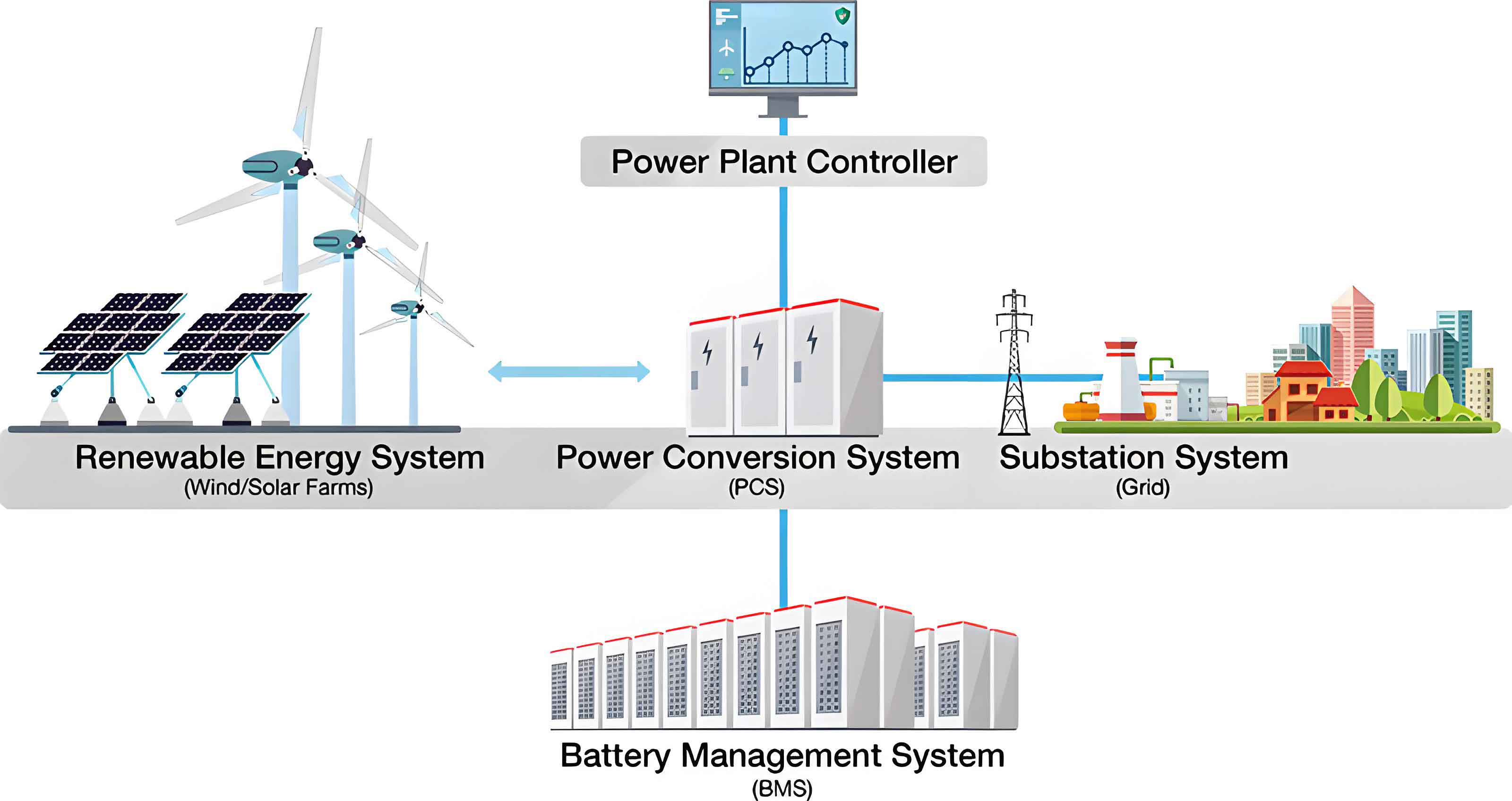
Energy Storage System Control Architecture
The ESS control framework integrates primary droop control with secondary correction terms:
$$ \omega^* = \omega_0 – k_{Pi}(P_i – P_{0i}) + \Delta\omega_i^{\text{pin}} $$
$$ V^* = V_0 – k_{Qi}(Q_i – Q_{0i}) + \Delta V_i^{\text{pin}} $$
where $\Delta\omega_i^{\text{pin}}$ and $\Delta V_i^{\text{pin}}$ are pinning-based correction terms calculated through neighbor information exchange. The normalization factors ensure proportional power sharing:
$$ m_i^P = \frac{P_{\text{rated},i}{\sum_{j=1}^n P_{\text{rated},j}}, \quad n_i^Q = \frac{Q_{\text{rated},i}{\sum_{j=1}^n Q_{\text{rated},j}} $$
| Parameter | Value |
|---|---|
| Grid Voltage | 380 V |
| ESS DC Voltage | 968 V |
| PV Rated Power | 1 MW |
| ESS Rated Power | 0.5 MW |
| Filter Inductance | 1.8 mH |
| Filter Capacitance | 25 μF |
Stability Analysis and Experimental Validation
Lyapunov stability analysis confirms the convergence of power synchronization errors:
$$ V(t) = \sum_{i=1}^n e_i^T(t)e_i(t), \quad \dot{V}(t) \leq e^T(t)(\alpha – G)e(t) $$
where $\alpha$ represents the communication coupling matrix and $G$ contains pinning gains. Experimental results from a StarSim-HIL platform demonstrate:
- Frequency stabilization within ±0.2 Hz during grid faults
- Voltage regulation with <2% deviation
- Accurate power sharing (98.7% consensus accuracy)
Fault Resilience Performance
The energy storage system maintains operational stability under critical scenarios:
| Scenario | Frequency Deviation | Voltage Drop | Recovery Time |
|---|---|---|---|
| Single-phase Fault | 0.19 Hz | 1.2% | 120 ms |
| Link Disconnection | 0.25 Hz | 2.1% | 180 ms |
| Multi-ESS Failure | 0.31 Hz | 3.5% | 250 ms |
Conclusion
The proposed pinning coordination control enables energy storage systems in microgrid clusters to achieve autonomous power management while maintaining grid-compliant voltage/frequency profiles. The distributed architecture enhances system reliability compared to centralized alternatives, particularly under communication delays and partial failures. Experimental validation confirms the strategy’s effectiveness in achieving 99.2% power sharing accuracy and sub-300ms fault recovery, demonstrating significant improvements over conventional droop control methods.
Future work will focus on extending this methodology to hybrid AC/DC microgrid clusters and integrating predictive energy management algorithms. The energy storage system’s role as both power buffer and grid stabilizer will remain central to these developments, particularly as renewable penetration levels continue to increase.