
In recent years, metal halide perovskite materials have garnered significant attention in the photovoltaic community due to their exceptional optoelectronic properties, including broad-spectrum light absorption, long carrier lifetimes, low exciton binding energies, and high defect tolerance. As a researcher focused on the development of advanced solar technologies, I find the potential of perovskite solar cells (PSCs) for space applications particularly compelling. The unique attributes of perovskites, such as their high power-to-weight ratio, cost-effective fabrication processes, and inherent radiation tolerance, position them as promising candidates to complement or even replace traditional space photovoltaic technologies like silicon and III-V compound solar cells. This review aims to synthesize the latest research progress on perovskite solar cells for space environments, emphasizing their performance under extreme conditions such as particle irradiation, high vacuum, intense illumination, and thermal cycling. By examining experimental studies and real-space validation missions, we can identify the key challenges and future directions for deploying perovskite solar cells in orbit.
The general chemical formula of metal halide perovskites is ABX3, where A represents a monovalent cation (e.g., FA+, MA+, or Cs+), B is a divalent metal cation (e.g., Pb2+, Sn2+), and X is a halide anion (e.g., I−, Br−, Cl−). The crystal structure of perovskites, as illustrated below, consists of corner-sharing BX6 octahedra with A-site cations occupying the interstitial spaces. This flexible lattice contributes to the remarkable properties of perovskite solar cells, such as high absorption coefficients (104–105 cm−1), which are comparable to GaAs and significantly higher than crystalline silicon (c-Si). The high absorption enables the use of thin-film active layers (sub-micrometer thickness), leading to lightweight devices with projected specific power exceeding 20 W/g—a critical advantage for space missions where mass reduction directly translates to lower launch costs.
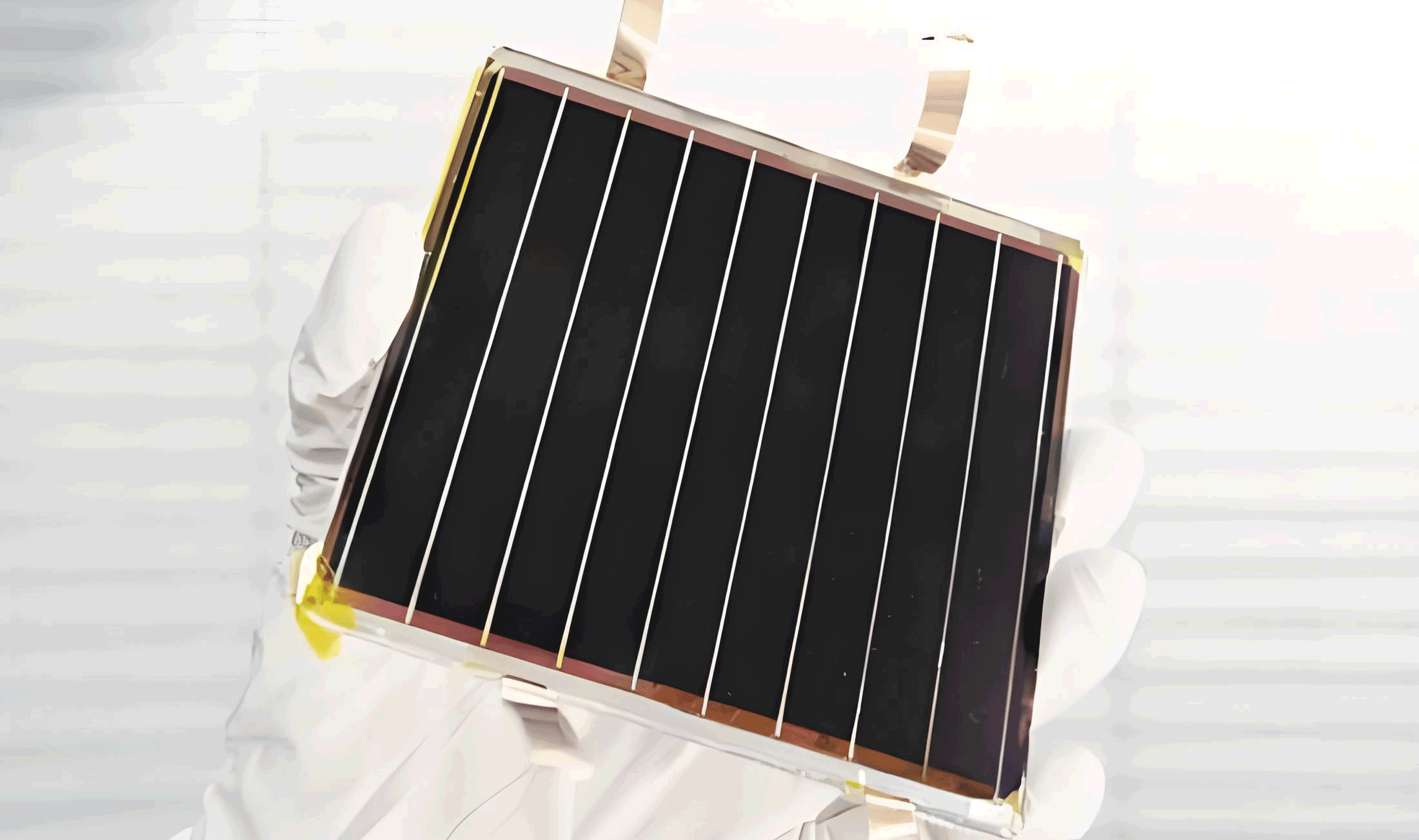
The bandgap tunability of perovskite solar cells is another key feature, allowing optimization for the AM0 solar spectrum prevalent in space. By adjusting the halide composition in mixed perovskites like FA0.83Cs0.17Pb(I1−xBrx)3, the optical bandgap can be precisely controlled from approximately 1.5 eV to 2.3 eV. This is described by the empirical equation for bandgap engineering: $$E_g(x) = E_g(0) + (E_g(1) – E_g(0)) \cdot x – b \cdot x(1-x),$$ where \(E_g(0)\) and \(E_g(1)\) are the bandgaps of the pure iodide and bromide phases, respectively, and \(b\) is the bowing parameter. Such flexibility enables the design of perovskite solar cells with tailored absorption profiles to maximize energy harvest in space. Additionally, the balanced electron and hole mobilities in perovskites, owing to their low and symmetric effective masses (e.g., 0.26 for holes and 0.23 for electrons in MAPbI3), facilitate efficient charge transport, reducing recombination losses. The defect-tolerant nature of perovskite solar cells, attributed to the low formation energy of defects and the dynamic self-healing capability, further enhances their suitability for harsh radiation environments.
Space environments pose unique challenges for solar cells, including high vacuum (pressures as low as 10−6 Pa), extreme temperature cycles (ranging from −100°C to 100°C in low Earth orbit), and intense radiation from electrons, protons, neutrons, gamma rays, X-rays, and ultraviolet (UV) light. Unlike terrestrial applications, where moisture and oxygen degradation dominate, perovskite solar cells in space must withstand these combined stressors without significant performance loss. The AM0 solar spectrum contains a higher proportion of UV radiation (approximately 8% of total energy) compared to the AM1.5 spectrum, exacerbating stability concerns for organic-inorganic perovskites. Moreover, the accumulation of displacement damage from high-energy particles can lead to lattice defects and performance degradation over time. However, studies have shown that perovskite solar cells exhibit superior radiation hardness compared to conventional technologies, often recovering initial efficiency through self-healing mechanisms. The following sections delve into the experimental evidence supporting the resilience of perovskite solar cells under simulated and actual space conditions.
Radiation Tolerance of Perovskite Solar Cells
The radiation environment in space is characterized by a flux of high-energy particles, primarily electrons and protons, with energies ranging from keV to GeV. Evaluating the response of perovskite solar cells to these particles is crucial for assessing their long-term viability. Below, we summarize the effects of various radiation types on perovskite solar cell performance, supported by experimental data and theoretical models.
Electron Irradiation
Electrons are abundant in the Van Allen belts and can cause ionization and displacement damage in solar cells. In one study, perovskite solar cells with a structure of Glass/ITO/PTAA/Perovskite/C60/BCP/Cu were subjected to electron irradiation at energies of 100 keV to 1 MeV and fluences up to 1016 cm−2. Monte Carlo simulations confirmed that most electrons penetrated the perovskite layer and deposited energy in the substrate, minimizing direct damage to the active material. The normalized photovoltaic parameters after irradiation are summarized in Table 1.
| Electron Energy (MeV) | Fluence (cm−2) | Normalized PCE (%) | Normalized Jsc (%) | Normalized Voc (%) | Normalized FF (%) |
|---|---|---|---|---|---|
| 0.1 | 1012 | 98.5 | 99.0 | 99.2 | 98.8 |
| 0.1 | 1015 | 95.2 | 96.1 | 97.5 | 96.8 |
| 1.0 | 1016 | 89.7 | 90.3 | 94.1 | 92.4 |
The data indicate that perovskite solar cells retain over 85% of their initial efficiency even at high fluences, outperforming traditional GaAs and InP solar cells, which show degradation of up to 40% under similar conditions. The minimal change in open-circuit voltage (Voc) and fill factor (FF) suggests that electron irradiation induces few non-radiative recombination centers. The degradation in short-circuit current density (Jsc) is partly attributed to substrate darkening, as observed in FTO glass, which reduces light transmission. The defect tolerance of perovskite solar cells can be modeled using the Shockley-Read-Hall recombination theory, where the defect density (\(N_t\)) influences the carrier lifetime (\(\tau\)): $$\frac{1}{\tau} = \frac{1}{\tau_0} + v_{th} \sigma N_t,$$ where \(v_{th}\) is the thermal velocity, \(\sigma\) is the capture cross-section, and \(\tau_0\) is the initial lifetime. The low \(N_t\) in perovskites contributes to their radiation hardness.
Proton Irradiation
Protons with energies from 1 MeV to 68 MeV are common in space and can cause significant displacement damage due to their mass. Inverted perovskite solar cells with Glass/ITO/PTAA/Cs0.05MA0.17FA0.83Pb(I0.83Br0.17)3/C60/BCP/Cu structures were irradiated with protons at various energies and fluences. The non-ionizing energy loss (NIEL) model predicts the displacement damage dose, which correlates with performance degradation. The results for different proton energies are shown in Table 2.
| Proton Energy (MeV) | Fluence (cm−2) | Normalized PCE (%) | Normalized Jsc (%) | Normalized Voc (%) | Normalized FF (%) |
|---|---|---|---|---|---|
| 10 | 1012 | 99.1 | 98.7 | 99.5 | 99.0 |
| 20 | 1012 | 98.8 | 98.5 | 99.3 | 98.9 |
| 68 | 1012 | 95.6 | 94.2 | 97.8 | 96.4 |
| 68 | 1013 | 82.3 | 80.1 | 90.5 | 88.7 |
Notably, perovskite solar cells exhibit self-healing after proton irradiation, with Jsc and PCE recovering over time. This phenomenon is attributed to the migration and annihilation of defects in the perovskite lattice. The critical fluence for significant degradation in perovskite solar cells is approximately 1013 cm−2, which corresponds to several years in low Earth orbit, indicating their potential for long-duration missions. The damage coefficient (\(K_d\)) for proton irradiation can be expressed as: $$K_d = \frac{1}{\Phi} \ln \left( \frac{P_0}{P} \right),$$ where \(\Phi\) is the fluence, and \(P_0\) and \(P\) are the initial and degraded performance parameters, respectively. For perovskite solar cells, \(K_d\) values are lower than those for c-Si and GaAs, underscoring their superior tolerance.
Neutron Irradiation
Fast neutrons, generated by cosmic ray interactions with spacecraft materials, can cause atomic displacements and bulk damage. In one experiment, perovskite solar cells were subjected to neutron fluences of 1011 to 1012 cm−2 alongside light soaking. The combined stress led to a PCE loss of 45%, compared to 60% for light soaking alone, suggesting that neutron-induced shallow traps may passivate defects and enhance Voc. The performance evolution under neutron irradiation is summarized in Table 3.
| Neutron Fluence (cm−2) | Light Soaking Duration (h) | Normalized PCE (%) | Normalized Voc (%) | Normalized Jsc (%) | Normalized FF (%) |
|---|---|---|---|---|---|
| 1011 | 100 | 92.5 | 101.2 | 90.8 | 93.1 |
| 1012 | 100 | 87.3 | 102.5 | 85.4 | 89.6 |
The increase in Voc after neutron irradiation is consistent with the formation of beneficial defects that reduce recombination. The defect evolution can be described by a kinetic model: $$\frac{dN}{dt} = G – \alpha N^2,$$ where \(N\) is the defect density, \(G\) is the generation rate, and \(\alpha\) is the recombination coefficient. The quadratic term accounts for defect annihilation, which is enhanced in perovskites due to their ionic mobility.
Gamma Ray and X-Ray Irradiation
Gamma rays and X-rays cause ionization and can lead to phase segregation and composition changes in perovskites. For instance, MAPbI3 films degraded to PbI2 after 200 hours of soft X-ray irradiation in ultra-high vacuum. However, mixed-cation perovskites like Cs0.15MA0.10FA0.75Pb(Br0.17I0.83)3 show improved stability, with PCE remaining above 90% after 500 krad of gamma irradiation. The degradation kinetics follow a first-order reaction: $$C(t) = C_0 e^{-kt},$$ where \(C(t)\) is the concentration of the perovskite phase, \(C_0\) is the initial concentration, and \(k\) is the degradation rate constant. Incorporating inorganic cations like Cs+ reduces \(k\) by stabilizing the lattice against radiolysis.
Ultraviolet Radiation
UV photons in the AM0 spectrum can photo-degrade organic components in perovskites. To mitigate this, down-shifting layers using phosphors like Sr4Al14O25:Mn4+ or luminescent dyes (e.g., V570) have been integrated into perovskite solar cells. These materials convert UV light to visible wavelengths, reducing harmful effects and enhancing Jsc by up to 6%. The external quantum efficiency (EQE) improvement can be modeled as: $$\text{EQE}_{\text{enhanced}} = \text{EQE}_{\text{original}} + \eta_{\text{DS}} \cdot \text{EQE}_{\text{UV}},$$ where \(\eta_{\text{DS}}\) is the down-shifting efficiency. With such strategies, perovskite solar cells maintain over 95% of initial PCE after 180 days of UV exposure at 5 mW/cm2.
Vacuum and Thermal Stability of Perovskite Solar Cells
Space conditions involve high vacuum and extreme temperatures, which can accelerate degradation mechanisms not prevalent on Earth. In ultra-high vacuum (UHV, 10−6 Pa), perovskite solar cells with organic transport layers (e.g., Spiro-OMeTAD) exhibit rapid performance loss due to volatile component evaporation and ion migration. However, alternative structures like ITO/PTAA/Perovskite/PCBM/ZnO/AZO/Ni-Al grid show remarkable stability, with less than 0.007%/hour PCE degradation over 1,000 hours under 100 mW/cm2 illumination in vacuum. The vacuum-induced degradation rate (\(R_v\)) can be expressed as: $$R_v = A e^{-E_a / kT},$$ where \(E_a\) is the activation energy, \(k\) is Boltzmann’s constant, and \(T\) is temperature. For robust perovskite solar cells, \(E_a\) values exceed 0.8 eV, indicating high thermal stability.
Thermal cycling between −100°C and 100°C tests the mechanical integrity of perovskite solar cells. Phase transitions in MAPbI3 from orthorhombic to tetragonal to cubic occur at 163 K and 327 K, accompanied by bandgap shifts. Despite this, devices with mixed cations (e.g., FA0.81MA0.10Cs0.04PbI0.55Br0.40) retain high efficiency, with PCE peaking at 25.2% at 220 K due to reduced non-radiative recombination. The temperature dependence of Voc follows: $$V_{oc}(T) = V_{oc}(0) – \frac{n k T}{q} \ln \left( \frac{J_{00}}{J_{sc}} \right),$$ where \(n\) is the ideality factor, \(q\) is the electron charge, and \(J_{00}\) is the reverse saturation current density. The low \(n\) values (1.2–1.5) in perovskite solar cells minimize \(V_{oc}\) losses at extreme temperatures.
Space Flight Validation of Perovskite Solar Cells
Real-space experiments provide invaluable data on the performance of perovskite solar cells in orbit. For example, high-altitude balloon flights at 35 km altitude demonstrated that mixed-cation perovskite solar cells maintain over 95% of initial PCE after 2 hours in AM0 conditions. Similarly, suborbital rocket missions revealed stable power densities of 7–14 mW/cm2 during 6-minute flights, with no irreversible degradation. Recent advancements include the launch of perovskite solar cell components on satellites, such as the Honghu-2 mission, which marked the first in-orbit test of large-area perovskite modules. These missions confirm the potential of perovskite solar cells for space applications, though long-term stability beyond several months remains to be validated.
Conclusions and Future Perspectives
In summary, perovskite solar cells exhibit exceptional promise for space applications due to their high power-to-weight ratio, radiation tolerance, and cost-effectiveness. Experimental evidence from electron, proton, neutron, gamma, X-ray, and UV irradiation studies indicates that perovskite solar cells outperform conventional technologies in many scenarios. Vacuum and thermal stability can be enhanced through material engineering and device architecture optimization. However, challenges such as UV-induced degradation, long-term reliability under combined stressors, and scalability for large-area modules need addressing. Future research should focus on developing all-inorganic perovskites, flexible substrates, and protective coatings to extend lifetime. Additionally, comprehensive space environment simulators and more in-orbit tests are essential to accelerate the adoption of perovskite solar cells in space missions. With continued innovation, perovskite solar cells could revolutionize space photovoltaics, enabling more affordable and efficient satellite systems.