
The pressing challenges of climate change and the global energy transition necessitate profound decarbonization across all sectors. The building sector, a significant contributor to global carbon emissions, requires urgent transformation of its heating and cooling systems to align with carbon neutrality goals. Traditional coal/gas-fired heating systems, plagued by high carbon emissions and low efficiency, are increasingly unsustainable. Air-source heat pumps (ASHPs), driven by electricity, have emerged as a highly efficient alternative for building air conditioning. However, their reliance on the conventional power grid, which is often fossil-fuel-dependent, limits their potential as a fully low-carbon solution. To address this fundamental limitation, this study proposes and investigates the integration of a rooftop solar system with an ASHP. This composite system aims to leverage solar photovoltaic (PV) generation to directly power the heat pump, thereby reducing grid dependence, lowering operational costs, and achieving synergistic energy-saving and emission-reduction effects. We focus on the hot-summer and cold-winter region of China, characterized by significant seasonal heating and cooling demands, using a typical residential building in Chengdu as a case study.
The research methodology involved a comprehensive simulation-based approach. First, a detailed dynamic building load simulation was conducted. A typical 6-story residential building with a total conditioned area of 2039.11 m² was modeled. Its thermal performance parameters were set according to the local energy efficiency design standard, as summarized in Table 1.
| Component | Heat Transfer Coefficient [W/(m²·K)] |
|---|---|
| Roof | 0.72 |
| External Wall | 0.89 |
| External Window | 2.60 |
Internal loads, occupancy schedules, and indoor temperature setpoints (26°C for cooling, 18°C for heating) were defined based on national standards and typical living patterns. Using the DeST software and Typical Meteorological Year (TMY) data for Chengdu, the annual hourly heating and cooling loads were simulated. The results, shown in Figure 2 of the original text, indicated a maximum heating load of 106.79 kW and a maximum cooling load of 189.98 kW, with annual cumulative loads of 32,465.11 kWh and 39,076.82 kWh, respectively. This confirms the substantial and dual demand for both heating and cooling in this climate, driving high annual energy consumption for space conditioning.
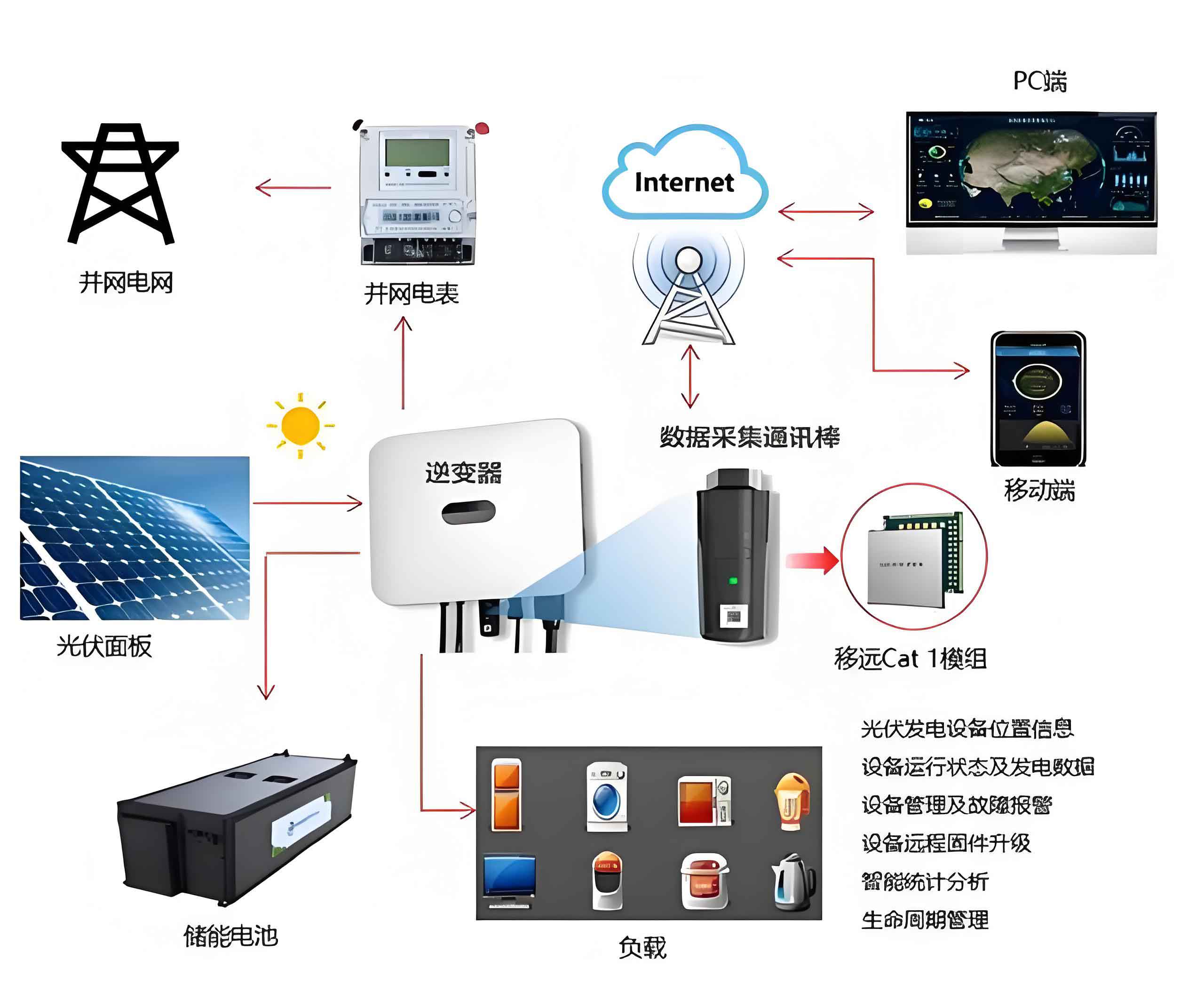
The proposed composite system, termed the Solar Photovoltaic – Air Source Heat Pump (PV-ASHP) system, was then designed and modeled. Its core configuration involves a grid-connected rooftop PV array that supplies electricity preferentially to the ASHP unit and associated circulation pumps. The system operates in a “self-consumption with grid feed-in” mode: PV-generated electricity powers the HVAC equipment first; any surplus is fed into the public grid, and any shortfall is supplemented by grid power. This intelligent power dispatch enhances the utilization of on-site renewable energy. The ASHP unit, sized based on the simulated peak loads, provides both space heating and cooling. Key component specifications are listed in Table 2.
| Component | Parameter | Value |
|---|---|---|
| Air-Source Heat Pump | Rated Cooling Capacity / Power | 161.25 kW / 54.48 kW |
| Rated Heating Capacity / Power | 179.17 kW / 85.32 kW | |
| PV Array (Monocrystalline Si) | Total Area / Tilt Angle | 425 m² / 30° |
| Circulation Pump | Rated Power | 1.8 kW |
The mathematical foundation for modeling the solar system is based on energy balance. The electrical energy output from the PV array is given by:
$$E_e = G \cdot S_c \cdot \eta_t$$
where \(E_e\) is the electrical power output (W), \(G\) is the solar irradiance on the PV panel surface (W/m²), \(S_c\) is the total area of the PV array (m²), and \(\eta_t\) is the photoelectric conversion efficiency of the PV cells. The efficiency is influenced by cell temperature and technology. For the ASHP unit, the key performance indicators are the Coefficient of Performance (COP) for heating and cooling modes:
$$COP_h = \frac{Q_h}{P_h}, \quad COP_c = \frac{Q_c}{P_c}$$
where \(COP_h\) and \(COP_c\) are the heating and cooling COPs, \(Q_h\) and \(Q_c\) are the heating and cooling capacities (kW), and \(P_h\) and \(P_c\) are the corresponding electrical power inputs (kW).
A detailed transient simulation model of the integrated PV-ASHP system was built using the TRNSYS software. The annual operation was simulated using Chengdu’s TMY data. The primary outputs analyzed were the system’s energy consumption, the contribution of the solar system, and the overall energy efficiency. The simulation provided monthly breakdowns of the electricity drawn from the grid for the standard ASHP system and the proposed PV-ASHP system. The results are summarized in Table 3.
| Metric | Standalone ASHP System | PV-ASHP Composite System | Change |
|---|---|---|---|
| Total HVAC Electricity Consumption (kWh) | 197,122 | 167,790 | -29,332 kWh (-14.87%) |
| PV Array Total Generation (kWh) | N/A | 60,891 | – |
| PV Electricity Self-Consumed by HVAC (kWh) | N/A | 33,602 | – |
| PV Surplus Electricity Fed to Grid (kWh) | N/A | 27,289 | – |
| Annual Average System Energy Efficiency Ratio (EER) | 2.39 | 3.11 | +0.72 (+23.15%) |
The data clearly demonstrates the significant impact of integrating the solar system. The PV array generated 60,891 kWh annually, of which approximately 33,602 kWh was directly consumed by the ASHP and pumps, offsetting 14.87% of the total HVAC electricity demand that would have been drawn from the grid in a standard setup. This direct renewable energy substitution is the primary driver for reduced grid dependency. Consequently, the annual average Energy Efficiency Ratio (EER) of the entire composite system, considering the useful thermal energy output versus the grid electricity input, improved markedly from 2.39 to 3.11—an enhancement of 23.15%. This metric underscores the superior energy utilization effectiveness of the PV-ASHP configuration.
To fully appraise the environmental benefits, a carbon footprint analysis for the building’s operational phase was conducted. The assessment focused on the emissions from HVAC system electricity use (Scope 2 indirect emissions) and the carbon reduction achieved through on-site renewable generation. The carbon emissions \(E_{hvac}\) over the building’s lifespan are calculated as:
$$E_{hvac} = \sum_j (q_{hvac, j} \cdot EF_j’ \cdot T_{ope})$$
where \(q_{hvac, j}\) is the annual consumption of energy carrier \(j\) (kWh), \(EF_j’\) is the corresponding emission factor (kg CO₂e/kWh), and \(T_{ope}\) is the building’s operational life (taken as 50 years). The emission factor for the Central China power grid (0.5703 kg CO₂e/kWh) was applied. For the PV-ASHP system, the carbon reduction \(E_{ren}\) from renewable energy includes both the avoided emissions from self-consumed PV electricity and the credited emissions offset by feeding surplus PV power to the grid, displacing grid-mix generation. The comparative results over the 50-year lifespan are presented in Table 4.
| System | Gross Carbon Emissions from Grid Electricity (tCO₂e) | Carbon Reduction from PV System (tCO₂e) | Net System Carbon Emissions (tCO₂e) |
|---|---|---|---|
| Standalone ASHP System | 5,621 | 0 | 5,621 |
| PV-ASHP Composite System | 4,785 | 1,614 | 3,171 |
The analysis reveals profound carbon mitigation potential. Over the building’s 50-year life, the integrated rooftop solar system contributes a total carbon reduction of 1,614 tCO₂e. This substantial reduction stems from the combination of directly powering the HVAC system and exporting clean electricity. Consequently, the net carbon emissions of the PV-ASHP system are calculated to be 3,171 tCO₂e, which is 2,450 tCO₂e lower than the standalone ASHP system. This represents a dramatic 28.73% reduction in the operational carbon footprint attributable to space heating and cooling. This quantifiable outcome strongly validates the composite system’s role in advancing building sector decarbonization.
In conclusion, this investigation confirms the technical feasibility and significant environmental advantages of coupling a solar photovoltaic system with an air-source heat pump for residential buildings in hot-summer and cold-winter climates. The simulation-based study demonstrates that the PV-ASHP composite system can effectively reduce annual grid electricity consumption for HVAC by 14.87% and elevate the system’s average annual energy efficiency ratio by 23.15%. Most importantly, the life-cycle carbon footprint analysis underscores a decisive environmental benefit, with a 28.73% reduction in operational carbon emissions achievable through the synergistic integration of solar PV generation. This research provides a compelling, quantitatively-supported solution that balances energy efficiency, operational cost savings, and substantial carbon mitigation, offering a viable pathway for the low-carbon retrofitting and construction of residential buildings in similar climatic regions. The success of this configuration highlights the critical importance of designing multi-vector energy systems that maximize the direct use of on-site renewables like solar system generation to electrify and clean our building thermal energy demands.