
The relentless demand for efficient and high-performance energy storage has placed lithium-ion batteries at the forefront of modern technology. Their superior energy density, extended cycle life, and relatively low self-discharge have made them indispensable for applications ranging from portable electronics to electric vehicles and grid storage. To meet ever-increasing performance and safety requirements, a profound understanding of the intricate physical and chemical phenomena occurring inside a lithium-ion battery during operation is paramount. These phenomena are not isolated; they are deeply interconnected. Electrochemical reactions generate heat, temperature fluctuations alter reaction kinetics and material properties, and the insertion and extraction of lithium ions induce significant mechanical stresses that can affect diffusion and even lead to material degradation. Therefore, developing a comprehensive modeling framework that captures this coupled behavior is critical for guiding the design, optimization, and safe operation of lithium-ion batteries.
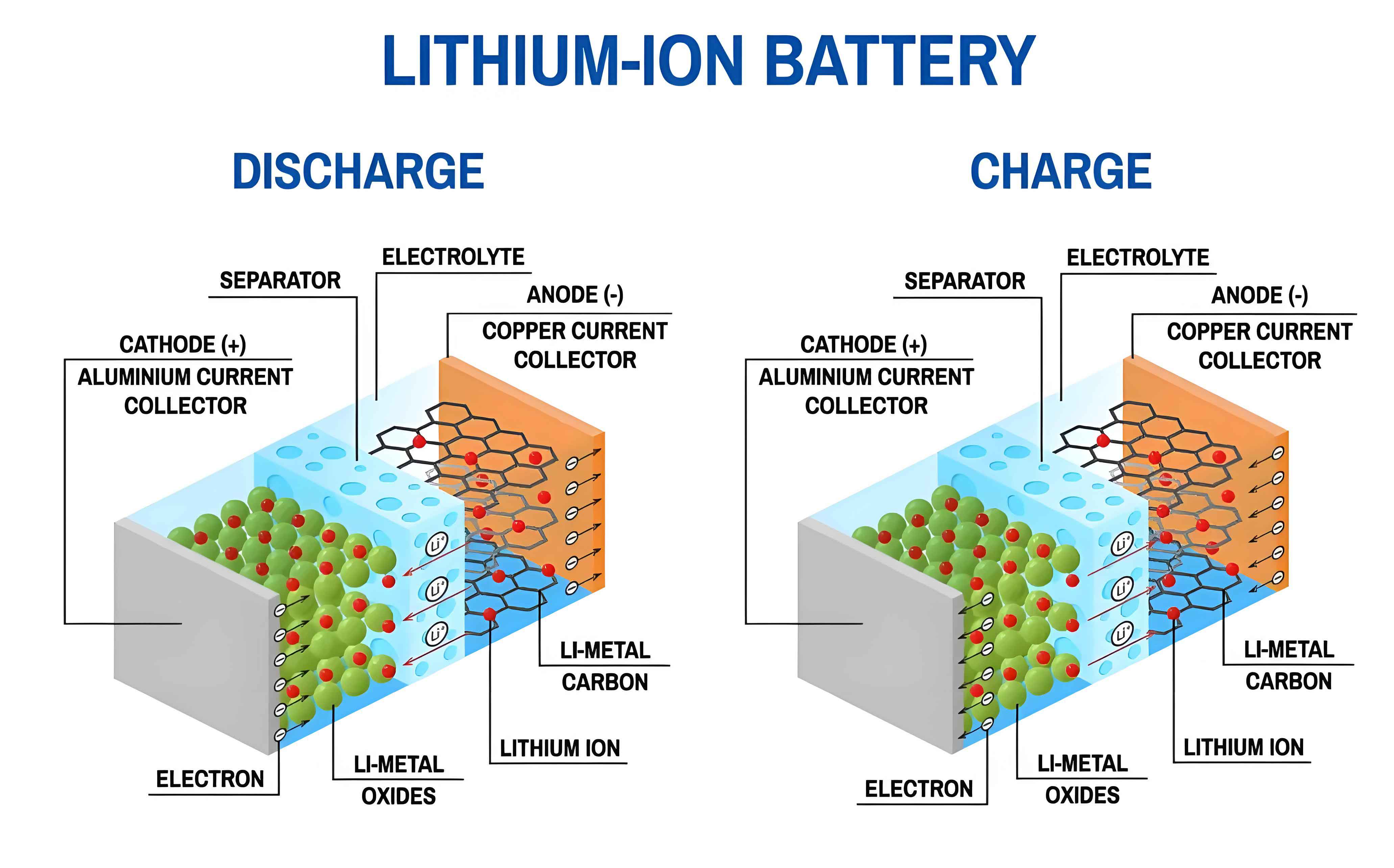
Traditional modeling efforts often simplify this complexity. While electrochemical-thermal (ET) models successfully capture the interplay between electrical and thermal responses, they frequently neglect the critical role of mechanics. Conversely, models focusing on stress generation (electrochemical-mechanical, or EM models) may oversimplify thermal effects. In this study, I have developed and implemented a more physically realistic, fully coupled electrochemical-thermal-mechanical (ETM) model. My primary objective is to construct a model that bridges multiple scales—from the macroscopic electrode down to the microscopic active particle—and incorporates the feedback of generated stresses back into the electrochemical processes. Specifically, this model accounts for stress generation at both the electrode and particle scales, a feature often missing in simpler models, and introduces corrections for stress effects on lithium diffusion and the interfacial overpotential. This provides a more holistic view of the internal state of a lithium-ion battery. Utilizing this advanced ETM model as a foundational tool, I then undertake a detailed numerical investigation into the impact of a key microstructural parameter: the positive electrode active particle size. Particle size fundamentally influences lithium diffusion paths, reaction surface area, and the magnitude of diffusion-induced stresses, thereby affecting overall cell performance, lifespan, and safety. This analysis aims to provide actionable insights for the microstructural design and manufacturing optimization of next-generation lithium-ion batteries.
1. Development of the Multi-Scale ETM Coupled Model
To accurately resolve the multi-physics phenomena, I employed a generalized pseudo-three-dimensional (P3D) modeling approach within the COMSOL Multiphysics finite element simulation environment. This framework is essential for incorporating mechanical analysis, as a simple one-dimensional model cannot adequately compute stress at the electrode scale. The model geometry represents a standard cell sandwich, consisting sequentially of the negative current collector, negative electrode (anode), separator, positive electrode (cathode), and positive current collector. The core innovation lies in the multi-scale representation: the macroscopic electrode is treated as a homogeneous porous medium, while within each representative volume element of the electrode, spherical active particles are resolved, allowing for the calculation of intra-particle stresses and concentration gradients.
1.1 Governing Equations for Electrochemical and Thermal Behavior
The electrochemical model is based on the well-established Doyle-Fuller-Newman framework. Charge conservation in the solid phase of the electrode matrix follows Ohm’s law, while in the liquid electrolyte, it accounts for both ionic migration and diffusion. The equations are presented below, where effective properties are used to account for the porous microstructure (using Bruggeman corrections).
Solid phase charge conservation:
$$ i_s = \nabla \cdot (-\sigma_s^{\text{eff}} \nabla \phi_s) = -S_a i_{\text{loc}} $$
with $\sigma_s^{\text{eff}} = \sigma_s \varepsilon_s^{\gamma}$ and $S_a = 3\varepsilon_s / r_p $.
Liquid phase charge conservation:
$$ i_e = \nabla \cdot \left( -\sigma_e^{\text{eff}} \nabla \phi_e + \frac{2\sigma_e^{\text{eff}} RT}{F} \left(1 + \frac{\partial \ln f}{\partial \ln c_e}\right)(1 – t^+) \nabla (\ln c_e) \right) = S_a i_{\text{loc}} $$
with $\sigma_e^{\text{eff}} = \sigma_e \varepsilon_e^{\gamma}$.
Mass conservation of lithium in the solid active particles is governed by Fick’s law of diffusion in spherical coordinates:
$$ \frac{\partial c_s}{\partial t} + \frac{1}{r^2}\frac{\partial (r^2 J)}{\partial r} = 0 $$
The flux $J$ is modified to include stress effects, as detailed in Section 1.3.
Mass conservation in the liquid electrolyte:
$$ \varepsilon_e \frac{\partial c_e}{\partial t} + \nabla \cdot \left( -D_e^{\text{eff}} \nabla c_e + \frac{i_e t^+}{F} \right) = \frac{S_a i_{\text{loc}}}{F} $$
with $D_e^{\text{eff}} = D_e \varepsilon_e^{\gamma}$.
The interfacial electrochemical reaction kinetics are described by the Butler-Volmer equation:
$$ i_{\text{loc}} = i_0 \left[ \exp\left(\frac{\alpha_a F \eta}{RT}\right) – \exp\left(-\frac{\alpha_c F \eta}{RT}\right) \right] $$
A key feature of my model is the comprehensive expression for the overpotential $\eta$, which includes corrections for temperature and, crucially, for the hydrostatic stress $\sigma_h$:
$$ \eta = \phi_s – \phi_e – E_{\text{eq}} – \frac{\partial E_{\text{eq}}}{\partial T} (T – T_{\text{ref}}) – \frac{\sigma_h \Omega}{F} $$
Here, $\sigma_h$ is the sum of stresses from both particle and electrode scales. The exchange current density $i_0$ is a function of surface concentrations and temperature-dependent kinetics.
The thermal behavior is captured by the energy conservation equation:
$$ \rho C_p \frac{\partial T}{\partial t} + \nabla \cdot (-k \nabla T) = Q_{\text{gen}} $$
The heat generation term $Q_{\text{gen}}$ includes contributions from irreversible reaction heat (activation polarization), reversible reaction entropy, and Joule heating (ohmic losses) in both solid and liquid phases: $Q_{\text{gen}} = Q_{\text{act}} + Q_{\text{rea}} + Q_{\text{ohm}}$.
1.2 Incorporation of Multi-Scale Mechanical Stress
Mechanical stress arises from two primary sources: the volumetric change of active particles due to lithium intercalation/deintercalation (diffusion-induced stress) and thermal expansion. My model calculates stress at two distinct scales.
Particle-Scale Stress: Within each spherical active particle, the constitutive relation accounting for concentration and temperature changes is given by:
$$ \varepsilon_{rr}^* = \frac{1}{E_p} [\sigma_{rr}^* – 2\nu_p \sigma_{\theta\theta}^*] + \frac{\Omega}{3} \Delta c^* + \alpha \Delta T^* $$
$$ \varepsilon_{\theta\theta}^* = \frac{1}{E_p} [\sigma_{\theta\theta}^* – \nu_p (\sigma_{\theta\theta}^* + \sigma_{rr}^*)] + \frac{\Omega}{3} \Delta c^* + \alpha \Delta T^* $$
Assuming spherical symmetry and elasticity, the radial and hoop (tangential) stresses can be analytically derived as functions of the radial concentration profile. The particle-scale hydrostatic stress is:
$$ \sigma_h^*(r) = \frac{\sigma_{rr}^* + 2\sigma_{\theta\theta}^*}{3} = \frac{2\Omega E_p}{3(1-\nu_p)} \left( \frac{1}{r_p^3} \int_0^{r_p} \Delta c \, r^2 dr – \frac{\Delta c(r)}{3} \right) $$
Electrode-Scale Stress: At the macroscopic electrode scale (treated as a composite material), the strain is influenced by the average behavior of particles and the composite itself:
$$ \varepsilon_{ij} = \frac{1}{E} [(1+\nu)\Sigma_{ij} – \nu \Sigma_{kk} \delta_{ij}] + \frac{\Omega}{3} \Delta c \delta_{ij} + \alpha \Delta T \delta_{ij} $$
where $\Sigma_{ij}$ represents the components of the stress tensor in the electrode. The electrode-scale hydrostatic stress is $\sigma_h^e = (\Sigma_{xx} + \Sigma_{yy} + \Sigma_{zz})/(3\varepsilon_s)$.
The total hydrostatic stress influencing the electrochemistry is the sum: $\sigma_h = \sigma_h^* + \sigma_h^e$.
1.3 Two-Way Stress-Chemistry Coupling
A significant advancement in this model is the implementation of a two-way coupling between stress and electrochemistry. Stress is not merely a passive output; it actively influences the processes that generate it.
1. Stress-Modified Diffusion: The thermodynamic driving force for diffusion includes the gradient of chemical potential, which depends on stress. This modifies the lithium flux within the solid particle to:
$$ J = -\frac{D_s}{RT} \left(1 – \frac{c_s}{c_{s,\text{max}}}\right) \frac{c_s}{c_{s,\text{max}}} \left( F \kappa \nabla c_s + \Omega c_{s,\text{max}} \nabla \sigma_h \right) $$
This term can either enhance or impede diffusion depending on the stress gradient.
2. Stress-Modified Overpotential: As shown in the Butler-Volmer equation, the hydrostatic stress $\sigma_h$ directly shifts the equilibrium potential, effectively acting as an additional overpotential term $-\sigma_h \Omega / F$. This means a region under high compressive stress will require a higher applied potential to drive lithium intercalation, and vice versa.
These coupling mechanisms ensure that the mechanical state of the lithium-ion battery electrodes and particles consistently feeds back into the electrochemical driving forces, leading to a more physically accurate simulation.
2. Model Parameters, Implementation, and Validation
My simulations are based on a high-energy lithium-ion battery with a LiMn$_2$O$_4$ cathode and a graphite anode. The parameters for the electrochemical, thermal, and mechanical properties are drawn from established literature and are summarized in the tables below. Crucially, several key properties are implemented as functions of temperature and concentration to capture their dynamic behavior during operation, such as electrolyte diffusivity $D_e(c_e, T)$, conductivity $\sigma_e(c_e, T)$, and kinetic rate constants via Arrhenius expressions.
| Parameter | Negative Electrode (Graphite) | Separator | Positive Electrode (LMO) |
|---|---|---|---|
| Thickness, $L_i$ ($\mu$m) | 120 | 30 | 150 |
| Active Material Volume Fraction, $\varepsilon_s$ | 0.50 | – | 0.49 |
| Porosity / Electrolyte Volume Fraction, $\varepsilon_e$ | 0.33 | 0.54 | 0.332 |
| Active Particle Radius, $r_p$ ($\mu$m) – Baseline | 12.5 | – | 8.5 |
| Maximum Solid-Phase Li Concentration, $c_{s,\text{max}}$ (mol m$^{-3}$) | 26390 | – | 22860 |
| Solid Phase Conductivity, $\sigma_s$ (S m$^{-1}$) | 100 | – | 3.8 |
| Bruggeman Exponent, $\gamma$ | 1.5 | 4.0 | 1.5 |
| Parameter | Negative Electrode | Separator | Positive Electrode |
|---|---|---|---|
| Density, $\rho$ (kg m$^{-3}$) | 2500 | 1200 | 1500 |
| Specific Heat Capacity, $C_p$ (J kg$^{-1}$ K$^{-1}$) | 700 | 700 | 700 |
| Thermal Conductivity, $k$ (W m$^{-1}$ K$^{-1}$) | 1.04 | 1.00 | 1.48 |
| Particle Young’s Modulus, $E_p$ (GPa) | 12.0 | 0.5 | 10.0 |
| Particle Poisson’s Ratio, $\nu_p$ | 0.30 | 0.35 | 0.30 |
| Partial Molar Volume, $\Omega$ (m$^3$ mol$^{-1}$) | 4.17e-6 | – | 3.50e-6 |
| Thermal Expansion Coefficient, $\alpha$ (K$^{-1}$) | 4.06e-6 | 1.30e-4 | 8.62e-6 |
The model was solved using finite element methods in COMSOL. To establish its credibility, I compared its predictions against published experimental data for the same lithium-ion battery chemistry under different constant-current (1C, 2C) discharge conditions. The validation focused on two primary outputs: the cell terminal voltage and the surface temperature evolution during discharge.
The results demonstrated excellent agreement between my ETM model and the experimental measurements. The simulated discharge curves closely matched the voltage plateaus and the drop at the end of discharge. More importantly, the predicted surface temperature rise during discharge aligned very well with the experimental data across different rates. For comparison, I also simulated the same conditions using a reduced model that neglected thermal coupling (an EM model). The ETM model consistently showed superior accuracy, particularly in predicting the temperature, which directly validates the importance of the fully coupled approach. This successful validation confirms that the developed ETM model reliably captures the essential multi-physics interactions within a working lithium-ion battery and provides a solid foundation for parametric studies.
3. Analysis of Positive Electrode Particle Size Effects
With a validated model, I proceeded to investigate the influence of the positive electrode active particle size ($r_p$). This is a critical microstructural parameter controlled during electrode manufacturing. I simulated six different cathode particle radii: 1, 3, 6, 10, 15, and 20 $\mu$m, while keeping all other cell parameters (including the anode particle size, electrode thicknesses, and porosity) constant. Each simulation was a 1C constant-current discharge from a fully charged state to a standard cutoff voltage.
3.1 Impact on Discharge Performance and Voltage
The discharge voltage profile is a primary indicator of cell performance. The results, plotted as voltage versus discharged capacity (or time), reveal a strong and systematic dependence on particle size. As the cathode particle size increases, the entire discharge curve shifts to a lower voltage plateau, and the discharge duration shortens significantly. For instance, the cell with 1 $\mu$m particles maintained a higher operating voltage and delivered its full capacity, whereas the cell with 20 $\mu$m particles reached the cutoff voltage much earlier, delivering less usable capacity. This is a direct consequence of increased polarization. Larger particles mean longer solid-state diffusion paths for lithium ions, leading to steeper concentration gradients between the particle surface and core. This diffusion limitation creates a significant concentration overpotential, which manifests as a larger voltage drop during operation. The model quantitatively captures how this polarization effect scales with particle size, adversely affecting the energy output of the lithium-ion battery.
3.2 Lithium Concentration and Stress Distributions
To understand the root cause of the performance decline, I examined the internal states. The solid-phase lithium concentration profile within a representative cathode particle at a fixed time during discharge (e.g., at 2000s) tells a clear story. For small particles (1 $\mu$m), the concentration profile is relatively flat, indicating that lithium can diffuse quickly throughout the particle, keeping the composition fairly uniform. For large particles (20 $\mu$m), a severe gradient develops: the surface is highly depleted (or concentrated, depending on the reaction), while the core remains near its initial state. This inefficient utilization of the active material is a key factor in capacity loss.
These concentration gradients directly drive diffusion-induced stress. The von Mises stress distributions within the particles reflect this. In the small 1 $\mu$m particle, the stress levels are relatively low and uniform. In the large 20 $\mu$m particle, significantly higher stresses develop, particularly near the surface and sometimes at the core, depending on the phase of discharge. High stress is a precursor to mechanical degradation mechanisms like particle cracking, which can accelerate capacity fade. The model also computes the stress distribution at the macroscopic electrode scale. Interestingly, while particle-scale stress is highest for large particles, the electrode-averaged stress profile through the electrode thickness shows a complex interaction where smaller particles can lead to higher constrained stress near the separator interface due to different collective deformation behavior.
3.3 Thermal Behavior
The thermal response of the lithium-ion battery is also affected by particle size. My simulations show that the maximum cell surface temperature rise during discharge increases with larger particle sizes. The cell with 20 $\mu$m particles runs hotter than the cell with 1 $\mu$m particles. This can be attributed to the increased polarization. The higher overpotentials required to drive current through diffusion-limited large particles result in greater irreversible heat generation ($Q_{\text{act}}$). While the reversible heat may also change, the net effect observed is an elevated operating temperature for larger particles. This has important safety and aging implications, as higher temperatures typically accelerate parasitic side reactions within the lithium-ion battery.
3.4 Energy Density Calculation
The most comprehensive metric for comparing designs is the gravimetric energy density, calculated as:
$$ E_{\text{cell}} = \frac{1}{m_{\text{cell}}} \int_{0}^{t_{\text{dis}}} V(t) \cdot I \, dt $$
where $m_{\text{cell}}$ is the total cell mass, $t_{\text{dis}}$ is the discharge time to cutoff voltage, $V(t)$ is the terminal voltage, and $I$ is the constant discharge current.
I calculated this for all six particle sizes. The results are summarized below:
| Cathode Particle Radius ($\mu$m) | Gravimetric Energy Density (Wh kg$^{-1}$) |
|---|---|
| 1 | 122.30 |
| 3 | 120.82 |
| 6 | 118.61 |
| 10 | 117.21 |
| 15 | 116.14 |
| 20 | 114.20 |
The trend is unequivocal: energy density monotonically decreases as particle size increases. The cell with 1 $\mu$m particles achieves the highest energy density, approximately 7% higher than the cell with 20 $\mu$m particles. This loss stems directly from the combined effects of lower operating voltage (due to polarization) and reduced accessible capacity (due to diffusion limitations), both captured precisely by the coupled model.
4. Conclusion
In this study, I have successfully developed and validated a high-fidelity multi-scale electrochemical-thermal-mechanical (ETM) coupled model for lithium-ion batteries. This model advances the state of the art by simultaneously resolving stress generation at both the electrode and particle scales and, critically, by incorporating the feedback of these stresses into the electrochemical kinetics and mass transport. This two-way coupling provides a more physically realistic simulation tool for analyzing the complex internal state of a lithium-ion battery.
Applying this model to investigate the effect of positive electrode active particle size yielded clear and significant insights. Smaller cathode particles (e.g., 1 $\mu$m) consistently lead to superior performance: they reduce internal concentration gradients, minimize diffusion-induced stress, lower operating temperature, mitigate polarization, and ultimately maximize the cell’s energy density. The numerical experiments quantitatively demonstrate that reducing particle size is an effective strategy for enhancing the performance and possibly the longevity of a lithium-ion battery.
However, practical implementation must balance these benefits against manufacturing constraints. Extremely small particles have a larger surface area, which can increase undesirable side reactions with the electrolyte and may complicate electrode slurry processing and coating. Furthermore, very fine powders pose challenges for handling and can reduce the overall tap density of the electrode, potentially counteracting some volumetric energy density gains. Therefore, the optimal particle size is likely a compromise that maximizes gravimetric energy density and rate capability while maintaining good cycle life and manufacturability. The fully coupled ETM model developed here serves as a powerful virtual platform to explore this and other design trade-offs, guiding the rational optimization of next-generation lithium-ion battery materials and architectures.