
Under the global push for carbon neutrality, solar power generation has become a cornerstone of renewable energy deployment. In this context, the selection and design of photovoltaic inverters directly impacts system efficiency, reliability, and economic viability. Among the various types of solar inverters—centralized, string, micro, and modular multi‑string—each configuration exhibits distinct characteristics in terms of scalability, maximum power point tracking (MPPT) capability, and cost‑effectiveness. This article presents a comprehensive optimization study of inverter design for a mountainous solar power plant, comparing different types of solar inverters and detailing the conversion from a centralized to a string inverter architecture. Through MATLAB/Simulink simulation and a full year of field operation, we demonstrate the technical and environmental advantages of the string topology. The analysis also includes a quantitative benefit assessment, both economic and green, over the 25‑year inverter lifecycle.
Introduction to Inverter Technology and Project Background
Photovoltaic systems rely on inverters to convert direct current (DC) from solar modules into alternating current (AC) for grid connection. The choice among types of solar inverters is critical: centralized inverters offer lower per‑watt cost for large‑scale plants but suffer from single‑point failures and reduced harvest under partial shading; string inverters provide module‑level MPPT with distributed architecture, improving energy yield; micro‑inverters operate at the panel level, ideal for residential and complex rooftops; modular multi‑string configurations combine flexibility with high efficiency. In our project—a solar plant located in a mountainous region with average annual solar radiation of 4 704.12 MJ/m²·a—the original design adopted a centralized scheme. The plant comprised 20 units, each 1 MWp, with 250 W polycrystalline panels arranged in 20 × 2 strings. Each 1 MW array had 20 DC combiner boxes (10‑in‑1‑out), a 2 × 500 kW centralized inverter, and a 1 000 kVA transformer stepping up to 35 kV. Field observations revealed that frequent shading from surrounding hills significantly reduced output. To mitigate this, we initiated an optimization project to replace the centralized topology with a string inverter configuration—one of the most promising types of solar inverters for shaded environments.
String Inverter Design Scheme
System Configuration
The redesigned string inverter system consists of 40 × 25 kW string inverters per 1 MW array, together with 5 AC combiner boxes and a single 1 000 kVA transformer (S10‑1000/38.5). The inverters are mounted directly on the PV module support structures, eliminating the need for a dedicated inverter room. The output voltage is 0.48 kV, which feeds the combiner box and then the step‑up transformer. Table 1 details the cost breakdown of the string inverter upgrade.
| Component | Quantity | Unit Cost (CNY) | Total Cost (CNY) |
|---|---|---|---|
| 25 kW inverter | 800 | – | 20 294 000 |
| AC combiner box | 100 | – | |
| 1 000 kVA transformer | 20 | – | |
| Communication cabinet | 20 | – | |
| Cables (total length) | – | – |
The total investment for the string inverter retrofit amounts to 2.0294 million CNY. Importantly, the original 500 kW inverters, DC combiner boxes, and associated equipment can be resold for approximately 0.5 million CNY, partially offsetting the initial cost.
Simulation and Performance Validation
To verify the feasibility of the string inverter design, we built a grid‑connected model in MATLAB/Simulink. The simulation conditions were set to a constant irradiance of 1 000 W/m² and ambient temperature of 25 °C. The total harmonic distortion (THD) of the grid‑current waveform was calculated as:
$$
\mathrm{THD}_i = \frac{\sqrt{I_2^2 + I_3^2 + \cdots + I_n^2}}{I_1} \times 100\%
$$
Under nominal conditions, the THD was 1.68 %, well below the 5 % grid‑code limit, confirming that the string inverter design meets power quality requirements.
To evaluate dynamic performance, we introduced three transient events: at t = 1.2 s, irradiance dropped from 1 000 to 700 W/m²; at t = 2.0 s, it returned to 1 000 W/m²; at t = 2.5 s, temperature fell from 25 °C to 5 °C. The simulation captured the grid‑current amplitude and PV array output power, both of which adjusted rapidly to maintain operation at the maximum power point (MPP). For example, the power generated by the PV modules as a function of irradiance G and temperature T can be expressed as:
$$
P_{\text{PV}} = V_{\text{MPP}} \cdot I_{\text{MPP}} \approx \eta_{\text{inv}} \cdot G \cdot A \cdot \left[1 – \beta (T – 25^\circ \mathrm{C})\right]
$$
where \(A\) is the total module area, \(\beta\) the temperature coefficient, and \(\eta_{\text{inv}}\) the inverter efficiency. The simulation results demonstrated that the string inverter, with its distributed MPPT per string, achieves faster recovery and higher average power yield than the earlier centralized topology. Unlike some types of solar inverters that share a single MPPT across a large array, each string inverter tracks its own optimal point, crucial for sites with non‑uniform irradiation.
Field Application and Economic Benefits
The string inverter retrofit was completed in October 2023. After one year of continuous operation, no inverter‑related faults occurred, and the grid‑current harmonic levels remained within national standards. We recorded the monthly energy generation before and after the conversion. Table 2 summarizes the monthly output (million kWh) for the 12‑month periods preceding and following the upgrade.
| Month | Before (2022‑10 to 2023‑09) | After (2023‑10 to 2024‑09) |
|---|---|---|
| 1 | 12.8 | 14.2 |
| 2 | 13.5 | 15.0 |
| 3 | 15.0 | 16.5 |
| 4 | 16.2 | 17.8 |
| 5 | 17.8 | 19.3 |
| 6 | 18.0 | 19.8 |
| 7 | 17.5 | 19.0 |
| 8 | 16.0 | 17.5 |
| 9 | 14.5 | 15.8 |
| 10 | 13.0 | 14.1 |
| 11 | 11.5 | 12.2 |
| 12 | 10.5 | 11.5 |
| Total | 1729.3 | 1880.9 |
The annual energy increased by 151.6 × 10⁴ kWh, or 8.77 %. Over the 25‑year inverter lifespan, the cumulative extra generation reaches:
$$
\Delta E_{\text{life}} = 151.6 \times 10^4 \, \text{kWh/year} \times 25 \, \text{years} = 3.790 \times 10^7 \, \text{kWh}
$$
With a local electricity price of 0.52 CNY/kWh, the direct revenue increment is:
$$
\Delta R_{\text{elec}} = 3.790 \times 10^7 \, \text{kWh} \times 0.52 \, \text{CNY/kWh} = 19.708 \, \text{million CNY}
$$
After subtracting the net upgrade cost (total investment 2.0294 million CNY minus resale value 0.5 million CNY = 1.5294 million CNY), the net economic benefit becomes:
$$
\text{Net benefit} = 19.708 – 15.294 = 4.414 \, \text{million CNY}
$$
This represents a return on investment of approximately 2.89 times over 25 years. Compared with other types of solar inverters, the string topology offers superior payback in partially shaded sites due to its granular MPPT.
Green Benefit Analysis
Beyond direct electricity sales, the extra clean generation avoids emissions that would otherwise be produced by the local grid. The emission factor for CO₂ in the regional grid is 0.581 g/kWh. For the additional 37.90 GWh over 25 years, the CO₂ reduction is:
$$
\Delta \mathrm{CO}_2 = 3.790 \times 10^7 \, \text{kWh} \times 0.581 \, \text{kg/kWh} = 2.202 \times 10^4 \, \text{tons}
$$
Using a carbon market price of 70 CNY/ton (current average), the carbon trading value amounts to:
$$
\text{Carbon revenue} = 2.202 \times 10^4 \times 70 = 1.541 \, \text{million CNY}
$$
Additionally, the reduction in conventional air pollutants—SO₂, NOₓ, and dust—is computed using average emission rates from coal‑fired plants: 0.26 g/kWh (SO₂), 0.29 g/kWh (NOₓ), and 0.08 g/kWh (dust). The total avoided masses over 25 years are:
$$
\begin{aligned}
\Delta m_{\mathrm{SO}_2} &= 3.790 \times 10^7 \times 0.26 \times 10^{-3} = 9.85 \, \text{tons} \\
\Delta m_{\mathrm{NO}_x} &= 3.790 \times 10^7 \times 0.29 \times 10^{-3} = 10.99 \, \text{tons} \\
\Delta m_{\mathrm{dust}} &= 3.790 \times 10^7 \times 0.08 \times 10^{-3} = 3.03 \, \text{tons}
\end{aligned}
$$
Applying the national pollution equivalent value (approximately 0.6 CNY per equivalent factor), the aggregated environmental benefit from these three pollutants is about 0.32 million CNY. Combined with the carbon benefit, the total green value reaches:
$$
\text{Green benefit} = 1.541 + 0.32 = 1.861 \, \text{million CNY}
$$
This quantifies how the selection among types of solar inverters influences not only energy yield but also carbon‑neutrality goals. The string inverter system, by maximizing energy capture, contributes directly to environmental sustainability.
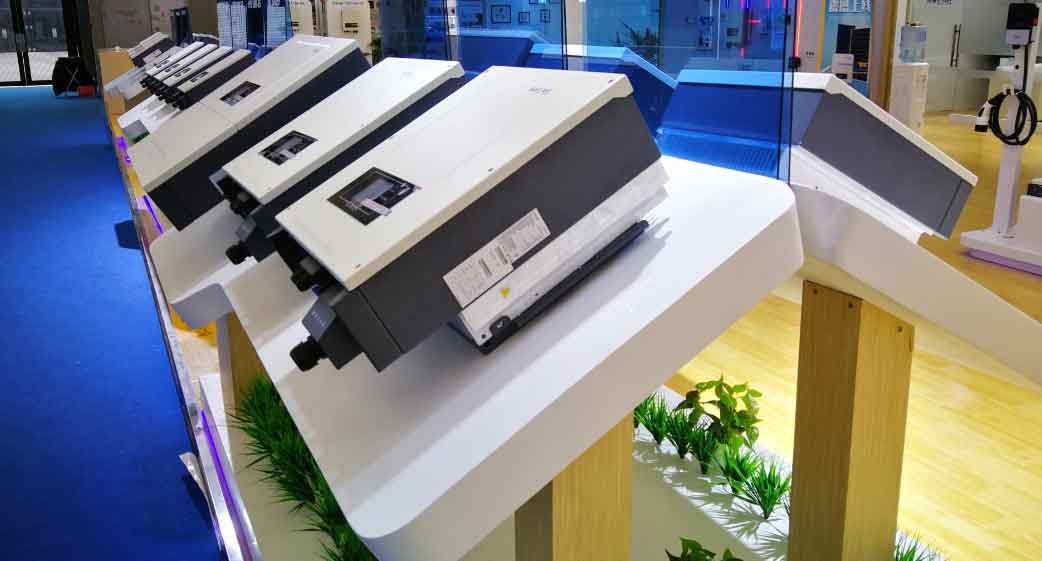
The image above illustrates a modern energy‑storage inverter, representative of the advanced power electronics used in string topologies. While our project uses standard grid‑tie string inverters, the underlying MPPT and harmonic control principles are similar.
Conclusion
This study demonstrates that converting a centralized inverter architecture to a string inverter topology yields substantial improvements for a mountainous solar plant prone to partial shading. Through simulation and one year of real‑world operation, we verified that the string inverter achieves faster MPPT response, lower THD (1.68 %), and an 8.77 % increase in annual energy output. Over the 25‑year inverter lifecycle, the net economic gain exceeds 4.4 million CNY, while environmental benefits—including 22 000 tons of CO₂ avoidance and significant reductions in SO₂, NOₓ, and dust—reach 1.86 million CNY. The key takeaway is that careful selection among types of solar inverters is not merely a technical decision; it directly drives both profitability and sustainability. For future projects in similar shaded or rugged terrains, the string inverter stands out as the most promising among all types of solar inverters evaluated.
These findings underscore the importance of adaptive inverter design in the pursuit of carbon peaking and neutrality. As inverter technologies evolve—including the integration of energy storage—the string platform retains its flexibility. Ongoing work will focus on hybrid systems that combine string inverters with battery storage to further enhance self‑consumption and grid stability.