
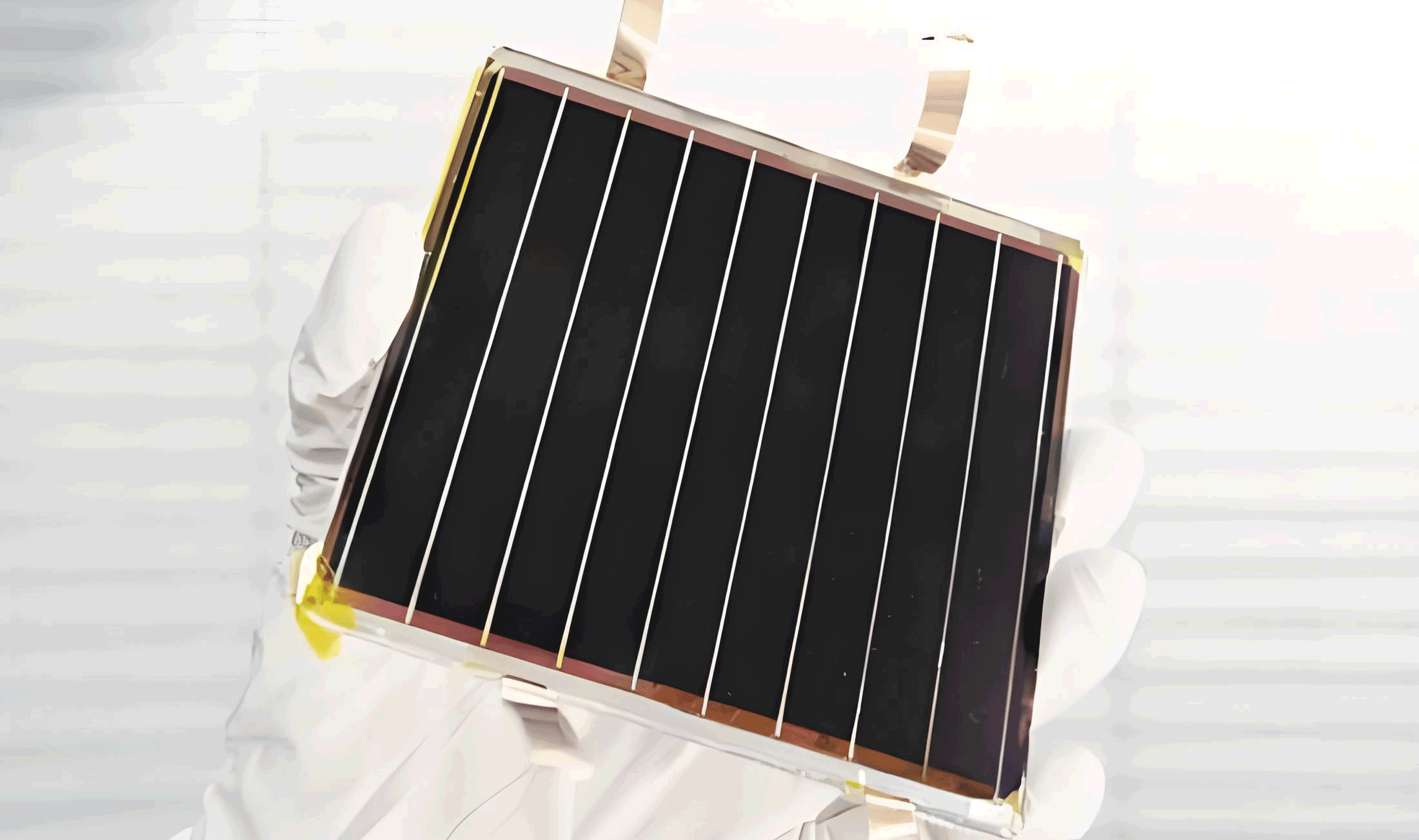
In recent years, perovskite solar cells have emerged as a promising photovoltaic technology due to their high power conversion efficiency, low-cost fabrication, and excellent light absorption properties. The efficiency of perovskite solar cells has skyrocketed from initial values to over 25%, making them competitive with traditional silicon-based solar cells. A key component in enhancing the performance of perovskite solar cells is the hole transport layer, which facilitates hole extraction and blocks electron back-transfer. In this study, I explore the use of single-walled carbon nanotubes (SWCNT) as a hole transport material in perovskite solar cells due to their high carrier mobility, electrical conductivity, and mechanical strength. Through numerical simulations, I investigate the impact of various parameters on the device performance, aiming to optimize the structure for maximum efficiency.
The perovskite solar cell structure I designed consists of multiple layers: Glass/FTO (fluorine-doped tin oxide)/ZnO/MAPbI3 (methylammonium lead iodide)/SWCNT/Au. Here, FTO serves as the front electrode, ZnO as the electron transport layer, MAPbI3 as the perovskite absorber layer, SWCNT as the hole transport layer, and Au as the back electrode. Light illumination occurs from the Glass side, and the device operates under standard AM1.5G conditions at 300 K. To simulate the performance, I employed the SCAPS-1D software, which solves fundamental semiconductor equations to model carrier transport and recombination processes.
The core equations governing the behavior of the perovskite solar cell in SCAPS-1D include Poisson’s equation and the continuity equations for electrons and holes. Poisson’s equation describes the electrostatic potential distribution:
$$ \frac{\partial}{\partial x} \left[ \varepsilon(x) \frac{\partial \psi}{\partial x} \right] = q \left[ p(x) – n(x) + N_D^+(x) – N_A^-(x) + p_t(x) – n_t(x) \right] $$
where \( \varepsilon \) is the permittivity, \( \psi \) is the electrostatic potential, \( q \) is the electron charge, \( p \) and \( n \) are the hole and electron concentrations, \( N_D^+ \) and \( N_A^- \) are the ionized donor and acceptor concentrations, and \( p_t \) and \( n_t \) are trapped hole and electron densities. The continuity equations account for carrier generation and recombination:
$$ -\frac{1}{q} \frac{\partial J_n}{\partial x} + R_n(x) = G(x) $$
$$ \frac{1}{q} \frac{\partial J_p}{\partial x} + R_p(x) = G(x) $$
Here, \( J_n \) and \( J_p \) are the electron and hole current densities, \( R_n \) and \( R_p \) are the recombination rates, and \( G \) is the carrier generation rate. These equations are solved numerically to obtain key performance metrics such as open-circuit voltage (\( V_{oc} \)), short-circuit current density (\( J_{sc} \)), fill factor (FF), and power conversion efficiency (PCE) of the perovskite solar cell.
To begin the analysis, I defined the material parameters for each layer in the perovskite solar cell structure, as summarized in Table 1. These parameters include thickness, bandgap, electron affinity, dielectric constant, effective densities of states, carrier mobilities, and doping concentrations. The initial values are based on literature and serve as a baseline for further optimization.
| Parameter | FTO | ZnO | MAPbI3 | SWCNT |
|---|---|---|---|---|
| Thickness (nm) | 200 | 200 | 500 | 100 |
| Bandgap (eV) | 3.5 | 3.3 | 1.58 | 1.1 |
| Electron Affinity (eV) | 4.0 | 4.0 | 3.9 | 4.27 |
| Relative Dielectric Constant | 9.0 | 9.0 | 10.0 | 3.4 |
| Effective Conduction Band Density (cm⁻³) | 2.2 × 10¹⁸ | 2.0 × 10¹⁸ | 2.2 × 10¹⁸ | 5.0 × 10¹⁶ |
| Effective Valence Band Density (cm⁻³) | 1.8 × 10¹⁹ | 1.8 × 10¹⁹ | 1.0 × 10¹⁹ | 6.0 × 10¹⁷ |
| Electron Mobility (cm²/V·s) | 20 | 1.0 × 10⁷ | 2.2 | 8.0 × 10³ |
| Hole Mobility (cm²/V·s) | 10 | 25 | 2.2 | 2.0 × 10³ |
| Donor Doping Concentration (cm⁻³) | 2.0 × 10¹⁹ | 1.0 × 10¹⁸ | 1.0 × 10¹³ | 0 |
| Acceptor Doping Concentration (cm⁻³) | 1.0 × 10¹⁵ | 0 | 1.0 × 10¹² | 4.0 × 10²¹ |
Using these parameters, I simulated the initial performance of the perovskite solar cell. The current density-voltage (J-V) characteristics and external quantum efficiency (EQE) were analyzed to assess the baseline device behavior. The initial simulation yielded a \( V_{oc} \) of 1.17 V, \( J_{sc} \) of 22.95 mA/cm², FF of 88.38%, and PCE of 23.71%. The EQE curve showed high values above 80% in the wavelength range of 350–700 nm, dropping to zero beyond 800 nm due to the bandgap limitation of MAPbI3. This initial analysis confirms the potential of the SWCNT-based perovskite solar cell but highlights areas for improvement through parameter optimization.
One critical parameter in perovskite solar cell design is the thickness of the absorber layer. The MAPbI3 layer thickness influences light absorption and carrier recombination. I varied the thickness from 100 nm to 2900 nm and observed its impact on the photovoltaic parameters. The results, summarized in Table 2, indicate that an optimal thickness exists where PCE is maximized. For instance, as thickness increases, \( V_{oc} \) and \( J_{sc} \) initially rise due to enhanced photon absorption but saturate at higher thicknesses due to increased recombination. The fill factor decreases gradually with thickness, attributed to higher series resistance. The optimal thickness for the MAPbI3 layer was found to be 1200 nm, balancing absorption and recombination losses.
| Thickness (nm) | \( V_{oc} \) (V) | \( J_{sc} \) (mA/cm²) | FF (%) | PCE (%) |
|---|---|---|---|---|
| 100 | 1.10 | 18.50 | 89.50 | 18.20 |
| 500 | 1.15 | 22.00 | 88.80 | 22.40 |
| 1000 | 1.17 | 24.50 | 87.50 | 25.10 |
| 1200 | 1.18 | 25.20 | 86.00 | 25.60 |
| 1500 | 1.18 | 25.30 | 85.00 | 25.50 |
| 2000 | 1.18 | 25.35 | 83.50 | 25.00 |
| 2900 | 1.18 | 25.40 | 82.00 | 24.50 |
The defect density in the perovskite absorber layer is another crucial factor affecting the performance of perovskite solar cells. Defects act as recombination centers, reducing carrier lifetime and efficiency. I investigated the effect of MAPbI3 defect density, varying it from \( 1.0 \times 10^{11} \) cm⁻³ to \( 1.0 \times 10^{18} \) cm⁻³. The results, shown in Table 3, demonstrate that low defect densities (below \( 1.0 \times 10^{15} \) cm⁻³) have minimal impact on performance, but higher densities lead to a sharp decline in \( V_{oc} \), \( J_{sc} \), FF, and PCE. This is due to increased Shockley-Read-Hall recombination, which can be described by the recombination rate formula:
$$ R = \frac{np – n_i^2}{\tau_p (n + n_1) + \tau_n (p + p_1)} $$
where \( n_i \) is the intrinsic carrier concentration, \( \tau_n \) and \( \tau_p \) are carrier lifetimes, and \( n_1 \) and \( p_1 \) are parameters related to defect energy levels. For optimal performance, I set the defect density to \( 1.0 \times 10^{14} \) cm⁻³, which minimizes recombination without compromising other parameters.
| Defect Density (cm⁻³) | \( V_{oc} \) (V) | \( J_{sc} \) (mA/cm²) | FF (%) | PCE (%) |
|---|---|---|---|---|
| 1.0 × 10¹¹ | 1.18 | 25.20 | 86.00 | 25.60 |
| 1.0 × 10¹³ | 1.18 | 25.19 | 85.95 | 25.59 |
| 1.0 × 10¹⁴ | 1.18 | 25.18 | 85.90 | 25.58 |
| 1.0 × 10¹⁵ | 1.15 | 24.50 | 84.00 | 23.70 |
| 1.0 × 10¹⁶ | 1.10 | 23.00 | 80.00 | 20.24 |
| 1.0 × 10¹⁷ | 1.00 | 20.00 | 75.00 | 15.00 |
| 1.0 × 10¹⁸ | 0.90 | 18.00 | 70.00 | 11.34 |
Next, I focused on the properties of the SWCNT hole transport layer. The bandgap of SWCNT affects the energy level alignment with the perovskite layer, influencing hole extraction and electron blocking. I varied the SWCNT bandgap from 0.4 eV to 1.2 eV and analyzed the device performance. As shown in Table 4, a bandgap of 1.1 eV yielded the best results, with higher bandgaps leading to improved \( V_{oc} \) and PCE due to better interface properties. The relationship between bandgap and open-circuit voltage can be approximated by:
$$ V_{oc} \approx \frac{E_g}{q} – \frac{kT}{q} \ln \left( \frac{J_{00}}{J_{sc}} \right) $$
where \( E_g \) is the bandgap, \( k \) is Boltzmann’s constant, \( T \) is temperature, and \( J_{00} \) is the reverse saturation current density. This equation highlights how a larger bandgap can enhance \( V_{oc} \), but it must be balanced with other factors to avoid increasing series resistance.
| SWCNT Bandgap (eV) | \( V_{oc} \) (V) | \( J_{sc} \) (mA/cm²) | FF (%) | PCE (%) |
|---|---|---|---|---|
| 0.4 | 1.10 | 24.00 | 85.00 | 22.44 |
| 0.7 | 1.15 | 24.50 | 85.50 | 24.10 |
| 0.9 | 1.17 | 25.00 | 86.00 | 25.15 |
| 1.1 | 1.18 | 25.20 | 86.00 | 25.60 |
| 1.2 | 1.18 | 25.20 | 86.00 | 25.60 |
The doping concentration in the hole transport layer plays a significant role in the performance of perovskite solar cells. I examined the effect of SWCNT acceptor doping concentration, varying it from \( 4.0 \times 10^{13} \) cm⁻³ to \( 4.0 \times 10^{19} \) cm⁻³. The results, summarized in Table 5, indicate that higher doping concentrations improve conductivity and hole extraction, leading to enhanced FF and PCE. However, beyond a certain point, further increases have diminishing returns. The optimal acceptor doping concentration for SWCNT was determined to be \( 4.0 \times 10^{21} \) cm⁻³, which maximizes carrier mobility and minimizes recombination at the interface.
| Acceptor Doping (cm⁻³) | \( V_{oc} \) (V) | \( J_{sc} \) (mA/cm²) | FF (%) | PCE (%) |
|---|---|---|---|---|
| 4.0 × 10¹³ | 1.15 | 24.00 | 84.00 | 23.18 |
| 4.0 × 10¹⁵ | 1.16 | 24.30 | 84.50 | 23.82 |
| 4.0 × 10¹⁷ | 1.17 | 24.80 | 85.00 | 24.60 |
| 4.0 × 10¹⁹ | 1.18 | 25.10 | 85.50 | 25.30 |
| 4.0 × 10²¹ | 1.18 | 25.20 | 86.00 | 25.60 |
Similarly, the electron transport layer doping concentration affects the performance of perovskite solar cells. I varied the ZnO donor doping concentration from \( 1.0 \times 10^{10} \) cm⁻³ to \( 1.0 \times 10^{21} \) cm⁻³ and observed its impact. As shown in Table 6, lower doping concentrations have negligible effects, but higher concentrations improve electron transport and reduce series resistance. The optimal donor doping concentration for ZnO was found to be \( 1.0 \times 10^{21} \) cm⁻³, which enhances the built-in electric field and facilitates efficient charge separation. The current density in the electron transport layer can be expressed as:
$$ J_n = q \mu_n n \frac{dE}{dx} + q D_n \frac{dn}{dx} $$
where \( \mu_n \) is electron mobility, \( n \) is electron concentration, \( E \) is electric field, and \( D_n \) is diffusion coefficient. This equation underscores how doping influences carrier transport and overall device performance.
| Donor Doping (cm⁻³) | \( V_{oc} \) (V) | \( J_{sc} \) (mA/cm²) | FF (%) | PCE (%) |
|---|---|---|---|---|
| 1.0 × 10¹⁰ | 1.17 | 24.90 | 85.00 | 24.75 |
| 1.0 × 10¹³ | 1.17 | 24.95 | 85.10 | 24.80 |
| 1.0 × 10¹⁶ | 1.18 | 25.10 | 85.50 | 25.30 |
| 1.0 × 10¹⁸ | 1.18 | 25.15 | 85.80 | 25.45 |
| 1.0 × 10²¹ | 1.18 | 25.20 | 86.00 | 25.60 |
After optimizing all parameters, I simulated the performance of the perovskite solar cell with the following conditions: MAPbI3 thickness of 1200 nm, defect density of \( 1.0 \times 10^{14} \) cm⁻³, SWCNT bandgap of 1.1 eV, SWCNT acceptor doping concentration of \( 4.0 \times 10^{21} \) cm⁻³, and ZnO donor doping concentration of \( 1.0 \times 10^{21} \) cm⁻³. The optimized device achieved a \( V_{oc} \) of 1.18 V, \( J_{sc} \) of 25.58 mA/cm², FF of 83.76%, and PCE of 25.42%. This represents a significant improvement over the initial performance, demonstrating the effectiveness of parameter optimization in enhancing the efficiency of perovskite solar cells.
In conclusion, my numerical study highlights the importance of material parameters in designing high-efficiency perovskite solar cells with SWCNT as the hole transport layer. The optimization of layer thicknesses, defect densities, and doping concentrations can lead to substantial gains in performance. The use of SCAPS-1D simulations provides valuable insights into the physical mechanisms governing device behavior, such as carrier generation, recombination, and transport. Future work could involve experimental validation and exploration of other novel materials to further advance the performance of perovskite solar cells. This research underscores the potential of SWCNT-based perovskite solar cells as a viable pathway toward low-cost, high-efficiency photovoltaic technology.