
In this study, I investigate the critical aspects of matching an off-grid solar system with water supply pump motors to enhance operational efficiency and reduce overall costs. The primary goal is to ensure reliable water supply throughout the year by leveraging solar energy, particularly in regions with varying natural resource conditions. By focusing on the optimization of solar power generation units and pump motors, I aim to achieve high water supply guarantee rates while minimizing financial investments. The off-grid solar system plays a pivotal role in this context, as it eliminates the need for electrochemical energy storage, relying solely on solar irradiance to power the pumping system. This approach not only promotes sustainability but also addresses the challenges of remote water supply applications.
The research is based on a case study in a loess plateau region, where monthly water demand is 1000 m³, and the pump must overcome a total head of 190 m, accounting for elevation differences, service head, and friction losses. The system operates for an average of 6 hours daily, and solar resource data are derived from satellite sources, specifically the Meteonorm database, which indicates an annual global horizontal irradiance of 1277 kWh/m². Without local meteorological measurements, I rely on this data to model the off-grid solar system’s performance, ensuring that the photovoltaic (PV) array and pump motor are optimally configured to handle seasonal variations in solar availability.
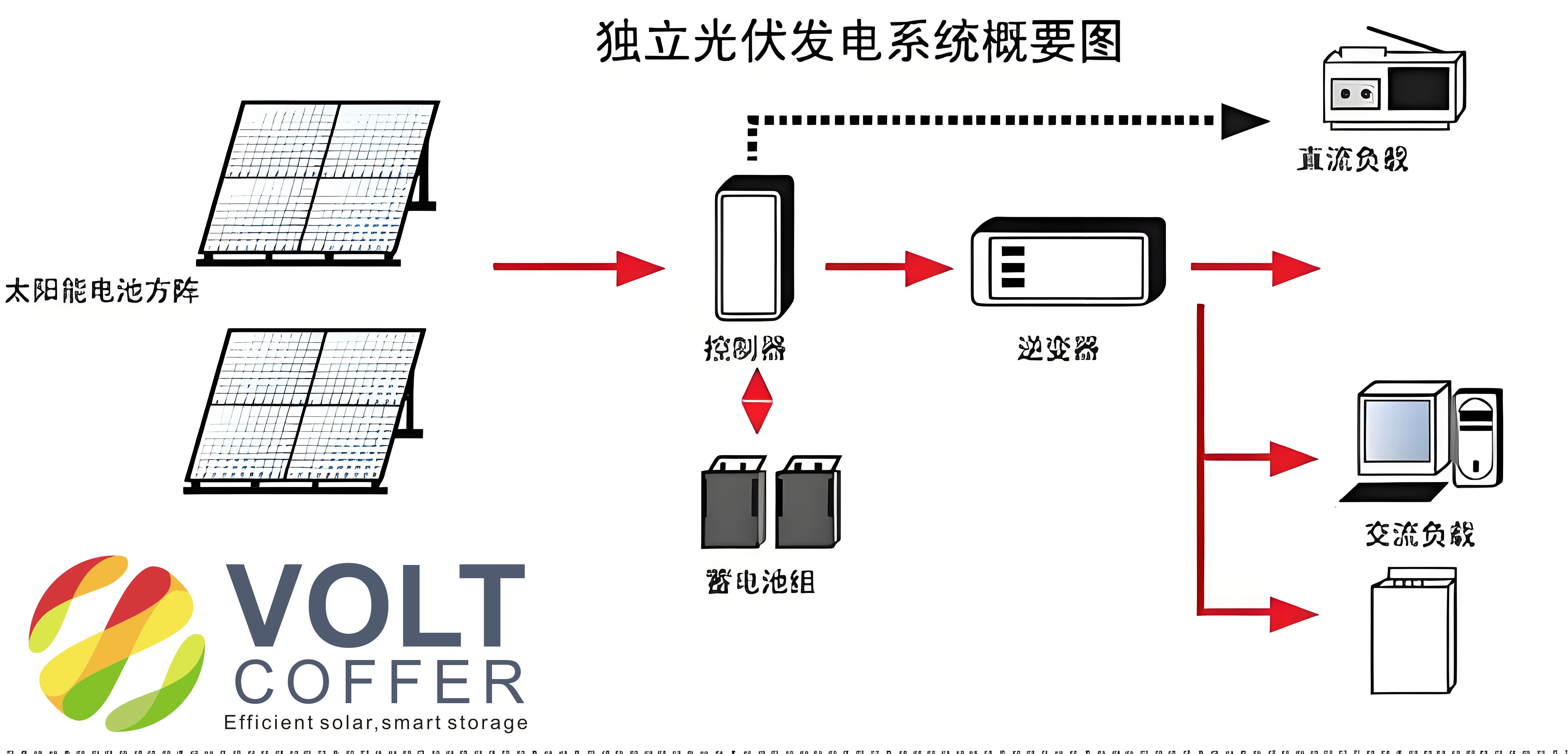
To establish a baseline, I first examine a conventional system configuration based on standard guidelines. According to relevant irrigation and drainage specifications, the daily operation duration should range from 6 to 9 hours, with a peak flow rate of 6 m³/h. Using standard calculation methods, I determine the maximum peak hydraulic power, pump peak power, and PV array capacity. The hydraulic power can be expressed as $$ P_h = \frac{\rho g Q H}{\eta_p} $$ where \( \rho \) is the density of water (approximately 1000 kg/m³), \( g \) is the acceleration due to gravity (9.81 m/s²), \( Q \) is the flow rate in m³/s, \( H \) is the total head in meters, and \( \eta_p \) is the pump efficiency. For a flow rate of 6 m³/h (or 0.00167 m³/s) and a head of 190 m, assuming a pump efficiency of 0.6, the hydraulic power is calculated as $$ P_h = \frac{1000 \times 9.81 \times 0.00167 \times 190}{0.6} \approx 5100 \text{ W}. $$ The pump peak power, considering motor and drive losses, is typically higher; in this case, it is estimated at 5796 W, leading to a PV array capacity requirement of 8279 W. However, based on the pump’s power curve, a 7.5 kW pump is insufficient, and an 11 kW photovoltaic water pump is selected, necessitating a PV array capacity of 15.71 kW, rounded to 16 kW. The PV modules are fixed at an azimuth angle of 0°, and the optimal tilt angle is initially set to 30° based on typical daily insolation curves.
I simulate the system’s performance using a 10 kWp PV array at a 30° tilt angle. The power curves for typical days in July and November reveal significant disparities in energy generation. For instance, in July, the effective utilization time is approximately 59.5 hours, while in November, it drops to 13 hours, resulting in an annual water supply guarantee rate of only about 25%. This highlights the inefficiency of the conventional off-grid solar system configuration, as it fails to account for seasonal variations in solar irradiance, leading to over-supply in summer and under-supply in winter. To address this, I proceed with an optimized approach that focuses on better matching the off-grid solar system with the pump motor.
The optimization methodology involves analyzing long-term hourly solar radiation data over 20 years to identify typical representative days for each month. This allows me to model the off-grid solar system’s power output under different tilt angles and match it with the pump’s operational requirements. I establish a PV water pumping system model that considers the power curves and system utilization hours, aiming to balance energy generation across months. Additionally, I account for cloudy and rainy days by incorporating probability-based scenarios to ensure reliability. The key is to adjust the PV array tilt angle to maximize performance during low-insolation periods, such as November, while maintaining adequate output in high-insolation months like July.
I begin by compiling the horizontal irradiance data for typical representative days, as shown in Table 1. This table summarizes the irradiance values at various times of the day for each month, along with the total daily radiation. The data indicate that July has the highest radiation levels, while November has the lowest, emphasizing the need for a tailored off-grid solar system design.
| Time | Jan 26 | Feb 12 | Mar 28 | Apr 12 | May 8 | Jun 10 | Jul 13 | Aug 17 | Sep 19 | Oct 4 | Nov 25 | Dec 26 |
|---|---|---|---|---|---|---|---|---|---|---|---|---|
| 7:00 | 0 | 1.1 | 0.6 | 168.8 | 231.8 | 305.2 | 302.0 | 188.0 | 155.8 | 100.6 | 1.8 | 0 |
| 8:00 | 80.5 | 116.9 | 287.8 | 361.9 | 430.7 | 512.9 | 524.6 | 379.2 | 375.8 | 284.9 | 118.3 | 68.7 |
| 9:00 | 250.8 | 291.0 | 484.3 | 536.8 | 620.3 | 703.4 | 729.0 | 571.0 | 585.1 | 473.3 | 276.5 | 219.3 |
| 10:00 | 414.0 | 458.1 | 655.3 | 703.3 | 786.6 | 854.6 | 891.1 | 729.1 | 752.8 | 618.9 | 420.4 | 378.0 |
| 11:00 | 538.1 | 598.8 | 785.1 | 784.3 | 894.0 | 951.6 | 998.5 | 846.5 | 859.4 | 728.7 | 504.1 | 477.6 |
| 12:00 | 606.2 | 665.3 | 848.4 | 842.7 | 939.6 | 999.8 | 1045.0 | 908.6 | 904.3 | 765.5 | 545.2 | 518.3 |
| 13:00 | 601.0 | 667.1 | 842.6 | 829.5 | 917.9 | 985.7 | 1029.2 | 910.5 | 879.4 | 718.4 | 528.1 | 510.4 |
| 14:00 | 531.3 | 601.8 | 770.4 | 747.9 | 837.6 | 918.6 | 955.0 | 841.6 | 788.8 | 630.6 | 435.7 | 431.5 |
| 15:00 | 400.5 | 456.4 | 645.8 | 605.1 | 702.6 | 792.3 | 823.7 | 711.6 | 640.2 | 492.5 | 306.1 | 303.4 |
| 16:00 | 240.4 | 281.5 | 461.3 | 448.3 | 524.7 | 619.6 | 644.1 | 539.0 | 441.0 | 305.8 | 148.6 | 145.5 |
| 17:00 | 72.3 | 108.7 | 250.2 | 257.0 | 324.9 | 417.3 | 436.1 | 337.1 | 219.9 | 125.1 | 4.4 | 5.4 |
| 18:00 | 0 | 0.7 | 30.3 | 257.0 | 139.8 | 211.1 | 220.5 | 142.5 | 10.9 | 1.5 | 0 | 0 |
| Total Radiation (kWh/m²) | 3.735 | 4.247 | 6.062 | 6.543 | 7.351 | 8.272 | 8.599 | 7.105 | 6.613 | 5.246 | 3.289 | 3.058 |
Next, I analyze the optimal tilt angle for the PV array. According to photovoltaic power station design standards, the tilt angle should maximize the annual solar radiation on the inclined surface. I calculate the average solar radiation for different tilt angles, as presented in Table 2. The results show that a tilt angle of 25° yields the highest annual radiation. However, for an off-grid solar system aimed at uniform monthly water supply, this angle leads to significant output variations between months. Therefore, I explore alternative tilt angles to achieve a more balanced energy generation throughout the year.
| Tilt Angle (°) | 22 | 23 | 24 | 25 | 26 | 27 | 28 |
|---|---|---|---|---|---|---|---|
| Solar Radiation | 4798.5 | 4801.3 | 4803.0 | 4803.8 | 4803.5 | 4802.3 | 4800.2 |
I model a 10 kWp off-grid solar system at various tilt angles to generate power curves for typical days. For instance, at a 45° tilt angle, the power curves for July and November show closer alignment in utilization hours compared to 30°. However, to further improve performance in low-radiation months like November, I increase the tilt angle to 55°. At this angle, with a system power threshold of 6000 W, the monthly utilization time in November reaches approximately 41 hours, similar to that in July. This adjustment ensures that the off-grid solar system operates consistently across seasons, enhancing the water supply guarantee rate.
The power output of the off-grid solar system can be modeled using the formula $$ P_{pv} = G_t \cdot A \cdot \eta_{pv} \cdot \eta_{inv} $$ where \( G_t \) is the irradiance on the tilted surface in W/m², \( A \) is the area of the PV array in m², \( \eta_{pv} \) is the PV module efficiency, and \( \eta_{inv} \) is the inverter efficiency. For a 10 kWp system, I assume typical values of \( \eta_{pv} = 0.18 \) and \( \eta_{inv} = 0.95 \), and calculate the effective area as $$ A = \frac{P_{rated}}{G_{std} \cdot \eta_{pv}} $$ where \( P_{rated} \) is the rated power (10,000 W) and \( G_{std} \) is the standard irradiance (1000 W/m²). Thus, \( A \approx 55.56 \text{ m}^2 \). The irradiance on the tilted surface is derived from horizontal irradiance using the Perez model or similar, but for simplicity, I use the data from Table 1 adjusted for tilt angle.
To validate the 55° tilt angle, I simulate the system for September, another representative month. The power curve indicates a utilization time of over 41 hours, confirming the angle’s suitability. Moreover, I classify the November power output into three typical operational scenarios based on occurrence probability: 30%, 20%, and 15%. These scenarios help account for weather variability and ensure the off-grid solar system’s reliability under different conditions.
With the optimized tilt angle established, I focus on matching the pump motor to the off-grid solar system. The key parameters include the system power threshold, flow rate, and pump power. The relationship between flow rate and power is given by $$ Q = \frac{P \cdot \eta_p}{\rho g H} $$ where \( P \) is the power input in watts. For a system power of 6000 W, assuming a pump efficiency of 0.6, the flow rate is $$ Q = \frac{6000 \times 0.6}{1000 \times 9.81 \times 190} \approx 0.00193 \text{ m}^3/\text{s} = 6.95 \text{ m}^3/\text{h}. $$ However, to meet the monthly water demand of 1000 m³, the required flow rate is higher. I calculate the necessary flow rate based on utilization hours: for 41 hours in November, the flow rate should be \( \frac{1000}{41} \approx 24.39 \text{ m}^3/\text{h} \). Using the power-flow relationship, I derive the required pump power as $$ P = \frac{\rho g Q H}{\eta_p} = \frac{1000 \times 9.81 \times (24.39 / 3600) \times 190}{0.6} \approx 20,000 \text{ W} = 20 \text{ kW}. $$ After considering losses and safety margins, a 26 kW pump is selected, requiring a PV array capacity of 43.3 kWp.
I evaluate multiple pump and PV configurations to find the most cost-effective solution. For instance, at a system power of 5500 W, the flow rate is 19.42 m³/h, necessitating an 18.5 kW pump and a 33.6 kWp PV array. Similarly, at 5000 W, a 15 kW pump and 30 kWp array are needed; at 4000 W, a 13 kW pump and 32.5 kWp array; and at 3000 W, an 11 kW pump and 36.7 kWp array. The water supply guarantee rate is calculated for each configuration, with the 15 kW pump and 30 kWp off-grid solar system achieving up to 95%.
To compare costs, I assume a PV system cost of 3.3 CNY/W and a pump cost of 20,000 CNY. For the optimized configuration (15 kW pump and 30 kWp PV), the total investment is \( 30,000 \times 3.3 + 20,000 = 119,000 \text{ CNY} \). In contrast, a conventional system with an 11 kW pump and 16 kWp PV costs approximately 70,000 CNY, but its unit water cost is about 2.35 times higher due to lower efficiency. This demonstrates that the optimized off-grid solar system, despite a higher initial investment, offers better long-term value by improving the water supply guarantee rate and reducing operational costs.
In conclusion, the optimization of an off-grid solar system for water supply pump matching is essential for achieving reliable and efficient operation. By carefully analyzing solar radiation data, adjusting the PV array tilt angle, and selecting appropriate pump motors, I can significantly enhance the system’s performance. The off-grid solar system’s ability to function without electrochemical storage makes it ideal for remote applications, but its success hinges on precise configuration. This study underscores the importance of a holistic approach that considers seasonal variations, economic factors, and technical specifications to maximize the benefits of solar energy in water supply systems.
Further research could explore advanced control strategies or hybrid systems to improve resilience. Nonetheless, the methodologies presented here provide a robust framework for designing off-grid solar systems that meet diverse water supply needs while promoting sustainable energy use. The off-grid solar system, when properly optimized, not only ensures water security but also contributes to environmental conservation by reducing reliance on fossil fuels.