
With the depletion of global fossil fuels and the increasing severity of environmental pollution, the construction of photovoltaic-energy storage microgrids in highway service areas not only enables green and low-carbon electricity consumption but also provides independent power supply for remote areas, enhancing the self-coordination capability of the service area’s electrical energy. Currently, the main issues in microgrid construction for highway systems focus on site selection, capacity, and investment decisions for road-domain photovoltaic power generation projects. Existing research rarely considers service areas as microgrids. This study establishes a typical architecture for highway service area microgrid systems and proposes an optimization model for dust removal maintenance of solar panels. Based on this, a capacity planning model for photovoltaic-energy storage microgrids in highway service areas under dust removal maintenance is developed. The NSGA-II algorithm is employed to solve the multi-objective optimization problem aimed at minimizing total system investment and operating costs while maximizing the microgrid’s self-sufficient electricity consumption. By computing the Pareto optimal solution boundary, the capacities of photovoltaic systems, energy storage, and contact lines in highway service areas under different levels of electricity self-sufficiency are determined.
The microgrid system structure for highway service areas is illustrated below. The service area microgrid primarily consists of distributed photovoltaic power generation, energy storage, and loads, where the loads mainly include electric vehicle charging loads and daily electricity consumption loads. Considering the variability in supply-demand balance under different meteorological scenarios, it is still necessary to connect to the main grid as a backup and operational guarantee.
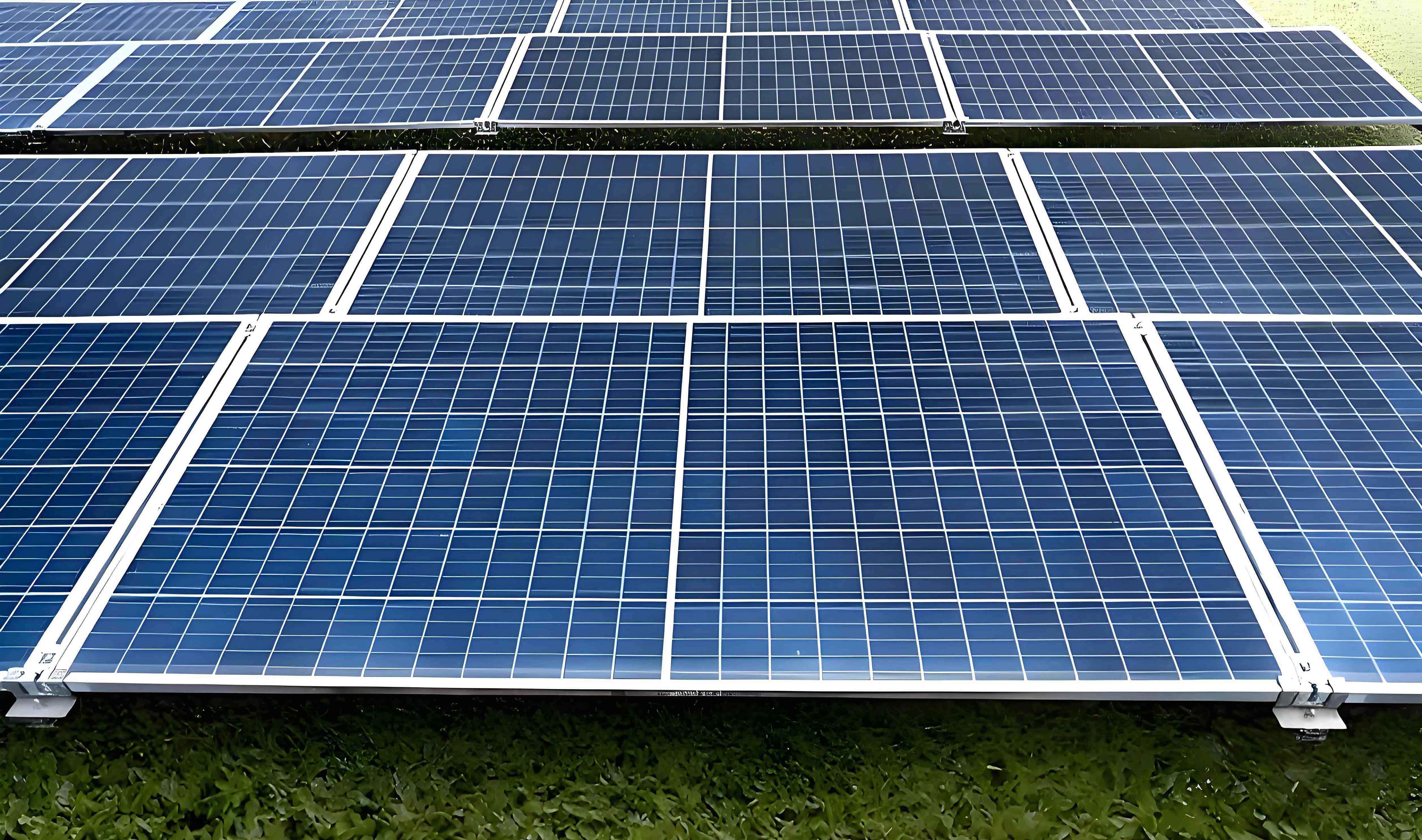
The photovoltaic array model describes how solar energy is converted into electricity using the photovoltaic effect of solar panel components. Based on solar radiation intensity, ambient temperature, and the output of the photovoltaic array under standard conditions, the electrical energy can be derived. The output power of the photovoltaic system at time t is given by:
$$ P_{pv}(t) = P_{stc} \frac{I_{r,t}}{I_{stc}} [1 + a_T (T_t – T_{stc})] $$
Here, \( P_{stc} \) is the output under standard conditions, \( I_{r,t} \) is the actual solar radiation intensity at time t, \( I_{stc} = 1 \text{kW/m}^2 \), \( a_T \) is the power temperature coefficient of the solar panels, \( T_t \) is the temperature of the solar panels at time t, and \( T_{stc} = 25 ^\circ\text{C} \). When other factors affecting photovoltaic output are not considered, the output can be simplified to:
$$ P_{pv}(t) = P_{stc} \frac{I_t}{I_{stc}} $$
where \( I_t \) represents the maximum solar radiation intensity reaching the ground without any influencing factors. The shading coefficient \( \eta_t \) for photovoltaic output can be calculated as:
$$ \eta_t = \frac{P_{pv} – P’_{pv}}{P_{pv}} $$
where \( P’_{pv} \) is the actual output of the photovoltaic system under the influence of external factors.
The energy storage charging and discharging model utilizes battery packs as the energy storage system. The core function of the electrochemical energy storage system is to track load changes through rapid energy storage and release. The multi-period energy coupling model for energy storage is expressed as:
$$ E_{bess}(t) = (1 – s) E_{bess}(t – 1) + \left( \eta_{ch} P_{ch,bess}(t) – \frac{P_{dis,bess}(t)}{\eta_{dis}} \right) \Delta t $$
Here, \( E_{bess}(t) \) is the electricity stored in the energy storage system at time t, \( s \) is the self-discharge rate of the battery unit, \( \eta_{ch} \) and \( \eta_{dis} \) are the charging and discharging efficiencies of the energy storage system, respectively, \( P_{ch,bess}(t) \) and \( P_{dis,bess}(t) \) represent the charging and discharging power of the energy storage system at time t, and \( \Delta t \) is the time step. The state of charge (SOC) is a key parameter measuring the remaining capacity of the battery, given by:
$$ SOC(t) = \frac{E_{bess}(t)}{E_{rate}} $$
where \( E_{rate} \) is the rated power of the battery energy storage system.
Key technologies and strategies for highway microgrid construction include the optimization model for dust removal maintenance of solar panels. In remote highway areas, dust generated from road construction and vehicle operation covers the solar panels, affecting their performance and increasing maintenance costs. Therefore, determining an appropriate cleaning cycle for the solar panels and obtaining the cleaning maintenance costs for photovoltaic power stations is of significant research importance. The time-varying prediction model for the power loss rate of photovoltaic generation with dust accumulation time is:
$$ \eta(\theta) = \eta^* \times (1 – e^{-\theta/\theta_c}) $$
where \( \eta^* \) is the asymptotic value of the photovoltaic power loss rate under dust accumulation conditions, \( \eta(\theta) \) is the photovoltaic power loss rate, \( \theta \) is the dust accumulation time in days, and \( \theta_c \) is the time constant. The daily electricity loss cost for the photovoltaic power station is:
$$ e_d = P_{pv} \times \eta(\theta) \times T_d \times l_g $$
where \( P_{pv} \) is the installed capacity of the photovoltaic power station, \( T_d \) is the daily average utilization hours of the photovoltaic power station, and \( l_g \) is the grid-connected electricity price for photovoltaics. The single cleaning maintenance cost for the photovoltaic power station is:
$$ e_c = P_{pv} \times S \times l_c $$
where \( S \) is the area per unit capacity of the solar panels, and \( l_c \) is the cleaning maintenance cost per unit area of the solar panels. The minimum total cost of electricity loss due to dust accumulation and cleaning maintenance is:
$$ \min C_{MVP} = \left( \int_0^{t_c} e_d d\theta + e_c \right) \cdot \frac{t_{all}}{t_c} $$
where \( t_c \) is the cleaning cycle, \( t_{all} \) is the statistical period, typically one year, and the integral of the daily electricity loss cost represents the total electricity loss cost over one cleaning cycle. By combining these equations, the cleaning cycle and maintenance costs of the solar panels can be used as input conditions for the planning model.
The capacity planning model for highway service area microgrids considers the construction investment and operational costs of photovoltaics, energy storage, and the contact line between the microgrid and the main grid. The objective function is to minimize the total cost of purchasing electricity from the main grid, maximize the revenue from selling electricity to the main grid, minimize the total penalty cost for load shedding, and minimize the total system investment and operating costs. Additionally, maximizing the self-sufficient electricity consumption of the highway service area microgrid is another objective function. Thus, the total objective function can be expressed as:
$$ \min f = C_{In} + C_{Ma} + C_{grid} – C_{ongrid} + C_{ab} $$
$$ \max \eta_{ser} = \frac{\int_0^{8760} [P_{load}(t) – P_{grid}(t)] dt}{\int_0^{8760} P_{load}(t) dt} $$
where \( C_{In} \), \( C_{Ma} \), \( C_{grid} \), \( C_{ongrid} \), and \( C_{ab} \) represent the system investment cost, maintenance cost, electricity purchase cost, electricity sales revenue, and loss of load penalty cost, respectively. \( P_{load}(t) \) and \( P_{grid}(t) \) denote the load demand power of the microgrid and the electricity purchased from the grid at time t, respectively.
The capacity planning model for highway service area microgrids with wind-photovoltaic-energy storage is multi-objective, multivariate, and nonlinear. Therefore, an improved NSGA-II is used to solve the model. The multi-objective function serves as the fitness function, and the solution process for the objective function is illustrated in the flowchart below. The algorithm parameters are set accordingly to ensure convergence to the Pareto optimal solutions.
In a case study of a large highway service area in East China, all solar panels use 545 W monocrystalline silicon modules with dimensions of 2.384 m × 1.303 m. The cleaning maintenance cost per unit area of the solar panels is set at 0.5 CNY/m². The daily average utilization hours of the photovoltaic power station are taken as 5 hours. With photovoltaics entering the grid parity era, the price for selling photovoltaic electricity to the main grid is set at 0.55 CNY/kWh. The cleaning cycle is the decision variable, and using a genetic algorithm to solve over the interval [0, 365], the optimal cleaning cycle for the 545 W solar panels is 21 days, with an annual total dust removal maintenance cost of 59.661 CNY.
For the multi-objective capacity planning model, based on the local actual photovoltaic output level and the actual load data of the large highway service area, the maximum developable photovoltaic capacity in and around the service area is selected as 4.046 MW. The planning period is 20 years, with a discount rate of 10%. The energy storage system uses lithium iron phosphate batteries with a charge-discharge efficiency of 95%, a self-discharge rate of 0.02%, and a loss of load penalty cost of 1.2 CNY/kWh. Using MATLAB to code the improved NSGA-II for solving the model, the population size is set to 100, the maximum number of iterations is 500, the crossover rate is 0.7, and the mutation rate is 0.3. The obtained Pareto optimal solution boundary is shown in the figure below, where the Pareto solutions are uniformly distributed and extensive, providing substantial information for decision-makers to choose between the conflicting objectives of minimizing total microgrid investment and operating costs and maximizing self-sufficient electricity consumption. The minimum total system cost is 3.924 million CNY, mainly including contact line construction investment, maintenance costs, and electricity purchase costs.
The optimal configuration results for the microgrid’s wind-photovoltaic-energy storage capacity at self-sufficiency rates \( \eta_{ser} \) of 40%, 60%, and 80% are presented in the following table:
| Parameter | \( \eta_{ser} = 40\% \) | \( \eta_{ser} = 60\% \) | \( \eta_{ser} = 80\% \) |
|---|---|---|---|
| Photovoltaic Model (W) | 545 | 545 | 545 |
| Number of Solar Panels in Service Area | 3028 | 4679 | 7202 |
| Battery Rated Power Capacity (kW) | 144.9 | 571.9 | 885.4 |
| Battery Rated Energy (kWh) | 289.8 | 1843.3 | 3622.5 |
| Contact Line Rated Capacity (kW) | 860 | 532 | 402.1 |
| Photovoltaic Dust Removal Maintenance Cost (10^4 CNY) | 18.07 | 27.92 | 42.97 |
| System Annual Comprehensive Cost (10^4 CNY) | 394.80 | 418.92 | 489.54 |
When the service area installs 3028 solar panels, the microgrid’s electricity self-sufficiency rate is 40%, indicating a low level of energy self-sufficiency. When the number of installed solar panels increases to 7202, the electricity self-sufficiency rate rises to 80%. The rated capacity of the contact line gradually decreases, starting from close to the microgrid’s maximum load demand to around 400 kW. The configured energy storage capacity gradually increases, with the energy storage system eventually stabilizing at 885.4 kW/3600 kWh. Additionally, the cost of photovoltaic dust removal maintenance accounts for 5% to 10% of the system’s annual comprehensive cost.
In conclusion, this study establishes a multi-objective capacity planning model for photovoltaic-energy storage microgrids in highway service areas under dust removal maintenance of solar panels and solves the model using NSGA-II. The research provides theoretical support and reference for demonstration projects of microgrid construction in highway service areas. Building on this, future work can further optimize the energy exchange strategies and capacity configuration models for grid-connected and access lines of highway microgrids with photovoltaics and energy storage, considering demand response.
The integration of solar panels and photovoltaic technology in highway service areas not only promotes sustainable energy use but also enhances the reliability and independence of the power supply. The optimization models and algorithms discussed here demonstrate the potential for significant cost savings and improved self-sufficiency through careful planning and maintenance. As the demand for electric vehicle charging and other services grows, the importance of efficient microgrid design becomes increasingly critical. Future research could explore dynamic cleaning cycles based on real-time dust accumulation data or integrate machine learning for predictive maintenance, further refining the capacity planning process for photovoltaic systems in diverse environments.