
Energy storage systems play a pivotal role in addressing the intermittency of renewable energy sources. Among these, Advanced Adiabatic Compressed Air Energy Storage (AA-CAES) systems have gained prominence due to their scalability, cost-effectiveness, and environmental benefits. However, residual heat generated during compression and expansion processes remains a critical bottleneck for improving system efficiency. This study investigates optimization strategies for a 100 MW AA-CAES system, focusing on waste heat reduction and utilization.
Thermodynamic Analysis of Residual Heat
In AA-CAES systems, residual heat arises from three primary sources:
- Compression Heat: Generated during adiabatic compression, partially stored in thermal reservoirs, with excess dissipated via cooling systems.
- Expansion Exhaust: Post-expansion air at elevated temperatures due to incomplete heat recovery.
- Unused Thermal Media: High-temperature storage fluids retained after discharge cycles.
The system’s round-trip efficiency ($\eta_{\text{rt}}$) is expressed as:
$$
\eta_{\text{rt}} = \frac{W_{\text{discharge}} – W_{\text{charge}}}{Q_{\text{input}}} \times 100\%
$$
where $W_{\text{discharge}}$ and $W_{\text{charge}}$ represent discharge and charge work, respectively, and $Q_{\text{input}}$ is the total heat input.
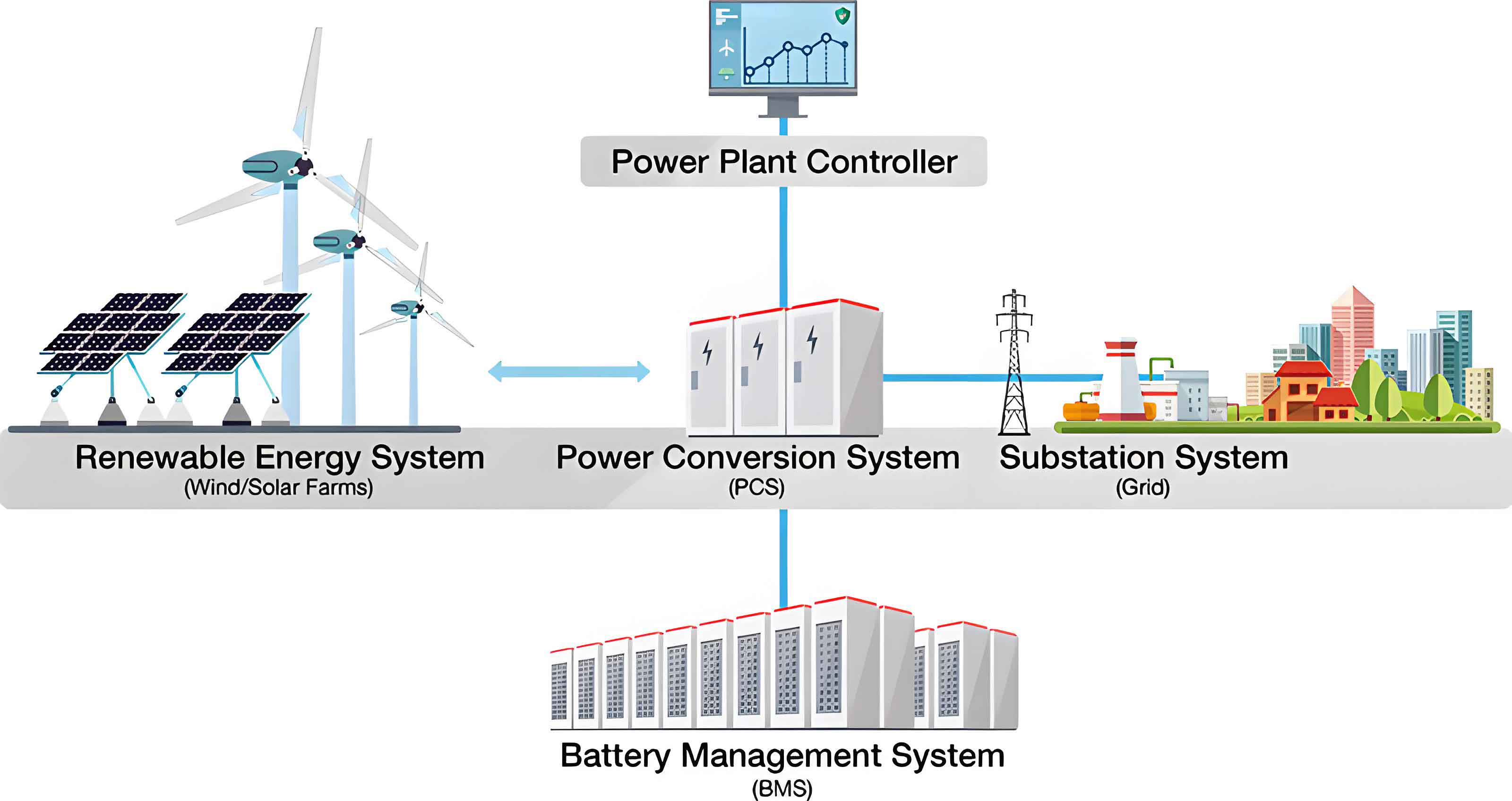
System Modeling and Parameter Optimization
A 100 MW AA-CAES system with four-stage compression and three-stage expansion was modeled using Thermoflex. Key design parameters are summarized below:
| Stage | Inlet Pressure (bar) | Outlet Temp. (°C) | Heat Storage (MW) |
|---|---|---|---|
| 1 | 0.93 | 205 | 38.2 |
| 2 | 4.80 | 205 | 39.1 |
| 3 | 18.2 | 205 | 40.7 |
| 4 | 67.5 | 108 | – |
For the expansion subsystem:
$$
W_{\text{expander}} = \dot{m} \cdot c_p \cdot (T_{\text{in}} – T_{\text{out}}) \cdot \eta_{\text{mech}}
$$
where $\dot{m}$ is mass flow rate, $c_p$ is specific heat capacity, and $\eta_{\text{mech}}$ is mechanical efficiency.
Optimization Strategies
1. Increasing Expander Inlet Temperature
Raising the expander inlet temperature from 175°C to 185°C demonstrated a linear relationship with power output:
| ΔT (°C) | Power Gain (%) | Heat Loss (MW) |
|---|---|---|
| +5 | 1.25 | 1.40 |
| +10 | 2.48 | 3.12 |
2. Organic Rankine Cycle (ORC) Integration
An ORC subsystem was integrated to recover residual heat from 170 t of unused high-temperature water (190°C → 50°C). The net power output for different working fluids is:
$$
W_{\text{net,ORC}} = \dot{m}_{\text{fluid}} \cdot (h_{\text{evap}} – h_{\text{cond}}) \cdot \eta_{\text{turbine}} – W_{\text{pump}}
$$
| Fluid | Net Power (kW) | Efficiency (%) |
|---|---|---|
| R113 | 686.33 | 12.4 |
| R141b | 628.26 | 11.7 |
| R11 | 589.26 | 10.9 |
Conclusion
This study demonstrates that energy storage system efficiency can be significantly enhanced through operational optimization and waste heat recovery. Key findings include:
- Expander inlet temperature elevation provides marginal gains but exacerbates thermal losses.
- ORC integration with R113 working fluid increases net output by 686.33 kW per cycle.
- The combined strategies improve round-trip efficiency by 3.2 percentage points.
Future work should explore hybrid energy storage systems combining AA-CAES with phase-change materials for enhanced thermal management.