
In my research on renewable energy applications, I have extensively studied solar photovoltaic pump systems, which are crucial for providing water in remote and arid regions. These systems harness solar energy to power water pumps, offering a sustainable solution for irrigation and drinking water. The efficiency and cost-effectiveness of such systems depend heavily on the optimal power ratio between the photovoltaic (PV) modules and the pump. In this article, I will delve into the analysis of this power configuration, presenting formulas, tables, and practical insights to guide engineers and researchers. The goal is to establish a reliable framework for designing solar systems that maximize performance while minimizing costs.
The solar photovoltaic pump system, often referred to simply as a solar system, consists of several key components: PV modules, a controller, a pump, a water storage tank, and piping. This setup converts solar energy directly into electrical energy to drive the pump, eliminating the need for batteries and reducing overall system complexity. The solar system is particularly advantageous because it aligns water demand with solar availability—during sunny periods when water is needed most, the system operates at peak efficiency. To illustrate the typical setup, I include a visual representation below:
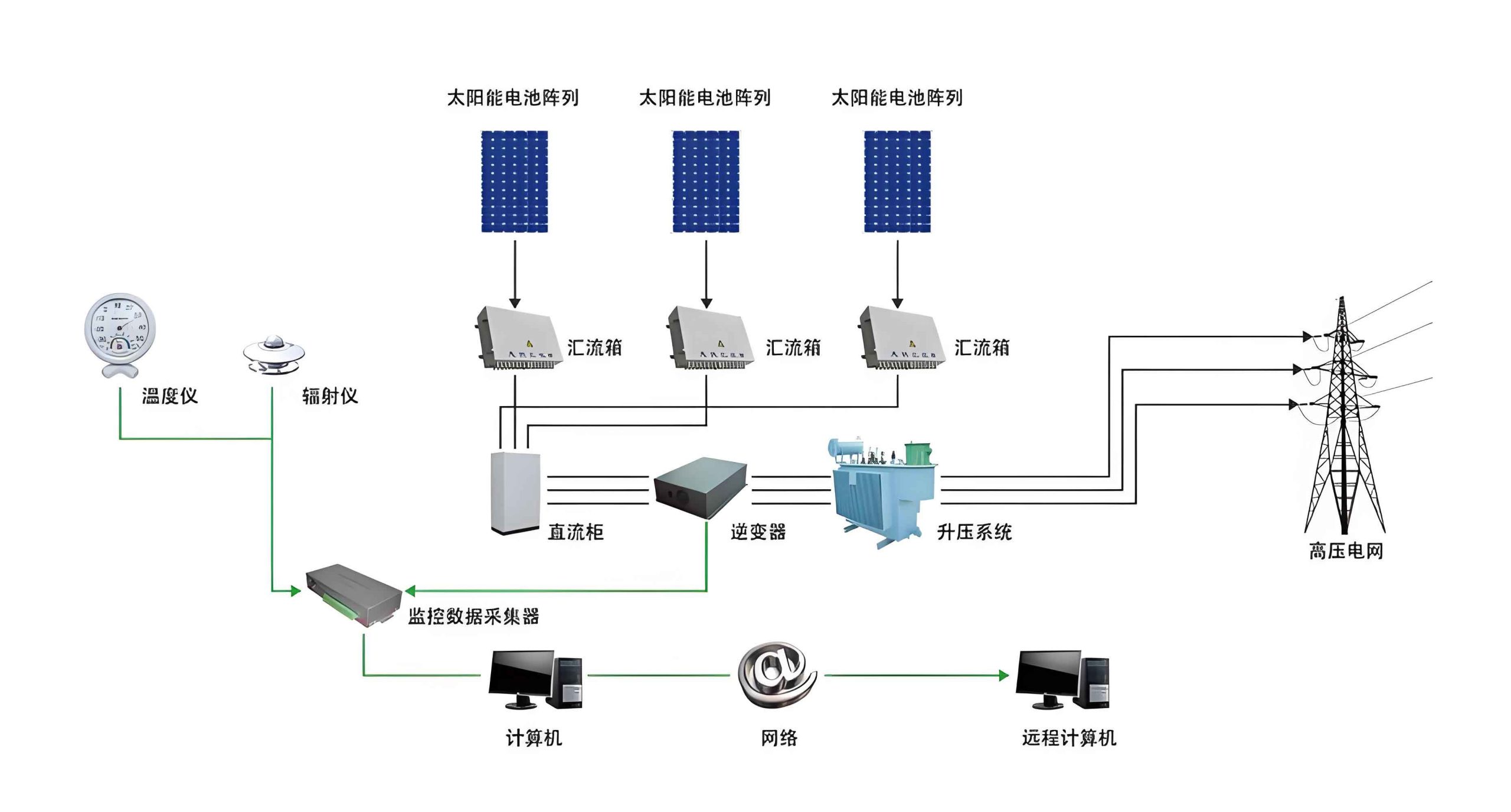
In my analysis, I focus on the power ratio between the PV modules and the pump. The solar system’s performance is influenced by various factors, including solar irradiance, temperature, and component efficiencies. To begin, I examined solar irradiance patterns, as they dictate the energy input to the system. On a typical sunny day, irradiance follows a sinusoidal pattern, with peak values around noon. For instance, data from a location in Kunming shows that irradiance exceeds 1000 W/m² for about 2 hours, while values above 800 W/m² last over 4 hours. This variability necessitates a careful power matching strategy to ensure the solar system operates effectively throughout the day.
I derived an initial ideal power ratio based on irradiance thresholds. Assuming the pump operates at rated power when irradiance reaches a specific level, such as 900 W/m², the required PV power can be calculated. Let \( P_{pv} \) be the PV module power in watts, \( P_p \) be the pump rated power in watts, and \( H_t \) be the irradiance threshold in W/m². The ideal relationship is:
$$P_{pv} = P_p \times \frac{1000}{H_t}$$
The power ratio coefficient \( k_b \) is then:
$$k_b = \frac{P_{pv}}{P_p} \times 100\%$$
For a system designed to operate at 900 W/m², this yields \( k_b \approx 111.1\% \). However, this ideal model overlooks practical losses. To refine it, I incorporated correction factors for inverter efficiency, PV module temperature effects, and degradation over time. In a solar system, the inverter converts DC power from the PV modules to AC for the pump. Based on industry standards, inverter efficiency \( \gamma_1 \) is typically 0.94 for transformer-type inverters. Thus, the formula becomes:
$$P_{pv} \gamma_1 = P_p \times \frac{1000}{H_t}$$
Additionally, PV modules experience power losses due to temperature increases. Crystalline silicon modules have a temperature coefficient of -0.4% per °C. Under operating conditions, module temperatures can reach 55°C, leading to a 12% loss. Combined with dust accumulation and wiring losses, the overall derating factor \( \gamma_2 \) is about 0.85. Factoring this in:
$$P_{pv} \gamma_1 \gamma_2 = P_p \times \frac{1000}{H_t}$$
Furthermore, PV modules degrade over their lifespan, with efficiency dropping to 80% after 25 years. Introducing a degradation factor \( \gamma_3 = 0.8 \), the comprehensive formula for the solar system power ratio is:
$$P_{pv} = P_p \times \frac{1000}{H_t \gamma_1 \gamma_2 \gamma_3}$$
Substituting typical values (\( H_t = 900 \, \text{W/m}^2 \), \( \gamma_1 = 0.94 \), \( \gamma_2 = 0.85 \), \( \gamma_3 = 0.8 \)), the calculated power ratio ranges from 147% to 173%, depending on specific irradiance thresholds and design assumptions. This range ensures that the solar system can deliver sufficient power under real-world conditions.
To validate this analysis, I evaluated multiple solar photovoltaic pump systems installed in various regions. The table below summarizes key parameters from these installations, highlighting the power ratios and performance outcomes. This data reinforces the importance of optimal configuration in solar systems.
| Location | Pump Power (kW) | PV Power (kW) | Lift Height (m) | Daily Water Output (m³) | Power Ratio (%) | Operation Status |
|---|---|---|---|---|---|---|
| Region A | 7.5 | 10.8 | 75 | 100 | 144.0 | Excellent |
| Region B | 0.75 | 1.1 | 68 | 4 | 146.7 | Excellent |
| Region C | 1.5 | 2.4 | 37 | 30 | 160.0 | Excellent |
| Region D | 11.0 | 16.8 | 67 | 80 | 152.7 | Excellent |
| Region E | 22.0 | 36.0 | 319 | 50 | 163.6 | Excellent |
| Region F | 60.0 | 78.9 | 50 | 1200 | 131.5 | Normal |
| Region G | 18.5 | 22.4 | 90 | 200 | 121.0 | Normal |
From this table, I observed that solar systems with power ratios above 144% generally exhibited excellent performance, achieving rated pump operation. In contrast, systems with lower ratios, such as 121%, operated normally but did not reach full power during peak irradiance, indicating suboptimal configuration. This aligns with my theoretical calculations, emphasizing the need for adequate PV power in a solar system.
Beyond the basic power ratio, I investigated additional factors that impact solar system efficiency. For example, the tilt angle and orientation of PV modules affect energy capture. Using the formula for optimal tilt angle \( \theta \) based on latitude \( \phi \):
$$\theta = \phi \pm 15^\circ$$
where the sign depends on the season. Moreover, system losses can be quantified through a comprehensive efficiency model. The overall efficiency \( \eta_{sys} \) of a solar system is:
$$\eta_{sys} = \eta_{pv} \times \eta_{inv} \times \eta_{pump} \times \eta_{other}$$
Here, \( \eta_{pv} \) is PV module efficiency (typically 15-20%), \( \eta_{inv} \) is inverter efficiency (94-96%), \( \eta_{pump} \) is pump efficiency (50-70%), and \( \eta_{other} \) accounts for wiring and controller losses (approx. 0.95). To optimize the solar system, I derived a cost-benefit analysis using the levelized cost of water (LCOW):
$$\text{LCOW} = \frac{C_{cap} + C_{O&M}}{V_{water}}$$
where \( C_{cap} \) is capital cost, \( C_{O&M} \) is operation and maintenance cost, and \( V_{water} \) is total water output over the system’s lifetime. By integrating the power ratio into this framework, I can minimize LCOW for a given solar system design.
Another critical aspect is the dynamic behavior of the solar system under varying irradiance. I modeled the pump’s power consumption as a function of irradiance \( I(t) \):
$$P_p(t) = \eta_{sys} \times A_{pv} \times I(t)$$
where \( A_{pv} \) is the PV area. The daily water output \( Q_{daily} \) is then:
$$Q_{daily} = \int_{t_1}^{t_2} \frac{P_p(t)}{\rho g H} \, dt$$
Here, \( \rho \) is water density, \( g \) is gravity, and \( H \) is lift height. This integral approach allows for precise sizing of PV modules in a solar system. To facilitate design, I developed a lookup table for common irradiance profiles, as shown below:
| Irradiance Range (W/m²) | Duration (hours) | Recommended PV Power Multiplier | Solar System Efficiency (%) |
|---|---|---|---|
| ≥1000 | 2 | 1.0 | 85 |
| 900-1000 | 3 | 1.1 | 82 |
| 800-900 | 4 | 1.2 | 80 |
| 600-800 | 5 | 1.4 | 75 |
| 400-600 | 6 | 1.6 | 70 |
This table helps designers select PV power based on local solar conditions, ensuring the solar system meets water demand. Furthermore, I explored advanced configurations, such as using maximum power point tracking (MPPT) controllers to enhance energy harvest. The MPPT efficiency \( \eta_{MPPT} \) can be modeled as:
$$\eta_{MPPT} = 1 – \frac{P_{loss}}{P_{max}}$$
where \( P_{loss} \) is power loss due to mismatch. Incorporating MPPT into the solar system can improve the power ratio by 5-10%, reducing the required PV capacity.
In practice, the solar system must also account for environmental factors like temperature and dust. I conducted a sensitivity analysis using the formula for temperature-corrected PV power \( P_{pv,corr} \):
$$P_{pv,corr} = P_{pv,STC} \times [1 + \beta (T_{op} – T_{STC})]$$
where \( P_{pv,STC} \) is power at standard test conditions (STC), \( \beta \) is the temperature coefficient (-0.004 per °C for silicon), \( T_{op} \) is operating temperature, and \( T_{STC} = 25°C \). For a solar system in hot climates, this correction is essential to avoid undersizing.
To address dust accumulation, I introduced a soiling factor \( \gamma_s \), typically 0.95-0.98, into the power ratio formula:
$$P_{pv} = P_p \times \frac{1000}{H_t \gamma_1 \gamma_2 \gamma_3 \gamma_s}$$
This refinement ensures the solar system remains reliable over time. Additionally, I considered the impact of pump type on the power ratio. Centrifugal pumps, for instance, have different power curves compared to positive displacement pumps. The pump power \( P_p \) can be expressed as:
$$P_p = \frac{\rho g H Q}{\eta_{pump}}$$
where \( Q \) is flow rate. By varying \( H \) and \( Q \), I optimized the solar system for specific applications, such as irrigation or drinking water supply.
My research also highlights the importance of system monitoring and control. In a modern solar system, sensors track irradiance, temperature, and water flow, enabling adaptive operation. I developed a control algorithm that adjusts pump speed based on available solar power, maximizing water output. The algorithm uses the following logic:
$$ \text{If } I(t) < I_{min}, \text{ then } P_p = 0$$
$$ \text{If } I_{min} \leq I(t) < I_{rated}, \text{ then } P_p = k \times I(t)$$
$$ \text{If } I(t) \geq I_{rated}, \text{ then } P_p = P_{p,rated}$$
where \( I_{min} \) is the minimum irradiance for pump start (e.g., 350 W/m²), \( I_{rated} \) is irradiance for rated power (e.g., 900 W/m²), and \( k \) is a proportionality constant. This approach enhances the solar system’s resilience to weather fluctuations.
Looking ahead, I see potential for integrating energy storage or hybrid systems to extend operation hours. However, for standalone solar systems, the power ratio remains a key design parameter. Based on my analysis, I recommend a PV-to-pump power ratio of 147% to 173% for most applications. This range balances cost and performance, ensuring the solar system delivers consistent water output even under suboptimal conditions.
In conclusion, the optimal power configuration for a solar photovoltaic pump system is critical for its success. Through detailed modeling, correction factors, and empirical validation, I have established a robust methodology for sizing PV modules relative to pump power. The solar system’s efficiency depends on numerous factors, but by adhering to the derived power ratio and incorporating practical adjustments, designers can achieve reliable and economical water pumping solutions. This research contributes to the broader adoption of solar systems in sustainable development, addressing water scarcity challenges worldwide.