
The widespread integration of distributed renewable energy sources, such as wind and photovoltaic (PV) generation, introduces significant challenges to modern power distribution systems. Their inherent intermittency and stochastic output can lead to voltage fluctuations, power quality issues, and network congestion. In this context, the energy storage battery system has emerged as a crucial enabling technology for active distribution network (ADN) management. By providing temporal energy arbitrage, peak shaving, valley filling, and smoothing of renewable generation, energy storage battery units enhance both economic efficiency and operational reliability. Consequently, determining the optimal locations and capacities for these energy storage battery installations—a problem known as siting and sizing—becomes a fundamental task for system planners.
This study focuses on developing a comprehensive methodology for the multi-objective optimal configuration of energy storage battery stations within distribution networks. We explicitly account for the uncertainties associated with renewable energy output and load demand by formulating the problem within a stochastic chance-constrained programming (SCCP) framework. Our model simultaneously pursues two primary, often conflicting, objectives: maximizing the net economic benefit over the system’s lifecycle and maximizing the reliability of power supply. To solve this complex, non-linear, mixed-integer optimization problem efficiently, we propose a novel hybrid algorithm that synergistically combines a Binary Particle Swarm Optimization (BPSO) for discrete location decisions with an Improved Particle Swarm Optimization (IPSO) for continuous capacity determination. The effectiveness of the proposed model and algorithm is rigorously validated through simulation studies on a modified IEEE 33-node test system under both islanded and grid-connected operational modes.
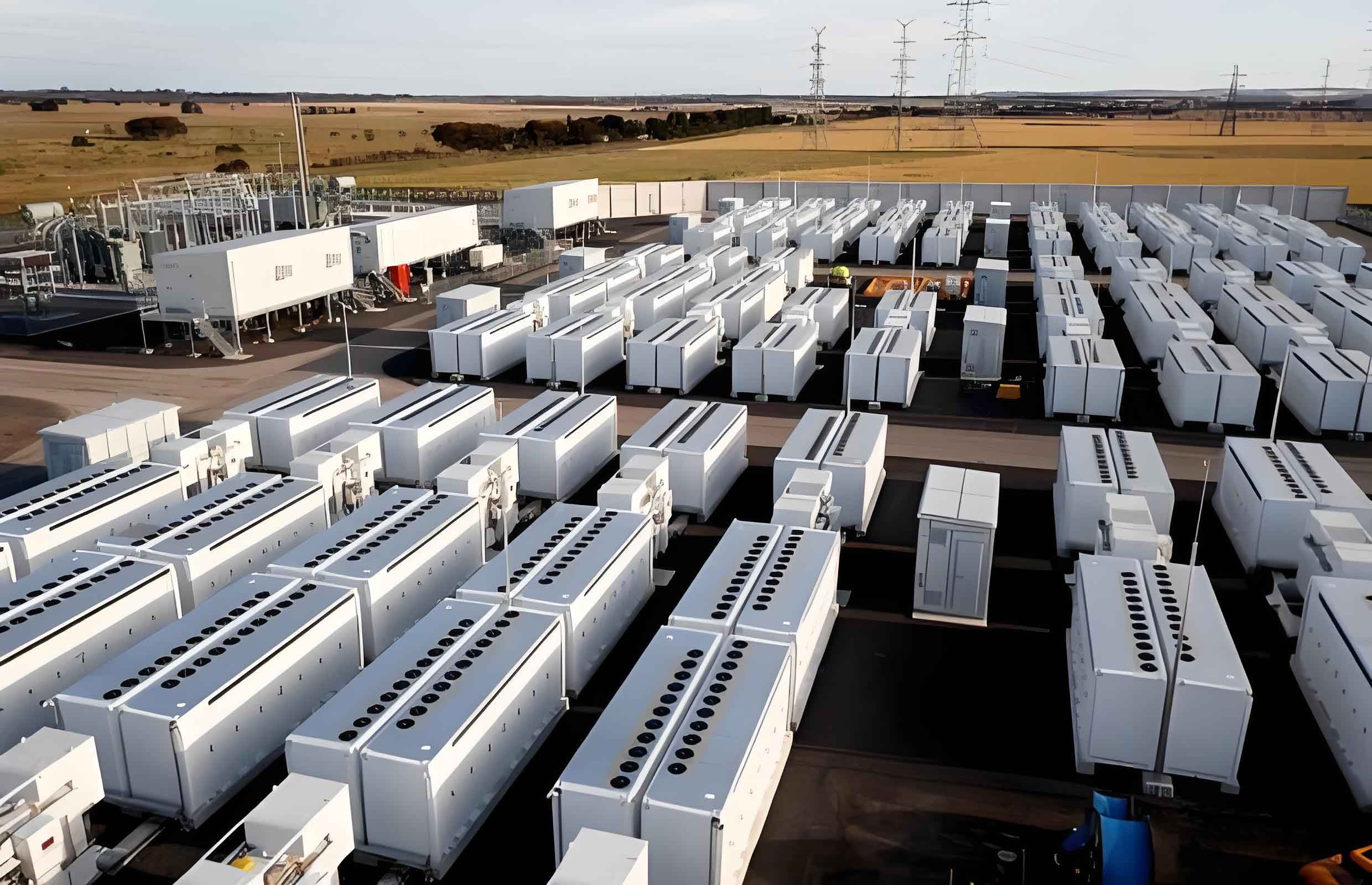
The core of our optimization model is built upon the mathematical representation of the energy storage battery station’s operation and costs. The state-of-charge (SOC) dynamics for a battery at node *i* and time *t* are governed by:
$$SSB_i(t) = SSB_i(t-1) + \eta_{ch,i} P_{ch,i}(t) \Delta t – \lambda_i Q_{SB,i}, \quad \text{if charging}$$
$$SSB_i(t) = SSB_i(t-1) – \frac{P_{dis,i}(t)}{\eta_{dis,i}} \Delta t – \lambda_i Q_{SB,i}, \quad \text{if discharging}$$
where \( SSB_i(t) \) is the stored energy, \( \eta_{ch,i} \) and \( \eta_{dis,i} \) are charging/discharging efficiencies, \( P_{ch,i}(t) \) and \( P_{dis,i}(t) \) are charging/discharging powers, \( \lambda_i \) is the self-discharge rate, \( Q_{SB,i} \) is the installed capacity, and \( \Delta t \) is the time interval.
The total lifecycle cost \( C_{total} \) of deploying energy storage battery stations is a critical component of the economic objective. It aggregates several cost streams, converted to their annual equivalent values considering the time value of money:
$$C_{total} = C_{inv} + C_{inst} + C_{O\&M} – C_{salv}$$
The detailed formulations are summarized in the following table:
| Cost Component | Mathematical Formulation | Description |
|---|---|---|
| Investment Cost (\(C_{inv}\)) | $$C_{inv} = \sum_{i=1}^{N_{site}} \frac{r(1+r)^{D}}{(1+r)^{D}-1} [Q_{SB,i} \cdot c_{unit,i} \cdot (n_i+1)]$$ | Cost of the energy storage battery units themselves, amortized over project life \(D\). \(n_i\) is the number of replacements. |
| Installation Cost (\(C_{inst}\)) | $$C_{inst} = \sum_{i=1}^{N_{site}} \sum_{j=0}^{n_i} \frac{r(1+r)^{D}}{(1+r)^{D}-1} (1+r)^{-d_i \cdot j} (1-\alpha_i)^{d_i \cdot j} C_{rep,i} \cdot N_i$$ | Cost of installing the units, which may decrease over time at rate \(\alpha_i\). |
| Operation & Maintenance Cost (\(C_{O\&M}\)) | $$C_{O\&M} = \sum_{i=1}^{N_{site}} \sum_{t=1}^{T} [u_{ch,i}(t) |P_{SB,i}(t)| k_{ch,i} + u_{dis,i}(t) |P_{SB,i}(t)| k_{dis,i}]$$ | Cost proportional to the absolute power throughput of the energy storage battery. |
| Salvage Value (\(C_{salv}\)) | $$C_{salv} = \sum_{i=1}^{N_{site}} \sum_{j=0}^{n_i} \frac{r(1+r)^{D}}{(1+r)^{D}-1} (1+r)^{-d_i \cdot j} \cdot k_{val} \cdot Q_{SB,i}$$ | Residual value of the energy storage battery equipment at the end of the planning horizon. |
The economic benefit \( B \) stems primarily from energy arbitrage: reducing renewable energy curtailment and minimizing expensive grid power purchases during peak periods. With \( q(t) \) as the time-of-use (TOU) electricity price, the benefit over a typical day is:
$$B = \sum_{t=1}^{T} q(t) \left[ \left(P_{ab}(t) – \bar{P}_{ab}(t)\right) + \left(P_{grid}(t) – \bar{P}_{grid}(t)\right) \right]$$
Here, \( P_{ab}(t) \) and \( \bar{P}_{ab}(t) \) are the curtailed renewable power before and after energy storage battery integration, while \( P_{grid}(t) \) and \( \bar{P}_{grid}(t) \) are the grid purchase powers.
Recognizing the stochastic nature of wind/PV output, we model their forecast errors using probability distributions (e.g., Weibull for wind, Beta for PV). This leads us to formulate a multi-objective stochastic optimization problem. The first objective is to maximize the expected net present value, which can be transformed into a minimization problem within a chance-constrained framework:
$$\min_{\mathbf{x}} \left\{ \min_{\bar{f}_1} \bar{f}_1 \right\} \quad \text{subject to:} \quad \text{Pr}\{ (B – C_{total}) \geq \bar{f}_1 \} \geq \alpha_1$$
where \( \mathbf{x} \) represents the decision variables (locations and capacities), \( \bar{f}_1 \) is the optimistic value of the net benefit, and \( \alpha_1 \) is the pre-specified confidence level. The second objective is to maximize system reliability, often measured by the Expected Energy Not Supplied (EENS) or a reliability index. We define a composite reliability index \( RI \) and aim to maximize its pessimistic value under uncertainty:
$$\max_{\mathbf{x}} \left\{ \max_{\underline{f}_2} \underline{f}_2 \right\} \quad \text{subject to:} \quad \text{Pr}\{ RI \leq \underline{f}_2 \} \geq \alpha_2$$
These objectives are subject to a set of technical and operational constraints, also expressed probabilistically to account for uncertainty:
1. Power Balance Chance Constraint:
$$\text{Pr}\{ | P_{grid}(t) + P_{WT}(t) + P_{PV}(t) + P_{SB}(t) + P_{CUT}(t) – P_{PB}(t) – P_{L}(t) | \leq \delta \} \geq \beta_1$$
This ensures generation-load balance with a high probability \( \beta_1 \), where \( P_{CUT}(t) \) is load curtailment and \( P_{L}(t) \) is the load.
2. Node Voltage Chance Constraint:
$$\text{Pr}\{ U_{i,min} \leq U_i(t) \leq U_{i,max} \} \geq \beta_2, \quad \forall i, t$$
This maintains nodal voltage within statutory limits with probability \( \beta_2 \). Voltages are determined by the non-linear power flow equations:
$$P_i(t) – U_i(t)\sum_{j=1}^{n} U_j(t)\left(G_{ij}\cos\theta_{ij}(t)+B_{ij}\sin\theta_{ij}(t)\right) = 0$$
$$Q_i(t) – U_i(t)\sum_{j=1}^{n} U_j(t)\left(G_{ij}\sin\theta_{ij}(t)-B_{ij}\cos\theta_{ij}(t)\right) = 0$$
3. Energy Storage Battery Operational Constraints:
These include capacity limits \( Q_{SB,i}^{min} \leq Q_{SB,i} \leq Q_{SB,i}^{max} \), SOC limits \( SSB_{i}^{min} \leq SSB_i(t) \leq SSB_{i}^{max} \), and power rating limits \( |P_{SB,i}(t)| \leq P_{SB,i}^{rated} \). Logical constraints ensure that charging, discharging, and curtailment actions are mutually exclusive.
To solve this complex problem, we developed a two-stage hybrid metaheuristic algorithm. The first stage employs Binary Particle Swarm Optimization (BPSO) to determine the optimal locations for the energy storage battery stations. Each particle’s position is a binary string where a ‘1’ indicates a candidate node is selected. The velocity update and position transition follow standard BPSO rules using a sigmoid function. The second stage utilizes an Improved Particle Swarm Optimization (IPSO) to determine the precise capacity ratings for the locations identified in stage one. Key improvements in IPSO include an elite preservation mechanism to prevent the loss of good solutions and a chaotic local search strategy applied to the global best particle to escape local optima. The two stages iterate cooperatively; the BPSO passes a location scheme to the IPSO, which evaluates its economic and reliability performance and feeds the fitness value back to guide the BPSO’s search. This hybrid BPSO-IPSO algorithm effectively navigates the discrete-continuous search space. The multi-objective handling is achieved using a weighted sum approach with a penalty function method for constraint violation, converting the chance constraints into deterministic equivalents via scenario analysis or analytical approximation for the specified confidence levels.
We validate our model and algorithm using the IEEE 33-bus radial distribution system, modified with distributed wind generators (at buses 13 and 16) and PV systems (at buses 29 and 32). Two distinct operational scenarios are analyzed:
Scenario 1 (Islanded Mode): The network operates in isolation from the main grid. The energy storage battery is the sole means for temporal energy shifting and reliability support.
Scenario 2 (Grid-Connected Mode): The network is connected to the main grid at the substation (bus 1), allowing power exchange at time-of-use (TOU) tariffs. The energy storage battery can perform arbitrage and provide reliability as a complement to grid power.
The following table presents the optimal siting and sizing results obtained by our hybrid BPSO-IPSO algorithm for the multi-objective case:
| Scenario | ESB Site (Bus) | Number of Units | Optimal Capacity (Power/Energy) |
|---|---|---|---|
| 1 (Islanded) | 4 | 2 | 170 kW / 800 kWh |
| 14 | 6 | 510 kW / 2400 kWh | |
| 30 | 4 | 340 kW / 1600 kWh | |
| 2 (Grid-Connected) | 2 | 6 | 510 kW / 2400 kWh |
| 2 | 5 | 425 kW / 2000 kWh | |
| 13 | 3 | 255 kW / 1200 kWh | |
| 29 | 5 | 425 kW / 2000 kWh |
The results show a clear divergence in strategy between the two modes. In the islanded mode, energy storage battery placements are more distributed (buses 4, 14, 30) to locally support voltage and reliability across the network. In the grid-connected mode, there is a concentration near the substation (bus 2) and renewable sources (buses 13, 29), focusing on bulk energy time-shift and maximizing arbitrage revenue from the grid. The economic and reliability performance metrics are compared below:
| Performance Metric | Scenario 1 (Islanded) | Scenario 2 (Grid-Connected) |
|---|---|---|
| Total Lifecycle Cost (\(C_{total}\)) | $2.01 million | $2.18 million |
| Annual Operational Benefit (\(B\)) | $0.42 million | $0.85 million |
| Net Present Value (NPV) | $10.61 million | $15.95 million |
| System Average Interruption Index (SAIFI) | 0.014 interruptions/customer.year | 0.002 interruptions/customer.year |
| Reliability Index (RI) | 0.986 | 0.998 |
Scenario 2 demonstrates superior economics due to revenue from grid arbitrage and significantly higher reliability due to the grid backstop. To quantify the value added by the energy storage battery, we compare the system’s annualized cost with and without the optimal energy storage battery configuration:
$$ \Delta C_{sys} = C_{sys}^{without\; ESB} – C_{sys}^{with\; ESB} $$
For Scenario 2, \( C_{sys}^{without\; ESB} = \$3.75\;\text{million} \) and \( C_{sys}^{with\; ESB} = \$2.25\;\text{million} \), yielding:
$$\Delta C_{sys} = \$1.50\;\text{million} \quad \text{(a 40\% reduction)}$$
Furthermore, we benchmarked our hybrid BPSO-IPSO against the standard PSO. The convergence characteristics and final solution quality were superior, as summarized below:
| Algorithm | Scenario 2 NPV | Scenario 2 RI | Avg. Computation Time |
|---|---|---|---|
| Standard PSO | $15.86 million | 0.997 | 28.2 seconds |
| Hybrid BPSO-IPSO (Proposed) | $15.95 million | 0.998 | 17.6 seconds |
The proposed algorithm not only found a better solution but also achieved it approximately 38% faster, demonstrating its efficacy in solving the siting and sizing problem for energy storage battery systems.
In conclusion, this study presents a robust framework for the multi-objective optimal configuration of energy storage battery stations in active distribution networks. By integrating a stochastic chance-constrained model that captures renewable uncertainty with an efficient hybrid BPSO-IPSO solver, our approach provides planners with a tool to make informed trade-offs between economic viability and system reliability. The case studies on the IEEE 33-node system under different operational paradigms confirm that strategically sited and sized energy storage battery systems can yield substantial economic benefits—reducing annual system costs by up to 40%—while simultaneously enhancing power supply reliability to indices above 0.99. The proposed hybrid algorithm proves to be both effective and computationally efficient for this purpose. Future work will involve extending the model to consider the degradation costs of the energy storage battery more precisely and integrating other distributed flexible resources like demand response into a unified optimization framework.