
With the increasing depletion of fossil fuels and environmental concerns, renewable energy-based microgrids have gained significant attention. Battery energy storage systems (BESS) have emerged as a critical solution for addressing peak-valley load differences in island-operated microgrids. This study proposes an optimized control strategy that integrates capacity configuration and charge-discharge management to enhance grid stability and economic efficiency.
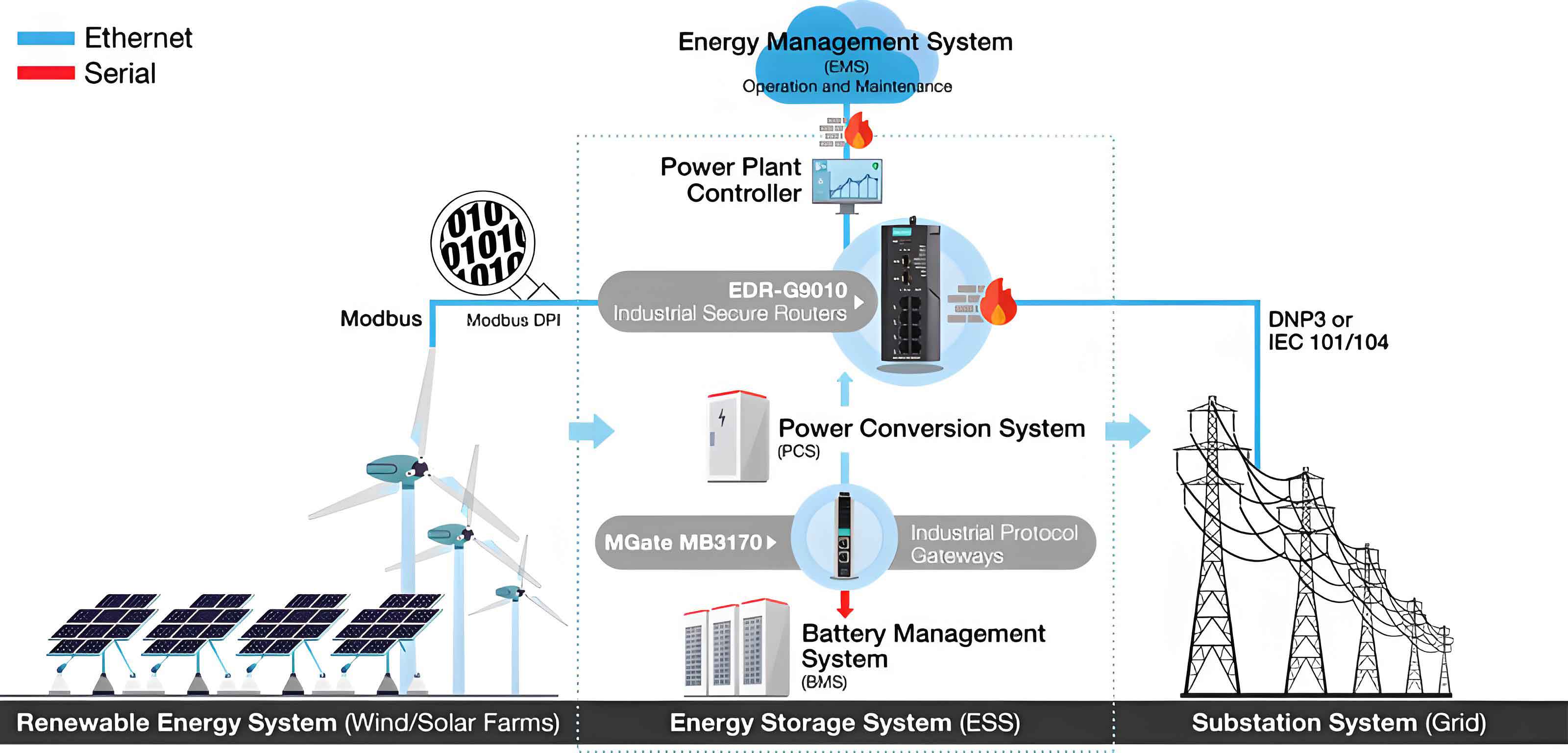
Structural Analysis and Operational Principles
The DC microgrid architecture incorporates distributed generation units and energy storage systems through power converters. The BESS operational model considers state-of-charge (SOC) dynamics:
$$ SOC_t = SOC_{t-1} – \frac{P_{bess,t} \Delta t}{\eta C} \times 100\% $$
where \( C \) denotes rated capacity and \( \eta \) represents charge/discharge efficiency. Key constraints include:
$$ 20\% \leq SOC \leq 80\% $$
$$ 0 \leq P_c \leq P_{e},\quad 0 \leq P_d \leq P_{e} $$
Capacity Configuration Optimization
A multi-objective optimization model minimizes total system cost while ensuring reliability:
$$ \text{Minimize } F = B_1 + B_2 – B_3 – B_4 $$
Cost components include:
| Component | Cost Equation |
|---|---|
| Capital Investment | \( B_1 = K_e P_{max} + K_q E_N \) |
| Operation & Maintenance | \( B_2 = K_o P_{max} + K_m Q_{day} \) |
| Revenue | \( B_3 = \sum_{t=1}^T C_{et}P_t \) |
| Subsidies | \( B_4 = K_b E_N \) |
The improved Artificial Bee Colony algorithm demonstrated superior performance in capacity optimization compared to traditional methods:
| Algorithm | Capacity (kWh) | Cost (Million ¥) | Convergence Iterations |
|---|---|---|---|
| Random Production | 1100 | 2.925 | N/A |
| Standard ABC | 1000 | 2.840 | 80 |
| Enhanced ABC | 900 | 2.630 | 40 |
Charge-Discharge Control Strategy
The constant parameter power difference strategy outperforms traditional constant power methods through adaptive load management:
$$ P_c =
\begin{cases}
P_2 – P_t & \text{if } P_t < P_2 \\
0 & \text{if } P_1 \leq P_t \leq P_2 \\
P_t – P_1 & \text{if } P_t > P_1
\end{cases} $$
Key performance metrics show significant improvements:
| Metric | Constant Power | Parameter Difference | Improvement |
|---|---|---|---|
| Peak Load (kW) | 4030 | 3400 | 15.63% |
| Valley Load (kW) | 1295 | 1895 | 46.33% |
| Standard Deviation | 802.31 | 601.14 | 25.07% |
The chaos-enhanced Particle Swarm Optimization algorithm effectively prevents local optima in power scheduling:
$$ v_{ij}^{t+1} = \omega v_{ij}^t + c_1r_1(pbest_{ij}^t – x_{ij}^t) + c_2r_2(gbest_{j}^t – x_{ij}^t) $$
$$ x_{ij}^{t+1} = x_{ij}^t + v_{ij}^{t+1} $$
Conclusion and Future Directions
This research demonstrates that optimized energy storage system configuration combined with intelligent control strategies can effectively reduce peak-valley differences by 25.07% while decreasing operational costs by 10%. Future work should investigate hybrid energy storage systems and multi-timescale coordination mechanisms for enhanced grid flexibility.
The proposed methods provide practical solutions for implementing battery energy storage systems in island microgrids, addressing both technical and economic challenges in renewable energy integration. Continued advancements in energy storage technology and control algorithms will further accelerate the transition toward sustainable power systems.