
Distributed photovoltaic (PV) systems have become a cornerstone of renewable energy adoption, particularly for factories, commercial buildings, and residential complexes. The selection of solar modules and solar inverters directly determines the technical feasibility and economic viability of such projects. This article analyzes the configuration strategies for PV components and solar inverters through practical case studies and mathematical modeling.
1. Current Status of PV Technology
The global solar industry has witnessed remarkable progress in crystalline silicon technology, with module conversion efficiencies improving from 14% to over 20% within five years. The price-performance ratio has simultaneously enhanced, as shown in Table 1:
| Parameter | 2018 | 2023 |
|---|---|---|
| Module Efficiency | 16-18% | 19-22% |
| Cost per Watt (USD) | 0.55 | 0.28 |
| Degradation Rate | 0.8%/year | 0.5%/year |
The system efficiency of distributed PV projects can be expressed as:
$$ \eta_{system} = \eta_{module} \times \eta_{inverter} \times \eta_{mismatch} \times \eta_{cable} $$
Where:
– $\eta_{module}$ = Module conversion efficiency
– $\eta_{inverter}$ = Solar inverter efficiency
– $\eta_{mismatch}$ = Mismatch losses (typically 2-4%)
– $\eta_{cable}$ = DC/AC cabling losses (1-3%)
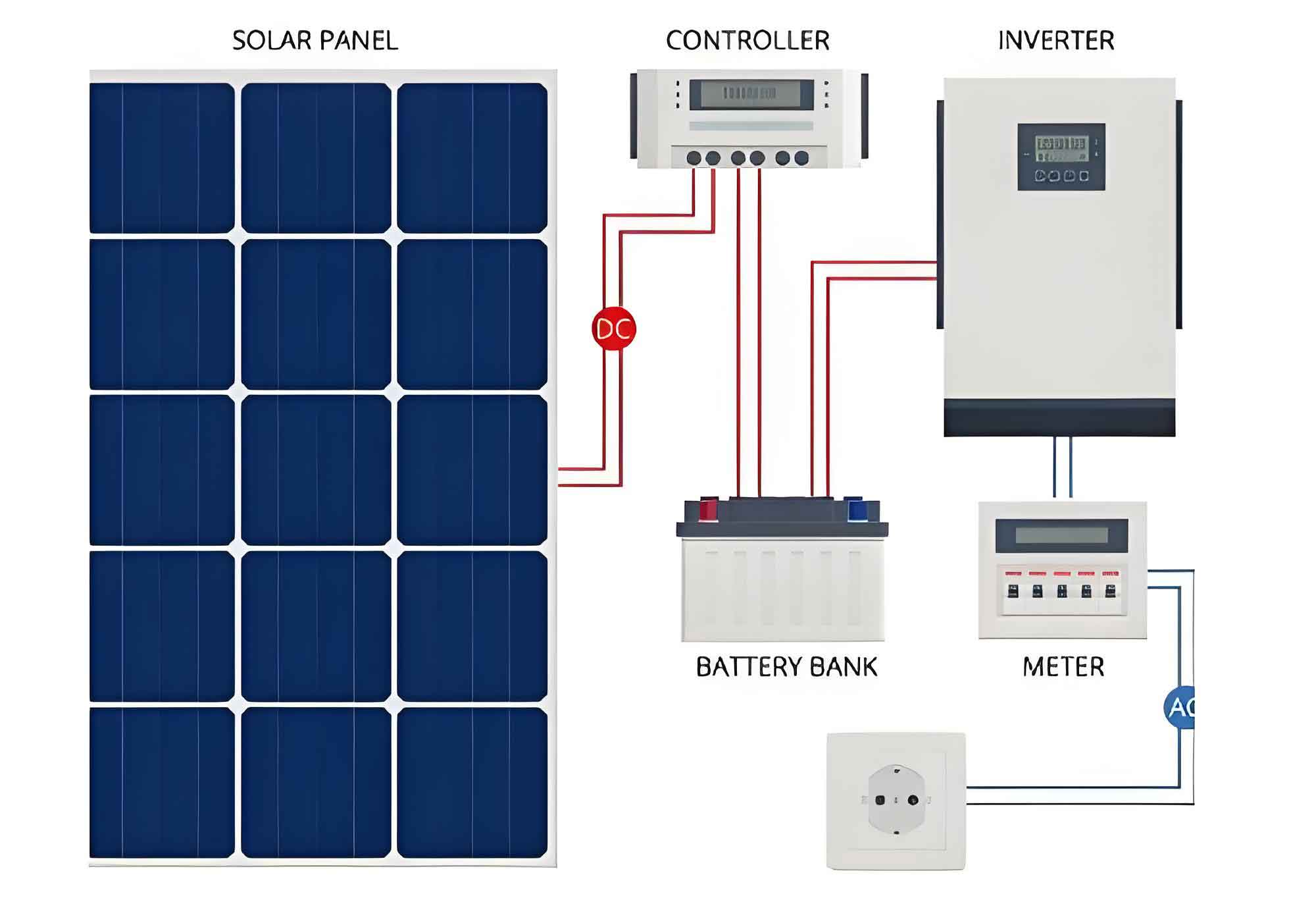
2. PV Module Selection Criteria
Monocrystalline silicon modules dominate commercial projects due to superior performance metrics:
| Parameter | Monocrystalline | Polycrystalline |
|---|---|---|
| Efficiency | 19-22% | 16-18% |
| Temperature Coefficient | -0.35%/°C | -0.45%/°C |
| 25-year Degradation | 15-17% | 18-20% |
The levelized cost of energy (LCOE) calculation demonstrates monocrystalline superiority:
$$ LCOE = \frac{\sum_{t=1}^{n} \frac{I_t + M_t}{(1+r)^t}}{\sum_{t=1}^{n} \frac{E_t}{(1+r)^t}} $$
Where:
– $I_t$ = Initial investment in year t
– $M_t$ = Maintenance costs
– $E_t$ = Energy output
– $r$ = Discount rate
3. Solar Inverter Configuration Strategy
String solar inverters provide optimal performance for distributed systems due to:
- MPPT efficiency > 99%
- DC input voltage range 150-1000V
- Reactive power capability 0.8 leading/lagging
The inverter sizing ratio (DC/AC ratio) should follow:
$$ 1.1 \leq \frac{P_{DC}}{P_{AC}} \leq 1.25 $$
For a 1.2MWp system with 60kW solar inverters:
$$ N_{inverters} = \frac{1200kW}{60kW} \times 1.15 = 23 \text{ units} $$
4. Case Study: 1.2MW Industrial Rooftop System
| Component | Specification |
|---|---|
| Modules | 440W Mono PERC, 144 cells |
| Inverters | 60kW string inverters |
| System Voltage | 1500V DC / 400V AC |
| Annual Yield | 1,450 kWh/kWp |
Performance ratio (PR) calculation:
$$ PR = \frac{\text{Actual Yield}}{\text{Theoretical Yield}} \times 100\% = \frac{1.45}{1.62} \times 100\% = 89.5\% $$
5. Advanced Inverter Features
Modern solar inverters must support:
- Reactive power compensation:
$$ Q = P \times \tan(\cos^{-1}(PF)) $$ - Frequency-watt control:
$$ P_{curtail} = P_{max} \times \frac{f_{grid} – f_{nominal}}{f_{deadband}} $$ - Voltage regulation:
$$ V_{adjust} = V_{ref} + k \times (P_{actual} – P_{ref}) $$
The harmonic distortion constraint requires:
$$ THD_i \leq 3\% \text{ at rated power} $$
6. Economic Analysis
Net Present Value (NPV) comparison for different configurations:
| Configuration | NPV (USD) | IRR |
|---|---|---|
| 330W poly + 50kW inverter | 1.12M | 9.8% |
| 440W mono + 60kW inverter | 1.45M | 12.3% |
The optimal configuration demonstrates 29.5% higher NPV through:
- 15% lower balance-of-system costs
- 3% higher energy yield
- 12% longer inverter lifetime
This technical and economic analysis confirms that proper matching of high-efficiency modules with appropriately sized solar inverters creates the most sustainable and profitable distributed PV solutions. The continuous innovation in solar inverter technology further enhances grid compatibility and system resilience, ensuring long-term operational excellence.