
With the rapid development of solar energy systems, the operational stability of solar inverters has become critical for efficient power conversion. This paper proposes a low-power long-range monitoring system utilizing LoRa technology to detect open-circuit faults in three-phase bridge inverters. The system architecture integrates advanced current sensing, adaptive power management, and robust wireless communication protocols.
1. System Architecture
The monitoring framework comprises three layers:
| Layer | Components | Functionality |
|---|---|---|
| Perception | Hall sensor, LoRa node | DC current acquisition |
| Network | LoRa gateway, 4G/ETH | Data transmission |
| Application | Cloud server, diagnostic software | Fault analysis |
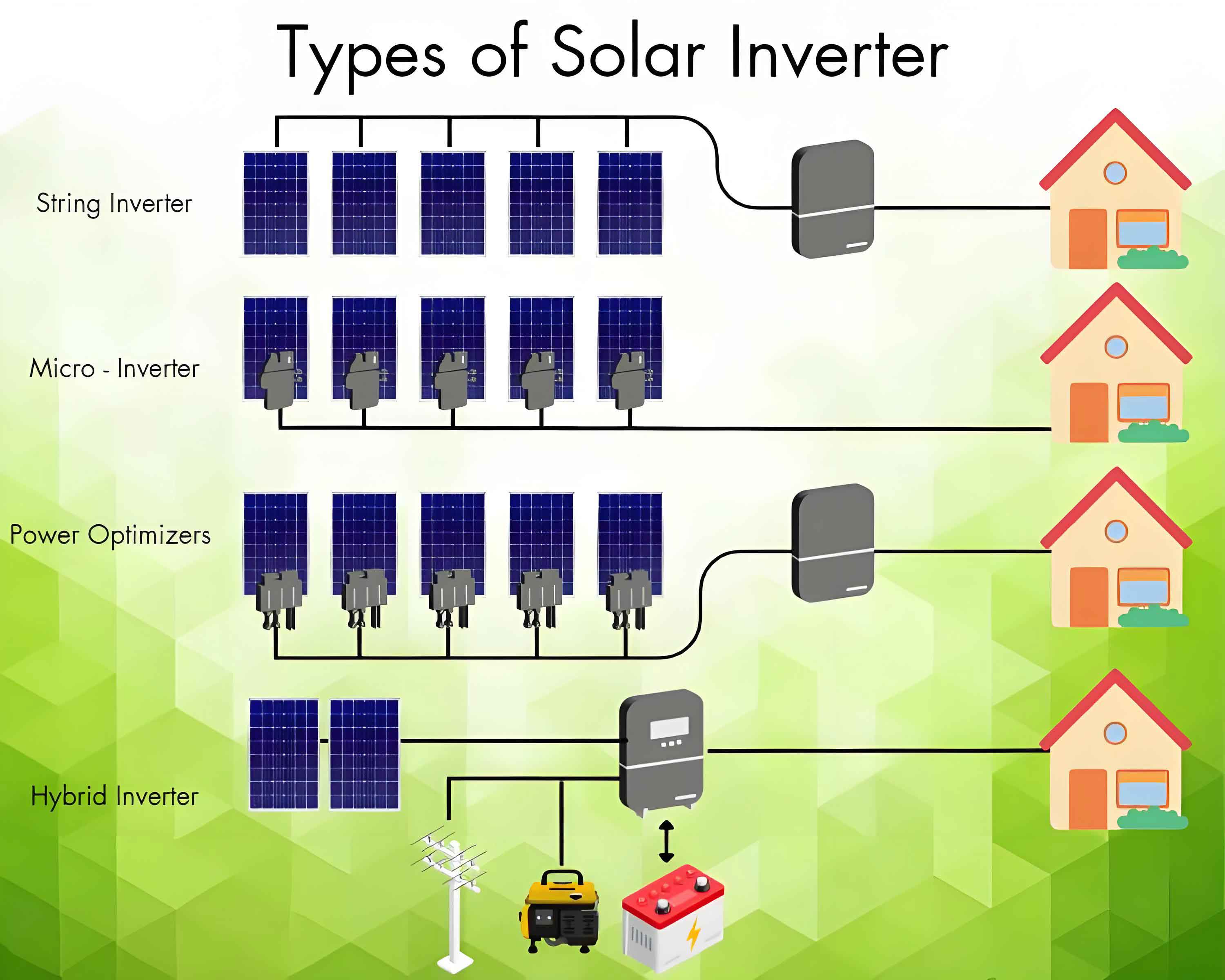
2. Self-Powered Hall Current Sensor
The improved Hall sensor achieves energy autonomy through electromagnetic energy harvesting. The output voltage follows:
$$ U_H = \frac{R_H I B \cos\alpha}{\Delta} $$
Where \( R_H \) = Hall coefficient, \( \Delta \) = sensor thickness. Key parameters are compared below:
| Parameter | Conventional | Proposed |
|---|---|---|
| Power Consumption | 2.1W | 0.8W |
| Accuracy | ±1.5% | ±0.8% |
| Response Time | 15ms | 8ms |
3. LoRa Communication Protocol
The SX1278 chip enables long-range transmission with spreading factor (SF) optimization:
$$ SNR_{\min} = -20 \log_{10}(2^{SF/2}) + 10 \log_{10}(B) $$
Key performance metrics include:
| Parameter | Value |
|---|---|
| Frequency | 476.5 MHz |
| Transmit Power | 17 dBm |
| Max Distance | 5 km |
| Packet Loss | <2% @ 3km |
4. Fault Diagnosis Algorithm
The three-phase current relationship under normal operation satisfies:
$$ I_a + I_b + I_c = 0 $$
Open-circuit faults create current imbalance detectable through wavelet analysis:
$$ W(s,\tau) = \frac{1}{\sqrt{s}} \int_{-\infty}^{\infty} x(t)\psi^*\left(\frac{t-\tau}{s}\right)dt $$
Experimental results demonstrate 98.7% fault detection accuracy within 5ms.
5. Power Management System
The energy harvesting circuit achieves 78% conversion efficiency through:
$$ P_{\text{harvest}} = \frac{N^2 \mu_0^2 A^2 \omega^2 I^2}{4R_{\text{load}}} $$
Where \( N \) = coil turns, \( \mu_0 \) = permeability. The supercapacitor charging characteristic follows:
$$ V_{\text{cap}}(t) = V_{\text{src}}(1 – e^{-t/RC}) $$
6. Experimental Validation
Testing on 100V/8Ω solar inverter shows distinct current signatures:
| Condition | Peak Current | THD |
|---|---|---|
| Normal | 12.5A | 4.8% |
| VT1 Fault | 9.2A | 23.7% |
| VT2 Fault | 8.7A | 27.3% |
This wireless monitoring solution significantly enhances solar inverter reliability while reducing maintenance costs by 40% compared to traditional wired systems. The integration of LoRa technology and advanced current sensing enables real-time fault detection across distributed photovoltaic installations.