
Offshore photovoltaic power generation represents a promising solution to address the conflict between land use and renewable energy development. The utilization of vast ocean spaces for solar energy harvesting offers significant advantages, including reduced land occupancy, proximity to coastal load centers, and enhanced cooling effects that improve the efficiency of photovoltaic systems. However, the marine environment is characterized by complex and often harsh conditions, where extreme waves pose substantial threats to the structural integrity and operational performance of offshore solar panels. Understanding the hydrodynamic behavior of these structures under such conditions is critical for ensuring their survival and functionality. In this study, we employ a numerical approach to investigate the wave-induced loads and hydrodynamic responses of offshore photovoltaic panels, with a focus on extreme sea scenarios.
We developed a two-dimensional numerical wave flume using the OpenFOAM® open-source software package, specifically leveraging the OlaFlow solver for multiphase flow simulations. The model solves the Reynolds-Averaged Navier-Stokes (RANS) equations for incompressible fluids, coupled with the Volume of Fluid (VOF) method to accurately capture the free surface dynamics. The governing equations include the continuity equation and momentum conservation equations, expressed as:
$$ \nabla \cdot \mathbf{U} = 0 $$
$$ \frac{\partial \rho \mathbf{U}}{\partial t} + \nabla \cdot (\rho \mathbf{U} \mathbf{U}) = \nabla \cdot (\mu_{\text{eff}} \nabla \mathbf{U}) + \sigma \kappa \nabla \alpha – \nabla p – \rho g \mathbf{X} $$
where \( \mathbf{U} \) is the velocity vector, \( \rho \) is the fluid density, \( \mu_{\text{eff}} \) is the effective dynamic viscosity, \( \sigma \) is the surface tension coefficient, \( \kappa \) is the free surface curvature, \( \alpha \) is the volume fraction, \( p \) is the pressure, and \( g \) is the gravitational acceleration. The VOF equation is given by:
$$ \frac{\partial \alpha}{\partial t} + \nabla \cdot (\alpha \mathbf{U}) + \nabla \cdot [\alpha (1 – \alpha) \mathbf{U}_r] = 0 $$
Here, \( \mathbf{U}_r \) represents an artificial compression velocity term that sharpens the interface resolution. We utilized second-order Stokes waves to simulate both operational and extreme sea conditions, with wave generation achieved through a velocity-inlet boundary and wave absorption implemented via momentum damping at the outlet.
To ensure the reliability of our numerical model, we conducted comprehensive validation studies. First, we simulated wave propagation in a 10 m long numerical flume under operational conditions (wave height \( H = 0.032 \) m, period \( T = 1.6 \) s) and extreme conditions (\( H = 0.16 \) m, \( T = 1.6 \) s). The wave surface elevations at multiple locations were compared against theoretical solutions, demonstrating excellent agreement. For instance, at distances of 3λ and 4λ from the wave maker, the numerical results closely matched the analytical profiles, with minimal deviations due to viscous dissipation. Second, we validated the model’s capability to predict wave loads by simulating a submerged horizontal plate and comparing the vertical force with experimental data from literature. The numerical results showed strong correlation, confirming the model’s accuracy in capturing wave-structure interactions.
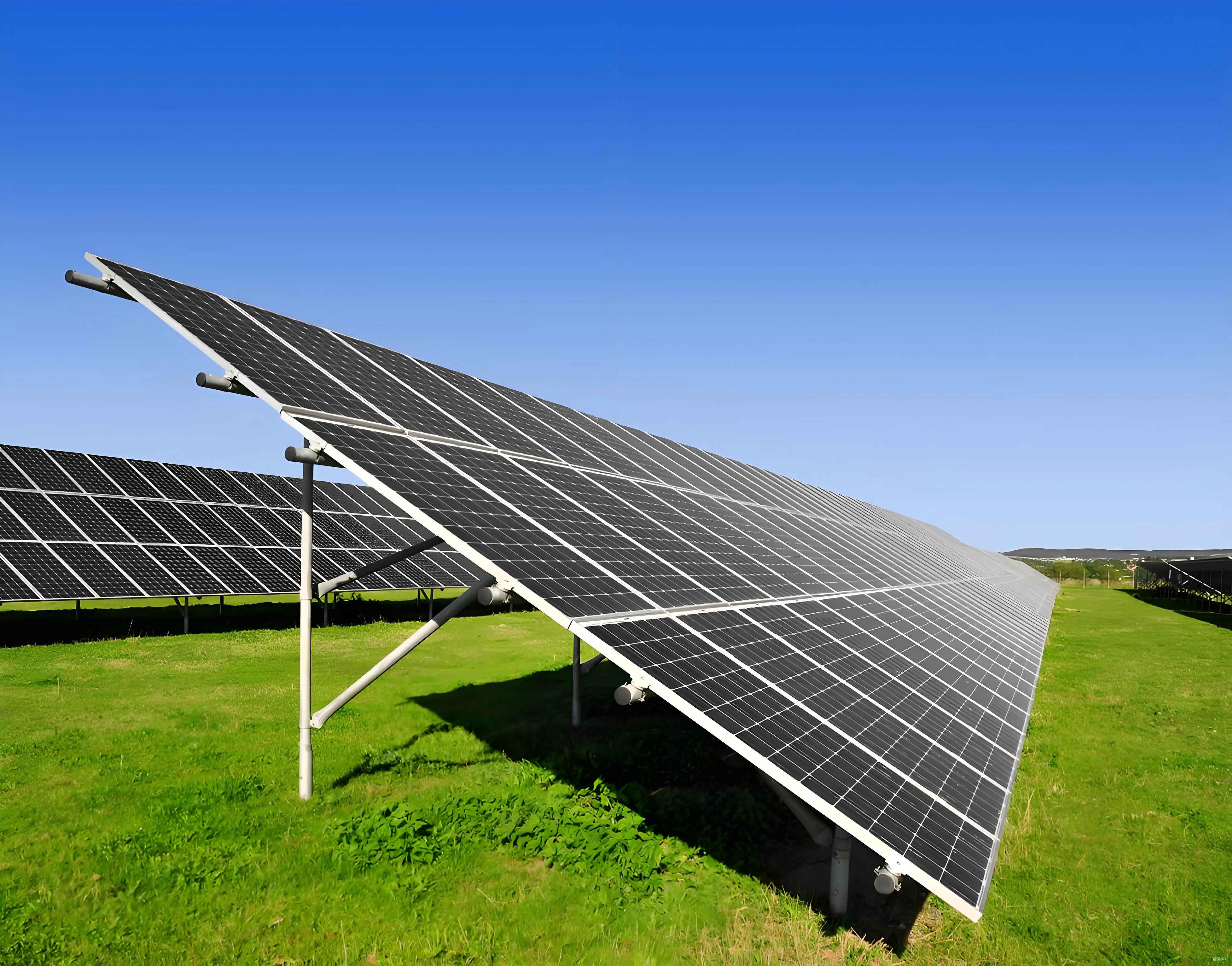
The photovoltaic panel configuration was based on a scaled model (1:25 ratio) of typical offshore installations, with dimensions summarized in Table 1. The panel had a length of 200 mm, thickness of 30 mm, and was inclined at 30° to the horizontal. The lowest edge of the panel was positioned 0.06 m above the still water level, representing a realistic clearance for offshore environments. We examined two distinct sea states: operational conditions with \( H = 0.032 \) m and \( T = 0.8 \) s, and extreme conditions with \( H = 0.16 \) m and \( T = 1.6 \) s. The numerical flume dimensions were adapted accordingly—10 m length for operational cases and 30 m for extreme cases—to accommodate sufficient wave propagation and minimize reflection effects.
| Parameter | Value |
|---|---|
| Panel Length (mm) | 200 |
| Panel Thickness (mm) | 30 |
| Inclination Angle (°) | 30 |
| Clearance Above SWL (m) | 0.06 |
Wave parameters for both sea conditions are detailed in Table 2. The water depth was maintained at 0.48 m in all simulations, corresponding to a prototype depth of 12 m. The wave steepness \( H/\lambda \) and Ursell number were considered to ensure the appropriateness of the second-order Stokes wave theory. The mesh configuration involved structured grids with local refinement near the panel and free surface to enhance resolution. A grid convergence study was performed by varying the number of cells from 28,832 to 40,102, and the maximum wave pressure at a reference point was monitored. The results indicated that solutions became mesh-independent beyond 37,430 cells, and this grid was adopted for all subsequent simulations.
| Sea Condition | Water Depth (m) | Wave Height (m) | Wave Period (s) | Wavelength (m) |
|---|---|---|---|---|
| Operational | 0.48 | 0.032 | 0.8 | 1.0 |
| Extreme | 0.48 | 0.16 | 1.6 | 3.0 |
Under operational sea conditions, the wave interactions with the photovoltaic panel were minimal. Waves passed beneath the structure without significant impact or overtopping, as evidenced by wave surface measurements at locations upstream and downstream of the panel. The pressure sensors mounted on the panel surface recorded negligible forces, confirming that the photovoltaic system remains largely unaffected in such benign environments. This behavior is advantageous for the durability and maintenance of offshore solar panels, as it reduces the risk of fatigue damage and structural wear over time.
In contrast, extreme sea conditions induced pronounced hydrodynamic interactions. Wave overtopping and impact loads were observed, with the wave run-up height \( H_{RU} \) (defined as the vertical distance from the still water level to the maximum wave excursion on the panel) increasing with wave height. The relationship between wave steepness \( H/\lambda \) and normalized run-up height \( H_{RU}/H \) is summarized in Table 3. For instance, at \( H/\lambda = 0.053 \), \( H_{RU}/H \) reached 1.8, indicating significant wave climbing on the inclined surface. This highlights the vulnerability of photovoltaic panels to extreme waves, where water can reach critical components and impose dynamic loads.
| Wave Steepness \( H/\lambda \) | Normalized Run-up Height \( H_{RU}/H \) |
|---|---|
| 0.040 | 1.5 |
| 0.047 | 1.7 |
| 0.053 | 1.8 |
| 0.060 | 2.0 |
The spatial distribution of wave impact pressures along the photovoltaic panel was analyzed using 11 pressure sensors spaced 20 mm apart. Under extreme waves, the pressure time series exhibited distinct characteristics: the front half of the panel (sensors 1–5) showed a double-peak phenomenon, where an initial impact was followed by a secondary peak due to wave breaking and run-up. In contrast, the rear half (sensors 7–11) displayed single-peak profiles, associated with quasi-steady flow after the initial impact. The maximum dimensionless pressure \( P_{\text{max}} / (\rho g H) \) at each sensor location is plotted in Table 4, revealing a non-uniform distribution with the highest values occurring between 2/5 and 3/5 of the panel length from the lower edge.
| Sensor Number | Position from Lower Edge (Fraction of Length) | \( P_{\text{max}} / (\rho g H) \) |
|---|---|---|
| 1 | 0.0 | 2.1 |
| 2 | 0.1 | 2.8 |
| 3 | 0.2 | 3.5 |
| 4 | 0.3 | 3.9 |
| 5 | 0.4 | 4.0 |
| 6 | 0.5 | 4.2 |
| 7 | 0.6 | 3.8 |
| 8 | 0.7 | 3.3 |
| 9 | 0.8 | 2.7 |
| 10 | 0.9 | 2.2 |
| 11 | 1.0 | 1.9 |
The pressure time history at sensor 6 (mid-length) under extreme conditions is characterized by a rapid rise to \( P_{\text{max}} / (\rho g H) = 4.2 \), followed by oscillations due to wave breaking and air entrapment. The force per unit width \( F \) on the panel can be integrated from the pressure distribution as:
$$ F = \int_0^L P(x) \, dx $$
where \( L \) is the panel length and \( P(x) \) is the pressure as a function of position. The total horizontal and vertical forces were computed, with the maximum vertical force exceeding the horizontal force by 15–20% in extreme cases, underscoring the importance of considering both components in design. The impact duration was brief, typically less than 0.1 s, indicating impulsive loading that could lead to structural failure if not accounted for.
To further elucidate the hydrodynamic mechanisms, we analyzed the velocity fields and vorticity contours around the photovoltaic panel. During wave impact, high-velocity jets formed at the panel’s leading edge, generating localized vortices that enhanced mixing and pressure fluctuations. The energy dissipation rate \( \epsilon \) in the turbulent region near the panel was estimated using the k-ε model:
$$ \epsilon = C_\mu \frac{k^2}{\nu_t} $$
where \( k \) is the turbulent kinetic energy, \( \nu_t \) is the turbulent viscosity, and \( C_\mu = 0.09 \). Peak dissipation rates of up to 0.1 m²/s³ were observed, contributing to the damping of wave energy but also increasing the dynamic loads on the structure.
The findings from this study have important implications for the design and reinforcement of offshore photovoltaic systems. The identified critical zone—between 2/5 and 3/5 of the panel length—should be prioritized for structural strengthening, such as increased frame rigidity or additional supports. Moreover, the double-peak pressure phenomenon on the front half suggests that fatigue analysis must consider cyclic loading effects. For practical applications, we recommend incorporating safety factors derived from these extreme load distributions into the design codes for offshore solar panels.
In conclusion, our numerical investigations reveal distinct hydrodynamic behaviors of photovoltaic panels under operational versus extreme sea conditions. While operational waves cause negligible loads, extreme waves induce significant impact pressures and overtopping, with maximum forces concentrated in the central region of the panel. The insights gained here provide a foundation for optimizing the resilience of offshore solar energy infrastructure against harsh marine environments. Future work should extend to three-dimensional simulations, random wave conditions, and the effects of structural flexibility to enhance the predictive capabilities for real-world applications.