
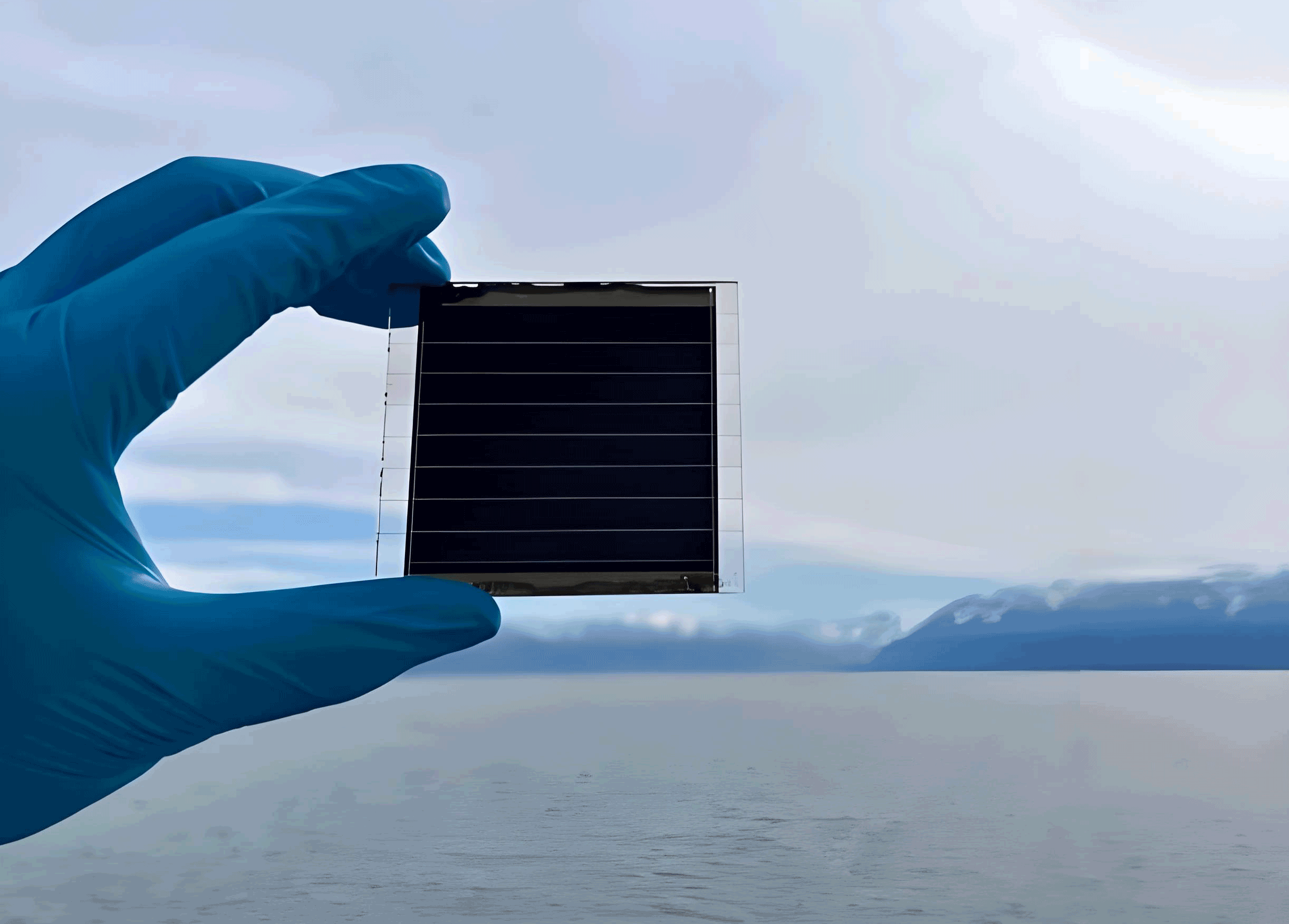
Perovskite solar cells have emerged as a promising third-generation photovoltaic technology due to their high efficiency, low cost, and solution processability. However, the toxicity of lead and instability issues in organic-inorganic hybrid perovskites have hindered their widespread commercialization. To address these challenges, lead-free alternatives such as germanium-based perovskites have gained attention. In this study, I focus on RbGeI3 as an absorber material for all-inorganic perovskite solar cells. Using the SCAPS-1D simulation software, I numerically analyze the device performance by optimizing key parameters including absorber layer thickness, defect density, doping concentrations, and back electrode work function. The goal is to achieve high power conversion efficiency (PCE) while maintaining stability and environmental friendliness. The simulated device structure consists of FTO/TiO2/RbGeI3/Spiro-OMeTAD/Au, where TiO2 serves as the electron transport layer (ETL) and Spiro-OMeTAD as the hole transport layer (HTL). Through systematic parameter variation, I demonstrate that RbGeI3-based perovskite solar cells can achieve a PCE of over 23%, highlighting their potential as efficient and sustainable photovoltaic devices.
The numerical simulations are performed using SCAPS-1D, which solves the semiconductor equations under steady-state conditions. The key equations governing the device physics include Poisson’s equation and the continuity equations for electrons and holes. Poisson’s equation describes the electrostatic potential distribution and is given by:
$$ \frac{d}{dx} \left( \epsilon(x) \frac{d\psi}{dx} \right) = q \left[ p(x) – n(x) + N_D^+(x) – N_A^-(x) + p_t(x) – n_t(x) \right] $$
where \( \epsilon(x) \) is the dielectric constant, \( \psi \) is the electrostatic potential, \( q \) is the electron charge, \( p(x) \) and \( n(x) \) are the hole and electron concentrations, \( N_D^+ \) and \( N_A^- \) are the ionized donor and acceptor concentrations, and \( p_t \) and \( n_t \) are trapped hole and electron densities. The continuity equations for electrons and holes account for carrier generation and recombination:
$$ -\frac{1}{q} \frac{dJ_n}{dx} + R_n(x) – G(x) = 0 $$
$$ \frac{1}{q} \frac{dJ_p}{dx} + R_p(x) – G(x) = 0 $$
Here, \( J_n \) and \( J_p \) are the electron and hole current densities, \( R_n \) and \( R_p \) are the recombination rates, and \( G \) is the generation rate. These equations are solved numerically with appropriate boundary conditions to obtain the current-voltage (J-V) characteristics and other performance metrics. The simulation assumes standard AM 1.5G illumination and a temperature of 300 K. The material parameters used in the simulation are based on literature and are summarized in Table 1.
| Parameter | Spiro-OMeTAD | RbGeI3 | TiO2 |
|---|---|---|---|
| Thickness (nm) | 200 | 400 | 30 |
| Bandgap \( E_g \) (eV) | 2.88 | 1.31 | 3.2 |
| Electron Affinity \( \chi \) (eV) | 2.05 | 3.9 | 4.0 |
| Relative Permittivity \( \epsilon \) | 3 | 23.01 | 100 |
| Effective Density of States in Conduction Band \( N_c \) (cm\(^{-3}\)) | 2.5 × 10\(^{20}\) | 2.8 × 10\(^{19}\) | 2 × 10\(^{20}\) |
| Effective Density of States in Valence Band \( N_v \) (cm\(^{-3}\)) | 2.5 × 10\(^{20}\) | 1.4 × 10\(^{19}\) | 1 × 10\(^{21}\) |
| Electron Mobility \( \mu_e \) (cm\(^2\)/V·s) | 0.002 | 1.0 | 28.6 |
| Hole Mobility \( \mu_h \) (cm\(^2\)/V·s) | 0.002 | 6.0 | 27.3 |
| Donor Doping Concentration \( N_D \) (cm\(^{-3}\)) | 0 | 0 | 5.06 × 10\(^{19}\) |
| Acceptor Doping Concentration \( N_A \) (cm\(^{-3}\)) | 10\(^{18}\) | 10\(^{9}\) | 0 |
| Defect Density \( N_t \) (cm\(^{-3}\)) | 10\(^{15}\) | 10\(^{15}\) | 10\(^{15}\) |
Additionally, interface defects between layers are considered to model recombination losses. The parameters for these interfaces are provided in Table 2. The defect types are set to neutral, with capture cross-sections of 1.0 × 10\(^{-19}\) cm\(^2\) for both electrons and holes. The energy level is fixed at 0.6 eV above the valence band edge, and the total defect density is 1.0 × 10\(^{11}\) cm\(^{-3}\). These settings help in accurately capturing the charge carrier dynamics at the interfaces.
| Parameter | Spiro-OMeTAD/RbGeI3 Interface | TiO2/RbGeI3 Interface |
|---|---|---|
| Defect Type | Neutral | Neutral |
| Electron/Hole Capture Cross-Section (cm\(^2\)) | 1 × 10\(^{-19}\) | 1 × 10\(^{-19}\) |
| Energy Distribution Type | Single | Single |
| Defect Energy Level (eV above E_v) | 0.6 | 0.6 |
| Characteristic Energy (eV) | 0.1 | 0.1 |
| Total Defect Density (cm\(^{-3}\)) | 1 × 10\(^{11}\) | 1 × 10\(^{11}\) |
The initial simulation results with default parameters yield a PCE of 20.48%, with an open-circuit voltage (\( V_{oc} \)) of 0.82 V, short-circuit current density (\( J_{sc} \)) of 30.85 mA/cm\(^2\), and fill factor (FF) of 80.86%. To improve this, I investigate the impact of various factors on the perovskite solar cell performance. The first parameter analyzed is the thickness of the RbGeI3 absorber layer. The thickness influences light absorption and carrier collection. As the thickness increases from 100 to 1000 nm, \( J_{sc} \) rises due to enhanced photon absorption, but \( V_{oc} \) and FF decrease owing to increased recombination and series resistance. The optimal thickness is found to be 600 nm, where the PCE peaks. This balance ensures sufficient light absorption without excessive recombination. The relationship between thickness and performance can be expressed using the absorption coefficient \( \alpha \) and the generation rate \( G(x) \), which is proportional to \( \alpha e^{-\alpha x} \). The total photocurrent density can be approximated as:
$$ J_{ph} = q \int_0^d G(x) \, dx $$
where \( d \) is the thickness. For thicker layers, \( J_{ph} \) saturates when the absorption depth is exceeded.
Next, I examine the effect of defect density in the RbGeI3 layer. Defects act as recombination centers, reducing carrier lifetime and efficiency. The defect density \( N_t \) is varied from 10\(^8\) to 10\(^{18}\) cm\(^{-3}\). At low defect densities (<10\(^{13}\) cm\(^{-3}\)), the performance remains stable, but beyond this, \( V_{oc} \) and \( J_{sc} \) drop sharply. The recombination rate \( R \) can be modeled using Shockley-Read-Hall statistics:
$$ R = \frac{np – n_i^2}{\tau_p (n + n_1) + \tau_n (p + p_1)} $$
where \( n_i \) is the intrinsic carrier concentration, \( \tau_n \) and \( \tau_p \) are carrier lifetimes, and \( n_1 \), \( p_1 \) are parameters related to defect energy levels. Lower defect densities result in longer lifetimes and higher efficiency. Thus, maintaining \( N_t \) below 10\(^{13}\) cm\(^{-3}\) is crucial for optimal performance.
Doping concentrations in the absorber and transport layers also play a vital role. For the RbGeI3 layer, the acceptor doping concentration \( N_A \) is varied from 10\(^5\) to 10\(^{17}\) cm\(^{-3}\). At low doping (<10\(^{15}\) cm\(^{-3}\)), the built-in electric field is weak, limiting carrier separation. As doping increases, the field strengthens, improving \( V_{oc} \) and FF. The optimal doping is 10\(^{17}\) cm\(^{-3}\). The built-in potential \( V_{bi} \) can be estimated as:
$$ V_{bi} = \frac{kT}{q} \ln \left( \frac{N_A N_D}{n_i^2} \right) $$
where \( N_D \) is the donor density in the ETL. Similarly, for the TiO2 ETL, donor doping \( N_D \) is varied from 10\(^{13}\) to 10\(^{21}\) cm\(^{-3}\). Higher doping reduces series resistance and improves charge extraction, but excessive doping may cause tunneling losses. The optimum is 10\(^{20}\) cm\(^{-3}\). For Spiro-OMeTAD HTL, acceptor doping \( N_A \) above 10\(^{17}\) cm\(^{-3}\) enhances hole conductivity and FF. The conductivity \( \sigma \) is given by \( \sigma = q \mu p \), where \( \mu \) is mobility and \( p \) is hole concentration. Thus, higher doping increases \( p \) and \( \sigma \).
The work function of the back metal electrode affects the Schottky barrier height and charge collection. I test Ag (4.57 eV), Cu (4.65 eV), C (5.0 eV), and Au (5.1 eV). Work functions below 4.9 eV create Schottky barriers, increasing series resistance and reducing FF. Au gives the best performance with FF of 82.57% and PCE of 20.92%. The barrier height \( \phi_B \) is related to the work function difference:
$$ \phi_B = \phi_M – \chi $$
where \( \phi_M \) is the metal work function and \( \chi \) is the electron affinity of the adjacent layer. Higher work functions minimize \( \phi_B \), facilitating ohmic contact.
After optimizing all parameters—absorber thickness of 600 nm, defect density <10\(^{13}\) cm\(^{-3}\), RbGeI3 doping of 10\(^{17}\) cm\(^{-3}\), TiO2 doping of 10\(^{20}\) cm\(^{-3}\), Spiro-OMeTAD doping of 10\(^{17}\) cm\(^{-3}\), and Au back electrode—the simulated perovskite solar cell achieves \( V_{oc} = 0.92 \) V, \( J_{sc} = 32.97 \) mA/cm\(^2\), FF = 78.10%, and PCE = 23.65%. This represents a significant improvement over the initial configuration. The enhanced performance is attributed to better light harvesting, reduced recombination, and efficient charge transport. The results underscore the potential of RbGeI3 as a lead-free absorber for high-efficiency perovskite solar cells.
In conclusion, my numerical analysis using SCAPS-1D demonstrates that RbGeI3-based all-inorganic perovskite solar cells can achieve high efficiency through careful parameter optimization. The study provides insights into the role of thickness, defects, doping, and electrodes in device performance. Future work could explore other transport layers or multijunction configurations to further push the limits of perovskite solar cell technology. The robustness of RbGeI3 against environmental factors and its non-toxic nature make it a compelling candidate for sustainable photovoltaics.