
As an avid researcher in the field of energy storage, I recently had the privilege of attending a premier national symposium focused entirely on solid-state battery technology. The experience was nothing short of transformative, offering a deep dive into the latest advancements, challenges, and future trajectories of this revolutionary power source. Solid-state batteries, with their promise of enhanced safety, higher energy density, and longer lifecycle, stand at the forefront of next-generation electrochemical energy storage systems. This gathering was a melting pot of ideas, where academia and industry converged to accelerate the path from laboratory innovation to commercial reality. In this detailed account, I will share my observations, the scientific discourse, and the collective wisdom gleaned from the event, all while emphasizing the critical role of solid-state battery development. To structure the vast information, I will employ tables and mathematical formulations to summarize key concepts, hoping to provide a comprehensive resource for fellow enthusiasts and professionals.
The symposium spanned several days, meticulously organized to foster maximum interaction and knowledge exchange. The schedule was packed with plenary sessions, interactive discussions, and networking opportunities, all dedicated to unraveling the complexities of solid-state battery systems. Below is a summarized table of the core agenda that framed my days.
| Day | Time | Agenda Segment |
|---|---|---|
| Day 1 | Afternoon | Participant Registration and Welcome |
| Day 2 | Morning | Opening Ceremony |
| Late Morning | Keynote Presentation Session | |
| Noon | Buffet Lunch | |
| Afternoon | Continued Keynote Presentations | |
| Evening | Gala Dinner | |
| Day 3 | Morning | Keynote Presentation Session |
| Noon | Buffet Lunch | |
| Afternoon | Final Keynote Presentations | |
| Late Afternoon | Interactive Q&A and Panel Discussion | |
| Evening | Closing Ceremony & Farewell Dinner |
The absence of parallel sessions was a strategic choice, ensuring that every attendee, including myself, could absorb the full spectrum of discussions on solid-state battery technology. The format included invited talks, product exhibitions, and expert interviews, creating a holistic environment for learning.
The scientific and technological discourse was structured around eight pivotal themes, each addressing a fundamental aspect of solid-state battery research and development. These themes formed the backbone of the presentations and discussions. I have compiled them into a table for clarity, and will elaborate on each with technical depth, incorporating relevant formulas and models.
| Theme Number | Focus Area | Core Objectives |
|---|---|---|
| 1 | Solid Electrolyte Materials | Fundamentals, novel systems, scalable manufacturing, and application. |
| 2 | Solid Electrolyte Separators/Membranes | Composite membranes, supported membranes, coating technologies. |
| 3 | Electrode Materials for Solid-State Batteries | Basics, new systems, preparation methods, and application. |
| 4 | Interface Engineering in Solid-State Batteries | Observation, modulation, manufacturing, and dynamic evolution during cycling. |
| 5 | Hybrid Solid-Liquid Electrolyte Lithium Batteries | Applications in power batteries, energy storage systems, and flexible batteries. |
| 6 | All-Solid-State Batteries | All-solid-state lithium, lithium-sulfur, lithium-air batteries, and all-solid-state sodium batteries. |
| 7 | High-Throughput Theory & Computational Design | Application of computational methods in solid-state battery R&D. |
| 8 | Industrialization Technology for Solid-State Batteries | Scaling up production, cost reduction, and integration into commercial products. |
Theme 1: Solid Electrolyte Materials The heart of any solid-state battery is its electrolyte. The discussions emphasized the search for materials with high ionic conductivity, negligible electronic conductivity, and excellent electrochemical stability. The ionic conductivity, $\sigma$, is a key parameter, often described by the Nernst-Einstein relation for dilute systems: $$ \sigma = n q \mu $$ where $n$ is the charge carrier concentration, $q$ is the charge per carrier, and $\mu$ is the carrier mobility. For solid electrolytes, the conductivity often follows an Arrhenius-type temperature dependence: $$ \sigma T = A \exp\left(-\frac{E_a}{k_B T}\right) $$ where $A$ is a pre-exponential factor, $E_a$ is the activation energy for ion hopping, $k_B$ is Boltzmann’s constant, and $T$ is the absolute temperature. Achieving high room-temperature conductivity (ideally > $10^{-3}$ S/cm) for lithium ions remains a grand challenge for widespread adoption of solid-state battery technology. Novel systems like sulfide-based (e.g., $\text{Li}_3\text{PS}_4$), oxide-based (e.g., $\text{Li}_7\text{La}_3\text{Zr}_2\text{O}_{12}$, LLZO), and polymer-based electrolytes were compared. A critical trade-off discussed was between ionic conductivity and electrochemical window stability. For instance, the stability window $\Delta E$ of an electrolyte against electrodes can be estimated from thermodynamic potentials, but kinetic factors often dominate in practical solid-state battery cells.
Theme 2: Solid Electrolyte Separators/Membranes This theme focused on practical forms of solid electrolytes. A standalone brittle ceramic electrolyte is unsuitable for flexible cells. Hence, the development of composite membranes—where solid electrolyte particles are embedded in a polymer matrix—was highlighted. The effective conductivity of such a composite, $\sigma_{\text{eff}}$, can be modeled using effective medium theory (e.g., Maxwell-Garnett equation for spherical inclusions): $$ \sigma_{\text{eff}} = \sigma_m \frac{2\phi(\sigma_i – \sigma_m) + \sigma_i + 2\sigma_m}{-\phi(\sigma_i – \sigma_m) + \sigma_i + 2\sigma_m} $$ where $\sigma_m$ and $\sigma_i$ are the conductivities of the matrix and inclusion, respectively, and $\phi$ is the volume fraction of inclusions. The goal is to maximize $\phi$ while maintaining mechanical integrity, a key consideration for manufacturing robust solid-state battery separators.
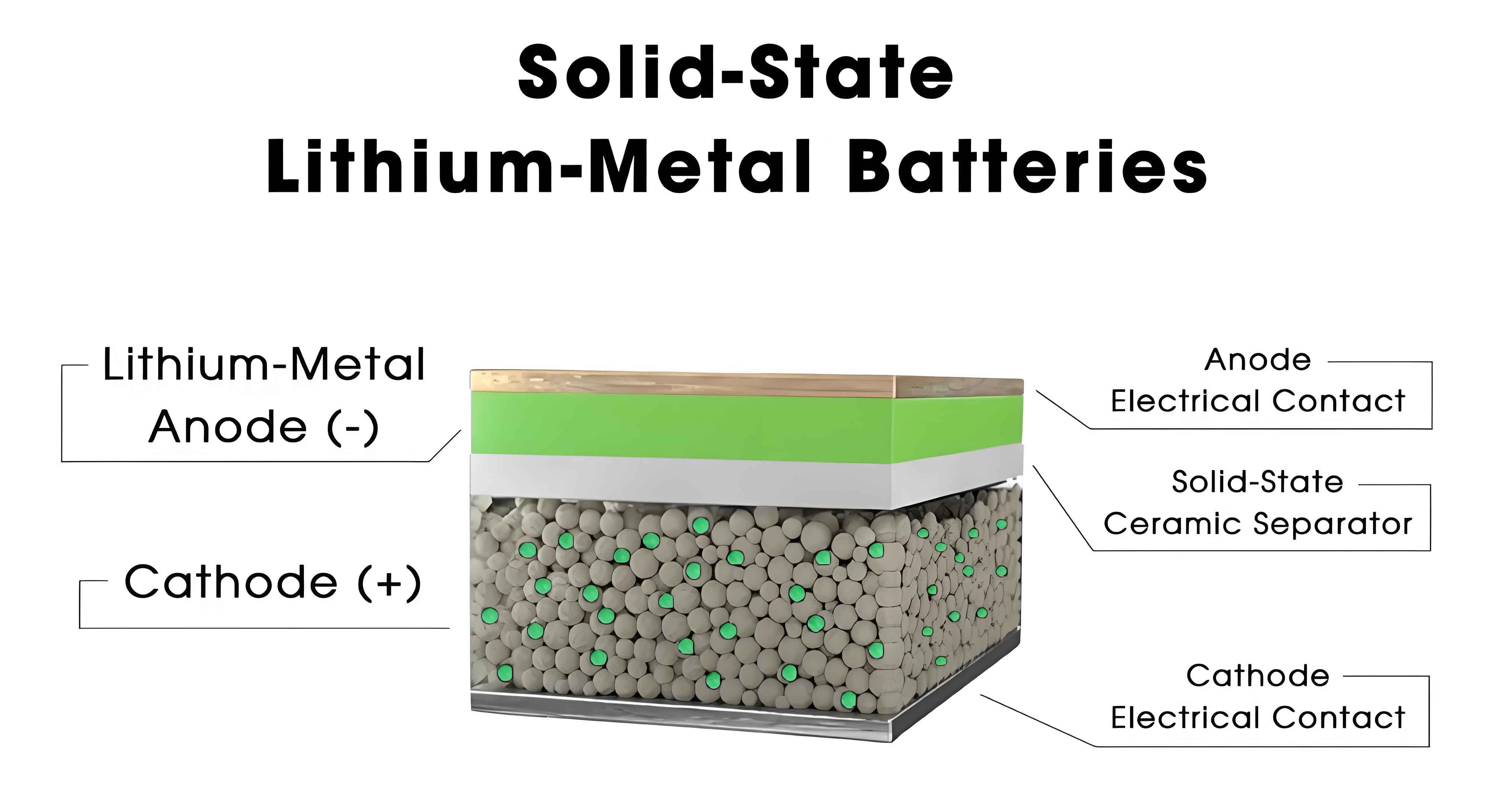
The image above conceptually illustrates the layered architecture of a typical solid-state battery, highlighting the dense, solid electrolyte separator between the electrodes—a crucial component discussed extensively under this theme.
Theme 3: Electrode Materials for Solid-State Batteries The shift to solid electrolytes demands reevaluation of electrode materials. For cathodes, high-capacity materials like layered oxides ($\text{LiNi}_x\text{Mn}_y\text{Co}_z\text{O}_2$), spinels, and polyanion compounds must form stable interfaces with the solid electrolyte. For anodes, the dream of using metallic lithium is closer to reality in a solid-state battery due to suppressed dendrite growth, but not without challenges. The capacity of an electrode material is paramount. For a cathode material undergoing a reversible reaction, the theoretical specific capacity $C_{\text{theo}}$ (in mAh/g) is given by: $$ C_{\text{theo}} = \frac{nF}{3.6 M} $$ where $n$ is the number of electrons transferred per formula unit, $F$ is Faraday’s constant (96485 C/mol), and $M$ is the molar mass (g/mol). The discussions often contrasted this with practical achievable capacities in full solid-state battery cells, which are lower due to interfacial losses and incomplete utilization.
Theme 4: Interface Engineering This was arguably the most debated topic. The solid-solid interface between electrode and electrolyte in a solid-state battery is a major source of high impedance and degradation. The total cell resistance $R_{\text{cell}}$ can be expressed as a sum: $$ R_{\text{cell}} = R_{\text{bulk, electrolyte}} + R_{\text{bulk, cathode}} + R_{\text{bulk, anode}} + R_{\text{interface, cathode}} + R_{\text{interface, anode}} $$ where the interface resistances $R_{\text{interface}}$ often dominate. This interfacial resistance is not static; it evolves with cycling due to chemical reactions, space charge layer formation, and mechanical stress. The space charge potential $\phi_{sc}$ at an interface can be described by the Poisson-Boltzmann equation in simplified models: $$ \frac{d^2\phi}{dx^2} = -\frac{\rho(x)}{\epsilon} $$ where $\rho$ is the charge density and $\epsilon$ is the permittivity. Strategies like introducing ultrathin buffer layers (e.g., $\text{Li}_3\text{BO}_3$ coatings) to mitigate these issues were a focal point. In-situ and operando characterization techniques to observe these dynamic changes in a working solid-state battery were highlighted as essential tools.
Theme 5: Hybrid Solid-Liquid Electrolyte Batteries Recognized as a pragmatic stepping stone, these systems combine a solid electrolyte (often as a separator) with a liquid or gel electrolyte in contact with electrodes. This hybrid approach ameliorates interfacial contact issues while retaining some safety benefits over conventional liquid batteries. The overall cell performance can be modeled by considering the ionic current through parallel and series pathways. For a simple model with a solid separator of conductivity $\sigma_s$ and thickness $d_s$ in series with liquid-soaked porous electrodes, the effective area-specific resistance (ASR) is critical. The power density $P$ of such a hybrid solid-state battery for electric vehicle applications was discussed in relation to its ASR and operating voltage $V$: $$ P \approx \frac{V^2}{\text{ASR}} $$ lowering ASR is therefore a direct path to higher power, a key requirement for fast-charging solid-state battery packs.
Theme 6: All-Solid-State Batteries The ultimate goal. Discussions covered various chemistries. For all-solid-state lithium-sulfur batteries, the overall reaction is: $$ 16\text{Li} + \text{S}_8 \rightarrow 8\text{Li}_2\text{S} $$ with a high theoretical energy density. However, the insulating nature of sulfur and $\text{Li}_2\text{S}$ and polysulfide shuttle (mitigated but not eliminated in solid-state systems) pose challenges. For all-solid-state lithium-air batteries, the complex reaction pathways involving $\text{Li}_2\text{O}_2$ formation/decomposition and the need for a stable, conductive solid electrolyte open to oxygen were explored. All-solid-state sodium batteries, leveraging abundant sodium, follow similar principles but with different material sets (e.g., $\text{Na}_3\text{PS}_4$ solid electrolyte). The general voltage $V$ of such a cell under load is given by: $$ V = E_0 – I(R_{\text{ohmic}} + R_{\text{ct}}) – \eta_{\text{conc}} $$ where $E_0$ is the open-circuit voltage, $I$ is the current, $R_{\text{ohmic}}$ is the bulk ohmic resistance, $R_{\text{ct}}$ is the charge-transfer resistance at interfaces, and $\eta_{\text{conc}}$ is the concentration overpotential (often small in solids but relevant in composite electrodes). Optimizing all these parameters is the essence of building a high-performance all-solid-state battery.
Theme 7: High-Throughput Theory & Computational Design The power of computation to accelerate solid-state battery discovery was evident. Density Functional Theory (DFT) calculations are used to predict properties like ionic migration barriers $E_a$, thermodynamic stability, and interface reactions. The nudged elastic band (NEB) method is commonly employed to find $E_a$ for ion hops in solid electrolytes. Machine learning models trained on large materials databases can screen for promising new solid electrolyte compositions with desired properties (e.g., high $\sigma$, wide stability window). A simplified expression for the probability of an ion hop, related to conductivity, is: $$ \Gamma = \nu_0 \exp\left(-\frac{E_a}{k_B T}\right) $$ where $\nu_0$ is an attempt frequency. Computational high-throughput screening aims to identify materials with low $E_a$ and compatible chemical properties, significantly shortening the R&D cycle for the next breakthrough solid-state battery material.
Theme 8: Industrialization Technology Translating lab-scale solid-state battery breakthroughs to gigawatt-hour production lines involves formidable challenges. Discussions centered on scalable synthesis of solid electrolytes (e.g., tape-casting, screen printing for thin films), assembly processes for multilayer structures, and quality control. The cost per kilowatt-hour ($/kWh) is the ultimate metric. It can be broken down as: $$ \text{Cost} = \frac{\sum(\text{Material Cost} + \text{Processing Cost} + \text{Cell Assembly Cost} + \text{Overhead})}{\text{Total Energy per Cell (kWh)}} $$ Reducing material cost (e.g., using less cobalt, simpler solid electrolytes) and developing high-yield, continuous manufacturing processes are critical to making solid-state battery technology economically viable for mass markets like electric vehicles and grid storage.
Beyond these thematic discussions, the interactive Q&A session was particularly enlightening. It revealed common concerns: the long-term cyclability of solid-state battery cells under realistic pressure constraints, the reproducibility of interface engineering techniques, and the environmental impact of large-scale production of certain sulfide electrolytes. The consensus was that a holistic, system-level approach is needed, where advances in materials, interfaces, and manufacturing co-evolve.
To further condense the performance targets discussed across various themes for a competitive solid-state battery, I present the following summary table.
| Parameter | Current State (Approx.) | Near-Term Target (5-10 years) | Ultimate Goal |
|---|---|---|---|
| Ionic Conductivity @ 25°C (S/cm) | $10^{-4}$ – $10^{-3}$ | $>10^{-3}$ | $>10^{-2}$ |
| Area-Specific Interfacial Resistance (Ω·cm²) | $10^1$ – $10^2$ | $<10$ | $<1$ |
| Energy Density (Wh/kg, cell-level) | ~250-350 | 400-500 | $>500$ |
| Cycle Life (to 80% capacity) | 500-1000 cycles | >1000 cycles | >2000 cycles |
| Operating Temperature Range (°C) | ~60-80 (for some) | -20 to 80 | -40 to 100 |
| Manufacturing Cost ($/kWh) | >200 | < 150 | < 100 |
The symposium also underscored the importance of standardized testing protocols for solid-state battery components and full cells. For instance, measuring the true ionic transference number $t_+$ in a solid electrolyte is crucial and can be defined as: $$ t_+ = \frac{\sigma_+}{\sigma_+ + \sigma_-} $$ where $\sigma_+$ and $\sigma_-$ are the cationic and anionic conductivities, respectively. For an ideal solid-state battery electrolyte, $t_+$ should be as close to 1 as possible.
In my personal reflection, attending this symposium was a powerful reminder that the evolution of solid-state battery technology is a marathon, not a sprint. The collaborative spirit between universities, national research institutes, and corporations was palpable. While formidable scientific hurdles remain—particularly in mastering interfaces and scalable, low-cost manufacturing—the collective intelligence and resources being deployed are unprecedented. The transition from liquid-electrolyte lithium-ion batteries to solid-state batteries is not merely an incremental improvement but a paradigm shift that could redefine energy storage for decades to come.
As I left the venue, my mind was buzzing with ideas. The path forward for solid-state battery technology requires continued fundamental research to uncover new materials and interface phenomena, coupled with aggressive engineering to transform these discoveries into reliable, safe, and affordable products. The journey of the solid-state battery from a laboratory curiosity to a cornerstone of our clean energy future is well underway, and I feel fortunate to be a witness and a participant in this exciting era.