
With the global shift towards renewable energy and the pursuit of carbon neutrality, distributed photovoltaic (PV) generation has seen rapid growth. Solar inverters, as critical interfaces between PV panels and the grid, play a pivotal role in ensuring stable and efficient power delivery. However, traditional solar inverters often rely on grid support or energy storage systems to maintain voltage and frequency stability. In extreme scenarios where the grid fails and energy storage is unavailable, solar inverters must operate in an islanding mode without external support, requiring advanced control strategies to sustain local loads. This article explores multi-mode control strategies for solar inverters without energy storage, focusing on seamless transitions between grid-connected and islanding operations. The proposed strategies enhance the resilience and power quality of distribution networks with high PV penetration.
The operational modes of solar inverters can be categorized into grid-connected mode, islanding mode without energy storage, and transition modes between them. In grid-connected mode, solar inverters typically employ current-controlled strategies to inject power into the grid, relying on the grid for voltage and frequency references. In contrast, islanding mode without energy storage necessitates voltage-controlled strategies, where solar inverters independently regulate the local bus voltage and balance power with loads. Smooth transitions between these modes are essential to prevent power interruptions and mitigate current or voltage surges. This article delves into the control methodologies for each mode and presents a seamless transfer strategy, supported by theoretical analysis and experimental validation.
Multi-Mode Control Strategies for Solar Inverters
Solar inverters must adapt to varying grid conditions and load demands. The multi-mode control framework enables solar inverters to switch between grid-following (current-controlled) and grid-forming (voltage-controlled) behaviors. This section details the control strategies for grid-connected and islanding operations without energy storage.
Grid-Connected Operation Mode
In grid-connected mode, solar inverters operate as current sources, synchronizing with the grid voltage via a phase-locked loop (PLL). The primary control objective is to track power references from upper-level systems, such as maximum power point tracking (MPPT) or constant power output. The power output of solar inverters in the synchronous reference frame (d-q frame) is expressed as:
$$P = \frac{3}{2} u_{md} i_{md} + \frac{3}{2} u_{mq} i_{mq}$$
$$Q = \frac{3}{2} u_{mq} i_{md} – \frac{3}{2} u_{md} i_{mq}$$
where \(u_{md}\) and \(u_{mq}\) are the d-axis and q-axis components of the inverter output voltage, and \(i_{md}\) and \(i_{mq}\) are the corresponding current components. With grid synchronization, the q-axis voltage component \(u_{mq}\) is approximately zero, simplifying the equations to:
$$P = \frac{3}{2} u_{md} i_{md}$$
$$Q = -\frac{3}{2} u_{md} i_{mq}$$
Thus, the current references \(i_{md\_ref}\) and \(i_{mq\_ref}\) can be derived from power references \(P_{ref}\) and \(Q_{ref}\). To ensure stable operation, the DC-link voltage must be regulated by the front-end Boost converter, which decouples the PV panel output from the inverter. The control structure for grid-connected solar inverters involves a dual-loop system: an outer voltage loop for DC-link regulation and an inner current loop for power tracking. This approach allows solar inverters to provide grid support while minimizing power fluctuations.
Islanding Operation Mode Without Energy Storage
When the grid fails and no energy storage is available, solar inverters must switch to islanding mode, acting as voltage sources to maintain local bus voltage and frequency. In this mode, solar inverters employ voltage-frequency (V-f) control, where the inverter output voltage is directly regulated. The control objective shifts to balancing power between the PV source and the load, as any mismatch manifests as DC-link voltage variations. The DC-link voltage serves as an indicator of power balance: an increase suggests excess PV power, while a decrease indicates insufficient power. Therefore, by regulating the DC-link voltage through the Boost converter, the PV operating point can be adjusted to match load demand. The voltage-controlled strategy for islanding solar inverters includes an outer voltage loop that generates current references for the inner current loop, ensuring stable AC voltage output. This mode is crucial for providing uninterrupted power to critical loads during grid outages.
To summarize the control strategies, Table 1 compares key aspects of grid-connected and islanding modes for solar inverters.
| Mode | Control Type | Voltage/Frequency Source | Power Balance Mechanism | Primary Objective |
|---|---|---|---|---|
| Grid-Connected | Current-Controlled | Grid | Grid absorbs mismatch | Track power references |
| Islanding Without Energy Storage | Voltage-Controlled | Solar Inverter | Adjust PV operating point via DC-link voltage | Maintain local voltage and frequency |
Seamless Transfer Strategy Between Grid-Connected and Islanding Modes
Seamless transitions between operational modes are vital to avoid power quality degradation and protect equipment. The proposed transfer strategy for solar inverters ensures smooth switching by initializing controllers and synchronizing voltages during mode changes.
Transition from Grid-Connected to Islanding Mode
Upon detecting a grid fault, solar inverters must disconnect from the grid and transition to islanding mode. The challenge lies in avoiding sudden changes in current references and phase angles, which could cause overcurrent surges. The transfer strategy involves switching the control loops from power-based current references to voltage-based references. Specifically, the current inner loop remains unchanged, but the reference generation shifts. During the transition, the voltage controller in islanding mode is initialized with the last current reference values from grid-connected mode, and the phase angle generator inherits the grid phase from the PLL. This initialization prevents jumps in control signals, enabling a seamless transfer. The Boost converter continues to regulate the DC-link voltage, ensuring power balance throughout the transition. This approach allows solar inverters to maintain stable output during the switch, supporting continuous load supply.
Transition from Islanding to Grid-Connected Mode
When the grid is restored, solar inverters need to reconnect smoothly. This requires pre-synchronization of the inverter output voltage with the grid voltage in terms of amplitude, frequency, and phase. The pre-synchronization process involves adjusting the voltage references and phase angles of the solar inverter to match the grid. A control loop compares the grid voltage (\(u_{dq\_PLL}\)) with the inverter reference (\(u_{mdq\_ref}\)), generating correction terms for voltage and frequency. The phase error \(\Delta \theta\) is fed into a PI controller to produce a frequency adjustment \(\Delta \omega\), which aligns the inverter phase with the grid. Similarly, the voltage amplitude is adjusted through an integral controller. Once synchronization is achieved, the solar inverter can close the connection switch and switch to grid-connected control. The current references are then derived from power commands, completing the transition without inrush currents. This pre-synchronization strategy is essential for safe reconnection of solar inverters to the grid.
The seamless transfer logic can be represented mathematically. For phase synchronization, the frequency adjustment is given by:
$$\Delta \omega = K_p \Delta \theta + K_i \int \Delta \theta \, dt$$
where \(K_p\) and \(K_i\) are PI gains, and \(\Delta \theta = \theta_{PLL} – \theta_{ref}\). For voltage synchronization, the adjustment is:
$$\Delta u = K_{v} \int (u_{dq\_PLL} – u_{mdq\_ref}) \, dt$$
These equations ensure gradual alignment, minimizing transients during mode transitions for solar inverters.
Experimental Verification
To validate the proposed multi-mode control and seamless transfer strategy, an experimental platform was developed using a two-stage solar inverter topology. The setup includes a front-end Boost converter and a three-level NPC inverter, connected to a local load and the grid via solid-state switches. The solar inverter is controlled by a DSP28377 microcontroller, with parameters listed in Table 2.
| Parameter | Value |
|---|---|
| Grid Voltage \(u_g\) | 70 V |
| Islanding Voltage Reference \(u_{md\_ref}\) | 70 V |
| Grid-Connected Power Reference \(P_{ref}\) | 210 W |
| Islanding Frequency Reference \(f_{ref}\) | 50 Hz |
| Load Resistance \(R_{load}\) | 20 Ω |
| DC Source Voltage \(u_{dc}\) | 70–80 V |
| Switching Frequency \(f_k\) | 10 kHz |
| Series Resistance \(R_{dc}\) | 2.5 Ω |
The experimental results demonstrate the effectiveness of the control strategies. During the transition from grid-connected to islanding mode, the solar inverter smoothly switched control modes, with no significant voltage or current spikes. The DC-link voltage stabilized quickly, and the PV panel operating point adjusted to meet load demand. In the reverse transition, pre-synchronization ensured that the inverter voltage matched the grid before reconnection, preventing overcurrent events. The solar inverter maintained stable operation in both modes, highlighting the robustness of the multi-mode framework. Additionally, the harmonic distortion of the inverter output in grid-connected mode was measured at 2.88%, indicating high power quality.
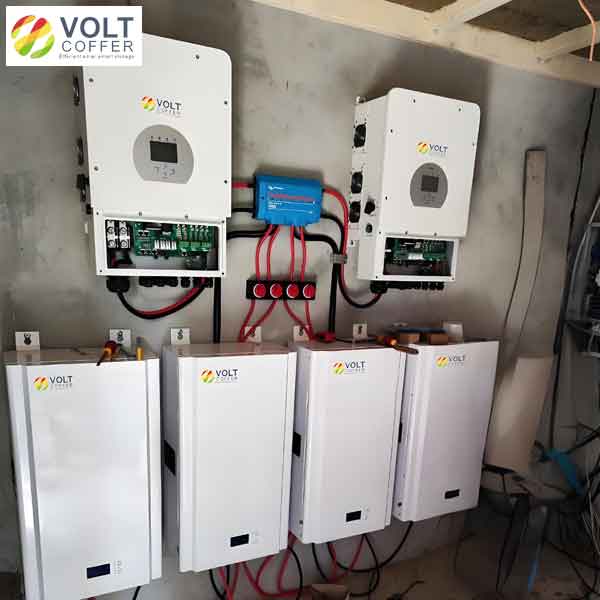
The hardware topology of solar inverters is crucial for implementing these strategies. The two-stage structure with a Boost converter and a three-level inverter offers flexibility in voltage regulation and efficiency. The image above illustrates a hybrid inverter system, akin to the experimental setup, showcasing the integration of solar inverters with power electronics for enhanced performance. Such configurations enable solar inverters to adapt to various operational modes, supporting grid resilience.
Conclusion
This article presented a comprehensive study on multi-mode operation and seamless transfer strategies for solar inverters without energy storage. The proposed control methodologies enable solar inverters to operate reliably in grid-connected and islanding modes, with smooth transitions between them. By leveraging voltage-controlled strategies in islanding mode and current-controlled strategies in grid-connected mode, solar inverters can maintain power balance and voltage stability under diverse conditions. The seamless transfer strategy, based on controller initialization and pre-synchronization, mitigates transients and ensures uninterrupted power supply to loads. Experimental validation confirmed the efficacy of these approaches, demonstrating stable performance and high power quality. These advancements enhance the active support capabilities of solar inverters in distribution networks, facilitating higher PV penetration and contributing to a sustainable energy future. Future work may explore adaptive control for varying load types and integration with other renewable sources.
The versatility of solar inverters is key to modern power systems. As solar energy adoption grows, the ability of solar inverters to operate in multiple modes without relying on energy storage becomes increasingly important. The strategies discussed here provide a foundation for developing resilient solar inverter systems that can withstand grid disturbances and maintain local power quality. By continuously refining these control techniques, solar inverters will play a pivotal role in achieving reliable and clean energy networks worldwide.