
With the global shift towards renewable energy and the pursuit of carbon neutrality, distributed photovoltaic (PV) systems are experiencing rapid growth in installation capacity. The ability of solar inverters to provide active support to the grid under varying conditions has become a critical research focus. In scenarios where distributed PV systems lose grid support or lack energy storage, solar inverters must transition to an islanded mode without energy storage, employing voltage-controlled strategies to independently maintain voltage stability. This paper explores multi-mode control strategies for solar inverters operating without energy storage and proposes a seamless switching strategy between grid-connected and islanded modes. The proposed approach ensures stable operation in both modes, facilitates smooth transitions, and maintains power balance between the solar inverter and loads. Experimental results validate the effectiveness of the strategy, enhancing power supply reliability in distribution networks with high PV penetration.
The increasing integration of solar inverters into power systems necessitates advanced control techniques to handle dynamic operational modes. Traditional grid-connected solar inverters typically use current-controlled strategies, relying on the grid for voltage and frequency support. However, during grid faults or instability, these inverters may disconnect due to anti-islanding protection, leading to load interruptions. To address this, research has focused on enabling solar inverters to operate in islanded modes without energy storage, where they must independently regulate voltage and frequency. This paper investigates multi-mode control strategies for solar inverters, including grid-connected operation with constant power control and islanded operation with voltage-frequency control. A key contribution is the development of a seamless switching strategy that minimizes current and voltage transients during mode transitions, ensuring uninterrupted power supply to critical loads.
Multi-Mode Control Strategies for Solar Inverters
Solar inverters can operate in several modes, including grid-connected mode, islanded mode without energy storage, and transition modes for switching between them. The topology of a typical two-stage solar inverter, consisting of a front-end Boost converter and a rear-end inverter, is considered. This structure decouples the DC bus voltage from the PV panel output, allowing flexible power control. The use of a three-level neutral point clamped (NPC) inverter reduces current ripple and switching losses, enhancing efficiency. The operational modes are as follows:
- Grid-Connected Mode: The solar inverter operates as a current source, injecting power into the grid based on reference power commands. It uses phase-locked loop (PLL) synchronization to match grid voltage and frequency.
- Islanded Mode Without Energy Storage: The solar inverter acts as a voltage source, maintaining stable voltage and frequency at the load bus. Power balance is achieved by adjusting the PV operating point through DC voltage regulation.
- Transition Modes: Smooth switching between grid-connected and islanded modes is ensured through control loop adjustments and pre-synchronization techniques.
In grid-connected mode, the solar inverter tracks power references (Pref, Qref) provided by upper-level control systems. The power output is calculated in the dq-reference frame, where the grid voltage vector is aligned with the d-axis. The active and reactive power equations are:
$$P = \frac{3}{2} u_{md} i_{md} + \frac{3}{2} u_{mq} i_{mq}$$
$$Q = \frac{3}{2} u_{mq} i_{md} – \frac{3}{2} u_{md} i_{mq}$$
Assuming the q-axis voltage component is negligible due to PLL synchronization, these simplify to:
$$P = \frac{3}{2} u_{md} i_{md}$$
$$Q = -\frac{3}{2} u_{md} i_{mq}$$
The DC bus voltage is regulated by the Boost converter to ensure power balance between the PV panels and the inverter. A dual-loop control structure is used for the Boost converter, with an outer voltage loop and an inner current loop. The inverter employs a current control loop to track the reference currents derived from power commands. This mode allows the solar inverter to support grid voltage and frequency while maximizing power extraction or following dispatch instructions.
In islanded mode without energy storage, the solar inverter must maintain constant voltage and frequency at the load bus. The inverter switches to voltage-frequency control, using an outer voltage loop to generate current references. The DC bus voltage serves as an indicator of power balance: if PV output power exceeds load demand, the DC voltage rises, and vice versa. The Boost converter adjusts the PV operating point to stabilize the DC voltage, ensuring that the solar inverter output matches load requirements. This control strategy enables the solar inverter to operate independently in the absence of grid or storage support, providing reliable power to local loads.
| Parameter | Grid-Connected Mode | Islanded Mode Without Energy Storage |
|---|---|---|
| Control Type | Current Control | Voltage Control |
| Power Reference | Pref, Qref | Load Demand |
| Voltage Source | Grid | Inverter Output |
| Frequency Source | Grid PLL | Internal Oscillator |
Seamless Switching Strategy Between Grid-Connected and Islanded Modes
The seamless switching strategy for solar inverters involves transitioning between grid-connected and islanded modes without causing voltage or current transients. This is achieved through control loop reconfiguration and pre-synchronization techniques.
Switching from Grid-Connected to Islanded Mode
When a grid fault is detected, the solar inverter disconnects from the grid and switches to islanded mode. The Boost converter continues to regulate the DC voltage, while the inverter control shifts from current control to voltage control. To avoid current spikes during the transition, the voltage control loop is initialized with the current references from the grid-connected mode. The phase angle for the voltage control is inherited from the PLL output, ensuring continuity in the reference frame. The switching logic involves:
- Disconnecting the grid connection switch (K1).
- Switching the inverter control from power-based current references to voltage-based references.
- Initializing the voltage controller integrals with pre-switch values to prevent jumps in current commands.
The power balance during switching is maintained by the DC voltage loop, which adjusts the PV power output to match load demand. The dynamic response of the solar inverter ensures that load voltage remains stable throughout the transition.
Switching from Islanded to Grid-Connected Mode
When the grid is restored, the solar inverter must synchronize with the grid before reconnection. Pre-synchronization control aligns the inverter output voltage with the grid voltage in magnitude, frequency, and phase. The control strategy includes:
- Voltage pre-synchronization: The inverter voltage reference is adjusted to match the grid voltage using a PI controller. The error between the grid voltage and inverter output is integrated to generate a correction term.
- Phase pre-synchronization: The phase difference between the inverter output and grid voltage is minimized by adjusting the frequency reference. A PI controller processes the phase error to produce a frequency offset.
The pre-synchronization process ensures that the solar inverter output matches the grid conditions before closing the connection switch. Once synchronized, the inverter switches back to current control mode, with power references set to the desired grid injection values. This approach prevents inrush currents and voltage disturbances during reconnection.
The overall switching strategy can be summarized with the following equations for pre-synchronization:
Voltage adjustment:
$$\Delta u_{dq} = K_{p,u} (u_{dq,\text{PLL}} – u_{mdq,\text{ref}}) + K_{i,u} \int (u_{dq,\text{PLL}} – u_{mdq,\text{ref}}) dt$$
Frequency adjustment:
$$\Delta \omega = K_{p,\theta} (\theta_{\text{PLL}} – \theta_{\text{ref}}) + K_{i,\theta} \int (\theta_{\text{PLL}} – \theta_{\text{ref}}) dt$$
Where \(K_{p,u}\), \(K_{i,u}\), \(K_{p,\theta}\), and \(K_{i,\theta}\) are proportional and integral gains for voltage and phase control, respectively.
| Step | Action | Control Adjustment |
|---|---|---|
| 1 | Detect grid fault | Disconnect grid switch |
| 2 | Switch to islanded mode | Inherit current references and phase |
| 3 | Regulate load voltage | DC voltage control adjusts PV power |
| 4 | Detect grid restoration | Initiate pre-synchronization |
| 5 | Align voltage and phase | PI-based correction loops |
| 6 | Reconnect to grid | Switch to current control mode |
Experimental Verification
To validate the proposed multi-mode control and switching strategy, an experimental platform was developed using a two-stage solar inverter. The setup includes a front-end Boost converter and a three-level NPC inverter, with an LCL filter for output conditioning. A DC source with series resistance emulates the PV characteristics, and the system is connected to a grid simulator and local loads through solid-state switches. The solar inverter controller is implemented on a DSP28377 processor, and key parameters are listed in Table 3.
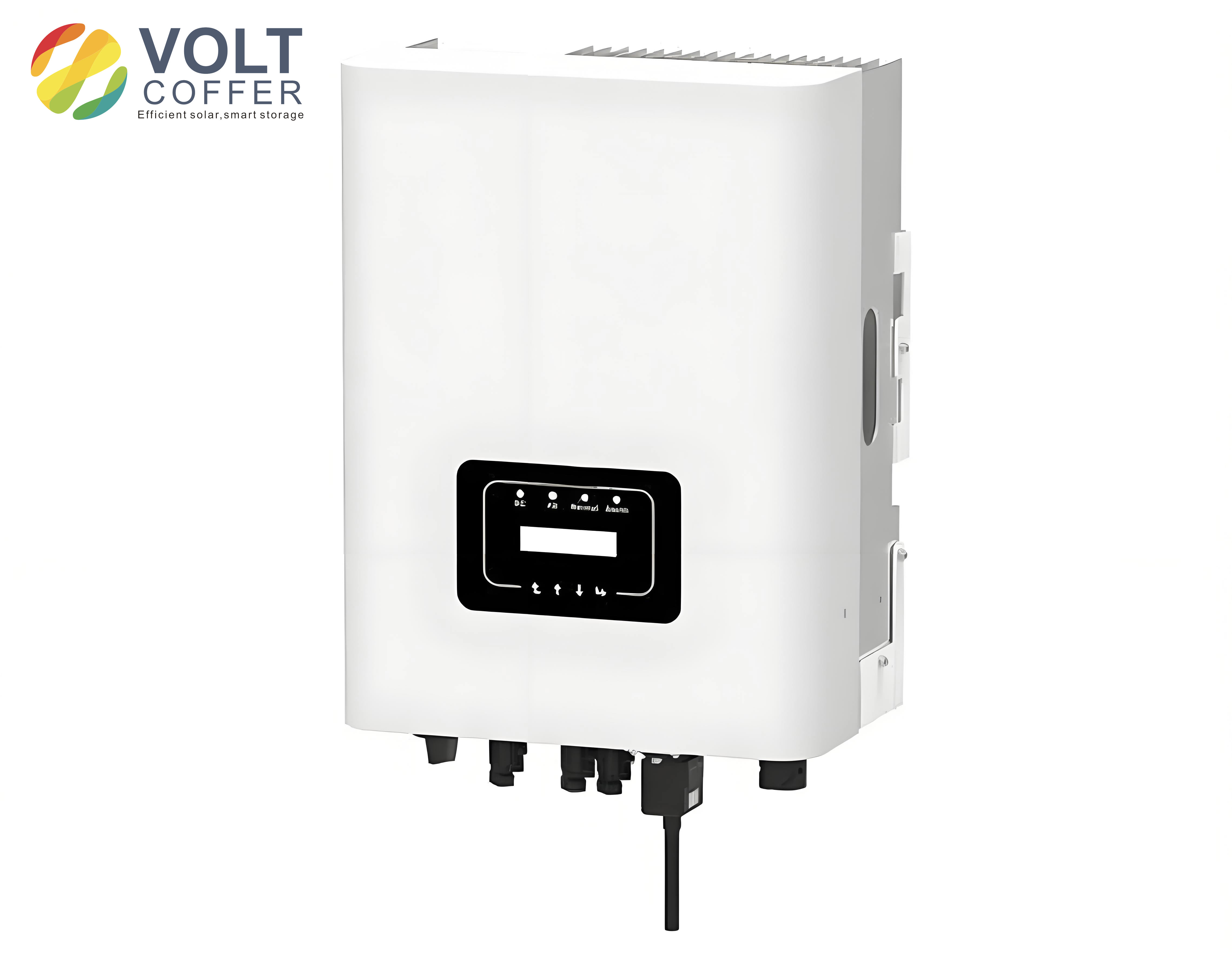
The experiments evaluated the solar inverter’s performance during mode transitions. In the first test, the solar inverter was switched from grid-connected to islanded mode by simulating a grid fault. The results show smooth transitions in voltage and current, with no significant overshoot or distortion. The DC voltage exhibited a minor dip but recovered quickly, and the inverter output power adjusted to match the load demand. In the second test, the solar inverter was switched from islanded to grid-connected mode after pre-synchronization. The output voltage aligned with the grid within six cycles, and the reconnection occurred without current spikes. The solar inverter maintained stable operation in both modes, demonstrating the effectiveness of the control strategy.
| Parameter | Value |
|---|---|
| Grid Voltage | 70 V |
| Islanded Voltage Reference | 70 V |
| Grid-Connected Power Reference | 210 W |
| Islanded Frequency Reference | 50 Hz |
| Load Resistance | 20 Ω |
| DC Source Voltage | 70-80 V |
| Switching Frequency | 10 kHz |
| Series Resistance | 2.5 Ω |
The harmonic distortion of the solar inverter output in grid-connected mode was analyzed, showing a total harmonic distortion (THD) of 2.88% for phase voltage, which meets power quality standards. These results confirm that the solar inverter can provide high-quality power under various operating conditions.
Conclusion
This paper presents a comprehensive multi-mode control and seamless switching strategy for solar inverters operating without energy storage. The proposed approach enables solar inverters to transition smoothly between grid-connected and islanded modes, ensuring uninterrupted power supply to loads. Key contributions include the development of voltage-frequency control for islanded operation and pre-synchronization techniques for grid reconnection. Experimental results demonstrate that the strategy minimizes transient impacts and maintains power balance during mode transitions. By enhancing the operational flexibility of solar inverters, this work supports the integration of distributed PV systems into modern power grids, contributing to grid stability and reliability. Future research could explore adaptive control techniques for handling variable PV generation and complex load profiles.